Punctuation can look like a small detail, but one tiny mark can change the appearance of an entire sentence. One common question is: Should the period go before or after the quotation mark?
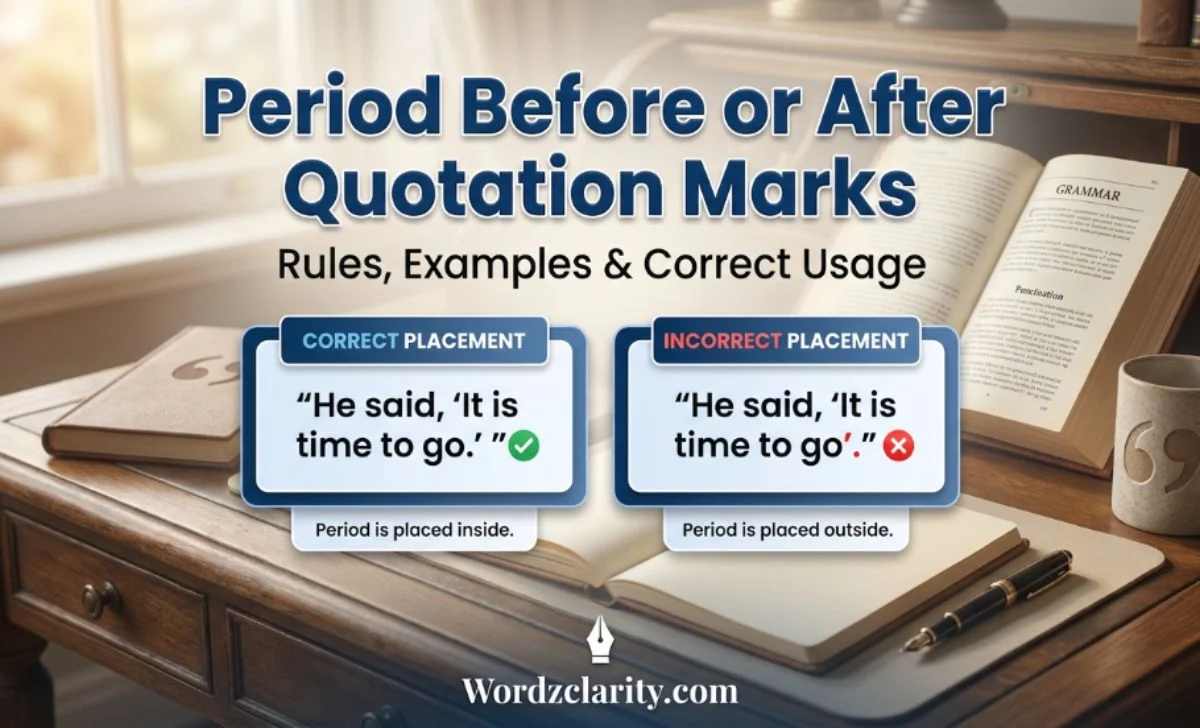
If you write in American English, the usual rule is simple: the period goes inside the closing quotation mark.
For example:
She said, “I am ready.”
But British English can follow a different approach. In many British style guides, the period, usually called a full stop, is placed according to whether it belongs to the quoted words or the larger sentence.
That difference can make quotation punctuation confusing, especially for students, writers, editors, and people who write for an international audience.
In this guide, you will learn where to put the period with quotation marks, how American and British English differ, what happens with question marks and exclamation marks, and how to handle quotations in academic and professional writing.
Quick Answer
In American English, a period normally goes inside the closing quotation mark.
Correct:
The teacher said, “Class is over.”
Not:
The teacher said, “Class is over”.
In British English, punctuation can follow a more logical system. A full stop goes inside the quotation marks when it belongs to the quoted material. If it belongs to the main sentence, it may go outside.
American English
She called it “a great idea.”
British English
She called it “a great idea”.
Both styles can be correct. The important thing is to follow the style used by your publication, school, employer, or country.
Why Does the Period Go Inside Quotation Marks?
The American rule is mostly a matter of standard punctuation style.
In American English, periods and commas are generally placed inside closing quotation marks, even when they are not part of the original quoted words.
For example:
He described the plan as “simple.”
The period belongs to the whole sentence, not necessarily to the quoted word simple. Yet American style still places the period inside the quotation marks.
This rule is different from the way many other punctuation marks work.
For example, a question mark may go inside or outside the quotation marks depending on what is being asked.
Did she really say, “I am leaving”?
Here, the whole sentence is a question, but the quoted words are not.
Compare it with:
Did she ask, “Are you leaving?”
Here, the quoted words themselves form a question, so the question mark goes inside the quotation marks.
This distinction becomes important when you are dealing with punctuation other than periods and commas.
Period Inside or Outside Quotation Marks
The easiest way to understand the American rule is to look at examples.
Period Inside
She said, “We should leave.”
The report calls the result “unexpected.”
He described the movie as “excellent.”
The website uses the term “user-friendly.”
In each example, the period appears before the closing quotation mark.
Period Outside
In standard American English, you normally should not write a simple sentence-ending period outside the quotation marks like this:
She said, “We should leave”.
That form may appear in British English or in styles that use logical punctuation, but it is not the normal American convention.
American English vs. British English
One of the main reasons this topic causes confusion is the difference between American and British punctuation styles.
American English generally uses a closed punctuation approach for periods and commas. The punctuation goes inside the quotation marks.
British English often uses a more logical punctuation approach. The punctuation goes inside the quotation marks when it belongs to the quoted material.
Here is a simple comparison:
| Style | Example |
|---|---|
| American English | She called it “a mistake.” |
| British English | She called it “a mistake”. |
The American example puts the period inside.
The British example puts the full stop outside because the quoted words are not a complete sentence. The full stop belongs to the larger sentence.
However, British usage is not always identical across every publication or style guide. Some British publishers use different house styles.
For that reason, writers should follow the style guide required for their work.
When Should the Period Go Inside the Quotation Marks?
If you are writing in American English, place the period inside the closing quotation mark in a normal sentence.
For example:
My manager called the idea “practical.”
The article describes the method as “effective.”
The customer said, “I need help.”
The teacher wrote, “Check your answers.”
This rule applies in everyday writing as well as in many professional and academic contexts.
Short Quoted Words
You can also use the same rule when quoting only a word or short phrase.
The word “correct” appears several times.
She described the answer as “perfect.”
The company calls this feature “essential.”
In American English, the period remains inside the quotation marks.
When Can the Period Go Outside?
If you are following a British style that uses logical punctuation, the full stop can go outside when it is not part of the quoted material.
For example:
The word “correct” appears several times.
The full stop belongs to the entire sentence, not to the quoted word.
Another example:
The report describes the result as “unexpected”.
Here, unexpected is only a quoted word. The full stop belongs to the main sentence.
However, this is a style choice. If you are writing for an American audience, use the American convention instead.
What If the Quotation Is a Complete Sentence?
When the quoted words form a complete sentence, punctuation is easier to see.
American English
Maria said, “I will call you tomorrow.”
The period goes inside the quotation marks.
The same pattern works with many direct quotations:
The coach said, “Practice starts at six.”
The doctor said, “You should get some rest.”
The manager said, “The meeting has been moved.”
The quotation itself is a complete sentence, and the period appears before the closing quotation mark.
What About a Quoted Phrase?
Sometimes you quote only a word or phrase rather than a complete sentence.
For example:
The word “necessary” is often misspelled.
In American English, the period still goes inside the closing quotation mark.
This is one reason American punctuation can seem unusual to learners. The period is not necessarily part of the quoted word or phrase, but American style still places it inside.
What About Question Marks?
A question mark follows a different rule.
Do not automatically put a period after a question mark.
For example:
She asked, “Are you ready?”
The question mark already ends the quoted question. You do not need another period.
But look at this example:
Did she really say, “I am ready”?
Here, the quoted words are a statement. The whole sentence is a question, so the question mark goes outside the quotation marks.
The rule is simple:
- If the quoted words are a question, put the question mark inside.
- If the whole sentence is a question but the quotation is not, put the question mark outside.
Compare the Two
She asked, “Are you ready?”
The quotation is a question.
Did she say, “I am ready”?
The main sentence is a question.
This rule is different from the normal American period rule, so it is worth remembering.
What About Exclamation Marks?
Exclamation marks work in a similar way.
If the quoted words are an exclamation, place the mark inside:
She shouted, “Stop!”
But if the whole sentence is an exclamation and the quoted words are not, the mark may go outside:
I can’t believe he actually said “yes”!
The key question is:
Which part of the sentence does the punctuation belong to?
That question helps you decide where to place question marks and exclamation marks.
Period Before or After a Quotation in Academic Writing
Academic writing often includes direct quotations, so punctuation placement matters.
Consider this example:
The researcher describes the result as “significant.”
In American English, the period goes inside the quotation marks.
When a quotation is followed by a citation, however, the placement can depend on the citation system being used.
For example, in some academic styles, the citation comes before the final period:
The researcher describes the result as “significant” (Smith 24).
Other citation systems have different rules.
This means you should not rely on the quotation-mark rule alone when writing academic papers. Always check the style guide required for your assignment or publication.
Common academic styles include:
- APA
- MLA
- Chicago
- IEEE
- AMA
Each style has its own rules for quotations and citations.
Period Before or After a Quotation in Citations
Citations can make quotation punctuation more confusing.
In many American academic styles, a parenthetical citation appears before the final period:
“The results were unexpected” (Smith, 2025).
The citation is part of the documentation for the quotation, so the punctuation follows the citation.
However, citation rules vary by style.
For this reason, if you are writing an academic paper, use the exact rules for the citation style your instructor, university, journal, or publisher requires.
Do not mix APA, MLA, Chicago, or other systems.
What About Quoted Titles?
Quotation marks are often used around the titles of shorter works, such as articles, poems, songs, chapters, and individual web pages.
For example:
I read the article “How to Write Better Sentences.”
In American English, the period goes inside the closing quotation mark.
Another example:
Her favorite song is “Yesterday.”
The same punctuation rule applies.
However, titles can involve additional capitalization and formatting rules, so punctuation should be handled separately from title style.
Period Before or After Quotation in Email Writing
Most everyday emails do not require complicated quotation rules.
If you quote something someone said, use normal sentence punctuation.
For example:
You wrote, “Please send the report today.”
Or:
The client described the service as “very helpful.”
In American English, the period goes inside the quotation marks.
If you are quoting an entire email or a longer message, the formatting may be different. In that case, keep the original text clear and separate from your own writing.
Period Before or After Quotation in Business Writing
Business writing should be clear and consistent.
For example:
The client called the proposal “too expensive.”
Our manager said, “We need more time.”
The report describes the change as “necessary.”
If your company follows American English, keep the period inside the quotation marks.
If your company follows British English, follow its preferred house style.
The most important thing is consistency. Do not switch between American and British punctuation rules in the same document without a reason.
Common Mistakes With Quotation Marks and Periods
Several mistakes appear again and again.
Mistake 1: Putting the Period Outside in American English
Incorrect in standard American English:
She called the idea “useful”.
Correct:
She called the idea “useful.”
Mistake 2: Adding Two Periods
Do not use two periods at the end of a quotation.
Incorrect:
He said, “I agree.”.
Correct:
He said, “I agree.”
The quotation already contains the sentence-ending period.
Mistake 3: Adding a Period After a Question Mark
Incorrect:
She asked, “Are you ready?”.
Correct:
She asked, “Are you ready?”
A question mark already ends the sentence.
Mistake 4: Ignoring the Required Style
A writer may know the American rule but use it in a document that requires British or another style.
Always check the style guide when you are writing for a school, journal, employer, or publisher.
How to Remember the Rule
If you mainly write American English, use this simple rule:
Period + quotation marks = period inside.
For example:
“I am ready.”
She called it “excellent.”
He described the plan as “simple.”
For British English, remember that punctuation may depend on whether the mark belongs to the quoted words or the main sentence.
That gives you a useful starting point:
American English: period usually goes inside.
British English: placement can depend on the quotation and style guide.
A Quick Comparison of Common Examples
| Situation | American English | British-style logical punctuation |
|---|---|---|
| Quoted statement | “I agree.” | “I agree.” |
| Quoted word | The word “correct.” | The word “correct”. |
| Quoted phrase | She called it “a mistake.” | She called it “a mistake”. |
| Quoted question | “Are you ready?” | “Are you ready?” |
| Main sentence is a question | Did he say “yes”? | Did he say “yes”? |
| Quoted exclamation | She shouted, “Stop!” | She shouted, “Stop!” |
The biggest difference is usually seen with periods and commas. Question marks and exclamation marks depend more on meaning.
Practical Tips for Better Punctuation
You can avoid most quotation punctuation mistakes by following a few simple habits.
1. Know Your English Style
Decide whether you are using American or British English.
This matters especially in formal writing.
2. Follow One Style
Do not mix punctuation styles without a good reason.
Consistency makes your writing look professional.
3. Check the Punctuation Mark
Do not treat every punctuation mark in the same way.
Periods, commas, question marks, and exclamation marks can follow different rules.
4. Ask What the Mark Belongs To
For question marks and exclamation marks, ask whether the punctuation belongs to the quotation or the whole sentence.
This simple question often gives you the answer.
5. Check Your Style Guide
If you are writing an academic paper, article, book, or professional document, check the required style guide.
A style guide is more reliable than a general rule because it tells you exactly which conventions to use.
FAQs
1. Does the period go inside quotation marks?
In standard American English, yes. A period normally goes inside the closing quotation mark.
Example:
She said, “I agree.”
British English may use a different rule when the period does not belong to the quoted material.
2. Does the period go outside quotation marks in British English?
It can. British English often uses logical punctuation, so a full stop may go outside when it is not part of the quoted material.
Example:
He called it “a mistake”.
However, British publishers can follow different style guides.
3. Do you put a period after a quotation with a question mark?
No. If the quotation ends with a question mark, you normally do not add another period.
Example:
She asked, “Are you ready?”
If the whole sentence is a question but the quotation is not, the question mark can go outside:
Did she say, “I am ready”?
4. Does a period go inside quotation marks for a title?
In American English, yes, when the title appears at the end of a sentence.
Example:
I read “The Last Question.”
The period goes inside the closing quotation mark.
5. Is a full stop the same as a period?
Yes. Period is the common American English term. Full stop is widely used in British English and other varieties of English.
They refer to the same punctuation mark: .
6. Does punctuation always go inside quotation marks?
No. Different punctuation marks follow different rules.
In American English, periods and commas usually go inside quotation marks. Question marks and exclamation marks depend on whether they belong to the quotation or the larger sentence.
7. Where does the period go with a quotation and citation?
The answer depends on the citation style.
For example, some academic styles place the citation before the final period:
“The results were significant” (Smith, 2025).
Always check the specific style guide you are using.
Conclusion
Knowing whether a period goes before or after a quotation mark becomes much easier once you know which English style you are using.
In American English, the period normally goes inside the closing quotation mark. For example, write, “She said, ‘I agree.’” when following the appropriate quotation style.
British English can be different. Many British style guides use logical punctuation, which means a full stop goes inside the quotation marks when it belongs to the quoted words. If it belongs to the main sentence, it may go outside.
Question marks and exclamation marks need separate attention. Their position depends on whether they belong to the quoted words or the complete sentence. Citations can also change the punctuation pattern, especially in academic writing.
The safest approach is simple: know your audience, follow the required style guide, and stay consistent. Once you understand these basic rules, punctuation with quotation marks becomes much easier to handle in emails, essays, reports, articles, and everyday writing.
Read More Blogs:
- Herd or Heard: What’s the Difference?
- Themselves or Theirselves: Which Is Correct?
- Theirself or Themself: Which Is Correct?
- Yall or Y’all: Which Spelling Is Correct?