Madame or madam? If you have ever written a formal letter, addressed a woman politely, or referred to a French title, you may have wondered which form is correct. The two words look almost identical, but they do not always appear in the same situations.
Madam is the usual choice for formal English address, especially when speaking directly to a woman or beginning a formal letter when her name is unknown.
Madame is closely linked with French usage and is commonly seen with French names, titles, and French-related contexts. Both forms are legitimate words, so the choice depends on context rather than one spelling always being right.
In this guide, you will learn the difference between madame and madam, when to use each word, how they work in letters and conversations, how they compare with ma’am, Mrs., and Ms., and which form is best for different types of writing.
Quick Answer: Madame or Madam?
Madam is generally the better choice for standard formal English when you are directly addressing a woman.
Excuse me, madam.
Thank you, madam.
Dear Madam, I am writing to ask about your services.
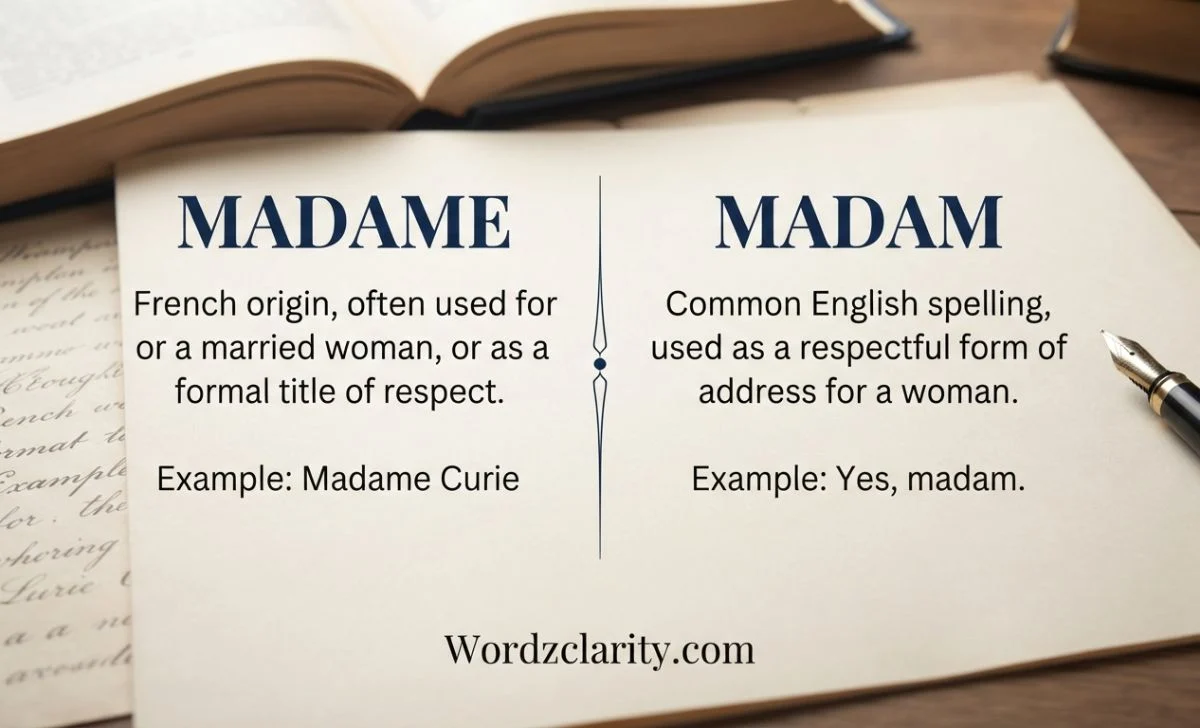
Madame is commonly used as a French title or in French names and contexts.
Madame Curie was a famous scientist.
The novel is based on Madame Bovary.
So, as a simple rule:
| Word | Common use | Example |
|---|---|---|
| Madam | Formal English address | Thank you, madam. |
| Madame | French or French-style title/name | Madame Curie was a scientist. |
However, this is a guide rather than an absolute rule. Madame is also recognized as an English noun, while madam has several established meanings beyond polite address.
What Does Madam Mean?
Madam is a formal way to address a woman, especially when you do not know her name or when the situation calls for respectful language.
Oxford defines madam as a formal form used when speaking or writing to a woman in a formal or business situation. It also gives Dear Madam as a conventional letter opening.
Madam as a Form of Address
You can use madam when speaking directly to a woman.
Examples:
- Excuse me, madam.
- May I help you, madam?
- Please take a seat, madam.
- Thank you for your patience, madam.
- I’m sorry, madam, but the store is closed.
In these examples, madam works as a polite form of direct address.
It does not normally identify the woman’s name. Instead, it shows respect or formality.
Madam in Formal Letters
Dear Madam is a traditional formal opening when you are writing to a woman whose name you do not know.
For example:
Dear Madam,
I am writing to ask about the position advertised on your website.
Cambridge describes Dear Madam as a usual way to begin a formal letter to a woman whose name is unknown.
In modern professional writing, however, it is often better to use a person’s name or a more specific department or role when you know it.
For example:
Dear Ms. Khan,
is usually more personal than:
Dear Madam,
Madam Before an Official Position
Madam can also appear before an official title or position.
Examples include:
- Madam President
- Madam Secretary
- Madam Speaker
- Madam Ambassador
- Madam Minister
- Madam Chair
Oxford and Cambridge both recognize this use of madam before official positions.
For example:
Madam President, may I ask a question?
Madam Speaker, the members are ready to vote.
Here, madam is not simply being used as a general word for a woman. It forms part of a formal title.
What Does Madame Mean?
Madame is a title associated especially with French usage. In English, it is commonly seen when referring to French women, French titles, established names, or French-related subjects.
Cambridge defines madame as a title for a woman, especially a married woman from France, and gives Madame Bovary as an example.
Madame in French
In French, madame is a standard title and form of address for a woman.
It can correspond to forms such as Mrs. or Madam in English, depending on the context.
The French plural is mesdames.
For an English reader, the important point is that madame should not be treated as a simple misspelling of madam. It is a genuine word with its own history and usage.
Madame in English
English also uses madame in certain contexts.
You may see it in:
- French names
- French literature
- historical references
- French culture
- formal French titles
- established names and expressions
Examples:
Madame Curie is remembered for her scientific work.
We studied Madame Bovary in literature class.
The museum displayed a portrait of Madame de Pompadour.
The presence of the final -e is therefore meaningful. It can signal that the French form is being retained.
Madame vs. Madam: The Main Difference
The easiest way to understand madame vs. madam is to look at the context.
| Situation | Better choice | Example |
|---|---|---|
| Formal English direct address | madam | Can I help you, madam? |
| Formal English letter | madam | Dear Madam |
| Official English title | madam | Madam President |
| French title | madame | Madame la ministre |
| French woman’s name | madame | Madame Curie |
| French literature | madame | Madame Bovary |
| French-related context | madame | Bonjour, Madame |
The key difference is not simply that one word is “correct” and the other is “wrong.”
Instead, madam is the normal English form in many formal address situations, while madame is strongly connected with French usage and established French names and titles.
When Should You Use Madam?
Use madam when you are writing or speaking in standard English and need a formal way to address a woman.
1. In Formal Conversation
Excuse me, madam. You dropped your phone.
2. In Customer Service
How may I help you, madam?
3. In a Formal Letter
Dear Madam,
I am writing regarding your recent advertisement.
4. With an Official Position
Madam President, the committee is ready.
5. In Formal Business Communication
Thank you for contacting us, madam.
These uses are supported by major dictionaries, which identify madam as a formal and polite form of address and as a conventional opening in formal letters.
When Should You Use Madame?
Use madame when the French form is appropriate or when it appears as part of an established French name or title.
1. With French Names
Madame Curie made important contributions to science.
2. In French Literature
The students discussed Madame Bovary.
3. In French Contexts
The receptionist greeted the visitor with Madame.
4. In French Titles
French uses madame as a title for women, including in formal expressions such as titles for officials.
The exact English equivalent can change with context. A French madame may be translated as Mrs., Madam, or another suitable English form.
Madam or Madame in Sentences
Seeing both words in real sentences makes the distinction easier.
Examples With Madam
- Excuse me, madam, may I ask you a question?
- Can I carry your bags, madam?
- Dear Madam, I am writing to request further information.
- Thank you for your help, madam.
- Madam President, the meeting can now begin.
- I’m sorry, madam, but we have no tables available.
- The receptionist asked, “How may I assist you, madam?”
These examples use madam as a formal English form of address.
Examples With Madame
- Madame Curie was a pioneering scientist.
- The class read Madame Bovary.
- The painting shows Madame de Pompadour.
- The character addresses her as Madame.
- The story takes place in France during the period when madame was a common form of address.
The second group has a stronger French or French-name connection.
Madam vs. Ma’am
Madam and ma’am are closely related, but they are not identical in style.
Ma’am is a shortened form of madam. Oxford identifies it as a contraction of madam. It is used as a polite way of addressing a woman, especially in North American English.
Compare:
Yes, madam.
Yes, ma’am.
Can I help you, madam?
Can I help you, ma’am?
Both can be polite. The choice depends on region, situation, and personal style.
In everyday spoken American English, ma’am can sound natural and familiar. Madam can sound more formal, traditional, or deliberate.
In British English, ma’am also has specific uses, including addressing the Queen or senior women officers in the police or armed forces.
Madam vs. Mrs. vs. Ms.
One common mistake is treating madam, Mrs., and Ms. as interchangeable.
They serve different purposes.
| Form | Main function | Example |
|---|---|---|
| Madam | Formal direct address | Thank you, madam. |
| Mrs. | Title before a woman’s name | Mrs. Khan |
| Ms. | Title before a woman’s name without specifying marital status | Ms. Khan |
| Ma’am | Shortened form used in polite address | Yes, ma’am. |
| Madame | French/French-style title or established name | Madame Curie |
For example:
Good morning, madam.
You are speaking directly to the woman.
But:
Good morning, Ms. Khan.
Here, Ms. comes before her surname.
This distinction is useful in business emails, customer service, academic communication, and official writing.
Dear Madam or Dear Madame?
For a standard English formal letter, Dear Madam is the usual choice when you are addressing a woman whose name you do not know. Cambridge specifically identifies this as a conventional formal letter opening.
For example:
Dear Madam,
I am writing to inquire about the position advertised on your website.
Using Dear Madame in an ordinary English letter can suggest that you are intentionally using the French form.
If the correspondence is genuinely in French, the situation is different. In French, Madame is the normal title.
A Better Modern Alternative
If you know the person’s name, use it.
Instead of:
Dear Madam,
you might write:
Dear Ms. Khan,
This is usually clearer and more personal in modern professional communication.
Madam President or Madame President?
For an English official title, Madam President is the standard construction.
For example:
Madam President, may I address the committee?
Cambridge gives Madam Minister/President/Secretary/Speaker as examples of the official title used when addressing a woman in a senior government position.
Do not automatically change Madam to Madame simply because the person is important or holds a high position.
Madame is appropriate when the title is genuinely French or belongs to a French-language context.
Capitalization: Madam or madam?
Capitalization depends on how the word is being used.
When madam is used as a general form of address, it may appear in lowercase:
Thank you, madam.
Excuse me, madam.
But an official title can be capitalized:
Madam President, the report is ready.
An established name is also capitalized:
Madame Curie changed the history of science.
The important point is to distinguish between a general form of address and a formal title or proper name.
How Do You Pronounce Madam and Madame?
The two words are related, but pronunciation can vary by language and region.
Cambridge gives the English pronunciation of madam as /ˈmæd.əm/ and lists English pronunciations for madame as well.
The French pronunciation of madame is different from the common English pronunciation.
If you are writing for an English-speaking audience, use the pronunciation that fits the language and context of your sentence.
The safest approach is not to assume that every appearance of madame must be pronounced exactly as it would be in French. English has adopted many foreign words and names, and established usage can affect pronunciation.
British English and American English Usage
Neither madam nor madame is simply a British-versus-American spelling pair.
This is important.
You should not think:
British English = madame
American English = madam
That is not the rule.
Madam is used in both British and American English for formal address. Cambridge lists the word in both varieties, and Oxford gives both British and American entries.
Practical Comparison
| Audience | Recommended approach |
|---|---|
| American English | Use madam for formal English address |
| British English | Use madam for formal English address |
| International English | Madam is usually the clearest formal choice |
| French-language context | Use madame |
| French names and established titles | Keep Madame |
| Formal English letter | Dear Madam when the name is unknown |
So, unlike words such as color/colour or favorite/favourite, madam/madame is not mainly a regional spelling difference.
The difference is more about language, context, title, and usage.
The History of Madam and Madame
The two words have a shared history.
Oxford traces madam to Middle English and Old French ma dame, meaning “my lady.”
This history explains why the two modern forms are so closely related.
Over time, English developed madam as a formal way to address a woman. French retained madame as its standard title and form of address.
English later continued to use madame in French names, French cultural contexts, and some specialized English uses.
This is why the extra -e is not simply an unnecessary spelling variation. It reflects the French form.
Common Mistakes With Madam and Madame
Mistake 1: Assuming Madame Is Always Wrong
It is not.
Madame is a legitimate word and is especially appropriate in French contexts and established French names.
Madame Curie is correct.
Mistake 2: Using Madame in Every Formal English Situation
This can make ordinary English sound unnecessarily French.
For example:
Excuse me, madam.
is the natural standard English choice.
Mistake 3: Writing “Dear Madame” in Every English Letter
For a standard English formal letter to an unnamed woman, use:
Dear Madam,
rather than automatically using Dear Madame.
Mistake 4: Changing Established Names
Do not rewrite established names simply to match English spelling preferences.
Madame Curie ✓
Madam Curie ✗ in the established name
Mistake 5: Confusing Madam With Mrs.
These forms have different jobs.
Thank you, madam.
Thank you, Mrs. Khan.
The first is direct address. The second uses a title with a surname.
Mistake 6: Treating Madam and Ma’am as Unrelated Words
Ma’am is a contraction of madam, so the words are closely connected.
Other Meanings of Madam
Although the main reason people search for madam or madame is formal address, madam has other dictionary meanings.
In British English, a proper little madam can describe a girl or young woman who behaves as though she expects others to obey her.
For example:
She’s becoming a proper little madam.
This use is informal and can be disapproving.
Madam can also refer to a woman who manages a brothel. This is a separate meaning and should not be confused with the polite form of address.
These meanings are less relevant to the main question, but knowing about them helps explain why context matters.
Practical Writing Tips
If you are unsure whether to use madam or madame, follow these steps:
- Check the language.
If you are writing in English, madam is usually the safer formal form of address. - Check the name.
If it is an established French name, keep Madame. - Check the purpose.
If you are directly addressing an unnamed woman, madam usually fits. - Check the title.
In English, use forms such as Madam President or Madam Speaker. - Check your audience.
A French audience may expect Madame, while an English-speaking audience may expect madam. - Use the person’s name when possible.
In professional writing, Dear Ms. Khan is often clearer than Dear Madam. - Do not treat the words as simple spelling variants.
They have overlapping histories but different modern uses.
FAQs
Is madam or madame correct?
Both are correct words. Madam is usually the standard choice for formal English address, while madame is strongly associated with French titles, names, and contexts.
Is madame a French word?
Yes. Madame is a standard French title and form of address. English also uses the word in certain French-related and established contexts.
Is madam more formal than ma’am?
Generally, madam has a more formal or traditional feel, while ma’am is a shortened form commonly used in polite speech. The best choice depends on region and context.
Should I write Dear Madam or Dear Madame?
For a standard English formal letter to a woman whose name you do not know, Dear Madam is the conventional choice.
Is Madame Curie correct?
Yes. Madame Curie is the established form of her name in English. The French form Madame should not be replaced simply because English often uses madam for direct address.
Is Madam President correct?
Yes. Madam President is a standard English construction for formally addressing a woman who holds that position.
What is the plural of madame?
In French, the plural is mesdames. English may also use madames in some contexts, but mesdames is the established French plural.
Conclusion
So, madame or madam? The answer depends on context.
Use madam when you need a formal English way to address a woman, especially in conversation, business communication, formal letters, or official titles. Examples include “Thank you, madam,” “Dear Madam,” and “Madam President.”
Use madame when the French form is appropriate, especially with French names, French titles, literature, and French-language contexts. Madame Curie and Madame Bovary are familiar examples.
The most important point is that madam and madame are not simply correct and incorrect spellings of the same word. They have a shared history, but their modern uses differ. Madam is generally the natural choice for formal English address, while madame preserves a French form or serves a French-related purpose.
When writing for an English-speaking audience, choose madam for ordinary formal address unless a French title or established name calls for madame.
Read More Blogs
- Trunk or Treat vs. Trick or Treat: What’s the Difference?
- Miss or Misses: Meaning, Grammar, and Correct Usage
- Amongst or Among: Meaning, Difference, and Correct Usage
- Bad Rap or Bad Rep: Meaning, Difference, and Correct Usage