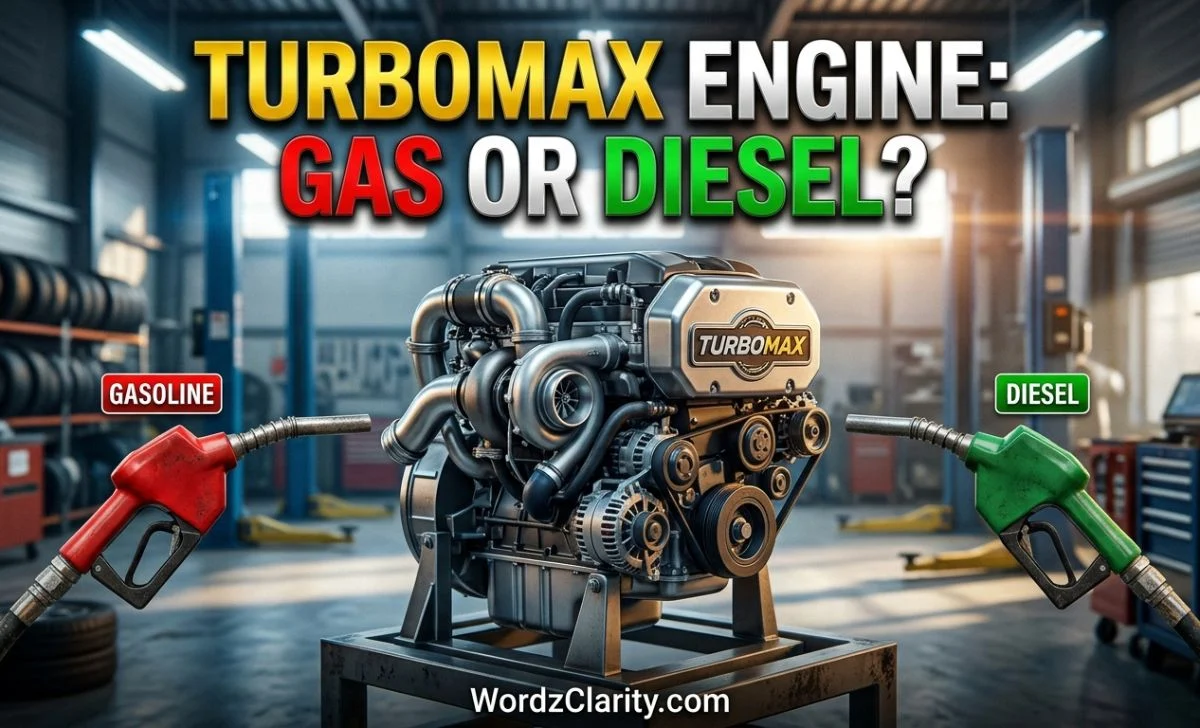
You spot “TurboMax” on the tailgate of a new Chevy or GMC pickup.
The name sounds tough, and it looks a lot like “Duramax,” GM’s famous diesel brand. So a fair question pops up: is this engine gas or diesel?
The answer affects what you pay at the pump, how much you can tow, and which truck trim you should buy. Guessing wrong can mean buying the wrong truck for your needs and budget.
This guide clears it up. You will learn the fuel type, the 2026 and 2027 specs, how the TurboMax compares to GM’s real diesel, and which engine suits your daily driving and towing needs. We keep it simple and stick to facts you can actually use.
Quick Answer:
The TurboMax is a gas engine. It is a turbocharged 2.7-liter four-cylinder built by General Motors (GM), and it runs on regular unleaded gasoline.
It is not a diesel. GM’s diesel in these trucks is a different engine, the 3.0L Duramax.
What Is the TurboMax Engine?
The TurboMax is GM’s turbocharged 2.7-liter inline-four gasoline engine. Its internal code is L3B, and the 2027 update is L4B.
You will find it in these trucks:
- Chevrolet Silverado 1500
- GMC Sierra 1500
- Chevrolet Colorado
- GMC Canyon
In the Silverado 1500 and Sierra 1500, it is the base engine on many trims. It is a small engine meant to feel like a bigger one.
Why People Think the TurboMax Is a Diesel
Three things cause the mix-up.
1. The Name Copies the Duramax Style
GM took the “Max” from its Duramax diesel line. The name signals power and toughness. It does not signal fuel type.
2. It Is Built to Last
GM engineers have said they designed this engine with diesel-like durability in mind. That is a design goal. It does not change what the engine burns.
3. It Makes Strong Low-End Torque
Torque is the pulling force you feel when you tow or merge onto a highway. Diesels are known for it. The TurboMax delivers strong torque at low engine speeds, so it can feel diesel-like on the road.
TurboMax Engine Specs: 2026 vs 2027
| Spec | 2026 and earlier (L3B) | 2027 update (L4B) |
|---|---|---|
| Type | 2.7L turbocharged inline-four | 2.7L turbocharged inline-four |
| Fuel | Gasoline | Gasoline |
| Horsepower | 310 hp | 350 hp |
| Torque | 430 lb-ft | 455 lb-ft |
| Silverado max towing | 9,500 lbs | 9,400 lbs |
| Silverado max payload | 2,260 lbs | 2,340 lbs |
The 2027 version adds 40 horsepower and 25 lb-ft of torque without increasing engine size. In the 2027 Silverado and Sierra, it pairs with a 10-speed automatic. The Colorado and Canyon keep their 8-speed automatic.
Towing and payload vary by trim, drivetrain, and configuration, so check the exact rating for the truck you plan to buy.
Does the TurboMax Need Premium Gas?
No. The TurboMax runs on regular 87-octane gasoline. Premium is not required.
That is good news for your budget. Many turbo engines ask for premium fuel, but this one does not.
The Diesel Option: Meet the 3.0L Duramax
If you want a diesel from GM, look at the 3.0-liter Duramax turbodiesel inline-six. It is a separate engine with a different fuel system, offered in the Silverado 1500 and Sierra 1500.
For 2027, GM lists it at 305 hp and 495 lb-ft of torque. Chevrolet says it can tow up to 12,000 pounds. With the large fuel tank, it can travel more than 900 miles on the highway.
TurboMax vs Duramax Diesel
| Feature | 2.7L TurboMax (gas) | 3.0L Duramax (diesel) |
|---|---|---|
| Fuel type | Regular gasoline | Diesel |
| Cylinders | 4 | 6 |
| Horsepower (2027) | 350 hp | 305 hp |
| Torque (2027) | 455 lb-ft | 495 lb-ft |
| Max towing (2027 Silverado) | 9,400 lbs | 12,000 lbs |
| Best for | Daily driving, light towing | Heavy towing, long highway trips |
The TurboMax wins on horsepower. The diesel wins on torque and towing. Neither is best for everyone. It depends on how you use your truck.
Which Engine Should You Choose?
Choose the TurboMax If You:
- Drive mostly around town or on short trips
- Tow light loads, like a small boat or utility trailer
- Want a lower starting price
- Prefer regular gas that is easy to find
Fuel economy is a strength. Dealer listings note up to 23 mpg highway on 2WD Silverado models. In the Colorado and Canyon, combined mpg runs from about 16 on the off-road ZR2 and AT4X AEV to about 20 on the most efficient rear-wheel-drive versions.
Choose the Duramax Diesel If You:
- Tow heavy trailers often
- Drive long highway distances
- Want the most pulling power
Consider a V8 If You:
- Want the top towing numbers from a gas engine
- Prefer the sound and feel of a V8
The 2027 Silverado offers new 5.7L and 6.6L V8 engines. The 5.7L can tow up to 13,700 pounds.
How to Confirm Your Engine’s Fuel Type
Not sure what is under your hood? Check these four things:
- The fuel door. It lists the required fuel. Diesel trucks say “Diesel Fuel Only.”
- The owner’s manual. It names your engine and fuel.
- The VIN. A dealer can decode it to confirm the engine.
- The badge. In GM trucks, Duramax means diesel and TurboMax means gas.
FAQs
Is the TurboMax engine a diesel?
No. It is a turbocharged gasoline engine.
What fuel does the TurboMax use?
Regular unleaded gasoline. Premium is not required.
Is there a TurboMax diesel?
No. GM’s diesel in these trucks is the 3.0L Duramax.
Can a four-cylinder really tow?
Yes. The Silverado’s TurboMax is rated to tow up to 9,400 to 9,500 pounds, depending on model year and setup. Heavy, frequent towing will use more fuel than it would in a V8, so match the engine to your real needs.
Are there other engines called “TurboMax”?
In pickups, the name belongs to GM’s gas engine. Some other equipment sellers may use similar names. If your engine is not from GM, check the data plate or owner’s manual for the maker and fuel type.
Conclusion
The TurboMax engine is a gas engine, not a diesel. It is GM’s turbocharged 2.7-liter four-cylinder, and it runs on regular unleaded fuel.
The name borrows from Duramax, but the two engines are different in fuel, design, and purpose.
For 2027, the TurboMax climbs to 350 horsepower and 455 lb-ft of torque, which makes it a strong pick for daily driving, commuting, and light towing.
If you regularly pull heavy trailers or drive long highway miles, the 3.0L Duramax diesel or a V8 will serve you better.
Before you buy, check the fuel door, the owner’s manual, or the VIN to confirm the engine. Then match the engine to how you really use your truck, not how you hope to use it someday.
That one step can save you money and frustration over the years you own it. Choose wisely.
Read More Blogs
- Allergy or Cold: 7 Clear Signs to Tell the Difference Fast
- Boy or Girl Test: Medical Tests That Can Reveal Your Baby’s Sex
- Weird or Wierd: Which Spelling Is Right? The Rule Explained.
- Sildenafil vs Tadalafil: Which ED Pill Fits Your Life?
- Ethernet in Portland, OR: Business Providers, Speeds, and Pricing