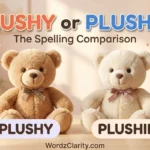
You’re writing a birthday card for your niece. The gift is a soft purple bunny. You type “plushy,” stop, and wonder if it should be “plushie.”
Fair question. Both words exist, and they overlap in a confusing way. Here’s what each one means and which to use.
The Quick Answer
Plushie is the standard word for a soft stuffed toy. Plushy is mainly an adjective for something soft or luxurious, like a plushy blanket.
There’s one wrinkle. Merriam-Webster also lists “plushy” as a noun, but it calls it a less common variant of “plushie.” So “plushy” for a toy isn’t a mistake. It’s just the rarer choice.
If you’re unsure, write “plushie” for toys and you’ll be fine.
What “Plushie” Means
A plushie is a toy made from soft, fuzzy fabric and filled with stuffing. Teddy bears, cartoon characters, and anime mascots all count.
Wiktionary lists plushie as a synonym of “plush toy.” Think of it as the friendly, everyday version. The “-ie” ending makes it sound small and sweet, much like “doggie” or “blankie.”
Examples:
- My daughter takes her shark plushie to every doctor visit.
- He won a giant panda plushie at the arcade.
- She keeps her plushies lined up on the bed by size.
What “Plushy” Means
“Plushy” has two jobs.
As an adjective
This is where “plushy” is most at home. It describes something with the texture of plush, or something notably luxurious. Hotel reviews and home décor articles use it all the time.
Examples:
- The hotel room had plushy towels and a huge bed.
- I finally replaced my old sofa with a plushy sectional.
- Her plushy winter robe is the first thing she grabs in the morning.
The adjective is old. Merriam-Webster traces it back to 1611. It’s not a new internet word.
As a noun
As a noun, “plushy” means the same as “plushie.” A USA Today headline in June 2026 asked whether Punch was outgrowing his plushy. So even big publications use it that way.
Plushy vs Plushie at a Glance
| Plushie | Plushy | |
|---|---|---|
| Used as a noun (a toy) | Yes, the standard form | Yes, less common |
| Used as an adjective (soft, luxurious) | No | Yes |
| Typical use | Toys and collectibles | Fabrics, furniture, bedding |
The main takeaway from the table: only “plushy” works as an adjective. “A plushie blanket” isn’t standard English.
Plushie, Plush Toy, or Stuffed Animal?
People mix these up constantly. Here’s how they usually differ.
Stuffed animal is what most Americans say in daily life. In the U.S. it’s the dominant term, while “soft toy” is common in the UK.
Plush toy is the neutral term you’ll see on store websites and product pages.
Plushie is the casual, fan-friendly word. It grew out of pop culture, anime fandoms, and online communities where collecting and aesthetics matter.
There’s one practical difference. A stuffed animal is shaped like an animal. A plushie can be anything: a slice of pizza, a ghost, a cartoon character, a cloud. If you’re writing about a plushie that isn’t an animal, “stuffed animal” would be the wrong label.
Why Plushies Were Everywhere in 2026
If it felt like plushies took over your feed this year, you’re right. The reason is one small monkey.
Punch is a young Japanese macaque at Ichikawa City Zoo. He was born in July 2025 and joined the rest of the troop on January 19, 2026. Videos showed him clinging to a stuffed orangutan for comfort. The toy was IKEA’s DJUNGELSKOG orangutan.
Then shoppers rushed in. The roughly $20 toy sold out worldwide. Some resale listings on eBay climbed as high as $129. Fans even rallied around the hashtag #KeepGoingPunch.
It was a good reminder of what a plushie really is. It’s a comfort object, and people of every age respond to that.
How to Pick the Right Word Every Time
Ask yourself two quick questions.
- Am I describing a toy? Use “plushie.”
- Am I describing how something feels or looks? Use “plushy.”
If you’re writing something formal, like a school paper or a product description, stick with “plushie” for toys. It’s the form readers expect.
Mistakes to watch for
- Calling a blanket a “plushie blanket.” Use “plushy blanket” instead.
- Switching between “plushie” and “plushy” for the same toy in one article. Pick one.
- Misspellings like “plushey.” That’s not a standard form of either word.
What to Check Before Buying a Plushie
A plushie looks harmless, but a few details matter, especially for little kids.
Look at the face. Sewn-on eyes and noses can’t be pulled off. Manufacturers point out that embroidered features remove the risk of detachment for children under three.
Know who sets the rules. The U.S. Consumer Product Safety Commission says a product is treated as a children’s product if kids are likely to use it, even when it isn’t marketed to them. Loose small parts, like animal eyes, are a major choking concern for stuffed toys. The federal small-parts rule targets products for children under three.
Check for recalls. In May 2026, the CPSC announced a recall of 227,500 plush toys. A removable plastic cube could break into small parts or sharp edges. Before you buy a baby plushie, take two minutes to search cpsc.gov.
Keep it simple for infants. Fewer attachments means fewer things that can break off.
How to Wash a Plushie
Plushies get dirty. Kids drag them everywhere, and adults aren’t much better. Here’s how to clean one without wrecking it.
- Read the care tag. It tells you what the toy can handle.
- Know when not to use the washer. Battery-powered toys, vintage plush, and bean-filled toys are poor candidates for the machine. The same goes for toys with glued-on parts, sequins, or internal batteries. Spot clean those instead.
- Use a mesh bag. It protects the seams and keeps small bits from snagging.
- Pick gentle and cold. One expert recommends a delicate or hand-wash cycle with cold water.
- Skip bleach and fabric softener. A mild detergent does the job.
- Let it air dry. Heat can damage plush toys, so most should air dry unless the label says otherwise.
FAQs
Is “plushy” a real word?
Yes. It’s an adjective meaning soft or luxurious, and a less common noun form of “plushie.”
Should I write plushie or plushy for a toy?
Write “plushie.” It’s the standard choice for a stuffed toy.
What is the plural of plushie?
Plushies. For example: “She has a shelf full of plushies.”
Are plushies and stuffed animals the same?
Mostly. A stuffed animal is shaped like an animal. A plushie can be any soft, plush-covered toy, including food and characters.
Can adults like plushies too?
Of course. Plenty of adults collect them, display them, or keep one on the bed. Punch’s story showed how much comfort a simple soft toy can bring.
Conclusion
When in doubt, remember this: a plushie is something you hug, and plushy is something that feels soft.
Write about toys with “plushie,” and use “plushy” when you want to describe a cozy fabric or a luxurious room. Do that and you’ll get it right almost every time.
Read More Blogs
- Equal or Less Than Sign: Meaning, Examples, and How to Type It
- Nosey or Nosy: Meaning, Difference, and Examples
- Petco or PetSmart: Which Store Gives You More for Your Money?
- Start or Sit Calculator: Compare Fantasy Football Players
- Is Condensation Endothermic or Exothermic?
- Weird or Wierd: Which Spelling Is Right? The Rule Explained.
- Ethernet in Portland, OR: Business Providers, Speeds, and Pricing
- Everyday vs Every Day: One Word or Two? (Rules + Examples)