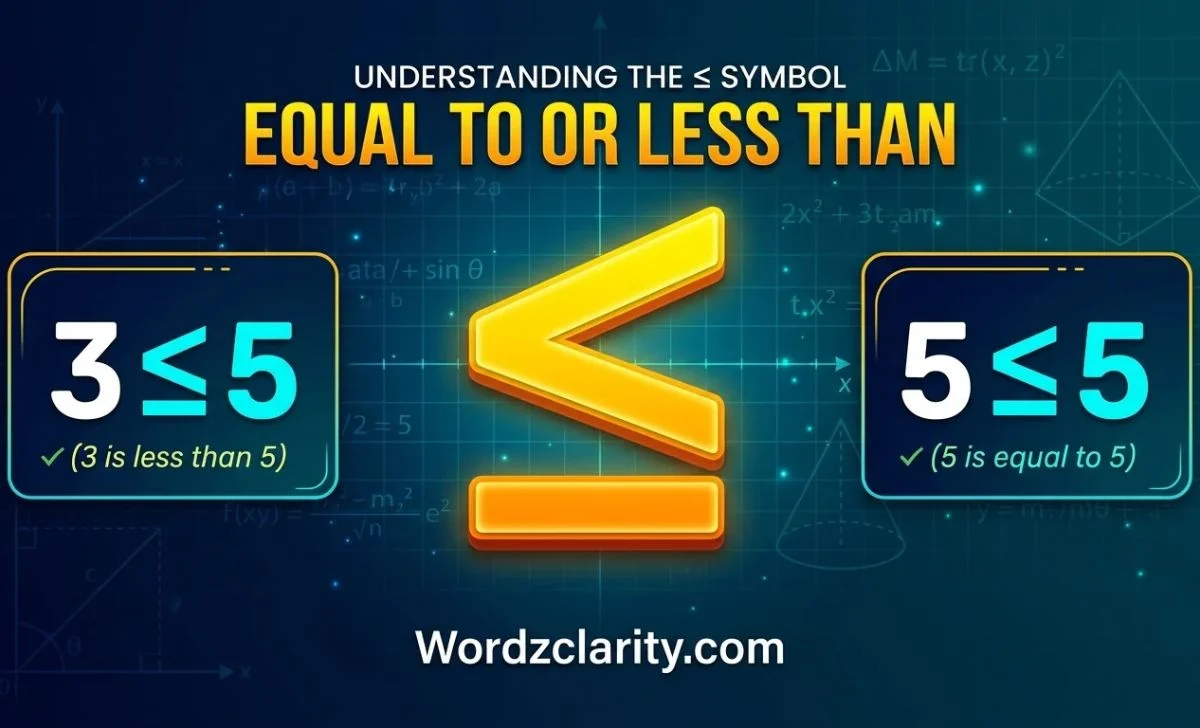
The equal or less than sign is commonly called the less than or equal to symbol. It looks like this: ≤. In mathematics, it shows that one value is smaller than another value or exactly the same.
This guide explains its meaning, how to read it, examples, related symbols, and ways to type or copy it on different devices easily.
Quick Answer: What Is the Equal or Less Than Sign?
The less than or equal to sign is ≤.
Copy and paste: ≤
This symbol means that a value can be smaller than or equal to another value. For example, (x \leq 5) means that (x) can be 5 or any value below 5.
The standard name is less than or equal to sign. People sometimes search for it as the “equal or less than sign,” but both phrases usually refer to the same symbol.
What Does the ≤ Symbol Mean?
The symbol ≤ combines two mathematical ideas: less than ((<)) and equal to ((=)).
When you write (a \leq b), you mean that (a) is either smaller than (b) or equal to (b). Both possibilities are allowed.
For example:
- (3 \leq 7) is true because 3 is less than 7.
- (7 \leq 7) is true because both values are equal.
- (9 \leq 7) is false because 9 is greater than 7.
The important point is that equality is allowed when you use ≤. The first value does not have to be strictly smaller.
How to Read the Less Than or Equal To Sign
Read the symbol ≤ as “less than or equal to.”
For example, (x \leq 10) is read as “x is less than or equal to 10.”
This means that (x) can be 10 or any number below it. Depending on the context, that could include whole numbers, decimals, or negative numbers.
Here are some more examples:
| Expression | How to read it | Meaning |
|---|---|---|
| (2 \leq 5) | 2 is less than or equal to 5 | True |
| (5 \leq 5) | 5 is less than or equal to 5 | True |
| (8 \leq 5) | 8 is less than or equal to 5 | False |
| (x \leq 12) | x is less than or equal to 12 | x can be 12 or lower |
How to Copy and Paste the ≤ Symbol
If you only need the symbol, the easiest method is to copy it from here.
Symbol to copy: ≤
Select the symbol, copy it, and paste it into your document, message, spreadsheet, or search box.
You can also use the following character information if you need the symbol for a technical task:
- Symbol: ≤
- Unicode name: Less-Than or Equal To
- Unicode code point: U+2264
- HTML entity:
≤ - HTML numeric code:
≤ - LaTeX command:
\leq
These codes are useful for web pages, mathematical documents, and other applications that support the relevant format.
How to Type the ≤ Symbol on a Keyboard
The steps depend on your device and application. Copying the symbol is a reliable alternative when a keyboard shortcut is unavailable.
On Windows
In Microsoft Word, you can use the Unicode input method:
- Type
2264in your document. - Press Alt + X.
- Word converts the code into ≤.
If this method does not work in your application, copy the symbol from this page and paste it where needed. You can also look for it in the application’s symbol menu.
On Mac
The simplest option is to copy ≤ and paste it into your document.
You can also open the Character Viewer to search for the symbol:
- Open the Character Viewer from your Mac’s input menu or keyboard controls.
- Search for “less than or equal to.”
- Select the symbol to insert it.
The exact steps for opening the Character Viewer may vary with your macOS version and settings.
On a Phone or Tablet
On an iPhone, iPad, or Android device, copying and pasting is usually the easiest option.
- Copy the symbol ≤ from this page.
- Open your message, note, document, or other app.
- Press and hold the text field.
- Select Paste.
Some keyboard apps also offer mathematical symbols, but their layouts vary.
Less Than or Equal To (≤) vs Less Than (<)
These symbols look similar, but they do not mean exactly the same thing.
The less than sign (<) means the first value must be smaller than the second. It does not allow the values to be equal.
The less than or equal to sign (≤) allows the first value to be smaller or equal.
| Symbol | Name | Example | Is equality allowed? |
|---|---|---|---|
| (<) | Less than | (3 < 5) | No |
| (\leq) | Less than or equal to | (5 \leq 5) | Yes |
| (>) | Greater than | (8 > 4) | No |
| (\geq) | Greater than or equal to | (4 \geq 4) | Yes |
| (=) | Equal to | (6 = 6) | Equality is required |
Remember this simple difference: < means smaller only, while ≤ means smaller or equal.
How to Remember Which Way the ≤ Sign Faces
A helpful way to remember the symbol is to look at its pointed end.
The pointed end faces the smaller value, while the open side faces the larger value.
For example:
- (4 \leq 9): 4 is smaller than 9.
- (9 \geq 4): 9 is greater than or equal to 4.
The extra line underneath the angle is the key difference. It adds the possibility of equality.
Compare (4 < 4) with (4 \leq 4). The first statement is false, but the second is true.
Examples of the ≤ Sign in Everyday Life
The less than or equal to sign is useful when a value must stay within a limit.
Age Limits
Suppose an activity is available to people aged 12 or younger. You could express the age condition as:
[\text{Age} \leq 12]
This includes age 12 and all ages below 12.
Spending Limits
Suppose you want to spend no more than $50. You can write:
[\text{Spending} \leq $50]
This means your total can be $50 or less. Spending exactly $50 meets the limit.
Maximum Weight
If a package must weigh no more than 10 kilograms, the condition is:
[\text{Weight} \leq 10\text{ kg}]
A package weighing 10 kg meets the limit. A package weighing 10.5 kg does not.
School Grades
Suppose a teacher uses a score of 60 or below to identify a particular score range. The condition can be written as:
[\text{Score} \leq 60]
This includes a score of 60 as well as any lower score. The symbol describes the mathematical condition; the meaning of the score depends on the grading system.
How Is ≤ Used in Algebra and Inequalities?
In algebra, an inequality compares two expressions instead of stating that they are equal.
For example:
[x + 2 \leq 8]
To solve it, subtract 2 from both sides:
[x \leq 6]
Therefore, any value of (x) that is 6 or lower satisfies the inequality.
For instance, (x = 6), (x = 4), and (x = 0) all work. A value such as (x = 7) does not.
When solving inequalities, remember that multiplying or dividing both sides by a negative number reverses the inequality sign. For example:
[-2x \leq 8]
Divide both sides by (-2) and reverse the sign:
[x \geq -4]
This rule is important because treating an inequality exactly like an equation can lead to the wrong answer.
FAQs
What is the equal or less than sign?
The phrase usually refers to the less than or equal to sign: ≤. It means that one value is smaller than or equal to another value.
What is the symbol for less than or equal to?
The symbol is ≤. You can copy it directly from this page.
Is ≤ the same as <?
No. The symbol < means strictly less than. The symbol ≤ means less than or equal to, so it also allows both values to be equal.
What is the difference between ≤ and ≥?
The symbol ≤ means less than or equal to. The symbol ≥ means greater than or equal to. The pointed end faces the smaller value in both symbols.
How do I type ≤ in Microsoft Word?
Type 2264 and press Alt + X. Word should convert the Unicode code into ≤. You can also use Word’s symbol menu.
What is the Unicode for ≤?
The Unicode code point is U+2264. The HTML entities are ≤ and ≤.
Does ≤ include the number itself?
Yes. The equal part means the two values can be the same. For example, (10 \leq 10) is true.
What does x ≤ 5 mean?
It means that (x) can be 5 or any value below 5. The allowed values depend on the number system being used.
Conclusion
The less than or equal to sign (≤) shows that one value is smaller than or equal to another. It is used in arithmetic, algebra, inequalities, and everyday situations involving limits.
Unlike the less than sign (<), it allows both values to be equal. You can copy the symbol directly or use its Unicode code, U+2264, in supported applications.
Read More Blogs
- Advise or Advice: The Simple Rule to Never Mix Them Up Again
- Suppose To or Supposed To: Which Is Correct?
- The Chariot Yes or No: What This Tarot Card Really Answers