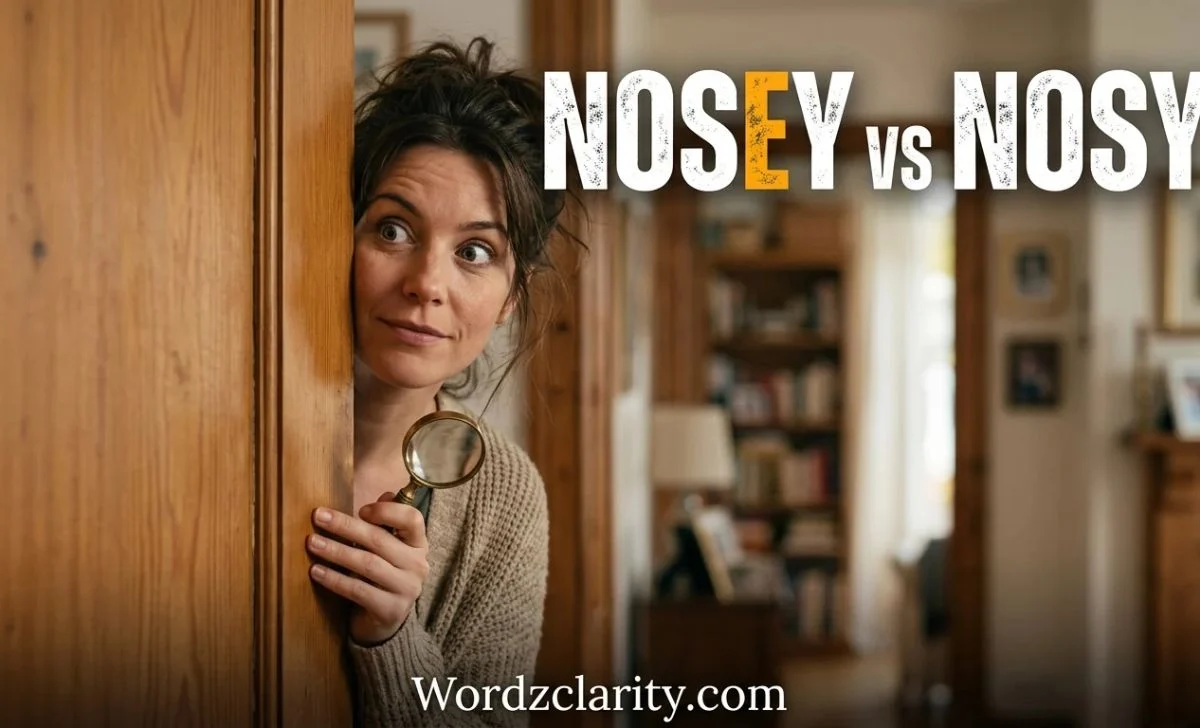
Nosey and nosy are two spellings of the same English word. Both describe someone who takes too much interest in other people’s private business.
However, one spelling is more common in American English, while the other is often seen in British writing.
This guide explains the meaning, correct spelling, pronunciation, examples, synonyms, and common usage mistakes with clear everyday sentences.
Quick Answer: Nosey or Nosy?
Both nosey and nosy are correct spellings. They have the same meaning and pronunciation.
- Nosy: The preferred spelling in American English.
- Nosey: An accepted alternative spelling, also used in British English.
- Meaning: Too interested in other people’s private affairs.
Example: My neighbor is nosy and always asks personal questions.
You can also write: My neighbor is nosey and always asks personal questions.
Both sentences are correct. If you are writing for a US audience, choose nosy for consistency.
What Does Nosy Mean?
Nosy is an adjective that describes someone who shows too much interest in other people’s private lives. A nosy person may ask personal questions, listen to private conversations, or try to discover information that does not concern them.
The word usually has a negative meaning. It suggests that someone is crossing a boundary rather than showing ordinary interest.
Examples:
- My nosy neighbor keeps asking how much money I earn.
- Stop reading my messages. You are being nosy.
- The reporter asked several nosy questions about the actor’s personal life.
In each example, the person wants information that may be private or none of their business.
What Does Nosey Mean?
Nosey means exactly the same as nosy. It describes someone who is overly interested in other people’s affairs.
The extra e does not change the meaning or pronunciation.
Examples:
- My nosey cousin wanted to know why I left the party early.
- A nosey stranger asked about my family.
- She ignored the nosey questions and changed the subject.
These sentences would also be correct with nosy. The choice is a spelling preference, not a difference in meaning.
Nosey vs Nosy: What Is the Difference?
The difference is spelling, not meaning. Both words describe excessive interest in matters that may be private.
| Feature | Nosy | Nosey |
|---|---|---|
| Correct spelling? | Yes | Yes |
| Meaning | Too interested in other people’s affairs | Same meaning |
| Pronunciation | /ˈnoʊzi/ in US English | Generally the same |
| American English | Preferred form | Accepted variant |
| British English | Also used | Accepted variant |
| Best writing tip | A good default for US audiences | Fine when following a style that uses it |
For most US-focused articles, school assignments, and professional writing, nosy is the safer default. However, nosey is not a spelling mistake.
The most important rule is to use one spelling consistently throughout a piece of writing.
Is Nosy or Nosey Correct in American English?
Nosy is the preferred spelling in American English. It is the form commonly used by American dictionaries and in general US writing.
For example:
- My coworker is nosy about everyone’s weekend plans.
- Don’t be nosy about their private conversation.
- The nosy customer kept asking personal questions.
Nosey is also recognized, so it is not automatically wrong in American English. However, if you are writing for a US audience, nosy is usually the better choice.
Is Nosy or Nosey Correct in British English?
Both spellings are accepted in British English. The form nosey is often seen in British writing, while nosy is also correct.
Examples:
- The nosey neighbor wanted to know who had visited.
- Don’t be so nosy about someone else’s plans.
- A nosey passerby stopped to watch the workers.
If you are writing for a British audience, either spelling can work. Follow your publication’s preferred style and keep it consistent.
Nosy Meaning in a Sentence
The easiest way to understand nosy is to see how people use it in everyday situations.
At Home
My brother is so nosy that he reads the labels on everyone’s packages.
This sentence suggests that the brother takes too much interest in other people’s belongings.
At Work
My coworker asked several nosy questions about my salary.
Here, nosy describes questions that may be too personal for the situation.
Among Friends
I wanted to know why she was upset, but I didn’t want to sound nosy.
This example shows that someone can be interested in another person’s situation while still respecting their privacy.
Online
The stranger sent nosy messages asking for my home address.
In this case, the questions feel intrusive because they request personal information.
In a Family Conversation
My aunt can be a little nosy when relatives discuss their plans.
This example uses nosy in a mildly critical way. Depending on the relationship and tone, the word can sometimes sound playful rather than harsh.
Nosy vs Curious: Are They the Same?
No. Nosy and curious are related, but they have different tones.
Curious usually means wanting to learn or understand something. It can describe a positive interest in ideas, people, or events.
Nosy usually means being too interested in matters that are private or do not concern you.
Compare these examples:
- Curious: I was curious about how the machine worked.
- Nosy: I asked my neighbor how much money was in their bank account.
The first example describes a desire to learn. The second suggests an overly personal question.
Context matters. Asking a question is not automatically nosy. The subject, relationship, timing, and other person’s comfort all affect how the question may be received.
Synonyms for Nosy and Nosey
Several words have meanings similar to nosy, but they do not all have exactly the same tone.
| Synonym | Meaning | Example |
|---|---|---|
| Inquisitive | Eager to ask questions or learn | The inquisitive student asked how the system worked. |
| Intrusive | Entering someone’s private matters without welcome | His intrusive questions made the conversation uncomfortable. |
| Prying | Trying to discover private information | She disliked his prying questions about her relationship. |
| Meddlesome | Interfering in other people’s affairs | The meddlesome neighbor tried to settle their argument. |
| Overcurious | More curious than a situation calls for | His overcurious questions made the visitor uneasy. |
Curious can be a softer alternative, but it is not always a direct synonym. A curious person may simply want to learn, while a nosy person is often interested in information that should remain private.
What Are the Different Forms of Nosy?
The adjective nosy has several related forms. These are useful when describing different degrees or types of behavior.
Nosier
Nosier is the comparative form. Use it when comparing two people or situations.
Example: My new neighbor is nosier than the previous one.
Nosiest
Nosiest is the superlative form. Use it when someone or something shows the greatest degree of nosy behavior within a group.
Example: He is the nosiest person in our office.
Nosily
Nosily is an adverb that describes an action done in a nosy way.
Example: She nosily looked through the papers on the desk.
Nosiness
Nosiness is a noun. It refers to the habit or quality of being nosy.
Example: His nosiness made it difficult for others to trust him with private information.
These forms are spelled with s and follow the usual spelling pattern for the word nosy.
What Does “Nosey Parker” Mean?
Nosey Parker is an informal expression, especially associated with British English. It describes a person who takes too much interest in other people’s business.
Example: Don’t be such a Nosey Parker. Let them discuss it privately.
The expression is often used humorously or teasingly, although it can also express annoyance. It is not a formal term, so it is better suited to conversation and informal writing.
Common Mistakes When Using Nosy or Nosey
A few simple rules can help you use these words correctly.
Treating Nosey as Incorrect
Incorrect assumption: Nosey is always a spelling mistake.
Correction: Both nosey and nosy are accepted spellings. Choose according to your audience or preferred style.
Assuming the Words Have Different Meanings
Incorrect assumption: Nosy describes a person, but nosey describes a different behavior.
Correction: Both spellings have the same meaning and can describe the same behavior.
Confusing Nosy With Curious
Incorrect assumption: Anyone who asks questions is nosy.
Correction: Asking questions can show healthy curiosity. The word nosy usually suggests excessive interest in private matters.
Switching Spellings Without a Reason
Example: My nosy neighbor asked a nosey question.
This sentence is understandable, but switching spellings unnecessarily can make writing look inconsistent.
Better: My nosy neighbor asked a nosy question.
Choose one spelling and use it consistently.
FAQs
Is nosy a real word?
Yes. Nosy is a standard English adjective used to describe someone who is too interested in other people’s private affairs.
Is nosey a real word?
Yes. Nosey is an accepted alternative spelling of nosy. Both words have the same meaning.
Which spelling is more common in the United States?
Nosy is the preferred spelling in American English. It is generally the better choice for US-focused writing.
Is nosey British English?
Nosey is used in British English, but it is not exclusive to Britain. Both nosey and nosy are accepted forms.
Are nosy and nosey pronounced the same?
Yes. They are generally pronounced the same way. The extra e changes the spelling, not the pronunciation.
Is nosy a positive or negative word?
Nosy is usually negative or disapproving because it suggests too much interest in private matters. In friendly conversation, it can sometimes be used playfully.
What is the opposite of nosy?
Possible opposites include discreet, respectful, and unobtrusive. The best choice depends on the sentence because each word expresses a slightly different idea.
What is the difference between nosy and inquisitive?
Inquisitive often describes a willingness to learn or ask questions. Nosy suggests that someone’s interest goes too far, especially when it involves another person’s private life.
What is the plural of nosy?
Nosy is an adjective, so it does not have a plural form. You can say nosy people or nosy neighbors. The comparative is nosier, and the superlative is nosiest.
Conclusion
Nosey and nosy are both correct spellings with the same meaning. They describe someone who shows too much interest in other people’s private affairs.
American English generally favors nosy, while nosey is also common in British writing. For clear and consistent writing, choose the spelling that suits your audience and use it throughout your article.
Read More Blogs
- Legal Counsel or Council: Which Word Is Correct?
- Truth or Consequences Hot Springs: What to Know Before You Visit
- Hell or High Water Louisville: What to Know Before You Visit