In August 2026, a pipe band from Warminster, Pennsylvania, marched onto Glasgow Green and won a world title. The band is called the Ulster Scottish Pipe Band.
An immigrant from Northern Ireland founded it in 1922, and it just beat 11 other finals bands from Scotland, Canada, France, New Zealand, Ireland, Australia and Seattle.
Its pipe major works as a quality assurance engineer. Two days after the win, he was back at his desk.
So whose music was that, Scottish or Irish?
The honest answer is both. Neither country invented the bagpipe.
The Short Answer
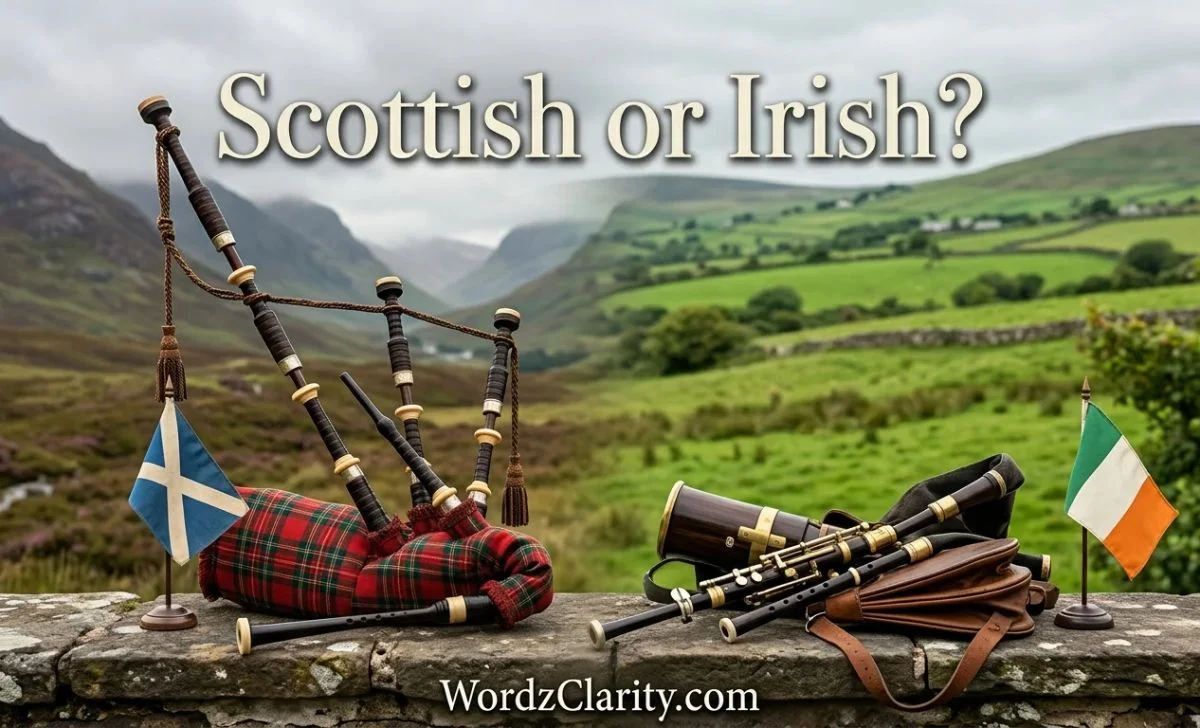
Scotland has the Great Highland bagpipe. Ireland has the uilleann pipes. They are different instruments with different sounds, and each country claims its own as a national symbol.
The loud, mouth-blown bagpipe you hear at parades and funerals is almost always the Scottish type. The Irish one is quieter, played seated, and pumped with the elbow.
Where Bagpipes Really Came From
Neither country has a claim to the original. The earliest known image of a bagpipe is a Hittite carving from around 1000 BCE, in what is now Turkey. Most historians trace the instrument to herders in the Middle East.
Nobody can say more than that. Bags and reeds rot, so ancient bagpipes left almost nothing behind. The instrument then spread west, and by the Middle Ages it was played across Europe.
This is why the “Scots invented it” and “the Irish had it first” arguments both fall flat. Each country adopted an old instrument and built its own tradition on top.
How Scotland Made the Bagpipe Its Own
The first written evidence in Scotland dates to 1396. Accounts of the Battle of the North Inch of Perth describe “warpipes” carried into the fight.
The army then did the most work. In the second half of the 1700s, Highland regiments joined the British Army, and they brought pipers with them. The tradition survived in the military and traveled the world with it.
That is how the Great Highland bagpipe became the sound of Scotland.
What Makes a Highland Bagpipe Special
- The player blows into a pipe to keep the bag full.
- The chanter plays the melody, but only nine notes.
- Three drones hold constant notes behind it.
- The chanter uses a double reed. The drones use single reeds.
Those nine notes follow a scale close to Mixolydian. The sound is loud, bright and built for open air.
Ireland Has Two Bagpipe Traditions
This is the part most articles skip. Ireland did not have one bagpipe. It had two.
The Irish Warpipes
The older one is the píob mhór, meaning “great pipe.” It was mouth-blown and made for marching. Irish pipers went to war with it, and the first clear references come from Henry VIII’s siege of Boulogne in 1544.
It faded in the 1800s. When it came back in the 1880s, it came back shaped by Highland piping. The warpipes played in Ireland today are essentially the Highland bagpipe.
The Uilleann Pipes
Ireland’s own national bagpipe is the uilleann pipes. They are bellows-blown. The player straps a bellows under one arm, pumps it with the elbow, and sits to play. The name is usually linked to the Irish word for “elbow.”
Their history is younger than people expect. The earliest certain date is 1743, when John Geoghegan published a tutor for what he called the “pastoral or new bagpipe.” The oldest surviving sets come from the second half of the 1700s.
The chanter covers two octaves. The pipes also have three drones and three regulators, which are keyed pipes that add chords. The sound is sweeter and quieter than a Highland pipe, which is why they are usually played indoors.
By the 1960s the instrument was in decline. In 1968, a group of pipers founded Na Píobairí Uilleann to stop that. It worked. UNESCO added uilleann piping to its list of Intangible Cultural Heritage in December 2017.
You can still see that revival today. On Saturday, November 7, 2026, events marked International Uilleann Piping Day across Ireland and abroad, including community events in upstate New York.
Scottish vs Irish Bagpipes at a Glance
| Feature | Great Highland bagpipe | Uilleann pipes |
|---|---|---|
| Country | Scotland | Ireland |
| Air supply | Mouth | Bellows pumped by the elbow |
| Position | Standing or marching | Seated |
| Melody range | 9 notes | About 2 octaves |
| Drones | 3 | 3, plus 3 regulators |
| Sound | Loud, piercing | Sweet, soft |
| Usual setting | Outdoors, parades, bands | Indoors, sessions, solo |
| Earliest clear date | 1396 (Scotland) | 1743 (certain date) |
A quick way to tell them apart: if the player is marching and you can hear the music a block away, it is Highland. If they are sitting and working an elbow, it is uilleann.
Were Bagpipes Ever Banned in Scotland?
Many people believe so. After the Jacobite defeat at Culloden in 1746, Britain did pass laws against Highland dress and weapons. Those laws never mentioned bagpipes.
The myth likely comes from a piper named James Reid. He was captured and tried for treason in 1746. He argued that he carried no weapon. The court replied that a Highland regiment never marched without a piper, so his bagpipe counted as “an instrument of war.”
Reid was executed for treason. He was not punished for breaking a law against pipes. That one phrase, though, has echoed for nearly 300 years.
Why Americans Hear Scottish Pipes at Irish Events
The most common place Americans hear bagpipes is a funeral. The reason goes back to the 1840s.
After the Great Famine, Irish immigrants arrived in huge numbers. Many were shut out of most jobs and ended up in two of the most dangerous ones: firefighting and police work. When one of them died, the family held an Irish funeral, and the pipes were played. Over time, families who were not Irish asked for the pipes too. The tradition is now more than 150 years old.
The pipes at those funerals are usually the Scottish type. They are louder and carry better outdoors, which suits a procession. The Irish warpipes are the same instrument anyway.
A 1972 pop hit helped cement the tune. The Royal Scots Dragoon Guards recorded “Amazing Grace” on pipes and drums. It spent five weeks at number one in the UK and became the best-selling single of the year. Police and fire funerals have used the pipes version ever since.
It is also why you see a Scottish-style piper at a St. Patrick’s Day parade. The Irish pipes are too quiet to march with. Highland-style pipes do the job.
That is what the Warminster band is about. A Northern Irish immigrant formed it to keep his music alive. A century later, his family’s band plays Highland pipes and wins on Scottish soil.
FAQs
Are bagpipes Irish?
Yes. Ireland has its own bagpipes: the uilleann pipes and the older warpipes.
Which came first, Scottish or Irish bagpipes?
Nobody can prove it. Scotland has a clear written record from 1396. Ireland’s first clear references are from the 1500s, though some earlier mentions are debated. The instrument itself came from the Middle East.
Which is harder to learn?
The uilleann pipes. The player has to manage bellows, a two-octave chanter and regulators together.
Which is louder?
The Highland bagpipe, by a wide margin.
Do Irish people play Scottish bagpipes?
Yes. Irish pipe bands play Highland-style pipes, and the warpipes played in Ireland today are the same instrument.
Conclusion
Bagpipes are not Scottish or Irish in the way most people mean it. The instrument is ancient and came from the Middle East. Each country built something of its own on top.
Scotland gave the world the Highland bagpipe: loud, military and made for the outdoors. Ireland gave it the uilleann pipes: soft, intricate and made for the room. Their histories overlap, and so do the players.
Next time you hear pipes at a parade, a funeral or a world championship in Glasgow, you will know what you are hearing. If you are asked which country owns them, the accurate answer is that neither does.
Read More Blogs
- TurboMax Engine: What Fuel Does It Use and Why?
- Everyday vs Every Day: One Word or Two? (Rules + Examples)
- Is O or I On: Understanding Power Switch Symbols
- To Fast or Too Fast: Meaning, Grammar Rules, and Examples
- Sergeant or Sargeant: Which Spelling Is Correct?
- Mantel or Mantle: Which One Is Correct?