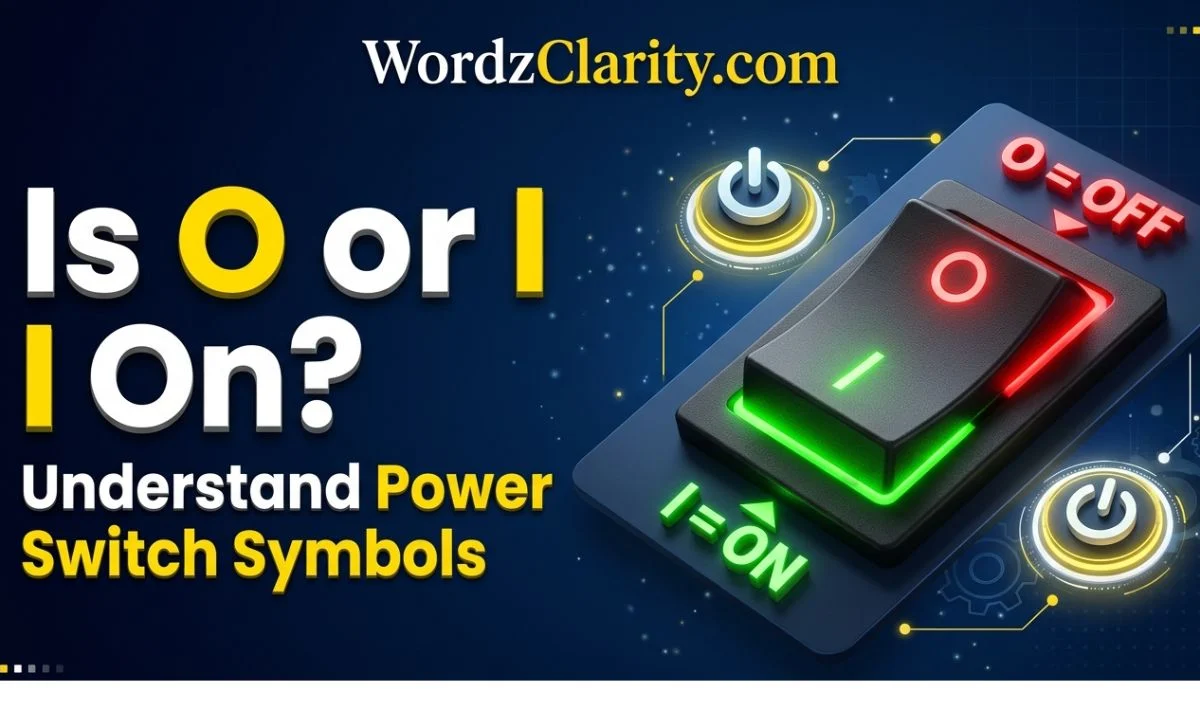
Have you ever looked at a power switch and wondered whether I or O means on?
These symbols appear on computers, household appliances, power supplies, and many other electronic devices.
Although they can look like letters or numbers, each has a specific meaning in the power-switch context.
Understanding the difference helps you identify the correct switch position without guesswork.
Quick Answer:
- I (vertical line) means ON.
- O (circle) means OFF.
- A combined line-and-circle symbol commonly identifies an ON/OFF power control.
- The standby symbol represents a different power state.
If you are looking at a traditional rocker switch marked I and O, choose the I position to turn it on and the O position to turn it off.
What Do I and O Mean on a Power Switch?
The two markings identify the ON and OFF positions of a standard power switch. They are standardized graphical symbols, not simply decorative versions of the letters I and O.
I Means ON
The vertical line represents the ON position. On a conventional mains power switch, it indicates that the switch connects the equipment to the mains supply.
For example, a desktop computer’s power supply unit (PSU) may have a rocker switch on its rear panel. Moving that switch to I enables the power supply to receive mains power.
However, this does not necessarily start the computer. You may still need to press the computer’s front power button.
O Means OFF
The circle represents the OFF position. On a standard mains switch, it indicates that the equipment is disconnected from the mains through that switch.
For example, moving a computer PSU’s rocker switch to O turns off its mains connection. The computer cannot operate normally from that supply while the switch remains off.
Keep in mind that switching off equipment does not guarantee that every internal component is free from stored electrical energy.
I vs O: The Essential Differences
| Feature | I symbol | O symbol |
|---|---|---|
| Meaning | ON | OFF |
| Appearance | Vertical line | Circle |
| Switch function | Connects equipment to mains power | Disconnects equipment from mains power |
| Common example | Computer PSU switched on | Computer PSU switched off |
| IEC reference | IEC 60417-5007 | IEC 60417-5008 |
These definitions describe the standard symbols used for mains power switches. A particular device may have additional controls that affect its operating state.
How to Tell Whether a Switch Is On or Off
Knowing what the symbols mean is only part of the answer. You also need to identify which position your particular switch occupies.
Check Which Side of the Rocker Is Pressed
On a rocker switch marked I and O, examine the markings printed beside or on the switch itself.
If the I side is pressed into the switch housing, the switch is generally in the ON position. If the O side is pressed in, it is generally OFF.
Do not rely solely on whether the switch points upward or downward. Manufacturers use different layouts, so the printed markings are more reliable than the direction of movement.
Check the Device’s Power Indicator
Some devices have an indicator light that provides additional information about their status. Computers, monitors, routers, and appliances may use lights to indicate power, activity, or standby.
However, indicator lights do not follow one universal color scheme. A light that means standby on one device may indicate a different condition on another.
Use the device’s manual if the switch position and indicator light appear inconsistent.
Understand the Difference Between Power and Startup
A switch can be ON even when the connected equipment is not actively operating.
For example, switching a computer PSU to I enables its power supply, but the computer may remain shut down until you press its front power button. Some components may still receive standby power.
This distinction helps explain why the rear switch position and the computer’s operating status do not always match.
Is I the Same as 1, and Is O the Same as 0?
The symbols can look similar, but letters and numbers are not automatically interchangeable. Their meanings depend on the context in which they appear.
I vs 1
The uppercase letter I and the number 1 can look almost identical in some fonts.
On a standard power switch, the vertical-line marking represents ON. A device may also use the number 1 to represent an ON state in a binary-style control, but you should not assume that every printed 1 is a power symbol.
Read the complete marking and consider where it appears.
O vs 0
The letter O and the number zero can also look alike. The standard circular power symbol represents OFF.
A zero may also indicate OFF on equipment that uses binary-style power markings. Elsewhere, it may simply be part of a number, setting, or technical label.
Comparison of Common Power Markings
| Marking | Typical meaning in a power-control context |
|---|---|
| I / vertical line | ON |
| 1 / number one | May indicate ON |
| O / circle | OFF |
| 0 / number zero | May indicate OFF |
| Standby symbol | Standby or a reduced-power state |
The first and third rows refer to the standardized ON and OFF symbols. The number-based markings depend on the device and its labeling.
What Does the Combined Power Button Symbol Mean?
A combined power symbol looks different from the separate I and O markings on a rocker switch.
The Line Inside a Circle
A line inside a circle commonly identifies a power button or ON/OFF control. On many electronic devices, pressing the button changes the device’s power state.
IEC 60417 distinguishes between a push-push ON/OFF control, in which both positions remain stable, and a momentary ON/OFF push button.
These controls can behave differently. A short press on a computer power button may start the machine, while a longer press may initiate a different action. The exact behavior depends on the device.
How Standby Differs From OFF
Standby is not the same as the standard O marking for OFF.
The standardized standby symbol is commonly shown as a broken circle with a short line. It identifies a control or position associated with bringing equipment into standby.
In standby, a device may consume some power while keeping certain functions available. By contrast, the standard OFF symbol indicates disconnection from the mains through the relevant switch.
If you need to disconnect equipment for maintenance, follow the manufacturer’s instructions rather than relying on a symbol alone.
Common Mistakes When Reading Power Switch Symbols
Assuming Up Always Means On
A switch’s physical orientation varies between products. The I and O markings identify the intended positions more reliably than the direction in which the rocker moves.
Confusing Standby With Complete Power-Off
A standby state may leave some parts of a device powered. If you need to isolate equipment from its supply, use the appropriate switch or disconnect it as instructed by the manufacturer.
Expecting Every Device to Start When I Is Selected
The I position enables the relevant power connection, but a separate startup action may be necessary. Computers are a common example.
Assuming OFF Means Safe to Open
The O symbol indicates the OFF function of the switch; it does not guarantee that internal components are safe to touch. Some equipment can retain electrical energy after disconnection.
Never open electrical equipment unless you are qualified and have followed the appropriate safety procedures.
FAQs
1. Is O or I on?
I means ON, while O means OFF on a standard power switch.
2. Is I on or off?
I, represented by a vertical line, indicates the ON position.
3. Is O on or off?
O, represented by a circle, indicates the OFF position.
4. Does 1 mean on and 0 mean off?
These numbers commonly represent ON and OFF in binary-style power controls, but their meaning depends on the device’s labeling.
5. Why do power switches use I and O?
Standardized graphical symbols help users recognize power-switch functions without relying on words in a particular language.
6. What does a line inside a circle mean?
It commonly identifies a power control. The precise behavior depends on whether the button uses a toggle, push-push, or momentary mechanism.
7. Is the standby symbol the same as O?
No. Standby indicates a different power state, while O identifies the standard OFF position.
8. How can I tell if a rocker switch is on?
Check the I and O markings and identify which side is pressed. Avoid relying only on the switch’s upward or downward direction.
9. Does switching to O remove all electrical energy?
No. It indicates disconnection from the mains through that switch, but stored electrical energy or other power sources may remain.
10. Should I unplug a device after switching it off?
Not necessarily for everyday use. Follow the manufacturer’s instructions, particularly when preparing equipment for cleaning, maintenance, or repair.
Conclusion
Understanding the I and O symbols makes operating electronic equipment much easier. On a standard power switch, I means ON, while O means OFF.
A combined line-and-circle symbol commonly identifies an ON/OFF control, whereas the standby symbol represents a different state.
Always check the markings instead of assuming that an upward or downward switch position determines its function. If a device behaves unexpectedly, consult its manual.
For maintenance or repairs, remember that switching to O does not guarantee that every internal component is free from electrical energy. Following the manufacturer’s safety instructions remains essential.
Read More Blogs
- Ashland or Weather: What to Expect by Month, Season & Year
- Jobs in Bend, Oregon: Hiring Now, Part-Time Jobs & Career Tips
- Kyoto or Osaka: Which City Should You Visit in Japan?
- CEO or COO: Differences in Roles, Responsibility, Salary & Power
- Fact or Opinion: Key Differences, Examples, Worksheets & Quiz