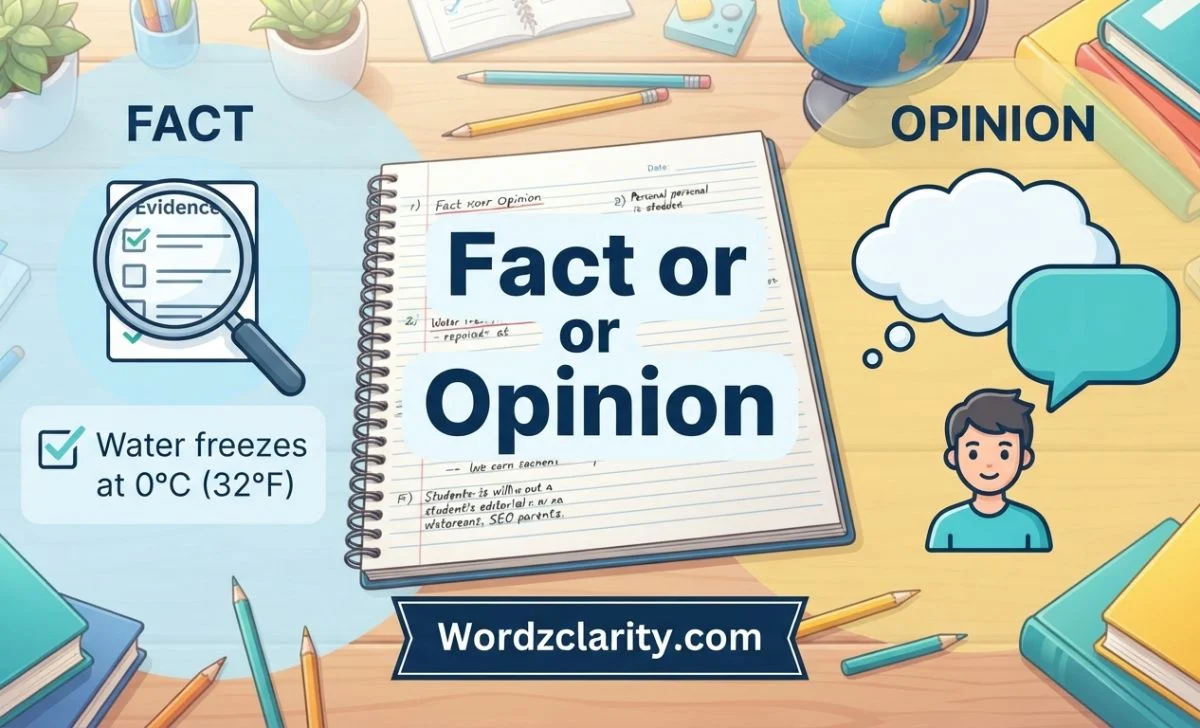
Have you ever read a sentence and wondered whether it is a fact or an opinion? It can be easy to tell the difference in simple cases. For example, “A week has seven days” is a fact, while “Monday is the worst day of the week” is an opinion.
However, some statements are harder to classify. News reports, advertisements, school assignments, and social media posts often mix facts with personal views. Learning to separate them helps you read with care, write with confidence, and make better decisions.
It also helps students improve reading comprehension and critical thinking. In this guide, you will learn what facts and opinions mean, how they differ, and how to identify each type of statement.
You will also find everyday examples, practice sentences, a fact or opinion worksheet with answers, and a short quiz. These simple tools will help you understand the topic and apply it in real life.
Quick Answer: What Is the Difference Between Fact and Opinion?
A fact is a statement that can be checked against evidence. An opinion expresses a person’s belief, feeling, preference, or judgment.
| Statement | Type | Why? |
|---|---|---|
| A year has 12 months. | Fact | A calendar can confirm it. |
| Summer is the best season. | Opinion | People have different preferences. |
| The team scored three goals. | Fact | The match record can confirm the score. |
| The team played brilliantly. | Opinion | “Brilliantly” is a judgment. |
| The library opens at 9 a.m. | Fact claim | Its official schedule can be checked. |
| The library is the nicest place to study. | Opinion | People may disagree. |
The easiest test is to ask: Can reliable evidence settle this statement, or does it express a personal view?
Remember that a claim can be checkable but false. For example, “A week has nine days” is a false factual claim, not a true fact or a personal opinion.
What Is a Fact?
A fact is information that can be tested, checked, or supported by reliable evidence. It may describe a date, number, event, measurement, or other detail that can be verified.
Facts appear in schoolbooks, scientific reports, news articles, business documents, and everyday conversations. They help people understand what happened and what the available evidence shows.
Examples of Facts
- A triangle has three sides.
- Earth travels around the Sun.
- A standard chessboard has 64 squares.
- Water freezes at about 0°C under standard atmospheric pressure.
- The meeting is scheduled for 10 a.m., according to the calendar invitation.
- The report records a 12% increase in sales.
Each statement can be checked. A geometry rule, scientific source, chessboard, calendar, or business report can provide the evidence.
How Can You Verify a Fact?
Use the method that best fits the claim.
- Check a reliable source. Use official records, textbooks, reference books, or trusted scientific sources.
- Look for evidence. A number in a report should have data to support it.
- Confirm the context. Dates, locations, units, and time periods can change the meaning of a claim.
- Compare sources when needed. For important or disputed claims, look for agreement among credible sources.
- Check the publication date. Information about schedules, prices, laws, and current events may become outdated.
A statement does not become a fact just because someone says it confidently. You need evidence to determine whether it is true.
What Is an Opinion?
An opinion is a personal belief, feeling, preference, or judgment. It tells readers what someone thinks about a person, place, event, product, or idea.
Opinions are common in conversations, reviews, essays, advertisements, and social media posts. They allow people to share their views and explain what matters to them.
Unlike factual claims, opinions often depend on personal taste or values. Two people can disagree without either person being dishonest.
Examples of Opinions
- Chocolate ice cream tastes better than vanilla.
- Reading is the most relaxing hobby.
- The new school uniform looks attractive.
- This restaurant serves the best pizza in town.
- Working from home is better than working in an office.
- Every student should have more time for outdoor activities.
These statements express preferences or judgments. People may offer reasons for their views, but those reasons do not make every opinion an objective fact.
Common Words That Signal an Opinion
Certain words can help you spot opinions:
- Best and worst
- Beautiful and ugly
- Boring and exciting
- Delicious and unpleasant
- Better and worse
- Should and ought
- Favorite and ideal
- Wonderful and terrible
For example, “The film lasts two hours” is a checkable statement. “The film is wonderful” expresses a judgment.
However, these words are only clues. The word should can appear in a factual report about a rule, while an opinion can appear without any obvious signal word. Always examine the meaning of the whole sentence.
Fact vs Opinion: Key Differences
Facts and opinions both appear in everyday communication, but they serve different purposes.
| Feature | Fact | Opinion |
|---|---|---|
| Meaning | A claim that can be checked against evidence | A belief, preference, feeling, or judgment |
| Main test | Can reliable evidence confirm or disprove it? | Does it express a personal or value-based view? |
| Evidence | Can be verified through suitable sources | May be supported by reasons or evidence |
| Agreement | Evidence can settle many factual questions | People may reasonably disagree |
| Common language | Dates, numbers, measurements, records | Best, favorite, beautiful, boring, should |
| Example | The shop closes at 8 p.m. | The shop closes too early. |
| Common use | Reports, research, records, instructions | Reviews, arguments, recommendations |
Can an Opinion Be Supported by Facts?
Yes. A person can use facts to explain or support an opinion.
Consider this statement:
“Walking is the best way to travel around the city because it costs nothing and helps people stay active.”
The claim about being the “best” way to travel is an opinion. The statements about cost and physical activity are factual claims that need context and evidence.
A stronger version would explain the circumstances. Walking may cost nothing for a short trip, but it may not suit someone who must travel a long distance or has limited mobility.
This example shows why it helps to separate the main judgment from the reasons offered to support it.
Fact or Opinion Examples in Everyday Life
The best way to learn this skill is to examine statements from different situations.
Examples at School
| Statement | Answer | Explanation |
|---|---|---|
| A school year has scheduled holidays. | Fact claim | The school calendar can be checked. |
| Science is the most interesting subject. | Opinion | Students have different interests. |
| The class has 25 students. | Fact claim | The class register can confirm the number. |
| Homework is too difficult. | Opinion | Difficulty depends on the student and task. |
Students can use this method in reading comprehension, homework, and classroom discussions.
Examples in Business Writing
| Statement | Answer | Explanation |
|---|---|---|
| The report lists sales of $50,000. | Fact claim | The report provides a record to check. |
| Our team delivered excellent service. | Opinion | “Excellent” is a judgment. |
| The meeting starts at 2 p.m. | Fact claim | The calendar invitation can confirm it. |
| This is the best plan for the company. | Opinion | It is a judgment about the best choice. |
Business writers should separate measurable results from broad praise. Instead of writing “We achieved excellent results,” give the actual figures and explain why they matter.
Examples in News and Media
News stories may include factual details, expert opinions, and a reporter’s interpretation.
| Statement | Type | Reason |
|---|---|---|
| The council approved the plan on Tuesday. | Fact claim | Meeting records can confirm the decision. |
| The new plan is a major mistake. | Opinion | It evaluates the decision. |
| The report lists 500 homes in the affected area. | Fact claim | The report can be checked. |
| The decision was unfair. | Opinion | It expresses a judgment. |
Do not assume every statement in a news article is correct simply because it appears in print. Check disputed claims against reliable sources. Also, look at whether a sentence reports an event or interprets its meaning.
Examples in Emails and Conversations
People often mix facts and opinions without noticing.
Email example:
“The delivery arrived at 11 a.m. The service was disappointing.”
The first sentence gives a time that can be checked. The second expresses a judgment about the service.
Conversation example:
“Our train was delayed by 20 minutes. Train travel is always frustrating.”
The delay may be confirmed by the service record. The second sentence expresses a personal view and uses “always” as a broad generalization.
Examples on Websites and Social Media
Online posts often combine facts with opinions to persuade readers.
- “This phone has a 6.5-inch screen.” — Fact claim that can be checked against the specifications.
- “This phone has the most beautiful design.” — Opinion.
- “The product received 2,000 reviews.” — Fact claim that can be checked on the relevant listing.
- “This is the best product on the market.” — Opinion unless “best” is defined by a specific, measurable comparison.
Advertisements may use factual details to support a positive impression. Before accepting a claim, check the source, date, context, and evidence.
How to Identify a Fact or Opinion
Use these steps whenever you need to classify a sentence.
Step 1: Read the Whole Statement
Do not decide based on one word alone. Read the full sentence and identify what it is saying.
For example, “The new park is beautiful” expresses an opinion. “The new park has two playgrounds” is a factual claim that can be checked.
Step 2: Ask Whether It Can Be Checked
Ask yourself, “What evidence could confirm or disprove this statement?”
A statement about a date, number, event, or measurement often allows verification. A statement about what is best, worst, or most enjoyable usually expresses a judgment.
Step 3: Look for Personal Feelings or Judgments
Words such as “amazing,” “boring,” and “favorite” often signal an opinion.
However, not every opinion uses these words. “The city needs a larger park” expresses a recommendation even though it contains no obvious emotional word.
Step 4: Find the Source
If the sentence makes a factual claim, identify a suitable source.
- Use a calendar to check a date.
- Use an official record to check a decision.
- Use a product specification to check a feature.
- Use a reliable scientific source to check a scientific claim.
If the statement cannot be settled by evidence because it depends on personal taste or values, it is likely an opinion.
Step 5: Separate Mixed Statements
Some sentences contain both a fact and an opinion.
For example:
“The restaurant opened in 2020, and it is the best place to eat in town.”
The opening year can be checked. The claim that it is the best place to eat is an opinion.
When a sentence contains both types, separate its parts before answering.
Fact or Opinion Worksheet With Answers
Use this practice worksheet to test your understanding. Read each statement and write F for a factual claim or O for an opinion.
Practice Sentences
- A week has seven days.
- Mangoes are the tastiest fruit.
- A standard chessboard has 64 squares.
- The new classroom is more comfortable than the old one.
- The school library closes at 4 p.m., according to its posted schedule.
- Reading books is better than watching films.
- The team scored two goals in the final.
- Rainy days are depressing.
- A triangle has three sides.
- Every school should offer more art classes.
- The company report lists 120 employees.
- This is the most useful website for students.
Answer Key and Explanations
| No. | Answer | Explanation |
|---|---|---|
| 1 | F | A calendar confirms that a week has seven days. |
| 2 | O | Taste differs from person to person. |
| 3 | F | A standard chessboard has 64 squares. |
| 4 | O | Comfort is a personal judgment unless specific measures are defined. |
| 5 | F | The posted schedule can confirm the closing time. |
| 6 | O | People have different preferences. |
| 7 | F | The match record can confirm the score. |
| 8 | O | People react to rainy weather in different ways. |
| 9 | F | This is a basic geometric property. |
| 10 | O | It recommends a policy based on values or educational goals. |
| 11 | F | The company report can be checked. |
| 12 | O | “Most useful” depends on the user’s needs and criteria. |
Important note: In this worksheet, F means a factual claim that can be checked, not a guarantee that every statement is true in every possible context. In real reading tasks, verify the evidence before accepting a factual claim as true.
Fact or Opinion Questions and Quiz
Choose the best answer for each question. Try to answer before checking the key.
1. Which statement is an opinion?
A. Earth has one natural moon.
B. A square has four sides.
C. Autumn is the most beautiful season.
D. A standard year has 12 months.
2. Which statement can be checked against a school record?
A. The teacher is very kind.
B. The class has 28 students.
C. Mathematics is boring.
D. The classroom looks wonderful.
3. What is the best way to check a factual claim?
A. Believe the person who says it.
B. Look for suitable evidence from reliable sources.
C. Choose the answer that sounds best.
D. Ask whether most people agree.
4. Which statement contains both fact and opinion?
A. The shop opens at 9 a.m.
B. The shop is the best place to buy shoes.
C. The shop opened in 2022, and its service is excellent.
D. The shop sells shoes.
5. Which word often signals an opinion?
A. Calendar
B. Measured
C. Recorded
D. Best
Quiz Answers
- C — “Most beautiful” expresses a personal judgment.
- B — A class register can confirm the number of students.
- B — Reliable evidence is the proper way to check a factual claim.
- C — The opening year is checkable, while “excellent” is a judgment.
- D — “Best” often signals an opinion, although context still matters.
Fact or Opinion Activities and Games
Teachers and parents can make practice more engaging with simple activities.
1. Sort the Sentences
Write several statements on cards. Ask students to place each card under a “Fact” or “Opinion” heading. After sorting, have them explain their choices.
Include some challenging examples that contain no obvious opinion words. This helps students learn to examine meaning rather than rely on keywords alone.
2. Find the Evidence
Give students a factual claim, such as “The museum opens at 10 a.m.” Ask them to identify the source that could confirm it.
They might use an official website, a posted schedule, or a visitor information page. The activity teaches students to connect factual claims with evidence.
3. Turn an Opinion Into a Clear Claim
Start with “This is the best school in town.” Ask students to explain what “best” means.
Does it mean the highest test scores, the most activities, or the strongest student support? Once the criteria are clear, students can look for measurable evidence. They should still recognize that choosing which criteria matter may involve opinion.
4. Analyze an Advertisement
Choose a simple product advertisement. Ask students to underline measurable claims and circle words that express praise.
For example, “The bottle holds 500 milliliters” is checkable. “The most amazing bottle ever” is promotional opinion language.
These activities build reading comprehension and critical thinking. They also help students apply the skill to real communication.
Common Mistakes When Identifying Facts and Opinions
Even simple sentences can cause confusion. Avoid these common errors.
Mistake 1: Thinking Every Fact Is True
A factual claim can be false. “The Moon is made of cheese” is a checkable claim, but evidence does not support it. It is not a true fact.
Mistake 2: Assuming Every Opinion Is Wrong
An opinion is not automatically false. It expresses a view or judgment. Two people may have different preferences without either being wrong.
Mistake 3: Relying Only on Signal Words
Words such as “best” and “beautiful” can help, but they are not enough. A sentence may express an opinion without using them.
Mistake 4: Treating All Numbers as Proof
Numbers can appear in false or misleading claims. A statistic needs a source, a clear definition, and the right context.
Mistake 5: Ignoring Mixed Statements
A sentence may contain a checkable detail and a personal judgment. Separate its parts instead of forcing the entire sentence into one simple category.
FAQs
1. What is the difference between fact and opinion?
A fact is a claim that can be checked against evidence. An opinion expresses a belief, feeling, preference, or judgment. Facts require verification, while opinions may reflect personal values or taste.
2. How can I tell whether a sentence is a fact or opinion?
Ask whether suitable evidence could confirm or disprove the claim. Then look for personal judgments and consider the full meaning. Do not rely only on words such as “best” or “should.”
3. Can an opinion include facts?
Yes. A person may use facts to support an opinion. For example, someone may recommend a bus service because it has frequent departures and low fares. The recommendation is an opinion, while the schedule and fares can be checked.
4. Is a false statement a fact or an opinion?
A false factual claim is not a true fact. It is a claim that can be checked and disproved. An opinion, by contrast, expresses a belief, feeling, or judgment.
5. Why do students learn fact and opinion?
This skill supports reading comprehension, writing, and critical thinking. It helps students identify an author’s point of view, check evidence, and understand how writers use facts and opinions to explain or persuade.
6. What are common opinion words?
Words such as “best,” “worst,” “beautiful,” “boring,” “favorite,” and “should” often signal opinions. However, context matters. A sentence can express an opinion without any of these words.
7. How can I practice fact or opinion at home?
Read short news stories, advertisements, reviews, or school passages. Identify checkable claims and personal judgments. Then explain how you would verify each factual claim. A worksheet or quiz can help you practise this skill.
Conclusion
Understanding fact or opinion helps you read carefully, write clearly, and make better choices. A fact is a claim that can be checked against evidence, while an opinion expresses a belief, feeling, preference, or judgment.
The difference may seem simple, but real statements can mix both types. That is why you should read the whole sentence, look at its meaning, and ask what evidence could confirm or disprove it.
When you work on a school assignment, check factual claims with reliable sources. When you read news or social media posts, separate reported details from personal views.
In business writing, support claims with clear data instead of broad praise. For opinions, explain the reasons behind your view and respect the fact that other people may disagree.
Use the fact or opinion worksheet and quiz in this guide to practise. With regular practice, you will become better at spotting unsupported claims, recognizing bias, and understanding what a writer really means. The key habit is simple: check the evidence, examine the judgment, and never confuse confidence with proof.
Read More Blogs
- Repast or Repass: Meaning, Difference, Pronunciation, and Usage
- Canvas vs. Canvass: Meaning, Difference, and Examples
- Censored vs. Sensored: How to Tell These Words Apart
- Complaint or Complain: Which Word Should You Use?
- Versus or Verses: How to Tell the Difference and Use Correctly