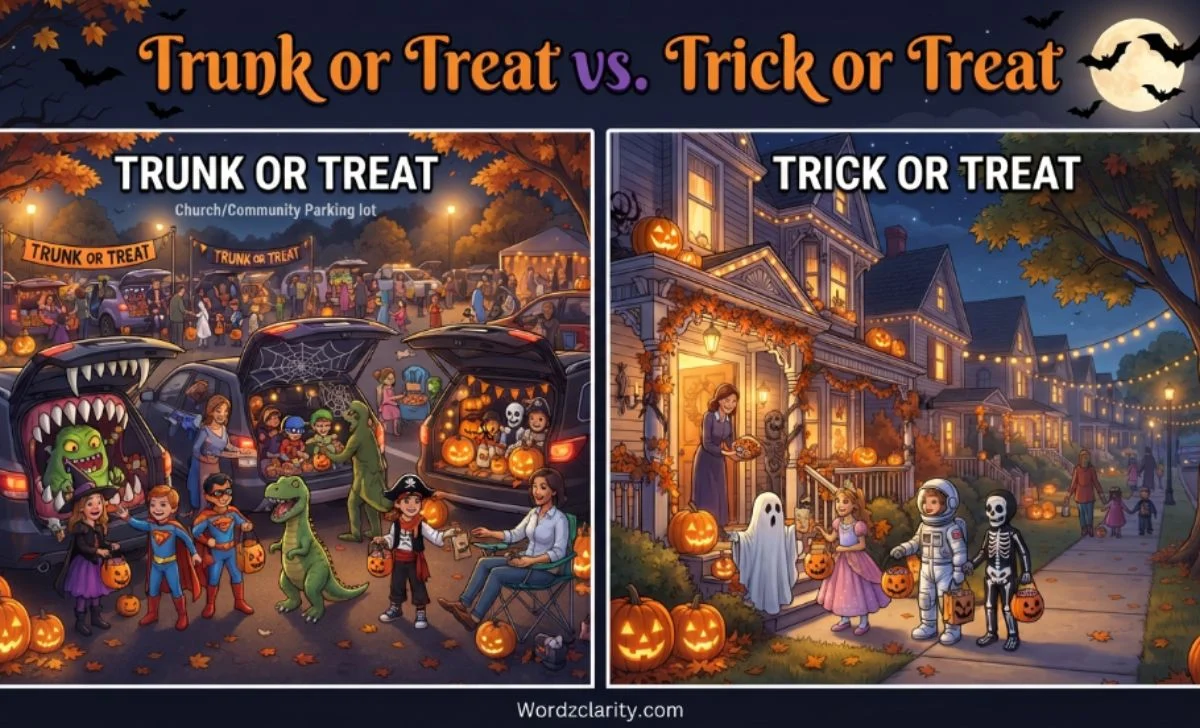
Halloween brings many familiar words and phrases, but trunk or treat and trick or treat can be confusing. They sound almost the same, and both involve costumes, children, candy, and Halloween fun. However, they describe two different ways of celebrating.
Trick or treat is the traditional Halloween activity in which children visit homes and ask for candy or other treats. Trunk or treat is a more organized event where children collect treats from decorated car trunks, usually in a parking lot or another central location.
In this guide, you will learn what both phrases mean, how they differ, where they came from, how to use them in writing, and which common forms are correct. You will also see clear examples so you can use trunk or treat and trick or treat naturally in everyday English.
Quick Answer
Trick or treat usually means going from house to house on Halloween to ask for candy.
The children went trick or treating around the neighborhood.
Trunk or treat usually means a planned Halloween event where children walk from one decorated vehicle to another and collect treats from the trunks.
The school is hosting a trunk or treat on Friday.
The simplest difference is:
| Trunk or Treat | Trick or Treat |
|---|---|
| Usually held in one central location | Usually takes place around a neighborhood |
| Children visit decorated cars | Children visit homes |
| Treats come from car trunks | Treats come from residents |
| Often an organized event | Usually a traditional Halloween activity |
| Common at schools, churches, and community events | Common in residential neighborhoods |
So, trunk or treat is not another spelling of trick or treat. They are related Halloween activities with different settings and formats.
What Does Trunk or Treat Mean?
Trunk or treat is a Halloween event where people gather in a designated place, park their cars, decorate their trunks, and hand out candy or other treats to children.
Instead of walking from house to house, children move from one decorated vehicle to another.
The name comes from the simple idea behind the event:
- Trunk refers to the rear storage area of a car.
- Treat refers to candy, sweets, or another small gift given to children.
A typical trunk-or-treat event may take place in a:
- School parking lot
- Church parking lot
- Community center
- Neighborhood gathering area
- Local organization’s event space
Some events include more than candy. Organizers may add games, music, prizes, costume contests, photographs, or other family activities.
Example of Trunk or Treat
Our church is holding a trunk or treat for local families.
The children loved visiting all the decorated cars at the trunk or treat.
The school’s trunk or treat will begin at 6 p.m.
The exact format can vary from one event to another, but the central idea remains the same: children collect treats from decorated vehicles at an organized Halloween gathering.
What Does Trick or Treat Mean?
Trick or treat is the traditional Halloween phrase associated with children visiting homes to ask for candy or other treats.
Children usually wear costumes and walk from house to house. When someone answers the door, they say:
“Trick or treat!”
The phrase refers to a playful choice between receiving a treat and facing a possible trick or prank.
Today, the phrase is generally understood as a traditional part of Halloween rather than a serious threat. The activity itself is commonly called trick-or-treating.
For example:
The children went trick-or-treating after dinner.
We bought extra candy for trick-or-treaters.
Several children came to our door and said, “Trick or treat!”
The traditional activity is usually house-to-house, which is the key difference between it and trunk or treat.
Trunk or Treat vs. Trick or Treat
Although both activities involve Halloween costumes and treats, the experience is different.
| Feature | Trunk or Treat | Trick or Treat |
|---|---|---|
| Main setting | Parking lot or central location | Neighborhood |
| Where children go | Car to car | House to house |
| Who gives the treats | Event participants | Homeowners or residents |
| Organization | Usually planned and scheduled | Often informal |
| Decorations | Car trunks and vehicles | Homes, yards, porches, and doors |
| Common hosts | Schools, churches, community groups | Neighborhood residents |
| Main movement | From one vehicle to another | From one home to another |
| Event atmosphere | Centralized gathering | Neighborhood activity |
The important point is that trunk or treat and trick or treat are not interchangeable terms.
If children walk around a neighborhood visiting homes, that is traditional trick-or-treating.
If families gather in one place and children visit decorated vehicles for candy, that is generally trunk or treat.
What Is the Main Difference Between Trunk or Treat and Trick or Treat?
The main difference is where children collect their treats.
With traditional trick-or-treating, children travel from house to house.
With trunk or treat, children usually stay in one organized location and travel from car to car.
For example:
Mia went trick-or-treating with her friends around the neighborhood.
Here, Mia is visiting homes.
Compare that with:
Mia went to the school’s trunk or treat on Saturday.
Here, the event is organized around decorated cars at the school.
Both activities can include costumes, candy, decorations, and Halloween games. The setting and organization are what make them different.
How Does a Trunk or Treat Event Work?
A trunk-or-treat event is usually simple.
1. Participants Bring Their Cars
Families, teachers, church members, volunteers, or community members bring vehicles to a designated location.
2. The Vehicles Are Decorated
Participants decorate their trunks and the areas around their cars. Some use simple Halloween decorations, while others create full themes.
3. Children Arrive in Costumes
Children attend the event wearing Halloween costumes, often with parents or other adults.
4. Children Visit Each Car
Instead of walking from house to house, children move around the parking area and visit the decorated vehicles.
5. Participants Hand Out Treats
People standing at the cars give children candy or other treats.
6. The Event May Include Other Activities
Depending on the organizer, a trunk or treat may also include:
- Games
- Music
- Costume contests
- Prizes
- Food
- Photos
- Crafts
- Family activities
This format makes trunk or treat more like a centralized Halloween event than a traditional neighborhood activity.
Why Do Churches and Schools Host Trunk or Treat?
Trunk or treat is often associated with churches, schools, and community organizations.
A central event allows organizers to bring many families together in one place. Instead of asking families to visit many individual homes, participants can gather at a scheduled time and location.
Churches may host trunk or treat as a community or family event. Schools can also use the format to create a Halloween celebration for students and families.
Common features include:
- Decorated cars
- Candy
- Costumes
- Games
- Music
- Family activities
- Community interaction
This does not mean every trunk-or-treat event is connected to a church or school. Neighborhood groups, businesses, and other organizations can host them too.
Where Did Trunk or Treat Come From?
Trunk or treat is a relatively modern Halloween tradition. It is generally described as an alternative to traditional trick-or-treating and became associated with organized events in the 1990s. Early events were particularly connected with churches and community groups.
There is no need to assign the tradition to one specific inventor. Its development is better understood as part of a broader shift toward organized Halloween gatherings.
The basic idea is simple: instead of sending children from house to house, families gather in one location and distribute treats from decorated vehicles.
Over time, the format spread beyond its early community and church settings. Schools, neighborhoods, and other organizations now use trunk or treat as a family-friendly Halloween event.
Where Did Trick or Treat Come From?
The history of trick-or-treating is older and more complex.
Historians connect the tradition with several older customs, including Celtic Halloween practices and medieval European traditions such as souling and guising. In these traditions, people could visit homes in costumes or disguise and receive food or other rewards.
The exact origin of the modern phrase “trick or treat” is not completely certain. Historical evidence shows that the phrase was in use in Canada by the early 20th century, with an important early printed example dating to 1917. Other sources identify 1927 as an early documented use connected clearly with Halloween.
The custom became increasingly popular in the United States during the 20th century. After World War II, the practice grew rapidly as candy became widely available and suburban neighborhoods made house-to-house visits easier.
So, while the modern activity is strongly associated with American Halloween, its background reflects several older traditions.
Why Do We Say “Trick or Treat”?
The phrase has two parts.
Treat refers to something given to the child, usually candy or another sweet.
Trick refers to the idea of a prank or mischief if no treat is provided.
Today, most children are not making a serious threat. The phrase has become a familiar and playful part of Halloween.
The historical meaning is more interesting, though. Older Halloween traditions included costumes, performances, requests for food, and forms of playful mischief. These customs likely influenced the development of modern trick-or-treating.
So the phrase is not simply a random combination of two Halloween words. It reflects the older idea of offering a treat in exchange for avoiding a trick or some form of mischief.
Trunk or Treat vs. Trick or Treat: Which Is Better?
There is no single answer.
The better choice depends on what kind of Halloween experience a family or community wants.
Why Some Families Prefer Trunk or Treat
A trunk-or-treat event can be attractive because it is:
- Centralized
- Organized
- Community-focused
- Easy to schedule
- Often suitable for group activities
Children can visit many decorated cars without traveling through an entire neighborhood.
Why Some Families Prefer Trick or Treat
Traditional trick-or-treating offers a different experience.
Children can:
- Walk around their neighborhood
- Visit different homes
- See Halloween decorations
- Spend time outdoors
- Experience a long-standing Halloween tradition
For many families, going from house to house is part of what makes Halloween feel like Halloween.
Can You Do Both?
Yes.
A family might attend a trunk-or-treat event and also go trick-or-treating later. One does not automatically replace the other.
The two activities can exist side by side.
Trunk or Treat, Trunk-or-Treat, or Trunk-or-Treating?
The spelling can change slightly depending on how the expression is used.
Trunk or Treat
Trunk or treat is the common form when referring to the event itself.
The school is hosting a trunk or treat.
We attended a trunk or treat last weekend.
Trunk-or-Treat
The hyphenated form can be useful when the expression works as a compound modifier before another noun.
The church planned a trunk-or-treat event.
We joined a trunk-or-treat celebration.
In general writing, trunk or treat is a clear choice when you are simply naming the event. The hyphenated form can help show that the entire expression modifies a following noun.
Trunk-or-Treating
Trunk-or-treating refers to the activity of taking part in a trunk-or-treat event.
The children enjoyed trunk-or-treating with their friends.
This is similar to the familiar form trick-or-treating.
Trick or Treat, Trick-or-Treat, or Trick-or-Treating?
The same basic distinction applies to trick or treat.
Trick or Treat
Use trick or treat when referring to the phrase children say.
The children shouted, “Trick or treat!”
Trick-or-Treat
The hyphenated form can be used when the expression functions as a compound modifier.
The town held a trick-or-treat event.
Trick-or-Treating
Use trick-or-treating for the activity.
We went trick-or-treating after sunset.
This distinction is useful because the phrase, the activity, and a compound modifier do not always function in the same grammatical way.
Common Mistakes to Avoid
1. Treating the Two Phrases as Synonyms
This is the biggest mistake.
Trunk or treat does not simply mean trick or treat.
They are related, but the activities are different.
2. Saying Trunk or Treat Always Happens at a Church
Churches often host these events, but they are not the only organizers.
Schools, neighborhoods, community groups, and other organizations can also host trunk or treats.
3. Assuming Trunk or Treat Is a Spelling Variant
It is not.
The word trunk changes the meaning of the expression. It refers to the vehicle trunk where treats are commonly distributed.
4. Confusing the Event With the Activity
You can say:
We attended a trunk or treat.
Or:
We went trunk-or-treating.
These forms refer to closely related ideas but have different grammatical functions.
5. Overusing the Hyphen
Do not automatically hyphenate every occurrence.
Use trunk or treat when naming or referring to the event in ordinary usage. A hyphenated form can be useful when the expression acts as a compound modifier.
Trunk or Treat Examples in Sentences
Here are natural examples from common situations.
Conversation
Are you taking the kids to the trunk or treat tonight?
School
The elementary school is hosting a trunk or treat for students and their families.
Church
Our church has a trunk or treat every October.
Community Event
The neighborhood association organized a trunk or treat in the community parking lot.
Website
Join us for our annual trunk or treat on October 30.
Social Media
We had so much fun at the school’s trunk or treat!
Business Writing
The company will sponsor a family-friendly trunk-or-treat event for local employees.
These examples show why the expression may appear with or without a hyphen depending on its grammatical role.
Trick or Treat Examples in Sentences
Conversation
Are the kids going trick-or-treating tonight?
Neighborhood
Several families went trick-or-treating after dinner.
Home
We bought two bags of candy for trick-or-treaters.
Website
Please leave your porch light on if you are welcoming trick-or-treaters.
Social Media
The kids had a great time trick-or-treating with their cousins.
News Writing
Local officials reminded families to stay alert while trick-or-treating.
Everyday Writing
We usually stay home and hand out candy on Halloween.
These examples show the difference between the phrase trick or treat and the activity trick-or-treating.
Is Trunk or Treat Replacing Trick or Treat?
Not necessarily.
Trunk or treat is better viewed as an alternative or additional Halloween activity rather than a universal replacement for traditional trick-or-treating.
Some families prefer a centralized event. Others prefer walking around their neighborhood. Some participate in both.
The choice can depend on the local community, event schedules, family preferences, and the type of Halloween celebration available.
Is Trunk or Treat Safer Than Trick or Treat?
A centralized trunk-or-treat event can make some parts of Halloween easier to organize because many families gather in one location. Organizers can manage the event area and plan activities in advance.
However, it is not accurate to say that every trunk or treat is automatically safer.
Parking lots involve vehicles, so organizers still need to manage traffic, walking areas, lighting, and adult supervision.
Traditional trick-or-treating also has its own safety considerations, including traffic, visibility, costumes, and supervision.
The safest option depends on how well the particular event or neighborhood is organized.
FAQs
Is trunk or treat the same as trick or treat?
No. Trick or treat traditionally involves visiting homes, while trunk or treat usually involves visiting decorated cars at an organized event.
Do kids say “trick or treat” at trunk or treat?
They often may. The phrase “trick or treat” is still the familiar Halloween expression used when children receive candy, even when the treats are being handed out at decorated vehicles.
Why is it called trunk or treat?
It is called trunk or treat because participants distribute treats from the trunks of decorated vehicles. The name is modeled on the familiar phrase trick or treat.
Where is trunk or treat usually held?
It is often held in a parking lot or another central location. Schools, churches, community groups, neighborhoods, and other organizations can host these events.
Is trunk or treat only for children?
Children are usually the main participants, but parents, guardians, volunteers, and other adults often take part in organizing, decorating vehicles, or handing out treats.
Can a school host a trunk or treat?
Yes. Schools can organize trunk-or-treat events for students and families. These events are often held in school parking areas or other designated spaces.
Is trunk or treat a new Halloween tradition?
Compared with traditional trick-or-treating, yes. Trunk-or-treating is a relatively modern practice, generally associated with organized events that became established in the 1990s.
Is trunk or treat replacing traditional trick or treat?
It can serve as an alternative, but it does not have to replace traditional trick-or-treating. Many communities and families use both formats.
Why do churches have trunk or treat?
Churches often use trunk or treat as a community and family event. It gives families a central place to gather, decorate cars, distribute treats, and enjoy Halloween activities.
Is “trunk or treats” correct?
The standard name of the event is trunk or treat, not trunk or treats. The word treat remains singular in the event name, following the model of trick or treat.
Conclusion
Trunk or treat and trick or treat are closely related Halloween expressions, but they do not mean the same thing. Trick or treat refers to the traditional house-to-house activity in which children visit homes, say “trick or treat,” and receive candy or other treats.
Trunk or treat is a more organized format in which children visit decorated vehicles, usually at one central location, and collect treats from car trunks.
The two traditions have different histories as well. Trick-or-treating developed from several older Halloween and European customs and became a widespread North American tradition during the 20th century.
Trunk or treat is much newer and is generally associated with organized community, school, and church events that became popular from the 1990s onward.
For everyday writing, remember the simple distinction: houses = trick or treat; decorated car trunks = trunk or treat. If you are describing the activity, trick-or-treating and trunk-or-treating are the natural forms. Neither expression is a spelling alternative for the other.
Read More Blogs
- Latter or Former: Meaning, Difference, Grammar, and Examples
- Amongst or Among: Meaning, Difference, and Correct Usage
- Bad Rap or Bad Rep: Meaning, Difference, and Correct Usage