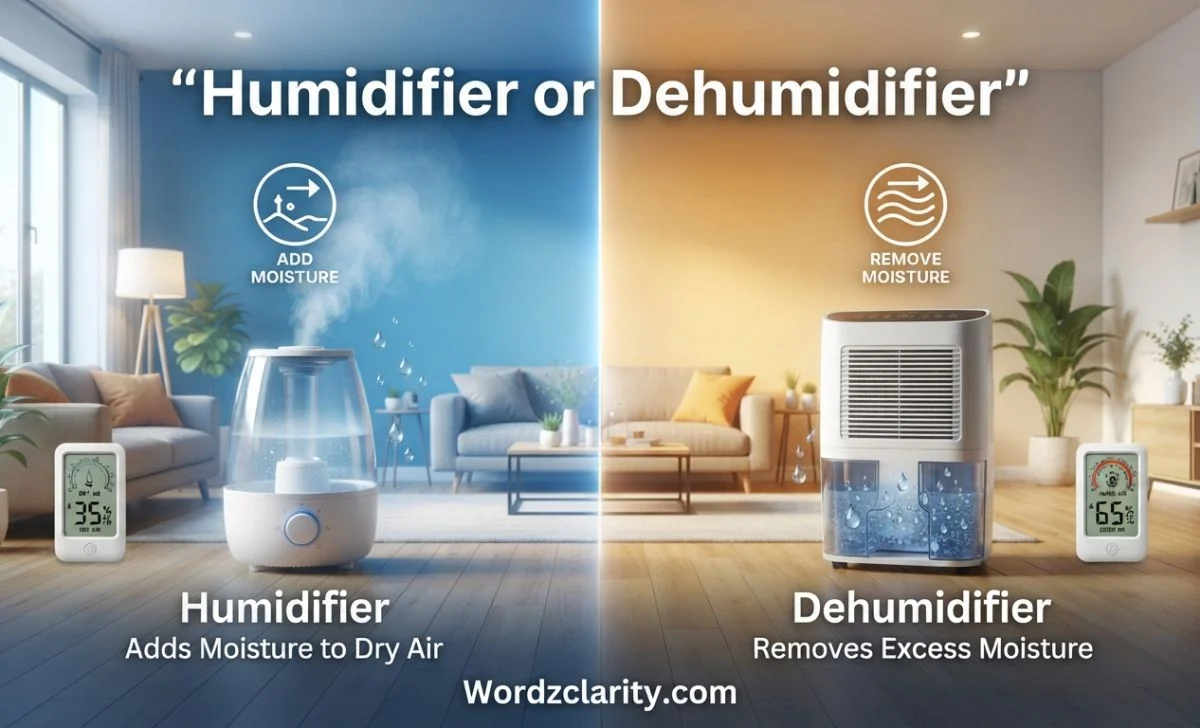
Your home can feel uncomfortable when the air is too dry or too damp. That is where a humidifier or dehumidifier can help. But these devices do opposite jobs, so choosing the wrong one may not solve the problem.
A humidifier adds moisture to indoor air, while a dehumidifier removes excess moisture. The right choice depends on your indoor humidity, the season, the room, and the problem you are trying to fix.
If you are wondering whether you need a humidifier or dehumidifier for a cough, stuffy nose, asthma, winter dryness, summer humidity, or mold, start by checking the humidity level. This guide explains the difference, common signs, seasonal uses, and how to choose the right option.
Quick Answer
A humidifier is generally useful when indoor air is too dry. It adds moisture to the air and may improve comfort when dry air irritates the nose, throat, skin, or sinuses.
A dehumidifier is useful when indoor air is too humid. It removes moisture and can help reduce dampness, condensation, and conditions that support mold and dust mites.
A good indoor humidity target for many homes is around 30% to 50% relative humidity (RH). A hygrometer can help you check the level instead of guessing.
| Problem | What to check | Possible choice |
|---|---|---|
| Dry nose or throat | Low humidity | Humidifier |
| Dry skin | Low humidity | Humidifier |
| Static electricity | Low humidity | Humidifier |
| Condensation on windows | High humidity | Dehumidifier or ventilation |
| Damp basement | High humidity | Dehumidifier |
| Musty smell | Moisture source | Dehumidifier + source control |
| Mold caused by damp conditions | High humidity/moisture | Dehumidifier + moisture control |
| Dust, pollen, or smoke | Airborne particles | Air purifier |
| Normal humidity | No clear humidity problem | You may need neither |
The important point is simple: do not choose a device based on a symptom alone. Check the humidity first.
Humidifier vs. Dehumidifier: What’s the Difference?
The main difference is what each device does to the moisture level in your home.
What Does a Humidifier Do?
A humidifier adds water vapor or moisture to indoor air.
It can be useful when heating systems or naturally dry conditions make indoor air uncomfortable. Low humidity may contribute to dry skin, irritated eyes, a dry nose, or throat discomfort.
Common humidifier types include:
- Cool-mist humidifiers
- Ultrasonic humidifiers
- Evaporative humidifiers
- Warm-mist humidifiers
- Steam vaporizers
- Whole-house humidifiers
For example:
The bedroom feels very dry during winter, so we use a humidifier at night.
The purpose is to increase humidity, not clean the air or remove moisture.
What Does a Dehumidifier Do?
A dehumidifier removes excess moisture from indoor air.
It can be helpful in damp basements, bathrooms, laundry areas, or homes with persistent humidity. High indoor humidity can contribute to condensation and create conditions that support mold and dust mites.
For example:
We installed a dehumidifier in the basement because the room felt damp and had a musty smell.
The purpose is to lower humidity.
Humidifier and Dehumidifier at a Glance
| Feature | Humidifier | Dehumidifier |
|---|---|---|
| Main job | Adds moisture | Removes moisture |
| Used for | Dry indoor air | Damp indoor air |
| Common setting | Dry bedroom | Damp basement |
| Helps with | Dryness and irritation | Moisture and condensation |
| Main concern | Too much humidity | Too little humidity |
| Useful measurement | Hygrometer | Hygrometer |
Think of them as opposite tools. One adds moisture; the other removes it.
What Humidity Level Should Your Home Have?
For many homes, indoor relative humidity around 30% to 50% is a useful target. Keeping humidity in this range can help avoid both very dry air and excessive moisture.
You do not need to guess the humidity based on how the room feels.
How to Measure Indoor Humidity
Use a small device called a hygrometer or humidity meter.
It tells you the relative humidity in the room.
For example:
- 25% RH: The air may be too dry.
- 40% RH: Often within a comfortable range.
- 50% RH: Near the upper end of the commonly recommended range.
- 65% RH: The room is quite humid and may need moisture control.
The exact level can vary with the home, climate, and individual needs. The measurement is still more useful than guessing.
If you plan to buy a humidifier or dehumidifier, a hygrometer is one of the simplest tools to have first.
Do You Need a Humidifier?
A humidifier may make sense when your indoor air is too dry.
Signs Your Air May Be Too Dry
Possible signs include:
- Dry or irritated nose
- Dry throat
- Dry skin
- Itchy or irritated eyes
- Cracked lips
- Static electricity
- Increased discomfort when indoor heating is running
Dry indoor air can irritate the nose and throat, and very dry conditions can contribute to problems such as bloody noses or cracked lips.
These signs do not prove that low humidity is the cause. A humidity reading can help confirm whether dry air is part of the problem.
When a Humidifier May Help
A humidifier may be useful when:
- Your indoor humidity is consistently low.
- The room feels dry during heating season.
- Your nose or throat feels irritated in dry indoor air.
- Your skin becomes uncomfortably dry indoors.
- Your home has a known low-humidity problem.
The goal is to bring humidity into a reasonable range rather than making the room as humid as possible.
Types of Humidifiers
Different humidifiers work in different ways.
Cool-mist humidifiers release cool moisture and are commonly used in bedrooms and living spaces.
Ultrasonic humidifiers use high-frequency vibrations to create a fine mist.
Evaporative humidifiers use a wet wick or filter and a fan to help water evaporate into the air.
Warm-mist humidifiers produce warm moisture.
Steam vaporizers heat water to create steam.
Regardless of type, maintenance matters. A poorly maintained humidifier can spread microorganisms or minerals into the air, especially some cool-mist and ultrasonic models.
Do You Need a Dehumidifier?
A dehumidifier may be useful when indoor humidity is too high.
Signs Your Air May Be Too Humid
Look for signs such as:
- Condensation on windows
- A damp feeling in the room
- Persistent musty odors
- Damp basement areas
- Visible moisture
- Mold growth linked to excess moisture
- Rooms that stay humid after showers
- Humidity readings above the recommended range
High indoor moisture can support mold and other biological growth. Common moisture sources include leaks, showers, cooking, basement seepage, and condensation.
When a Dehumidifier May Help
A dehumidifier can be useful when:
- A basement stays damp.
- A room has consistently high RH.
- Condensation keeps appearing.
- Humidity remains high after normal ventilation.
- You need help controlling indoor moisture.
However, a dehumidifier should not be the only response to a water leak or major moisture problem.
If water is entering through a roof, pipe, foundation, or other source, fix that source first.
Where Is a Dehumidifier Commonly Used?
Common locations include:
- Basements
- Bathrooms
- Laundry rooms
- Storage areas
- Damp bedrooms
- Humid living spaces
EPA guidance also recommends controlling moisture sources and keeping indoor humidity below 60%, with 30% to 50% being the preferred range in many homes.
Humidifier or Dehumidifier for a Cough?
There is no single answer for every cough.
If your indoor air is very dry, adding moisture with a humidifier may improve comfort. Mayo Clinic notes that a cool-mist humidifier may help ease a stuffy nose during a cold.
But if your home is already humid, adding more moisture may make the indoor environment worse.
A better approach is:
- Check the room’s humidity.
- If it is low, consider a humidifier.
- If it is high, do not add more moisture.
- Look for other possible causes of the cough.
- Seek medical advice if the cough is severe, persistent, or concerning.
A humidifier is not a treatment for the underlying cause of a cough.
Humidifier or Dehumidifier for a Stuffy Nose?
A stuffy nose can happen for many reasons, including colds, allergies, dry air, and nasal irritation.
When the air is dry, adding moisture may improve comfort. A humidifier can therefore make sense when a humidity reading shows that the room is too dry.
But a humidifier is not automatically the right answer.
If the room already has high humidity, adding more moisture can increase condensation and create conditions that support mold and dust mites.
So the useful question is not simply:
“Do I have a stuffy nose?”
It is:
“Is the air in my room too dry?”
That distinction can prevent you from choosing the wrong device.
Humidifier or Dehumidifier for Asthma, Allergies, or Flu?
These situations need a little more care.
Asthma
Humidity can affect indoor conditions linked to asthma triggers. Dust mites and mold can be important indoor triggers for some people. The CDC recommends keeping indoor humidity around 30% to 50% and notes that air conditioning or a dehumidifier can help control humidity when mold is a concern.
A humidifier should not be added simply because someone has asthma.
If you have asthma or significant allergies, discuss humidifier use with a healthcare professional, especially if symptoms change.
Allergies
High humidity can support dust mites and mold, while very dry air can irritate the nose and throat.
The best approach is to keep humidity within a reasonable range and address the specific trigger.
Flu
A humidifier may improve comfort when indoor air is dry, but it does not cure influenza.
If someone has flu symptoms, focus on appropriate medical care and general comfort measures rather than treating the humidifier as a flu treatment.
Humidifier or Dehumidifier for Winter?
Winter often creates a dry-air problem, especially indoors when heating systems are running.
You may notice:
- Dry skin
- Dry lips
- Dry nose
- Throat irritation
- Static electricity
- Dry indoor air
If your humidity reading is low, a humidifier may help bring moisture back into the room.
However, winter does not automatically mean you need a humidifier. A poorly insulated or poorly ventilated home can still have moisture problems.
Check the humidity before using either device.
Humidifier or Dehumidifier for Summer?
Summer can create the opposite problem in many climates.
Warm outdoor air, cooking, showers, poor ventilation, and moisture entering the home can increase indoor humidity.
Signs include:
- Sticky or damp air
- Condensation
- Musty smells
- Damp basement areas
- Mold linked to moisture
If humidity is high, a dehumidifier may help remove excess moisture.
Air conditioning can also reduce indoor moisture as part of the cooling process.
Do You Need a Humidifier, Dehumidifier, or Air Purifier?
These devices solve different problems, so they should not be treated as interchangeable.
Humidifier
Choose a humidifier when the main issue is low humidity.
Dehumidifier
Choose a dehumidifier when the main issue is excess humidity.
Air Purifier
An air purifier is designed to remove or reduce certain airborne particles, depending on its filtration system.
Common targets include:
- Dust
- Pollen
- Pet dander
- Smoke particles
- Other airborne particles
EPA describes source control and ventilation as important parts of indoor air quality, with air cleaning or filtration as a supplemental measure.
What If You Think You Need All Three?
You may not.
For example:
Dry air + dust:
A humidifier may address the humidity problem, while an air purifier may address airborne particles.
High humidity + mold concerns:
A dehumidifier and moisture control may be more relevant.
Normal humidity + airborne particles:
An air purifier may make more sense than either humidity device.
The first step is always to identify the actual indoor-air problem.
Can You Use a Humidifier and Dehumidifier in the Same Home?
Yes. A home can have different humidity conditions in different rooms.
For example:
- A dry upstairs bedroom may need humidity control.
- A damp basement may need dehumidification.
- A bathroom may need better ventilation.
However, using both devices in the same room at the same time can work against their purposes. One adds moisture while the other removes it.
If different areas of the home have different conditions, measure each area before deciding what it needs.
What Should You Check Before Buying Either One?
Buying a device should come after identifying the problem.
1. Check the Humidity
Use a hygrometer.
Do not rely only on how the room feels.
2. Look for a Moisture Source
If humidity is high, ask why.
Possible sources include:
- Leaking pipes
- Roof leaks
- Basement seepage
- Showers
- Cooking
- Wet laundry
- Poor ventilation
- Condensation
EPA recommends controlling moisture sources because uncontrolled moisture can support biological growth.
3. Check Ventilation
Bathroom and kitchen exhaust fans can help remove moisture and pollutants when properly vented outdoors.
Better ventilation may reduce the need for continuous dehumidification.
4. Consider the Room
A basement, bedroom, bathroom, and living room can have very different humidity conditions.
Do not assume the whole house has the same RH.
5. Consider the Season
Winter may bring dry indoor air because of heating.
Summer may bring higher humidity in some climates.
But the actual humidity reading matters more than the calendar.
Humidifier and Dehumidifier Maintenance
Maintenance is important for both types of equipment.
Humidifier Maintenance
A humidifier contains water, so the tank needs regular attention.
Follow the manufacturer’s instructions, and generally:
- Empty standing water regularly.
- Refill with clean water as directed.
- Clean the unit at the recommended intervals.
- Keep the area around it dry.
- Consider low-mineral or distilled water when appropriate for the model.
- Do not allow visible moisture to build up around the unit.
EPA guidance recommends regular cleaning and daily water changes for many portable humidifiers, along with following manufacturer instructions.
Too much humidity can also create problems. If you see condensation on windows or walls, reduce humidifier use or lower its setting.
Dehumidifier Maintenance
For a dehumidifier:
- Empty the water tank regularly.
- Clean the unit according to the manufacturer’s instructions.
- Keep filters clean when the model has a filter.
- Check the drain hose if using continuous drainage.
- Keep airflow areas clear.
- Watch for leaks or standing water.
A dehumidifier should help control moisture, not become another source of standing water.
Humidifier vs. Dehumidifier: Which One Do You Need?
Use this simple decision process:
Choose a Humidifier If:
- Your indoor RH is too low.
- The air feels unusually dry.
- Your nose or throat feels irritated by dry air.
- Your skin becomes very dry indoors.
- Winter heating has made the air noticeably dry.
Choose a Dehumidifier If:
- Your indoor RH is consistently high.
- You see frequent condensation.
- A basement feels damp.
- Your home has persistent musty odors.
- Moisture is contributing to mold growth.
Consider an Air Purifier If:
- Your humidity is already in a reasonable range.
- Your main concern is airborne dust or pollen.
- You want additional particle filtration.
You May Need Neither If:
- Your humidity is already in a comfortable range.
- There is no significant moisture problem.
- Your main concern is caused by something unrelated to indoor humidity.
The best choice starts with measurement rather than symptoms.
FAQs
Is a humidifier or dehumidifier better for a stuffy nose?
It depends on the humidity. If the air is too dry, a humidifier may improve comfort. If humidity is already high, adding more moisture is not a good idea.
Is a humidifier or dehumidifier better for asthma?
Neither is automatically better for everyone with asthma. Keeping indoor humidity around 30% to 50% can help limit conditions associated with dust mites and mold. People with asthma should consider their individual triggers and discuss humidifier use with a healthcare professional.
Should I use a humidifier or dehumidifier in winter?
Check the humidity first. Heated indoor air can become dry, which may make a humidifier useful. However, some homes can still have excessive moisture during winter.
Should I use a humidifier or dehumidifier in summer?
If indoor humidity is high, a dehumidifier may help. Air conditioning can also reduce moisture. A humidifier is generally not needed when the room is already humid.
Can a humidifier help with a cough?
It may improve comfort when dry air is irritating the nose or throat, but it does not treat every cause of cough. Check humidity before adding moisture.
Does a dehumidifier help with mold?
It can help control the moisture conditions that allow mold to grow. However, it does not replace fixing leaks, removing mold, or correcting the source of moisture.
Do I need an air purifier or a dehumidifier?
Choose based on the problem. A dehumidifier controls excess moisture. An air purifier is intended to reduce certain airborne particles. If you have both high humidity and airborne particles, you may need different solutions for each issue.
Conclusion
Choosing between a humidifier and dehumidifier becomes easier when you stop guessing and check the humidity first. A humidifier adds moisture when indoor air is too dry, while a dehumidifier removes moisture when indoor air is too damp. For many homes, keeping relative humidity around 30% to 50% is a useful target.
Your symptoms can provide clues, but they should not be the only reason you choose a device. A dry nose may point toward low humidity, while condensation or a musty basement may point toward excess moisture. An air purifier serves a different purpose by helping reduce certain airborne particles.
Before buying anything, measure the room, look for moisture sources, consider ventilation, and think about the season. This simple process can help you choose the device that addresses the actual indoor-air problem.
Read More Blogs
- Trunk or Treat vs. Trick or Treat: What’s the Difference?
- Hulu or Netflix: Which Is Better in 2026?
- Zelle or Venmo: Which Is Better for Sending Money?
- Olipop or Poppi: Which Prebiotic Soda Is Right for You?