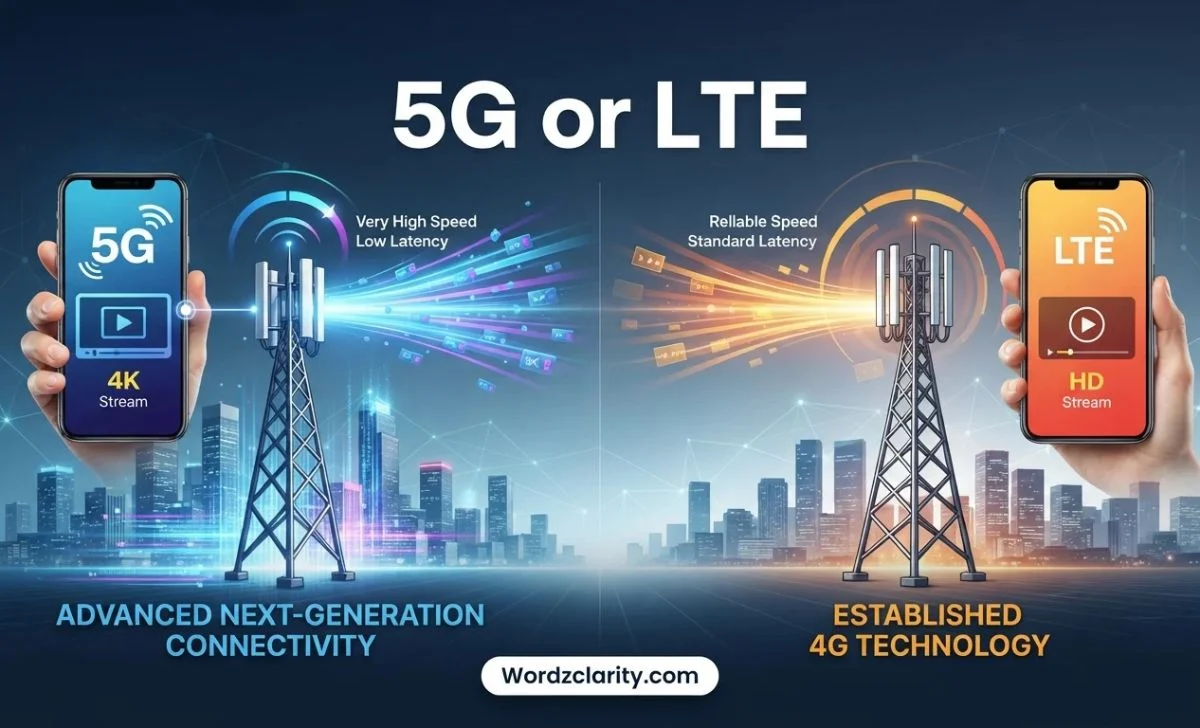
Seeing 5G or LTE at the top of your phone can raise a simple question: which one should you use? 5G is newer and can offer higher speeds and lower latency, but that does not mean it will always perform better than LTE.
Your location, signal strength, network coverage, carrier, phone, and network congestion can all affect the result. LTE is also not an outdated technology that suddenly becomes useless when 5G is available. In many places, it still provides a strong and reliable mobile connection.
The choice can also become confusing on an iPhone or Samsung Galaxy because phones may switch between 5G and LTE automatically. This guide explains 5G vs. LTE, 4G vs. LTE, speed, coverage, calls, hotspot use, battery life, phone settings, and when you may prefer one connection over the other.
Quick Answer
5G is the newer mobile network technology and can provide higher speeds, lower latency, and greater network capacity than LTE. LTE is a mature 4G technology with broad coverage and can still be fast enough for everyday mobile use.
So, 5G or LTE—which is better? There is no universal answer.
Use 5G when you have good 5G coverage and want higher performance for activities such as large downloads, high-quality streaming, or demanding hotspot use.
LTE can make more sense when 5G coverage is weak, when your phone keeps switching networks, or when you want a stable connection without needing the extra capacity of 5G.
For example:
- Strong 5G signal + good coverage: 5G may offer better performance.
- Weak 5G + strong LTE: LTE may feel faster and more reliable.
- Normal browsing and messaging: LTE may already be enough.
- Large downloads or busy networks: 5G may have an advantage.
- Battery concerns: a phone’s network mode and local signal conditions can affect battery use.
On iPhone, 5G Auto can automatically switch to LTE when 5G does not provide a noticeably better experience. Apple also provides an LTE-only option in cellular settings. (Apple Support)
5G vs. LTE: What Is the Difference?
The simplest difference is that LTE belongs to the 4G generation, while 5G is the next generation of cellular technology.
LTE stands for Long-Term Evolution. It became a major 4G mobile technology and is still widely used for mobile data and voice services.
5G uses 5G New Radio (5G NR) and introduces a newer radio system designed to support higher capacity, lower latency, and new network capabilities. 3GPP, the organization responsible for developing cellular standards, defines both standalone and non-standalone 5G deployments. (3GPP)
| Feature | LTE | 5G |
|---|---|---|
| Generation | 4G | 5G |
| Radio technology | LTE | 5G NR |
| Typical advantage | Mature coverage and reliability | Higher potential speed and capacity |
| Latency | Higher than 5G in comparable conditions | Lower potential latency |
| Coverage | Broad in many markets | Varies by band and location |
| Network architecture | LTE/EPC | 5G can use NSA or SA architecture |
| Devices | 4G/LTE phones | 5G-compatible phones |
| Everyday use | Browsing, calls, streaming, apps | Same uses plus higher-performance applications |
The word “potential” matters. A 5G connection is not automatically faster simply because the phone displays a 5G icon.
Is LTE the Same as 4G?
This is one of the most common questions in a LTE vs. 4G comparison.
In everyday phone use, you will often see 4G LTE used as a single label. That is why people often use “4G” and “LTE” as if they mean exactly the same thing.
Technically, however, 4G is a generation label, while LTE is a specific cellular technology within the evolution toward 4G networks.
You may therefore see:
- 4G
- 4G LTE
- LTE
- LTE-Advanced
- LTE-Advanced Pro
For most smartphone users, the practical point is simple: when your phone shows LTE, you are using an LTE cellular connection rather than a 5G NR connection.
LTE vs. 4G vs. 5G
| Term | What it refers to |
|---|---|
| 4G | Fourth-generation mobile networking |
| LTE | Long-Term Evolution cellular technology |
| 4G LTE | Common consumer label for LTE service |
| LTE-Advanced | More advanced LTE technology |
| 5G | Fifth-generation mobile networking |
| 5G NR | New Radio technology used for 5G |
This distinction becomes useful when comparing 4G vs. LTE vs. 5G because the terms are not all describing the same technical layer.
Is 5G Faster Than LTE?
5G can be faster than LTE, but actual speed depends on the network.
A 5G connection may deliver much higher download and upload speeds when the carrier has suitable spectrum, strong coverage, sufficient capacity, and a compatible device.
But real-world speed is affected by:
- Signal strength
- Distance from the cell site
- Spectrum band
- Network congestion
- Carrier configuration
- Phone modem
- Number of connected users
- Indoor or outdoor location
- Network architecture
This explains why someone can sometimes see LTE faster than 5G on a speed test.
For example, imagine two connections:
5G: weak signal, crowded cell, 20 Mbps
LTE: strong signal, less congestion, 80 Mbps
The LTE connection is faster in that situation even though 5G has higher theoretical potential.
So the better question is not simply:
“Is 5G faster than LTE?”
It is:
“Which network is performing better where I am right now?”
Why Is My LTE Sometimes Faster Than 5G?
This is a common reason people search for “why is LTE faster than 5G?”
A few things can cause it.
Weak 5G Signal
A weak 5G signal can reduce performance. Your phone may also move between 5G and LTE as network conditions change.
5G Network Congestion
If many people are using the same 5G cell, available capacity can be shared among users.
Different Spectrum Bands
Not all 5G is the same.
A low-band 5G connection can provide wide coverage but may not deliver the same speeds as some mid-band or higher-frequency deployments.
Stronger LTE Coverage
Your phone might be connected to a strong LTE signal while receiving a weaker 5G signal.
This is one reason a phone can display LTE even though 5G is available somewhere in the area.
Samsung explains that Galaxy phones can fall back to 4G/LTE when 5G is unavailable or outside 5G coverage. (Samsung pl)
5G Coverage vs. LTE Coverage
Coverage is one of the biggest differences between 5G and LTE.
LTE networks have been deployed for many years, so they can provide broad coverage in many markets.
5G coverage is expanding, but its performance varies greatly depending on the spectrum being used.
Low-Band 5G
Low-band 5G generally travels farther and can provide wider coverage.
It can be useful for broad-area mobile service, but its speed advantage over LTE may be smaller than users expect.
Mid-Band 5G
Mid-band 5G offers a useful balance between coverage and capacity.
This is one reason it is important when discussing real-world 5G performance.
mmWave 5G
High-frequency millimeter-wave (mmWave) 5G can provide very high capacity and speed, but its range and ability to penetrate obstacles are more limited.
This means the 5G icon does not tell you which type of 5G you are using.
What Is 5G NR?
5G NR means 5G New Radio.
It is the radio access technology developed for 5G networks.
Compared with LTE, 5G NR supports different frequency ranges, wider channel configurations, flexible numerology, and other capabilities designed for the 5G system. 3GPP documentation describes 5G NR support across sub-6 GHz and mmWave frequency ranges. (3GPP)
You do not normally need to understand NR to use a 5G phone.
But the term matters when reading technical specifications because:
5G = the broader generation/system
5G NR = the radio technology used for 5G
5G NSA vs. 5G SA
You may also see 5G NSA and 5G SA.
5G NSA
NSA means Non-Standalone.
An NSA 5G network can use LTE infrastructure as an anchor while adding 5G NR for additional capacity or performance. 3GPP describes NSA 5G as using an LTE anchor alongside 5G NR. (3GPP)
5G SA
SA means Standalone.
A standalone 5G network uses 5G NR with a 5G Core rather than relying on the LTE core in the same way as NSA.
| Type | Main idea |
|---|---|
| 5G NSA | 5G NR works with LTE infrastructure |
| 5G SA | 5G NR works with a 5G Core |
| LTE | Uses LTE radio and LTE network architecture |
This distinction is mostly important for understanding network architecture. Most phone users do not need to change anything manually.
5G or LTE for Phone Calls?
If you are asking “Is 5G or LTE better for phone calls?”, the answer is more complicated than simply choosing the newer network.
Modern mobile voice can use technologies such as:
- VoLTE — Voice over LTE
- VoNR — Voice over New Radio
- IMS
- Wi-Fi Calling
- EPS fallback
The exact voice setup depends on the carrier, device, and network.
For example, a phone may use 5G for mobile data while voice service relies on LTE-based technology in some network configurations.
This is one reason you may notice the network indicator change during a call.
The important point is that 5G does not automatically mean better call quality. Call quality depends on the carrier’s voice network, signal, device, and connection conditions.
5G or LTE for Hotspot?
For a mobile hotspot, 5G can provide a major advantage when good 5G coverage is available.
A hotspot shares your phone’s mobile connection with other devices, such as:
- Laptop
- Tablet
- Smart TV
- Another phone
- Gaming device
Higher 5G capacity and speed can make large downloads, video calls, cloud work, and streaming more comfortable.
But LTE can still work well for hotspot use.
For example:
Strong 5G:
Good choice for large files, video meetings, and high-bandwidth use.
Weak 5G:
LTE may provide a more stable connection if its signal is stronger.
Strong LTE:
Often enough for email, web browsing, documents, and moderate streaming.
Apple’s iPhone support documentation also lists Personal Hotspot among supported cellular features, with availability depending on the carrier and region. (Apple Support)
5G or LTE for Battery?
Battery life is another reason users ask whether they should use 5G or LTE for battery.
5G can sometimes increase battery use, but there is no simple rule that says 5G always drains a phone faster.
Battery behavior can depend on:
- 5G signal strength
- Network conditions
- Phone modem
- Background activity
- Data usage
- How often the phone searches for networks
- Whether the phone is connected to multiple network technologies
Samsung notes that some Galaxy phones can experience increased battery use when maintaining 5G alongside LTE or other network connections, depending on the network configuration. (Samsung pl)
On iPhone, Apple offers 5G Auto, which can switch to LTE when 5G speeds do not provide a noticeably better experience, helping optimize battery life. (Apple Support)
So if battery life is your main concern, using an automatic network mode may be more practical than forcing one network all the time.
5G or LTE on iPhone
The choice is especially common for iPhone users because iOS provides several cellular options.
On supported iPhones, Apple provides settings such as:
- 5G Auto
- 5G On
- LTE
With 5G Auto, the iPhone can switch to LTE when 5G does not offer a noticeable performance benefit. With the LTE option, you can turn off 5G cellular use. (Apple Support)
Should You Use 5G or LTE on iPhone?
If your carrier has strong 5G coverage, 5G Auto is often a practical setting because the phone can decide when 5G provides a useful benefit.
You may consider LTE when:
- 5G coverage is weak in your area.
- Your phone keeps switching between 5G and LTE.
- You are trying to reduce network-related battery use.
- LTE provides a more stable connection where you live or work.
The exact settings and available options can vary by iPhone model, carrier, and region.
5G or LTE on Samsung Galaxy
Samsung Galaxy phones also support network mode settings that can allow the phone to move between available networks.
On supported Galaxy devices, you can generally find network settings through:
Settings → Connections → Mobile Networks → Network Mode
The available choices vary by model, software, carrier, and region. Samsung’s current support guidance explains that users can switch between network modes such as 5G, 4G, 3G, and 2G on supported Galaxy devices. (Samsung pl)
Why Does Samsung Switch From 5G to LTE?
This can happen when:
- 5G coverage becomes weak.
- You move outside a 5G service area.
- LTE provides a better available connection.
- The carrier manages the connection automatically.
- Local network conditions change.
Samsung notes that Galaxy phones can automatically revert to 4G/LTE when 5G is unavailable. (Samsung pl)
So seeing LTE on a 5G phone does not necessarily mean something is wrong.
Why Does My Phone Switch Between 5G and LTE?
Automatic switching is normal on many phones.
Your phone constantly evaluates available network conditions.
It may choose LTE when:
- 5G signal becomes weak.
- You leave the 5G coverage area.
- LTE offers a better connection.
- Your device is using an automatic network mode.
- The carrier’s network configuration directs the phone to another connection.
For example, you might see:
Outside: 5G
Inside a building: LTE
Back outdoors: 5G
Walls, distance, spectrum, network load, and signal conditions can all affect the connection.
5G or LTE for Everyday Use?
For normal smartphone activities, both can be sufficient.
Web Browsing
LTE is usually capable of handling websites, searches, email, and ordinary browsing.
5G can make heavy pages or downloads load faster when the connection is strong.
Social Media
Both can handle social media apps comfortably.
The difference may become more noticeable when apps load large videos or high-resolution media.
Video Streaming
LTE can support common streaming activities.
5G can provide additional bandwidth for higher-quality video and faster downloads, especially when the network is not congested.
Online Gaming
Gaming depends heavily on latency and connection stability, not just download speed.
A strong LTE connection can sometimes provide a better gaming experience than weak or congested 5G.
Video Calls
Both LTE and 5G can support video calls.
For a video meeting, stable connectivity may matter more than having the highest possible download speed.
5G vs. LTE: Speed, Latency, Coverage, and Battery
| Factor | 5G | LTE |
|---|---|---|
| Speed | Higher potential | Usually lower potential |
| Latency | Lower potential | Generally higher |
| Coverage | Depends heavily on band and deployment | Broad and mature in many areas |
| Capacity | Designed for higher capacity | Mature capacity |
| Battery | Depends on device and signal | Can be efficient in strong coverage |
| Gaming | Strong 5G can help | Strong LTE can still work well |
| Hotspot | Excellent with strong 5G | Good for many uses |
| Calls | Depends on voice network | Mature VoLTE support in many networks |
| Everyday use | Very capable | Still sufficient for many users |
This table should not be read as a guarantee. Actual network performance matters more than the label on the status bar.
What Is Carrier Aggregation?
Carrier aggregation combines multiple component carriers to increase available bandwidth.
It became an important part of LTE-Advanced and also exists in modern 5G network designs.
In simple terms, instead of relying on only one slice of spectrum, the network can combine multiple carriers.
This can improve:
- Throughput
- Network capacity
- Download speeds
- Upload performance
It is one reason an advanced LTE connection can perform much better than someone might expect from simply seeing “LTE.”
Why Signal Strength Matters More Than the 5G Icon
The network label alone does not tell the full story.
A strong LTE connection can outperform a weak 5G connection.
Imagine:
| Connection | Signal | Congestion | Result |
|---|---|---|---|
| 5G | Weak | High | May feel slow |
| LTE | Strong | Low | May feel faster |
| 5G | Strong | Low | Potentially excellent |
| LTE | Strong | High | Performance may drop |
This is why running a speed test in the same location can be more useful than comparing the network icons.
Should You Turn Off 5G?
You do not necessarily need to turn off 5G.
Keeping 5G enabled can make sense if:
- Your area has strong 5G coverage.
- You use large amounts of mobile data.
- You often download large files.
- You use your phone as a hotspot.
- You benefit from lower latency.
- Your phone handles 5G efficiently.
LTE may make more sense if:
- 5G coverage is poor.
- Your phone frequently switches between networks.
- LTE is more stable in your usual locations.
- You want to limit unnecessary 5G use.
On iPhone, 5G Auto is designed specifically to let the phone use LTE when 5G does not provide a noticeable benefit. (Apple Support)
Common 5G and LTE Mistakes
Mistake 1: Assuming 5G Is Always Faster
5G has higher potential performance, but real-world results vary.
Better approach: Compare actual speed and stability in your location.
Mistake 2: Thinking LTE Means a Bad Connection
LTE is still a capable 4G technology.
Better approach: Look at performance rather than the network label alone.
Mistake 3: Assuming 5G Means Better Calls
5G data and voice services are not exactly the same thing.
Better approach: Consider VoLTE, VoNR, carrier support, and signal quality.
Mistake 4: Forcing 5G Everywhere
If 5G coverage is weak, forcing 5G may not improve your experience.
Better approach: Use automatic network selection when appropriate.
Mistake 5: Ignoring the Phone
A carrier may offer 5G, but your phone must support the required 5G bands and network features.
Better approach: Check your specific phone model and carrier compatibility.
How to Choose Between 5G and LTE
Use this simple checklist.
Choose 5G When:
- You have strong 5G coverage.
- Your phone supports the available 5G bands.
- You want faster downloads.
- You use a mobile hotspot frequently.
- You stream high-quality video.
- You need higher network capacity.
- Your local 5G network performs well.
Choose LTE When:
- LTE has stronger coverage where you use your phone.
- Your 5G signal is weak.
- LTE is more stable in your area.
- Your everyday use does not require high speeds.
- You want to avoid unnecessary network switching.
Use Automatic Network Selection When:
You move between areas with different levels of 5G and LTE coverage.
This is often the easiest option because your phone can select an available network based on its settings and network conditions.
FAQs
Is 5G better than LTE?
5G offers higher potential speed, lower latency, and greater capacity, but it is not always better in every location. A strong LTE connection can outperform weak or congested 5G.
Is LTE still good in 2026?
Yes. LTE remains useful for everyday activities such as browsing, messaging, streaming, calls, and many other mobile tasks. Its usefulness depends on the carrier and coverage in your area.
Why does my iPhone say LTE instead of 5G?
Your iPhone may be outside 5G coverage, have 5G unavailable at that moment, or be using a setting such as 5G Auto. Apple says 5G Auto can switch the iPhone to LTE when 5G does not provide a noticeably better experience. (Apple Support)
Why does my Samsung switch from 5G to LTE?
Samsung Galaxy phones can automatically switch between available network technologies. If 5G is unavailable or its coverage becomes weak, the phone may use LTE instead. (Samsung pl)
Is 5G or LTE better for battery life?
It depends on the phone and network conditions. 5G can use more battery in some situations, particularly when the phone maintains multiple network connections or works with weak coverage. Automatic network modes can help manage this.
Is 5G or LTE better for hotspot?
A strong 5G connection can provide faster hotspot performance and more capacity. However, strong LTE can be better than weak or congested 5G. The actual connection matters more than the network name.
Is 5G or LTE better for phone calls?
Neither is automatically better for every call. Voice quality depends on the carrier’s voice technology, signal strength, device, and network. VoLTE and VoNR are examples of technologies used for cellular voice services.
Conclusion
Choosing between 5G or LTE is not simply a matter of picking the newer technology. 5G can provide higher speeds, lower latency, and greater capacity, while LTE remains a mature and widely useful 4G technology. The best option depends on your phone, carrier, location, signal strength, network congestion, and the type of activity you are doing.
For iPhone users, 5G Auto can provide a practical balance by allowing the phone to use LTE when 5G offers little noticeable benefit. Samsung Galaxy users can also use automatic network modes where supported. Strong 5G can be valuable for large downloads, high-quality streaming, gaming, and hotspot use. Strong LTE can still be more reliable than weak 5G.
If you are unsure, start with automatic network selection and check your actual connection. The best network is the one that gives you the speed, stability, coverage, and battery performance you need where you use your phone.
Read More Blogs
- Madame or Madam: Meaning, Spelling, and Usage Explained
- Zelle or Venmo: Which Is Better for Sending Money?
- 401(k) vs. IRA: Contribution Limits, Taxes, Fees, and Withdrawals
- Flakey or Flaky: Which Spelling Is Correct?