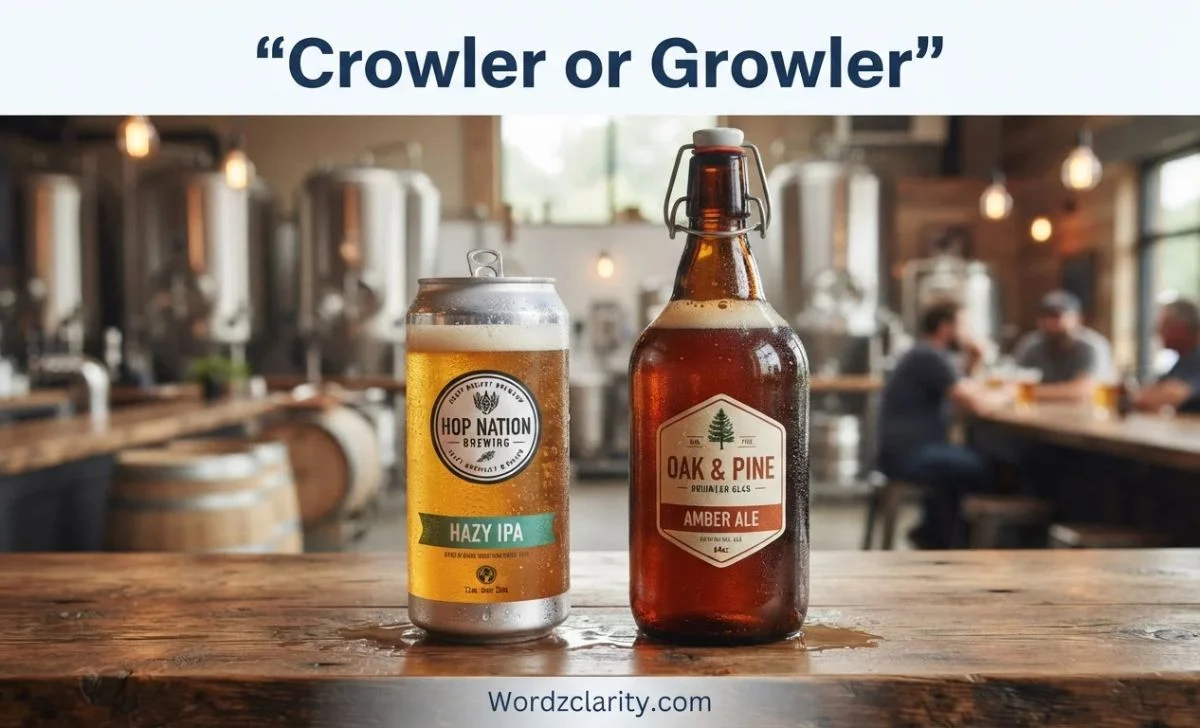
If you have ever ordered draft beer to take home, you may have heard the terms crowler and growler.They sound similar. So, what is the difference between a crowler and a growler?
The short answer is simple: a crowler is usually a large, sealed can filled with draft beer, while a growler is a reusable container, often made of glass, stainless steel, or ceramic, that holds draft beer. Both can be good choices, but they differ in size, packaging, reuse, storage, and convenience.
You may also come across the term howler, which is another smaller beer container. This can make the comparison even more confusing.
In this guide, you will learn what crowler and growler mean, how they differ, how much beer they hold, why a growler has that name, what a howler is, and which option may work better for different situations.
Quick Answer
Crowler and growler are both containers for taking draft beer home. However, they are different.
A crowler is usually a large aluminum can. A brewery or taproom fills the can with draft beer and seals it. It looks like a regular beer can.
A growler is usually a reusable container for draft beer. Glass growlers are common. Stainless steel and other materials are also available.
| Feature | Crowler | Growler |
|---|---|---|
| Typical material | Aluminum | Glass, stainless steel, ceramic, or other materials |
| Common use | Take-home draft beer | Take-home draft beer |
| Usually reusable? | Usually no | Yes |
| Sealing | Sealed like a can | Cap or stopper |
| Common sizes | Often around 32 oz | Often 32 oz or 64 oz |
| Light protection | Excellent | Depends on material |
| Easy to recycle | Yes, where accepted | Usually reused |
| Main advantage | Sealed and convenient | Reusable and refillable |
For example:
- “I bought a crowler of IPA from the brewery.”
- “I filled my growler with the new stout.”
Both sentences are natural when referring to draft beer containers.
What Is a Crowler?
A crowler is a large can used to package draft beer for take-home use. Instead of pouring beer into a traditional glass growler, a brewery or taproom fills a can from the tap and seals it.
The word crowler combines the ideas of a can and a growler. The result is a beer container that has the portability and sealing benefits of a can while serving the same basic purpose as a growler.
Crowlers became popular as craft breweries looked for convenient ways to package fresh draft beer for customers. Oskar Blues Brewery describes its history of canning beer and currently uses the term “Crowler” for draft-beer fills at its taprooms.
What does a crowler can look like?
A crowler generally looks like a large aluminum beer can. The main difference is that the brewery fills and seals it after you select a beer.
A typical process looks like this:
- You choose a beer from the tap.
- The staff prepares a clean crowler can.
- You take the sealed beer home.
This makes a crowler especially useful when you want fresh draft beer without carrying a glass container.
Is a crowler just a can?
Not exactly.
A crowler is a type of can used for draft beer, but it is not simply the same as buying a regular packaged beer can from a store.
What Is a Growler?
A growler is a reusable container for draft beer.
Modern growlers also come in stainless steel, ceramic, and other materials. A growler has a cap or closure.
Growlers are especially popular with people who regularly buy beer from local breweries and want to refill the same container.
For example:
“The brewery filled my growler with their seasonal IPA.”
Here, growler refers to the container, not the beer itself.
How does a growler work?
A typical growler process is simple:
- Bring or buy a suitable growler.
- Choose a beer from the tap.
- The brewery fills the container.
- You take it home and refrigerate it.
Crowler vs. Growler: Key Differences
1. Material
The main visual difference is the material.
A crowler is usually an aluminum can.
- Glass
- Stainless steel
- Ceramic
- Other food-safe materials
The material affects weight, durability, light exposure, and cleaning.
2. Reusability
After you finish the beer, you can clean the growler and use it again. However, the brewery must accept that type of container.
Crowlers are usually single-use containers. After opening a crowler, you normally recycle the can instead of washing and refilling it.
3. Sealing
A crowler uses a can lid to seal the beer.
A growler uses a removable cap or closure.
A good seal helps protect the beer from oxygen. A sealed crowler is also easy to carry without opening the container.
4. Portability
Crowlers are easy to carry. They have a shape similar to large cans.
Glass growlers can be heavier and more fragile. Stainless steel growlers are often lighter and more durable than glass.
5. Light Exposure
Light can affect some beers, especially after long exposure.
An aluminum crowler blocks light. A glass growler may let light through. Some glass growlers have designs that offer more protection.
A crowler does not always keep beer fresh longer than a growler. Several factors can affect freshness, including the filling method, seal, temperature, oxygen exposure, and storage time.
Crowler Size vs. Growler Size
One common search question is “crowler size vs growler.”
There is no single universal size for every brewery, but some sizes are common.
A crowler is often around 32 ounces, while a traditional growler is commonly around 64 ounces.
That means a standard 64-ounce growler holds about twice as much beer as a 32-ounce crowler.
However, breweries may offer different sizes, so it is always best to check the container before ordering.
| Container | Common size | Approximate amount |
|---|---|---|
| Howler | 32 oz or smaller | About 2 pints |
| Crowler | 32 oz | About 2 pints |
| Growler | 64 oz | About 4 pints |
A 32-ounce crowler can be a good choice when you want a smaller amount. A 64-ounce growler makes more sense when you want enough beer to share or drink over a longer period.
Crowler vs. Growler vs. Howler
If you searched “growler vs crowler vs howler,” you may be wondering where the third term fits.
A howler is generally a smaller beer container.
The names can be confusing because breweries do not always use them in exactly the same way.
| Term | General meaning | Common purpose |
|---|---|---|
| Crowler | Large sealed beer can | Take-home draft beer |
| Growler | Reusable beer container | Take-home draft beer |
| Howler | Smaller beer container | Smaller take-home beer amount |
The most important distinction is usually crowler vs. growler, because these represent two different packaging styles.
Why Is It Called a Growler?
The origin of the word growler is less straightforward than its modern use.
Several stories have been told about why beer containers became known as growlers. One popular explanation connects the name to the sound or noise made when beer or carbonation moved inside the container. Other historical explanations have also been suggested.
Because the historical record is not perfectly settled, it is better not to present one popular story as an absolute fact.
Today, however, the meaning is clear: a growler is a container used to carry draft beer.
The word has become part of craft-beer vocabulary, even though growler can also have unrelated meanings in other contexts.
Where Did the Word “Crowler” Come From?
The term crowler is much more directly connected to the idea of combining a can with a growler.
Oskar Blues has played an important role in the development and popular use of canned craft beer. The brewery’s history describes its early move into cans and its continuing use of crowlers for beer-to-go.
The word therefore makes sense as a blend:
can + growler = crowler
A crowler keeps the basic purpose of a growler , taking draft beer home , while using a sealed can instead of a reusable bottle-style container.
Which Is Better: Crowler or Growler?
There is no single winner.
The better choice depends on what matters most to you.
Choose a crowler if you want:
- A sealed container
- Easy portability
- Good protection from light
- No need to return the container
- A smaller amount of beer
- A convenient option for travel or outdoor activities
A crowler can also be useful if you do not want to clean and store another container at home.
Choose a growler if you want:
- A reusable container
- Regular brewery refills
- A larger quantity of beer
- A long-term container
- A glass or stainless-steel option
- Less dependence on single-use packaging
A stainless-steel growler can be especially useful for people who frequently visit breweries and want a durable container.
Does a Crowler Keep Beer Fresher Than a Growler?
This question is more complicated than simply saying one container is always better.
Beer freshness depends on several factors, including:
- Oxygen exposure
- How the container was filledHow
- well the container was sealed
- Storage temperature
- Exposure to light
- The type of beer
A properly sealed crowler can offer strong protection from light and outside air.
For either container, the safest practical approach is to keep the beer cold and drink it promptly after opening.
Do not assume that a crowler or growler will keep beer fresh indefinitely.
Are Crowlers Reusable?
Usually, no.
Crowlers are generally designed as sealed cans for take-home beer. After you open one, it is normally recycled according to local recycling rules.
Some specialized systems may use different packaging or refillable containers, but you should not assume that an ordinary crowler is intended for repeated refilling.
If you want a container specifically for repeated use, a growler is usually the more suitable choice.
Are Growlers Reusable?
Yes. Growlers are generally designed to be reusable.
You can wash and dry the container and return it to a brewery for another fill if that brewery accepts it.
Good cleaning matters. Beer residue left inside a growler can affect the next fill and may create unpleasant flavors or odors.
For the best results:
- Empty the growler soon after drinking.
- Rinse it thoroughly.
- Wash it according to the container manufacturer’s guidance.
- Let it dry completely.
- Store it clean and ready for the next fill.
A clean growler is much more useful than one that has old beer residue sitting inside it.
Crowler or Growler for Beer: Which Should You Choose?
If you are standing at a brewery and cannot decide, think about your immediate needs.
For a short trip
A crowler is easy to carry because it is sealed.
For sharing
A larger growler may make more sense if you want more beer for several people.
For regular brewery visits
A reusable growler can be a practical choice.
For outdoor activities
A sealed crowler can be easier to transport, especially when you do not want to carry a glass container.
For light-sensitive beer
An opaque container such as an aluminum crowler can provide strong protection from light.
For long-term reuse
A stainless-steel or glass growler is usually the better fit.
Common Mistakes With “Crowler” and “Growler”
Because the words sound similar, people sometimes mix them up.
Mistake 1: Treating them as exact synonyms
A crowler and a growler serve a similar purpose, but they are not identical containers.
Better: Use crowler for the sealed can and growler for the reusable beer container.
Mistake 2: Assuming every growler is glass
Glass is common, but it is not the only option.
Remember that growlers also come in stainless steel, ceramic, and other materials.
Mistake 3: Assuming every crowler is the same size
There is no reason to assume every brewery uses exactly the same capacity.
Better: Check the labeled size before buying.
Mistake 4: Thinking “growler” means the beer itself
A growler is the container, not a particular style of beer.
You can put different types of draft beer into a growler.
Mistake 5: Assuming a crowler and a regular beer can are identical
A crowler is a can, but the term usually refers to a can that is filled with draft beer for take-home use.
Crowler and Growler Examples in Real-World Writing
Seeing the words in context makes the difference easier to remember.
Everyday conversation
- “Should we get a crowler before we leave?”
- “I brought my growler to the brewery.”
- “They have a new IPA available in crowlers.”
- “Can you fill my growler with the stout?”
Business or brewery website
- “Crowlers are available for select beers.”
- “Please bring a clean growler for refills.”
- “Growler fills are available during taproom hours.”
- “Ask our staff about today’s crowler options.”
Social media
- “Picked up a crowler of my favorite IPA today.”
- “This weekend’s growler fill is a new hazy pale ale.”
Reviews
- “The brewery offers both crowler and growler options.”
- “I chose a crowler because it was easier to transport.”
Customer question
- “How much does a crowler hold?”
- “Do you fill outside growlers?”
- “Can I bring my own growler?”
These examples show that both terms are normal English words in the context of craft beer.
Crowler or Growler: Plural Forms
The plural forms are straightforward:
- One crowler → two crowlers
- One growler → two growlers
- One howler → two howlers
Examples:
- “The brewery sells several crowlers each weekend.”
- “We brought two growlers to the taproom.”
- “The shop offers different sizes of howlers.”
There is no need to add an apostrophe when making these words plural.
Is “Crowler” or “Growler” the Correct Spelling?
Both crowler and growler are correct spellings, but they refer to different things.
This is not a case of one spelling being American English and the other being British English. They are separate words with different meanings.
Use crowler when you mean the sealed can used for draft beer.
Use growler when you mean the reusable container used for draft beer.
So, if someone asks:
“Is it crowler or growler?”
The best answer is:
Both are correct. The right word depends on the type of container you mean.
That distinction is important because changing one letter changes the meaning.
Crowler vs. Growler at a Glance
| Question | Crowler | Growler |
|---|---|---|
| Is it a beer container? | Yes | Yes |
| Used for draft beer? | Yes | Yes |
| Usually made of aluminum? | Yes | No |
| Usually reusable? | No | Yes |
| Often made of glass? | No | Yes |
| Often made of stainless steel? | Sometimes, but not typical | Yes |
| Usually sealed after filling? | Yes | Yes, with a cap |
| Commonly around 32 oz? | Yes | Some are |
| Commonly around 64 oz? | Less typical | Yes |
| Good for regular refills? | Usually no | Yes |
| Protects beer from light? | Very well | Depends on material |
Practical Tips for Choosing Between Them
When choosing between a crowler and a growler, ask yourself these questions:
1. How much beer do I need?
If you want a smaller amount, a 32-ounce crowler may be enough.
If you want a larger amount for a group, a traditional 64-ounce growler may be more suitable.
2. Will I reuse the container?
If yes, a growler is the natural choice.
3. Will I carry it somewhere?
For easy transport, a sealed crowler may be more convenient.
4. Will it be exposed to light?
An opaque container offers better light protection than clear glass.
5. Will I drink it soon?
If you plan to drink the beer soon, either option can work well when filled and stored properly.
6. Does the brewery accept outside growlers?
Policies vary. If you plan to bring your own growler, check the brewery’s rules before visiting.
FAQs
1. Is a crowler the same as a growler?
No. Both are used to take draft beer home, but a crowler is generally a sealed can, while a growler is usually a reusable container with a removable cap.
2. Why is it called a crowler?
The word crowler is commonly understood as a blend of can and growler. It describes a can that serves the take-home role traditionally associated with a growler.
3. Why is a beer container called a growler?
The exact historical origin of the term is not completely certain. Several explanations exist, including stories involving the sound or movement of beer. Today, growler clearly refers to a container for draft beer.
4. Is a crowler better than a growler?
Neither is always better. A crowler can be more convenient and portable, while a growler is better if you want a reusable container and regular refills.
5. How much beer does a crowler hold?
Many crowlers hold about 32 ounces, but sizes can vary by brewery. Always check the container’s labeled capacity.
6. How much beer does a growler hold?
A traditional growler is commonly around 64 ounces, although smaller growlers and other sizes are also available.
7. What is a howler compared with a growler?
A howler is generally a smaller beer container, often around 32 ounces. The exact size and terminology can vary between breweries.
Conclusion
When choosing between crowler or growler, remember that both terms are correct. However, they describe different beer containers. A crowler is usually a sealed aluminum can filled with draft beer. A growler is a reusable container made from glass, stainless steel, ceramic, or other materials.
The main difference is not spelling or regional English. It is packaging and use. Crowlers are convenient, sealed, portable, and often around 32 ounces. Growlers are reusable, refillable, and commonly hold around 64 ounces. A howler is another related term that usually refers to a smaller container.
If you want convenience and a sealed package, a crowler may be the better choice. If you visit breweries often and want a container you can refill, a growler may suit you better.
So, when writing or speaking about draft beer, use crowler for the sealed can and growler for the reusable beer container. Neither word is a misspelling of the other.
Read More Blogs
- Nor or Or: Meaning, Difference, Grammar Rules, and Examples
- Each vs Every: When to Use Each and Every Correctly
- Premier vs Premiere: Learn the Difference With Easy Examples
- Repast or Repass: Meaning, Difference, Pronunciation, and Usage