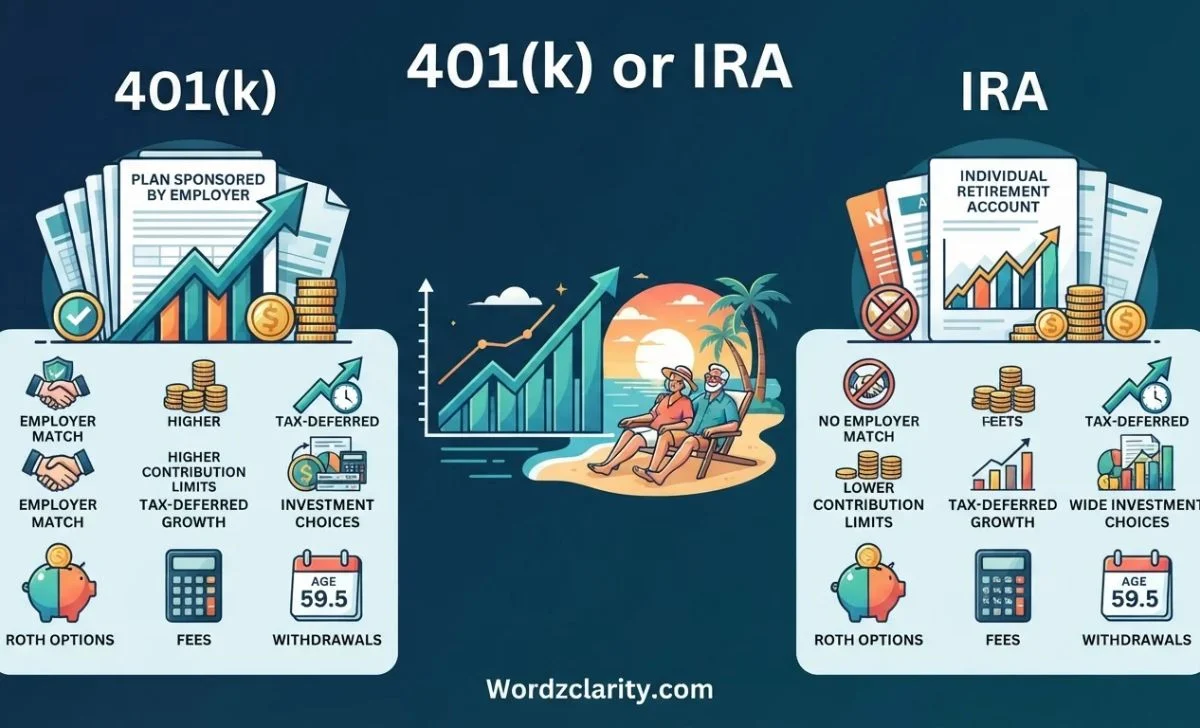
Saving for retirement often raises a simple question: 401k or IRA? Both accounts can help you build retirement savings, but they are not the same. A 401(k) is usually offered through an employer, while an IRA is an individual retirement account that you open yourself.
They also differ in contribution limits, tax treatment, investment choices, employer matching, income rules, fees, and withdrawals. The comparison becomes more complicated when you add a traditional 401(k), Roth 401(k), traditional IRA, Roth IRA, TSP, or taxable brokerage account.
This guide explains the key differences in simple terms. You will learn how each account works, how their tax benefits compare, what you can contribute, and why some people use both a 401(k) and an IRA.
Quick Answer
A 401(k) is generally an employer-sponsored retirement plan, while an IRA is an individual retirement account that you open through a financial institution.
For 2026, the basic employee contribution limit is $24,500 for a 401(k). The combined contribution limit for traditional and Roth IRAs is $7,500. People age 50 and older may qualify for additional catch-up contributions.
The main differences are:
- 401(k): Usually connected to your employer.
- IRA: Opened and managed individually.
- 401(k): May offer an employer match.
- IRA: Usually offers broad investment choices.
- Traditional accounts: Generally provide tax benefits before or during retirement.
- Roth accounts: Use after-tax contributions and can provide tax-free qualified withdrawals.
- Both: You can generally have a 401(k) and an IRA at the same time.
So, the question is not always 401k or IRA. For some people, the useful comparison is how to use both accounts within the applicable rules.
401(k) vs. IRA at a Glance
| Feature | 401(k) | IRA |
|---|---|---|
| Account type | Employer-sponsored retirement plan | Individual retirement account |
| Common types | Traditional 401(k), Roth 401(k) | Traditional IRA, Roth IRA |
| 2026 basic contribution limit | $24,500 | $7,500 combined |
| Employer match | May be available | No employer match |
| Contributions | Often through payroll | Usually made directly |
| Investment choices | Limited to plan options | Often broader |
| Roth option | Roth 401(k) | Roth IRA |
| Tax-deductible option | Traditional 401(k) | Traditional IRA may qualify |
| Income restrictions | Generally no income limit for regular employee deferrals | Some IRA tax benefits have income rules |
| Can you have both? | Yes | Yes |
The 2026 limits are subject to IRS rules and can change in future years. The IRS lists a $24,500 employee elective-deferral limit for 401(k) plans and a $7,500 annual limit for traditional and Roth IRAs combined.
What Is a 401(k)?
A 401(k) is a retirement plan normally offered through an employer. You contribute money from your paycheck, and the contributions are invested according to the options available in the plan.
There are two common tax treatments:
- Traditional 401(k)
- Roth 401(k)
With a traditional 401(k), contributions are generally made on a pre-tax basis, and withdrawals are generally taxable.
With a Roth 401(k), contributions are made with after-tax money. Qualified distributions can generally be tax-free.
How an Employer Match Works
One important feature of some 401(k) plans is an employer match.
For example, suppose your employer says it matches 50% of your contributions up to 6% of your salary. If you contribute 6%, the employer may contribute an additional amount according to the plan’s formula.
The exact matching formula varies by employer.
This is an important difference when comparing a 401(k) or IRA because an IRA generally does not receive an employer match.
What Is an IRA?
IRA stands for Individual Retirement Account. Unlike a 401(k), an IRA is generally opened by the individual.
You can open an IRA through a brokerage firm, bank, or another eligible financial institution. The two most common types for individual investors are:
- Traditional IRA
- Roth IRA
A traditional IRA may allow a tax deduction for contributions if you meet the applicable requirements. Investment earnings generally are not taxed until distributions are taken.
Roth IRA contributions are not deductible, but qualified distributions can generally be tax-free.
An IRA can also give you more control over the financial institution and investment choices than some employer-sponsored plans.
401(k) vs. IRA Tax Benefits
Tax treatment is one of the biggest differences between these accounts.
Traditional 401(k)
Traditional 401(k) contributions generally receive an upfront tax advantage. Taxes are generally paid when taxable distributions are taken.
Traditional IRA
Traditional IRA contributions may be deductible, but the deduction can be limited by income and whether you or your spouse are covered by a workplace retirement plan.
Roth 401(k)
Roth 401(k) contributions are made with after-tax money. Qualified distributions can generally be tax-free.
Roth IRA
Roth IRA contributions are made with after-tax money and are not deductible. Qualified withdrawals can generally be tax-free. Roth IRA contributions are subject to income eligibility rules.
Simple Tax Comparison
| Account | Contribution tax treatment | Qualified retirement withdrawal |
|---|---|---|
| Traditional 401(k) | Generally pre-tax | Generally taxable |
| Roth 401(k) | After-tax | Generally tax-free |
| Traditional IRA | May be deductible | Generally taxable |
| Roth IRA | Not deductible | Generally tax-free |
The exact tax result depends on your circumstances and the type of contribution or withdrawal.
401(k) vs. IRA Contribution Limits
Contribution limits are another major difference.
For 2026, the IRS lists:
- 401(k): $24,500 employee elective-deferral limit
- Traditional and Roth IRAs combined: $7,500
- 401(k) catch-up: generally $8,000 for people age 50 and older
- IRA catch-up: $1,100 for people age 50 and older
For people who turn 60, 61, 62, or 63 during 2026, a higher 401(k) catch-up limit of $11,250 may apply under SECURE 2.0 rules.
The IRA limit applies across your traditional and Roth IRAs. For example, you cannot contribute $7,500 to a traditional IRA and another $7,500 to a Roth IRA under the standard annual limit. The combined total is subject to the applicable limit.
Can You Have a 401(k) and an IRA?
Yes. Having a 401(k) through work does not automatically prevent you from having an IRA.
For example, someone could have:
- Traditional 401(k)
- Roth IRA
Or:
- Roth 401(k)
- Traditional IRA
Or potentially several retirement accounts at the same time.
However, having a workplace retirement plan can affect whether a traditional IRA contribution is deductible. Roth IRA contributions also have income eligibility rules.
This is why 401k and IRA contribution limits should be considered separately.
Traditional 401(k) vs. Traditional IRA
A traditional 401(k) and a traditional IRA both offer tax benefits for retirement savings. The main difference is how each account is set up and used.
Traditional 401(k)
A traditional 401(k):
- Is usually offered by an employer
- Lets you contribute through payroll
- Has a higher annual contribution limit
- May include an employer match
- Offers investments selected by the plan
Traditional IRA
A traditional IRA:
- Is opened by the individual
- Has a lower annual contribution limit
- Often offers more investment choices
- May allow a tax deduction based on your income and workplace retirement coverage
Both accounts can help you save for retirement, but their rules and features are different.
For example, an employee might contribute to a traditional 401(k) through every paycheck, while separately making a contribution to a traditional IRA at a brokerage firm.
Roth 401(k) vs. Roth IRA
A Roth 401(k) and a Roth IRA both use after-tax contributions, but they are different accounts.
The biggest differences include:
| Feature | Roth 401(k) | Roth IRA |
|---|---|---|
| Offered by | Employer plan | Individual financial institution |
| 2026 basic contribution limit | $24,500 employee limit | $7,500 combined IRA limit |
| Employer match | May be available | No |
| Income contribution restriction | Generally not the same as Roth IRA | Yes |
| Investment choices | Plan-dependent | Usually broad |
The IRS says Roth IRA contribution eligibility is subject to modified adjusted gross income limits. For 2026, the phase-out range is $153,000–$168,000 for single filers and heads of household and $242,000–$252,000 for married couples filing jointly.
That distinction is important when someone searches for 401k vs Roth IRA.
401(k) vs. IRA: Employer Match
The employer match is one of the clearest differences between the two accounts.
An IRA is an individual account, so your employer does not normally match your IRA contribution.
A 401(k), however, may include:
- Employer matching contributions
- Employer nonelective contributions
- Profit-sharing contributions
Not every employer offers the same benefits.
For example, one employer may match 100% of employee contributions up to 3% of salary, while another may use a different formula.
Check your Summary Plan Description and plan documents for the exact rules.
Investor.gov also highlights employer matching as an important feature to review when starting a workplace retirement plan.
401(k) vs. IRA: Investment Options and Fees
Investment choices can vary significantly.
A 401(k) normally provides a list of investments selected by the employer’s plan. These may include:
- Index funds
- Mutual funds
- Target-date funds
- Bond funds
- Other investment options
An IRA can often provide a broader selection because you choose the financial institution.
Depending on the provider, an IRA may offer:
- Stocks
- Bonds
- ETFs
- Mutual funds
- Index funds
- Target-date funds
However, having more investment choices does not automatically mean lower fees.
When comparing 401k vs IRA fees, look at:
- Administrative fees
- Fund expense ratios
- Investment costs
- Advisory fees
- Trading fees, where applicable
Investor.gov notes that investment fees and expenses can have a significant effect on long-term retirement savings.
401(k) vs. IRA vs. Brokerage Account
A taxable brokerage account is different from both a 401(k) and an IRA.
401(k)s and IRAs are designed to provide retirement-related tax advantages. A taxable brokerage account generally does not have the same retirement-account tax treatment.
| Feature | 401(k) | IRA | Taxable Brokerage |
|---|---|---|---|
| Retirement tax advantages | Yes | Yes | Generally no |
| Employer match | Possible | No | No |
| Annual retirement contribution limit | Yes | Yes | No comparable retirement-account limit |
| Investment choices | Plan-dependent | Usually broad | Usually broad |
| Retirement withdrawal rules | Apply | Apply | No retirement-account early-withdrawal penalty |
| Tax treatment | Depends on type | Depends on type | Taxable investment activity may apply |
A brokerage account can therefore serve a different purpose. It may be useful for investments outside retirement accounts, while a 401(k) or IRA can provide specific retirement tax advantages.
Is the TSP a 401(k) or IRA?
The Thrift Savings Plan (TSP) is a federal government retirement savings plan.
It is not an IRA and it is not literally a 401(k), although it shares important characteristics with employer-sponsored defined-contribution plans.
The TSP is available to eligible federal employees and members of the uniformed services.
For 2026, the IRS includes the federal government’s TSP among the plans subject to the $24,500 elective-deferral limit.
So if someone searches:
“Is the TSP a 401k or IRA?”
The simple answer is: TSP is a separate federal retirement plan, not an IRA or a 401(k).
401(k) or IRA Calculator: What Does It Do?
A 401k or IRA calculator can help estimate how different contribution amounts may affect retirement savings.
A calculator may ask for:
- Current age
- Retirement age
- Current savings
- Monthly contribution
- Annual contribution
- Employer match
- Expected investment return
- Years until retirement
- Inflation assumptions
For example, you might compare two hypothetical scenarios:
Scenario A: $500 per month into a 401(k)
Scenario B: $500 per month into an IRA
You could then change the employer-match assumption, contribution amount, or expected return to see how the projected balances change.
However, a calculator is only an estimate. Investment returns are not guaranteed, and the result depends on the assumptions entered.
401(k) or IRA: Withdrawal Rules
Withdrawal rules depend on the specific account.
Traditional 401(k) and traditional IRA distributions are generally taxable. Taking money from a retirement account before age 59½ may also result in an additional tax unless an exception applies.
Roth accounts work differently. Qualified Roth distributions can generally be tax-free, but the requirements depend on whether the account is a Roth IRA or Roth 401(k).
Required minimum distribution rules also differ by account type and can change as federal law changes.
Because withdrawals can create tax consequences, it is important to check current IRS rules before taking money out.
What Happens to a 401(k) When You Change Jobs?
Changing jobs can create several options for your old 401(k).
Depending on the plan and your circumstances, you may be able to:
- Leave the money in the former employer’s plan
- Move the money to your new employer’s plan
- Roll the money into an IRA
- Take a distribution
A 401(k) rollover to an IRA can give you more control over the account and investment choices, but the tax consequences depend on how the rollover is completed.
Investor.gov explains that a former employer’s retirement account may potentially be rolled into another employer plan or an IRA. It also notes that cashing out can create taxes and potentially penalties.
A rollover is different from a new annual IRA contribution. The IRS states that rollover contributions are not subject to the normal annual IRA contribution limit.
401(k) vs. IRA: Common Mistakes
1. Thinking a 401(k) and IRA are the same
Both are retirement accounts, but they have different structures and rules.
2. Assuming every 401(k) has the same fees
Employer plans can differ in administrative fees and investment expenses.
3. Assuming every traditional IRA contribution is deductible
The deduction can depend on income and workplace retirement-plan coverage.
4. Treating Roth as a separate account category
“Roth” describes a tax treatment. A Roth 401(k) and Roth IRA are different account types.
5. Ignoring the employer match
If your employer provides matching contributions, include that benefit in your comparison.
6. Confusing contribution limits
The 401(k) limit and IRA limit are separate. The IRA limit applies across your traditional and Roth IRAs combined.
7. Treating Reddit comments as universal advice
Searches such as 401k or IRA Reddit can show real experiences, but individual situations vary. A comment about one person’s employer plan may not apply to another person’s plan.
401(k) or IRA Reddit: What Do People Discuss?
People searching 401k or IRA Reddit or 401k vs IRA Reddit often discuss practical questions such as:
- Should I contribute to my 401(k) or IRA?
- How important is the employer match?
- Is my 401(k) fee too high?
- Should I roll an old 401(k) into an IRA?
- Is a Roth IRA better for my situation?
- Which account gives me more investment choices?
- Should I use a taxable brokerage account after retirement accounts?
These discussions can help you understand common experiences, but they should not replace checking your plan documents, IRS rules, and actual investment fees.
The most useful comparison is usually based on the specific accounts available to you rather than a general internet ranking.
401(k) or IRA: A Simple Comparison Guide
| If your priority is… | Compare… |
|---|---|
| Employer contributions | 401(k) match |
| Higher annual contribution capacity | 401(k) |
| More control over investments | IRA |
| Potential traditional tax deduction | Traditional 401(k) or traditional IRA |
| Potential tax-free qualified withdrawals | Roth 401(k) or Roth IRA |
| Lower investment costs | Actual fund and plan fees |
| Easy payroll saving | 401(k) |
| More financial-institution choices | IRA |
| Federal employee retirement savings | TSP |
| Investing outside retirement accounts | Taxable brokerage |
This is why 401k or IRA which is better does not have one universal answer.
The relevant comparison depends on your employer plan, tax situation, income, investment choices, fees, and retirement goals.
FAQs
Is a 401(k) an IRA for tax purposes?
No. A 401(k) and IRA are separate types of retirement accounts. They can have similar tax treatments, but their contribution limits, eligibility rules, and other features differ.
Can I contribute to a 401(k) and Roth IRA in the same year?
Generally, yes. You can have both accounts, but Roth IRA contributions are subject to income eligibility rules. Your workplace retirement plan can also affect the deductibility of traditional IRA contributions.
Is a Roth IRA better than a 401(k)?
A Roth IRA and 401(k) have different features. A 401(k) may provide employer matching and a higher contribution limit, while an IRA may provide broader investment choices. The comparison depends on the specific accounts and circumstances.
What is the difference between a 401(k) and an IRA?
A 401(k) is generally an employer-sponsored retirement plan, while an IRA is an individual retirement account. They also have different contribution limits, investment choices, tax rules, and withdrawal provisions.
Can I roll my 401(k) into an IRA?
Depending on the plan and your circumstances, you may be able to roll an old 401(k) into an IRA. A direct rollover can help avoid having the money paid directly to you.
What is the 2026 401(k) and IRA contribution limit?
For 2026, the employee elective-deferral limit for most 401(k) plans is $24,500. The combined contribution limit for traditional and Roth IRAs is $7,500. Additional catch-up rules apply to eligible older participants.
Is the TSP a 401(k) or IRA?
The TSP is a separate federal retirement savings plan. It is not an IRA or literally a 401(k), although it shares features with employer-sponsored retirement plans.
Conclusion
When comparing 401k or IRA, remember that the two accounts serve similar retirement goals but work in different ways. A 401(k) is generally provided through an employer and may offer an employer match, payroll contributions, and a higher annual contribution limit.
An IRA is opened individually and often provides broader control over investment choices. Traditional and Roth versions also have different tax treatments. For 2026, the basic employee 401(k) contribution limit is $24,500, while the combined traditional and Roth IRA limit is $7,500. You do not necessarily have to choose one.
Many people can use both, depending on their income, employer plan, tax situation, and goals. Compare the actual fees, investment options, employer match, contribution limits, and withdrawal rules before making a decision.
Read More Blogs
- Dwarfs or Dwarves: How to Use Each Word Correctly?
- Life or Lives: Meaning, Examples, and Proper Usage
- Shined or Shone: Which is correct and use for which porpuse?
- Lended or Lent: Which Is Correct? Past Tense of Lend Explained