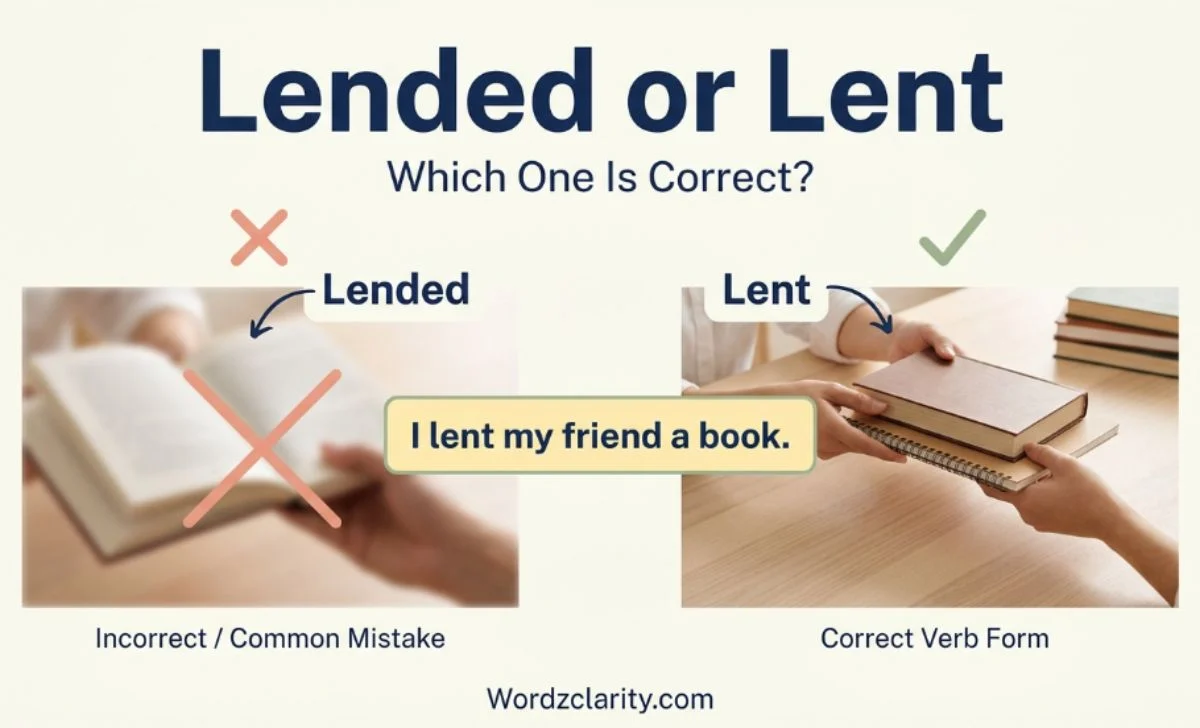
Have you ever written a sentence like “I lended him my book” and wondered whether lended is actually correct? You are not alone. The verb lend can be confusing because its past form does not follow the usual -ed pattern.
The correct past tense of lend is lent, not lended. For example, “I lent my friend some money” is correct, while “I lended my friend some money” is not the standard form in modern English.
In this guide, you will learn why lent is the correct form, how to use lend, lent, and lending, and how these words differ from borrow and loan. You will also see practical examples from everyday conversations, emails, business writing, and academic English.
Quick Answer: Lended or Lent?
Lent is the standard past tense and past participle of lend.
| Form | Correct? | Example |
|---|---|---|
| Lend | Yes | I will lend you my laptop. |
| Lent | Yes | I lent you my laptop yesterday. |
| Lending | Yes | She is lending me her notes. |
| Lended | No, not the standard form | I lended him my book. |
Cambridge Dictionary lists the verb forms as lend – lent – lent, confirming that lent is used for both the past simple and past participle.
So, if you are asking “lended or lent which is correct?”, choose lent in standard English.
Correct examples
- I lent him my car.
- She lent me $50.
- They lent their house to a relative.
- We lent the equipment to another team.
- He has lent me several books.
Incorrect standard-English examples
- I lended him my car.
- She lended me $50.
- They lended their house to a relative.
The simple rule is easy:
Lend → Lent → Lent
Why Is “Lent” the Past Tense of Lend?
The main reason this causes confusion is that many English verbs form their past tense by adding -ed.
For example:
- work → worked
- clean → cleaned
- open → opened
- help → helped
Because of this pattern, it may seem logical to say lended.
However, lend is an irregular verb. Its past form does not use the regular -ed ending. Instead, the word changes to lent.
The three main forms are:
lend → lent → lent
Here:
- lend = present/base form
- lent = past simple
- lent = past participle
For example:
Present:
I lend my books to my classmates.
Past:
I lent my books to my classmates yesterday.
Present perfect:
I have lent my books to several classmates.
Cambridge Grammar also identifies lent as the past simple and -ed form of lend.
This is similar to other irregular verbs:
- send → sent → sent
- spend → spent → spent
- build → built → built
- keep → kept → kept
- lend → lent → lent
The important point is that lended may look grammatically logical, but standard English uses lent.
Lend, Lent, and Lending: Verb Forms
Understanding all forms of the verb makes it much easier to avoid mistakes.
1. Lend
Lend is the base or present form.
Use it when talking about something happening now, something that happens regularly, or something that will happen in the future.
Examples:
- Can you lend me your pen?
- I usually lend my books to friends.
- Will you lend me your car?
- She can lend us some equipment.
2. Lent
Lent is both the past tense and past participle of lend.
Examples:
- I lent him my jacket yesterday.
- She lent me her notes.
- We lent the company some equipment.
- He has lent me his camera.
Notice that the word stays lent when used with have, has, or had.
For example:
- I have lent him my book.
- She has lent me her laptop.
- They had lent us the equipment.
3. Lending
Lending is the -ing form of lend.
Examples:
- I am lending him my bicycle.
- She is lending money to her brother.
- They are lending equipment to the school.
- The bank is lending money to businesses.
This gives you the complete basic pattern:
lend → lent → lent → lending
Lended or Lent in the Past Tense
If you need the past tense of lend, use lent.
For example:
I lent my friend my bicycle.
Not:
I lended my friend my bicycle.
More examples:
| Present | Past |
|---|---|
| I lend him money. | I lent him money. |
| She lends me her notes. | She lent me her notes. |
| We lend our equipment. | We lent our equipment. |
| They lend books to students. | They lent books to students. |
A useful test is to replace lend with another irregular verb.
You would not normally say:
- “I sended the email.”
- “She builded the house.”
- “He keeped the book.”
You use:
- sent
- built
- kept
In the same way:
lend → lent
Is “Lended” a Word?
You may see lended occasionally, especially in informal writing, learner English, or nonstandard usage. However, it is not the standard past tense or past participle of lend in modern English.
For normal writing, use lent.
This matters especially in:
- school assignments
- professional emails
- business documents
- websites
- reports
- applications
- formal communication
If you are editing a sentence and see lended, the safest standard-English correction is usually lent.
Example
Before:
I lended my colleague my laptop.
After:
I lent my colleague my laptop.
The second sentence is the natural standard form.
Lend vs. Lent: What Is the Difference?
The difference is mainly time and grammar.
Lend refers to the base or present form.
Lent refers to the past form and past participle.
Compare these sentences:
- I lend my car to my brother sometimes.
- I lent my car to my brother last week.
- I have lent my car to him before.
The first sentence describes a present or repeated action. The second describes a completed action in the past. The third uses the past participle with have.
Simple rule
If the action is happening now or is planned:
lend
If the action already happened:
lent
If you use have, has, or had:
lent
Lend vs. Borrow
One of the most common mistakes involving lend is confusing it with borrow.
The difference is based on direction.
Lend means give something temporarily.
Borrow means receive or take something temporarily with the intention of returning it.
Cambridge explains the distinction in the same way: the person who gives something temporarily lends it, while the person who receives it borrows it.
Compare:
Can you lend me your pen?
You are asking another person to give you the pen temporarily.
Can I borrow your pen?
You are asking to receive and use the pen temporarily.
Compare these examples
| Lend | Borrow |
|---|---|
| I lent Sarah my book. | Sarah borrowed my book. |
| Can you lend me $20? | Can I borrow $20? |
| He lent me his car. | I borrowed his car. |
| She lent us some chairs. | We borrowed some chairs. |
A simple memory trick is:
Lend = give
Borrow = receive
Lend vs. Loan
Loan can also be used as a verb, especially when talking about money, property, or formal arrangements.
For example:
- The bank loaned him money.
- The company loaned us some equipment.
- She lent me her car.
Both lend and loan can function as verbs, although their usage can vary by context and style. Merriam-Webster notes that loan has a long history of use as a verb in English.
In everyday English, lend is very common when talking about temporarily giving something to another person:
Can you lend me your pen?
For financial contexts, loan is also very common:
The bank loaned the business $50,000.
Do not confuse loan with borrow, either. The direction remains important.
- Bank loans money.
- Customer borrows money.
Lended or Lent Examples
Seeing the correct form in different situations can make the rule easier to remember.
Everyday conversation
- Can you lend me your charger?
- I lent him my headphones yesterday.
- She has lent me her umbrella.
- Will you lend me your notes?
- We lent our neighbors some chairs.
School and academic writing
- The student borrowed a book that the library had lent to him.
- My classmate lent me her notes.
- The university lent the equipment to the research team.
Business writing
- The company lent its equipment to a partner.
- The bank lent money to the new business.
- We have lent the required equipment to your department.
- Please return the items that were lent to your team.
Emails
Instead of writing:
I lended you the documents last week.
Write:
I lent you the documents last week.
Or:
I have lent you the documents you requested.
Social media and informal messages
Even in casual writing, lent is the normal form:
I lent him my hoodie and never got it back.
She lent me her camera for the trip.
The casual setting does not change the verb form.
Common Mistakes With Lend
Here are some mistakes worth watching for.
Mistake 1: Using “lended”
Incorrect:
I lended him my phone.
Correct:
I lent him my phone.
Mistake 2: Confusing lend and borrow
Incorrect:
Can you borrow me your pen?
Correct:
Can you lend me your pen?
Or:
Can I borrow your pen?
Mistake 3: Using “lent” for the present
Incorrect:
Can you lent me your book?
Correct:
Can you lend me your book?
After can, use the base form lend, not lent.
Mistake 4: Using “lended” after have
Incorrect:
I have lended him my car.
Correct:
I have lent him my car.
Mistake 5: Using “lent” when talking about receiving
Incorrect:
I lent a book from the library.
If you received the book, say:
I borrowed a book from the library.
The library lent the book to you; you borrowed it.
Lent vs. Leant
Another word that can cause confusion is leant.
Leant is a past form of lean, meaning to move or rest at an angle.
For example:
He leant against the wall.
Lent, on the other hand, is the past form of lend.
She lent me her book.
So:
- lend → lent
- lean → leant in varieties of English that use leant
There is no relationship between the meanings.
Compare:
I lent him my jacket.
and:
I leant against the wall.
The first sentence is about temporarily giving something. The second is about resting or inclining.
Is There a British or American Difference?
There is no British-versus-American spelling difference for the past tense of lend.
Both British and American English use:
lend → lent
Examples:
- British English: I lent him my car.
- American English: I lent him my car.
The form lended does not become correct simply because you are writing for an American or British audience.
This is different from words such as:
- colour / color
- organise / organize
- travelling / traveling
With lend, the past form remains lent in both major varieties of English.
“Lent” Has Another Meaning
There is one other meaning of Lent that you may encounter.
Lent can also be a noun referring to the Christian period before Easter. In that context, it is normally capitalized:
Many Christians observe Lent before Easter.
This is completely different from the verb lent:
She lent me her book.
The pronunciation and spelling are the same, but the meaning and grammatical role are different. Cambridge Dictionary also lists Lent as the name of the Christian period before Easter.
How to Use “Lent” Correctly
When you want to describe something that was temporarily given to someone, lent is usually the word you need.
A useful sentence pattern is:
Subject + lent + person + thing
Examples:
- I lent John my car.
- She lent me her phone.
- They lent us some money.
- We lent the school our equipment.
You can also use:
Subject + lent + thing + to + person
Examples:
- I lent my car to John.
- She lent her phone to me.
- They lent some money to us.
- We lent the equipment to the school.
Both structures are natural.
Quick Editing Checklist
Before publishing an email, article, assignment, or website page, check these points:
- Did you use lent as the past tense of lend?
- Did you avoid using lended in standard English?
- Did you use lend after modal verbs such as can, will, and should?
- Did you use lent after have, has, or had?
- Did you use borrow when someone receives something temporarily?
- Did you use lend when someone gives something temporarily?
- Are you using Lent with a capital letter when referring to the Christian season?
If the answer is yes, your usage should be clear and grammatically sound.
FAQs
1. Is “lended” correct?
Lended is not the standard past tense or past participle of lend in modern English. The standard form is lent.
2. What is the past tense of lend?
The past tense of lend is lent.
Example:
I lent my friend my laptop yesterday.
3. What is the past participle of lend?
The past participle is also lent.
Example:
I have lent him my notes.
The three forms are:
lend – lent – lent
4. Can you say “I lended him money”?
In standard English, use “I lent him money.” The word lended is not the standard past form of lend.
5. Is “lent” the correct word?
Yes. Lent is the standard past tense and past participle of lend.
6. What is the difference between lend and borrow?
Lend means to give something temporarily. Borrow means to receive or take something temporarily with the intention of returning it.
Example:
I lent Sarah my book, and Sarah borrowed my book.
7. Is there a difference between British and American English for “lent”?
No. Both British and American English use lent as the past tense and past participle of lend.
Conclusion
When choosing between lended or lent, the answer is straightforward: lent is the standard form. The verb lend is irregular, so it does not form its past tense by simply adding -ed. Its three main forms are lend, lent, lent.
Use lend for the base or present form, lent for the past tense and past participle, and lending for the -ing form. For example, you can say, “I will lend you my book,” “I lent you my book yesterday,” or “I have lent you my book.”
It is also important to keep lend and borrow separate. The person who gives something temporarily lends it, while the person who receives it borrows it.
Whether you are writing an email, school assignment, business document, website, or casual message, choosing lent instead of lended will keep your English natural and standard.
Remember:
Lend → Lent → Lent
Read More Blogs:
- Desert vs Dessert: The Easy Way to Tell These Two Words Apart
- Humour or Humor: Which Spelling Is Correct?
- Milwaukee or Makita: Which Brand Is Better for Your Tools?
- Website or Web Site: Which Form Is Correct in Modern English?
- Coarse or Course: How to Choose the Right Word Every Time