Fourth and forth are easy to confuse because they look and sound very similar. However, they do not have the same meaning, and you cannot use them interchangeably.
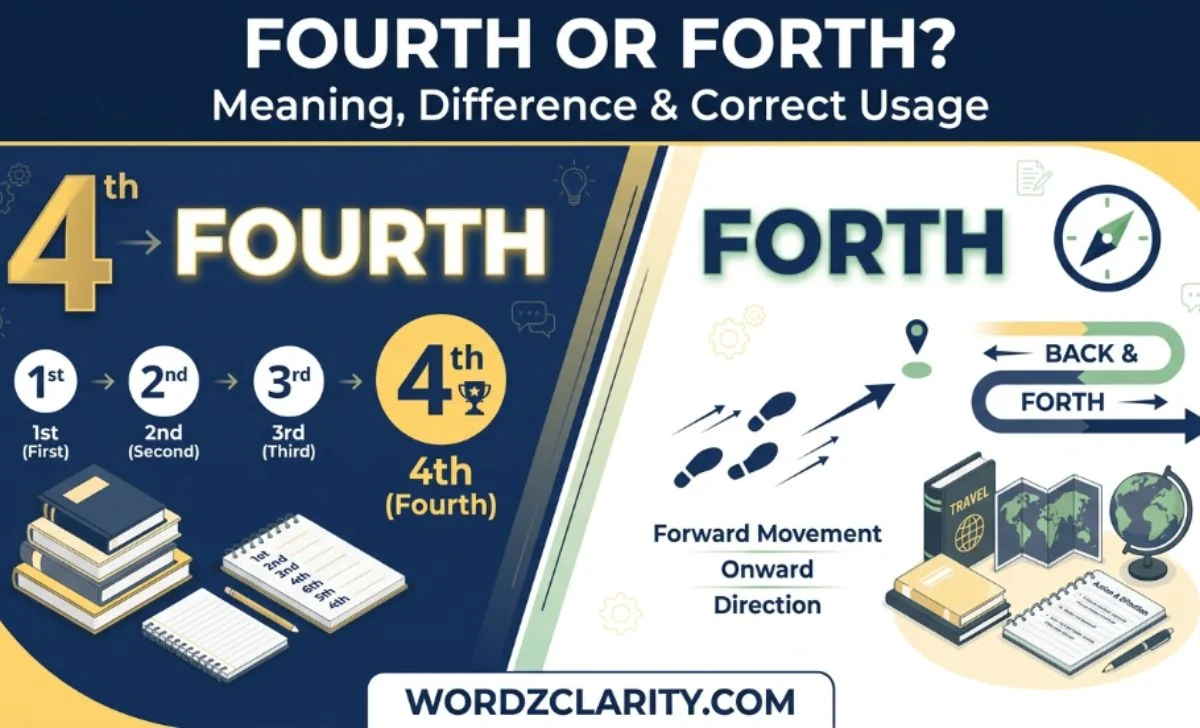
If you are talking about number four in a sequence, the correct word is fourth. For example, “She finished fourth in the race.” If you mean moving forward, onward, or outward, use forth: “The travelers set forth at sunrise.”
The confusion becomes even more common in phrases such as back and forth, go forth, bring forth, and set forth.
Many people also wonder whether fourth and forth are pronounced differently, whether there is a British or American difference, and which spelling belongs in expressions such as “back and forth.”
In this guide, you will learn the difference between fourth and forth, their meanings, pronunciation, correct spelling, common expressions, sentence examples, and simple ways to remember which word to use.
Quick Answer:
Both fourth and forth are correct English words, but they have different meanings.
- Fourth refers to the number 4 in a sequence.
- Forth means forward, onward, or outward and is mainly used as an adverb.
Compare these examples:
She finished fourth in the competition.
Here, fourth tells us her position in a sequence.
The soldiers marched forth into the unknown.
Here, forth means moving forward or onward.
A quick memory trick is:
Fourth = four + th → number 4
Forth = forward → moving onward
So, if you mean 4th, choose fourth. If you mean forward or onward, choose forth.
What Does “Fourth” Mean?
Fourth is the ordinal form of the number four. It describes something that comes after the first, second, and third items in a sequence.
For example:
- first
- second
- third
- fourth
- fifth
Cambridge Dictionary defines fourth as the written form of 4th, and it can describe a position in a series, a date, or other things related to the number four.
Examples of fourth
- Today is the fourth day of the month.
- She came fourth in the race.
- This is my fourth attempt.
- He lives on the fourth floor.
- We are meeting on the fourth of May.
- The company reported strong results in the fourth quarter.
You can think of fourth as the answer to the question:
“Which position?”
For example:
Which position did she finish in?
She finished fourth.
Fourth as an ordinal number
The difference between a cardinal number and an ordinal number is useful here.
Four is a cardinal number because it tells you how many.
Fourth is an ordinal number because it tells you position or order.
| Type | Word | Example |
|---|---|---|
| Cardinal number | four | I have four books. |
| Ordinal number | fourth | This is my fourth book. |
Therefore, fourth is an ordinal number.
What Does “Forth” Mean?
Forth is generally an adverb meaning forward, onward, outward, or away from a particular point. It often appears in formal, literary, or established expressions.
Cambridge Dictionary describes forth as meaning out or away from a place, or forward from a point in time.
For example:
The travelers set forth early in the morning.
Here, forth suggests moving onward or beginning a journey.
Another example is:
From this day forth, we will work together.
Here, forth refers to time moving forward.
Common meanings of forth
Depending on the sentence, forth can suggest:
- forward
- onward
- outward
- away
- from this point onward
It is not related to the number four in meaning.
Examples
- The explorers went forth into the forest.
- She stepped forth to accept the award.
- The army marched forth.
- From that day forth, everything changed.
- The flowers burst forth in spring.
In modern everyday English, forth is less common as a standalone word than fourth. However, it remains very familiar because it appears in several common phrases.
Fourth vs. Forth: The Main Difference
The easiest way to understand the difference is to look at what each word describes.
| Word | Meaning | Part of Speech | Example |
|---|---|---|---|
| Fourth | Number 4 in a sequence | Adjective, noun, adverb | She finished fourth. |
| Forth | Forward, onward, or outward | Adverb | They went forth. |
Use “fourth” for order or position
He was the fourth person to arrive.
This is the fourth chapter.
She finished fourth in the race.
Use “forth” for movement or onward progress
The travelers set forth at dawn.
The crowd moved forth.
From that day forth, he changed his habits.
A simple question can help:
Does the sentence relate to the number four?
If yes, use fourth.
Does it mean forward, onward, or outward?
If yes, use forth.
Are Fourth and Forth Pronounced the Same?
For most speakers, fourth and forth are pronounced the same or nearly the same.
Cambridge gives the UK pronunciation of both words as /fɔːθ/ and the US pronunciation as /fɔːrθ/.
The important point is that the extra u in fourth does not create a separate syllable or a major difference in pronunciation.
This makes the two words homophones or near-homophones in ordinary English pronunciation, depending on accent and analysis.
That is one reason people confuse them in writing.
Pronunciation comparison
| Word | UK | US |
|---|---|---|
| Fourth | /fɔːθ/ | /fɔːrθ/ |
| Forth | /fɔːθ/ | /fɔːrθ/ |
In American English, the r sound may be heard more clearly. In many British accents, particularly non-rhotic accents, the r is not pronounced in the same way.
So when someone says:
“I came fourth.”
and:
“They moved forth.”
the words can sound the same even though their meanings are completely different.
Fourth and Forth in a Sentence
Seeing both words in complete sentences makes the distinction easier.
Examples with “fourth”
- Maria finished fourth in the race.
- This is the fourth time I have visited London.
- He lives on the fourth floor.
- The meeting is scheduled for the fourth of June.
- This is our fourth annual conference.
- She read the fourth chapter before dinner.
- The team moved into fourth place.
- We are entering the fourth quarter.
- He celebrated his fourth birthday.
- This is the fourth question on the test.
Examples with “forth”
- The travelers set forth before sunrise.
- The soldiers marched forth.
- She stepped forth to speak.
- From that day forth, he became more careful.
- The flowers burst forth after the rain.
- The explorers ventured forth into the forest.
- He came forth with a new proposal.
- The truth eventually came forth.
- The group moved forth toward the city.
- The company put its plans forth for discussion.
Notice how fourth is connected with order or number, while forth is connected with movement, direction, or emergence.
“Back and Forth” or “Back and Fourth”?
The correct expression is:
back and forth
Not:
back and fourth
This is one of the most common mistakes involving these two words.
Back and forth means moving repeatedly between two places, positions, ideas, or sides.
Examples:
- The children ran back and forth across the yard.
- We walked back and forth along the beach.
- They argued back and forth for hours.
- The two teams exchanged emails back and forth.
- We have been going back and forth about the proposal.
Cambridge specifically lists back and forth as an established use of forth, while Merriam-Webster also identifies it as one of the common phrases containing forth.
Easy way to remember it
Think:
Back ↔ forward
That gives you:
back and forth
It has nothing to do with the number four.
Common Expressions With “Forth”
Although forth is less common as an independent word in everyday conversation, it appears in several familiar expressions.
1. Go forth
Go forth means to go forward or onward.
Go forth and do your best.
2. Set forth
Set forth can mean to begin a journey or to state/explain something clearly.
They set forth before dawn.
The report sets forth several recommendations.
3. Bring forth
Bring forth means to produce, create, or cause something to appear.
The discussion brought forth several useful ideas.
4. Put forth
Put forth can mean to present, offer, or make an effort.
She put forth a strong argument.
The team put forth a great effort.
5. From this day forth
This means from this day onward.
From this day forth, we will follow the new rules.
6. And so forth
And so forth means “and so on.”
The store sells books, magazines, notebooks, and so forth.
These expressions help explain why forth is still a useful English word even though it is not normally used to describe the number four.
Fourth in Dates, Positions, and Numbers
Fourth appears frequently in everyday writing because ordinal numbers are common.
Dates
You may see:
My birthday is on the fourth of July.
In American English, the date may also be written:
My birthday is on July fourth.
Positions
She finished fourth in the competition.
The team is currently in fourth place.
Floors
Their office is on the fourth floor.
Attempts
This is my fourth attempt.
Events
We are holding our fourth annual meeting.
Quarters
Sales increased during the fourth quarter.
Cambridge also uses fourth quarter in its Business English material, showing how commonly the word appears in professional contexts.
Fourth or Forth: Common Mistakes
Because the words sound alike, the mistake usually happens in writing rather than speaking.
Mistake 1: Back and fourth
Incorrect:
We went back and fourth.
Correct:
We went back and forth.
Mistake 2: Fourth instead of forth
Incorrect:
The soldiers marched fourth.
Correct:
The soldiers marched forth.
Here, the meaning is onward, not number four.
Mistake 3: Forth instead of fourth
Incorrect:
She finished forth in the race.
Correct:
She finished fourth in the race.
A finishing position is an ordinal number.
Mistake 4: Go fourth
Incorrect:
Go fourth and never give up.
Correct:
Go forth and never give up.
The phrase means go forward or onward.
Mistake 5: The forth chapter
Incorrect:
Read the forth chapter.
Correct:
Read the fourth chapter.
A chapter’s position in a sequence requires fourth.
Fourth vs. Forth in Emails and Business Writing
Choosing the right word matters in professional writing because spelling mistakes can make an otherwise clear message look careless.
Example 1: Project update
Incorrect:
The project has now entered its forth phase.
Correct:
The project has now entered its fourth phase.
The project has four or more phases, and this is phase number four.
Example 2: Discussion
Incorrect:
We have gone back and fourth on this issue.
Correct:
We have gone back and forth on this issue.
The phrase describes repeated discussion.
Example 3: Proposal
The report sets forth several recommendations.
Here, forth is part of the expression set forth, meaning to present or state something.
Fourth vs. Forth in Academic Writing
The same distinction applies in essays, research papers, and assignments.
Correct examples
The fourth section examines the results.
The researchers moved forth with the next stage of the study.
The discussion went back and forth between the two theories.
The fourth chapter provides the final analysis.
A useful editing habit is to check every instance of fourth/forth after writing. Ask whether you mean number four or forward/onward.
Fourth vs. Forth in Websites and Social Media
Online writing often contains quick messages where spelling mistakes are easy to miss.
For example:
We are now on the fourth version of the website.
But:
The debate continued back and forth on social media.
And:
The new campaign moves the brand forth into a new market.
Although informal platforms may contain spelling errors, the standard forms remain the same.
Is There a British or American Difference?
There is no British-versus-American spelling difference between fourth and forth.
Both British and American English use:
- fourth for number four in a sequence
- forth for onward, forward, or outward movement
The pronunciation can vary by accent, particularly because of the treatment of the r sound. Cambridge gives /fɔːθ/ for its UK pronunciation and /fɔːrθ/ for its US pronunciation for both words.
So you do not need to choose one spelling because your audience is American or British.
Instead, choose the word according to its meaning.
| Meaning | UK English | US English |
|---|---|---|
| Number 4 in a sequence | fourth | fourth |
| Forward/onward | forth | forth |
| Back-and-forward movement | back and forth | back and forth |
| Number 4 abbreviation | 4th | 4th |
Fourth as a Noun
Although many learners first meet fourth as an ordinal adjective, it can also be used as a noun.
For example:
He finished fourth.
Here, fourth describes the person’s position without directly modifying another noun.
It can also refer to one of four equal parts:
One fourth of the cake was left.
A fourth of the students were absent.
Cambridge lists this fractional meaning as well as meanings connected with music.
So fourth has several uses connected with the number four.
Does “Forth” Mean “Fourth”?
No.
The two words may sound alike, but forth does not mean the number four.
Compare:
The runner finished fourth.
This means position number four.
The runner moved forth.
This means the runner moved forward or onward.
Changing the spelling changes the meaning.
That is why context is important when deciding between the two.
Synonyms for Fourth and Forth
Because the words have different meanings, their possible synonyms are also different.
Synonyms or related expressions for “fourth”
Depending on context:
- 4th
- number four
- fourth in sequence
- fourth place
- one-quarter
- quarter
For example:
One fourth of the cake
can also be expressed as:
One quarter of the cake.
However, not every synonym works in every sentence.
Synonyms or related words for “forth”
Depending on context:
- forward
- onward
- ahead
- outward
- away
- ahead from a point
For example:
The soldiers marched forth.
can be understood as:
The soldiers marched forward.
The exact synonym depends on the sentence and tone.
A Simple Trick to Remember Fourth and Forth
Use this two-second test:
If you mean “4th” → FOURTH
The word fourth contains four.
first → second → third → fourth
If you mean “forward” → FORTH
Think:
forth = forward
So:
Go forth.
Move forth.
March forth.
And remember the fixed expression:
back and forth
not back and fourth.
This small memory trick can prevent most mistakes.
Practical Writing Tips
When editing your writing, use these rules:
- Use fourth for number four in a sequence.
- The fourth chapter
- Fourth place
- Fourth attempt
- Use forth for movement or onward direction.
- Move forth
- Go forth
- March forth
- Remember “back and forth.”
- We walked back and forth.
- Watch for phrases such as “set forth” and “bring forth.”
- The report sets forth the findings.
- Do not choose based on pronunciation.
- They sound the same or nearly the same for many speakers.
- Choose based on meaning.
- Number four → fourth
- Forward/onward → forth
FAQs
1. What is the difference between fourth and forth?
Fourth relates to the number four or the fourth position in a sequence. Forth means forward, onward, or outward and is often used in phrases such as back and forth and set forth.
2. Is “back and fourth” correct?
No. The standard expression is back and forth.
We went back and forth during the discussion.
3. Are fourth and forth pronounced the same?
For many English speakers, yes. Cambridge lists the same UK and US pronunciation patterns for both words, although accents can affect how the r is pronounced.
4. Is fourth an ordinal number?
Yes. Fourth is the ordinal number corresponding to four.
The sequence is:
first → second → third → fourth
5. What is the meaning of forth?
Forth generally means forward, onward, outward, or away from a point. It is especially common in expressions such as back and forth, set forth, and from this day forth.
6. Which is correct: go fourth or go forth?
Go forth is correct when you mean “go forward” or “go onward.”
Go forth and do your best.
Go fourth would only make sense in an unusual context where “fourth” describes a position or sequence.
7. Which is correct: fourth place or forth place?
Fourth place is correct because you are referring to position number four.
She finished in fourth place.
Conclusion
The difference between fourth and forth becomes simple once you focus on meaning rather than pronunciation. Fourth is connected with the number four and describes the fourth position in a sequence.
You use it in phrases such as fourth place, fourth floor, fourth chapter, and fourth quarter. Forth, on the other hand, generally means forward, onward, or outward. It appears in expressions such as go forth, set forth, bring forth, and the very common back and forth.
Both words are correct, and neither is a British or American spelling variant of the other. The main challenge is that they sound the same or very similar for many speakers, so the difference becomes especially important in writing.
When you are unsure, remember one simple rule: fourth = 4th, while forth = forward or onward. This distinction will help you choose the right word in conversations, emails, academic writing, business documents, websites, and everyday communication.
Read More Blogs:
- Repore vs Rapport: Grammar Rule, Meaning & Real-Life Examples
- Nineth or Ninth? Complete English Grammar Guide with Examples
- Is Ready or Not Cross-Platform? Everything You Need to Know
- Brasil or Brazil: Differences, Meaning, and When to Use Each