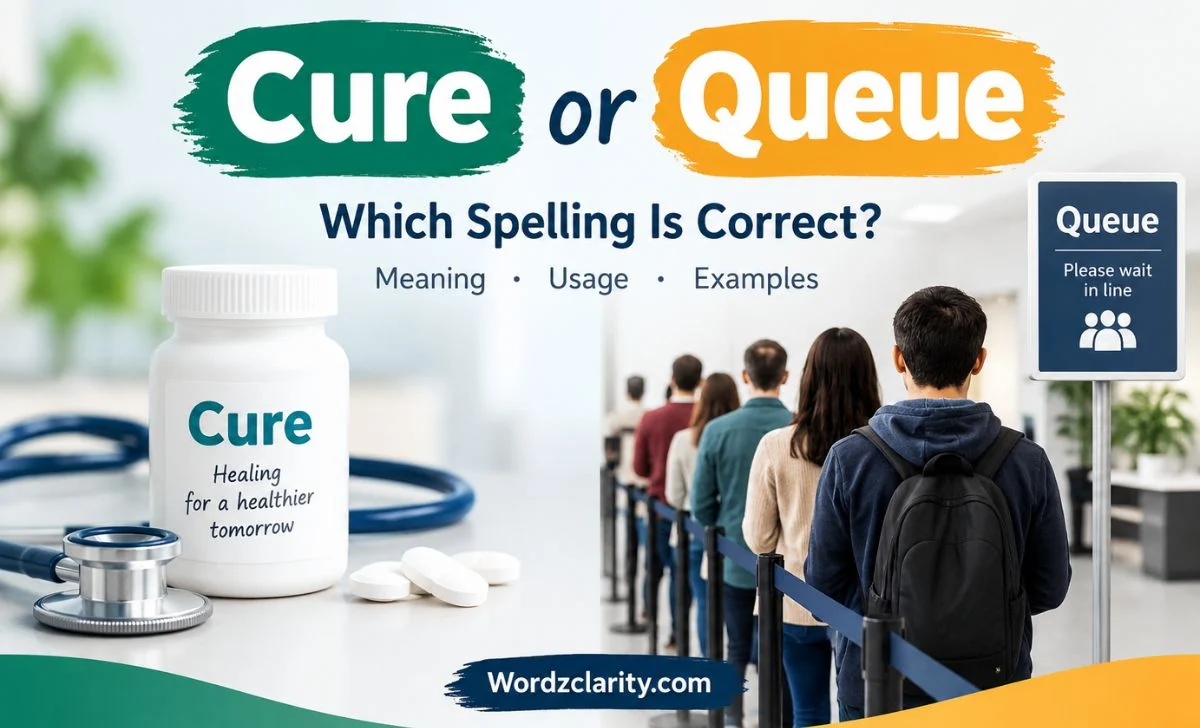
Have you ever seen the words cure and queue and wondered whether they are related, interchangeable, or simply different spellings? Although both are common English words, they have completely different meanings and are used in very different situations.
The confusion can become even greater when cue enters the picture because cue and queue sound alike in most varieties of English.
The word cure is mainly connected with treating or solving a disease, illness, or problem. Queue, on the other hand, refers to a line or sequence of people or things waiting for something. Cue means a signal, hint, or prompt that tells someone when to act.
In this guide, you will learn the difference between cure or queue, how to use each word correctly, how queue differs from cue, and how to avoid common mistakes in everyday writing.
Quick Answer
Cure and queue are different words with different meanings.
- Cure means a treatment or remedy that removes a disease, illness, or problem. It can also be used as a verb.
- Queue means a line of people or things waiting in order. It can also be used as a verb meaning to join or place something in a queue.
- Cue means a signal, prompt, or indication that tells someone what or when to do something.
Simple examples
The doctor hopes to find a cure for the disease.
We had to wait in a queue outside the store.
The actor took his cue and walked onto the stage.
So, if you are talking about healing or treatment, use cure. If you mean a waiting line or ordered sequence, use queue. If you mean a signal or prompt, use cue.
What Does “Cure” Mean?
Cure is a noun and a verb. Its central meaning is connected with removing or resolving an illness, disease, or other problem.
As a noun, cure means something that successfully treats or eliminates a disease or condition.
Scientists are searching for a cure for the disease.
As a verb, cure means to make someone healthy again or remove a disease or problem.
The treatment cured his infection.
The word can also be used outside medicine. In everyday English, people sometimes use cure to describe a solution to a problem.
There is no easy cure for this problem.
Common uses of “cure”
You may see cure in:
- Medical writing
- Health articles
- News reports
- Scientific research
- Everyday conversation
- Business discussions
- Informal expressions
For example:
Researchers are working on a possible cure.
Time may not cure every problem.
The new treatment could cure the infection.
What Does “Queue” Mean?
Queue is a noun and a verb. Its most common meaning is a line of people or things waiting for their turn.
There was a long queue outside the bank.
In British English, queue is especially common when talking about people waiting in line.
In American English, line is usually more common in ordinary conversation.
For example:
British English:
We stood in a queue for twenty minutes.
American English:
We stood in line for twenty minutes.
Both sentences describe people waiting for their turn.
“Queue” as a verb
Queue can also be used as a verb. It means to form a line, wait in line, or arrange something in a particular order.
Customers queued outside the restaurant.
It can also describe digital systems:
The files are queued for processing.
This use is common in technology, computing, printing, customer service, and business systems.
Cure vs Queue: The Main Difference
The easiest way to remember the difference is to connect each word with its central idea.
| Word | Main meaning | Part of speech | Example |
|---|---|---|---|
| Cure | A treatment or solution | Noun / Verb | The doctor found a cure. |
| Queue | A waiting line or ordered sequence | Noun / Verb | We joined the queue. |
| Cue | A signal or prompt | Noun / Verb | That was my cue to leave. |
There is no spelling variation between cure and queue. They are not British and American versions of the same word. They are separate words.
Cure or Queue: Which Word Should You Use?
These three words have different meanings.
Cure is about getting rid of a disease, illness, or problem.
- The medicine may cure the infection.
- Doctors are looking for a cure.
- There is no easy cure for the disease.
Queue means a line of people or things waiting for their turn.
- We stood in a queue at the store.
- There was a long queue outside.
- Your request is in the queue.
Cue means a signal that tells someone what to do or when to act.
- The actor waited for his cue.
- The music was his cue to start.
- That was my cue to leave.
A simple way to remember them is:
Cure = treatment
Queue = waiting line
Cue = signal
When you know the meaning you need, it is easy to choose the right word.
A Simple Way to Remember
You can remember the difference with three short meanings:
Cure means a treatment or solution.
Queue means a line or waiting list.
Cue means a signal or prompt.
For example:
- A doctor looks for a cure.
- Customers wait in a queue.
- An actor waits for a cue.
The three words may look or sound confusing, but their meanings are very different. When you focus on the meaning of the sentence, choosing the correct word becomes much easier.
Queue vs Cue: Why Are They Confused?
The confusion between queue and cue is much more common than confusion between cure and queue.
The reason is simple: queue and cue are pronounced alike in standard English, even though they have different spellings and meanings.
These words are called homophones because they sound the same but have different meanings and spellings.
Queue
Queue = a line, sequence, or waiting list.
We joined the queue at the ticket counter.
Cue
Cue = a signal, hint, or prompt.
The music was the cue for the dancers to begin.
A useful memory trick is:
Queue = line
Cue = signal
“Cue the Music” or “Queue the Music”?
This is one of the most useful distinctions to understand.
When you mean start the music at the appropriate moment, the expression is usually:
Cue the music.
Here, cue means to signal someone or something to begin.
For example:
The director said, “Cue the music!”
However, queue the music can also be correct when you mean put songs into a waiting list or sequence for playback.
For example:
I queued several songs for the party.
The difference is subtle but important.
Cue the music
Means signal the music to start.
The producer cued the music at the right moment.
Queue the music
Means place music into a sequence or playlist to be played later.
I queued three songs before starting the workout.
So both expressions can be grammatical, but they communicate different actions.
“That’s My Cue” or “That’s My Queue”?
The correct expression is:
That’s my cue.
It means that something is a signal or indication that it is time for you to act.
For example:
When the lights turn off, that’s my cue to leave.
The host mentioned my name, so that was my cue to come on stage.
That’s my queue would normally be incorrect if you mean “that is my signal.”
However, queue is correct when referring to a line or sequence:
My number is next in the queue.
A simple way to remember this is:
- Cue = signal to act
- Queue = line or sequence
Common Mistakes With Cure, Queue, and Cue
These three words are easy to confuse when you are writing quickly. Here are some common mistakes.
Mistake 1: Using “queue” for a medical treatment
Incorrect:
Scientists are looking for a queue for cancer.
Correct:
Scientists are looking for a cure for cancer.
A medical solution is a cure, not a queue.
Mistake 2: Using “cure” for a waiting line
Incorrect:
There was a long cure outside the theater.
Correct:
There was a long queue outside the theater.
A waiting line is a queue.
Mistake 3: Writing “queue” when you mean “cue”
Incorrect:
That’s my queue to leave.
Correct:
That’s my cue to leave.
A signal or indication is a cue.
Mistake 4: Confusing “cue the music” with “queue the music”
If you mean “tell the music to begin,” use:
Cue the music.
If you mean “put songs into a waiting sequence,” use:
Queue the music.
Cure in Real-World Writing
Cure is common in health and medical writing. It can also describe a way to solve a problem.
For example:
- Medical: Researchers are looking for a cure for the disease.
- News: Scientists have made progress toward a possible cure.
- Email: The doctor says the treatment may cure the infection.
- Academic: More research is needed to find a permanent cure.
- Everyday: I wish there were a cure for this headache.
In each example, cure relates to treatment, healing, or solving a problem.
Queue in Real-World Writing
Queue means a line or an ordered group waiting for its turn. You may see it in everyday speech, business, and technology.
For example:
- Everyday: We waited in the queue for tickets.
- Business: Customers were placed in a queue.
- Customer service: Ten customers are still in the queue.
- Technology: Your request is in the processing queue.
- Computing: The printer queue has several documents.
- Online services: Your application is now in the queue.
In each case, queue describes people, tasks, or items waiting in order.roup waiting for processing, service, or action.
Queue in British English vs American English
Unlike cure, the word queue has an interesting regional usage pattern.
In British English, queue is very common for a physical line of people.
There was a queue outside the cinema.
In American English, people usually use line in this situation.
There was a line outside the movie theater.
However, American English also uses queue in technical and computing contexts.
For example:
The request is waiting in the queue.
So, queue is not incorrect in American English. It is simply less common than line for an ordinary physical waiting line.
| Meaning | British English | American English |
|---|---|---|
| People waiting | queue | line |
| Waiting sequence | queue | queue |
| Computer processing | queue | queue |
| Customer-service system | queue | queue |
| Signal or prompt | cue | cue |
| Medical treatment | cure | cure |
Is “Queue” a British Word?
No. Queue is not exclusively British English.
It is used in both British and American English. The main difference is frequency and context.
British speakers commonly say:
I was waiting in the queue.
American speakers are more likely to say:
I was waiting in line.
But an American technology company can easily write:
Your request has been added to the queue.
Therefore, you should not treat queue as a British spelling of line. They are different words with overlapping meanings in certain contexts.
Where Does the Word “Queue” Come From?
The word queue has a long history and comes from French. Its earlier sense was connected with a tail, which helps explain the idea of people or things arranged one behind another.
Over time, English developed the modern meaning of a line of people or things waiting in order.
Today, the word has both everyday and technical uses.
The technical meaning is particularly important in computing. A queue can describe data, tasks, requests, or messages waiting to be processed in sequence.
This is why you may see phrases such as:
- Print queue
- Message queue
- Processing queue
- Job queue
- Customer queue
- Waiting queue
Where Does the Word “Cure” Come From?
Cure is also an old English word with roots connected to Latin through French. Its historical development is associated with care, treatment, and healing.
Modern English uses cure mainly for the successful treatment or removal of a disease or problem.
The word has also developed broader meanings. For example, someone might jokingly say:
A vacation is the perfect cure for stress.
Here, cure is being used figuratively to mean something that helps solve or relieve a problem.
How to Remember the Difference
If you frequently confuse these words, connect each one with one simple idea.
Cure = treatment
Think about:
disease → treatment → cure
Example:
Researchers are looking for a cure.
Queue = line
Think about:
people → waiting → queue
Example:
We joined the queue.
Cue = signal
Think about:
signal → action → cue
Example:
The bell was my cue to leave.
This three-word association makes the difference much easier to remember.
Practical Writing Tips
When choosing between these words, do not focus only on how they sound. Focus on the meaning you want to communicate.
Ask yourself three questions
1. Am I talking about healing or solving a problem?
Use cure.
The treatment may cure the infection.
2. Am I talking about people or things waiting in order?
Use queue.
The files are in the queue.
3. Am I talking about a signal or prompt?
Use cue.
That was my cue to start.
This method works in emails, essays, reports, social media posts, and everyday conversations.
More Example Sentences
Here are additional examples to make the differences clear.
Cure
- Scientists continue to search for a cure.
- The medicine helped cure the infection.
- There is no simple cure for the problem.
- Researchers are testing a possible cure.
- The doctor explained that the treatment was not a guaranteed cure.
Queue
- We waited in the queue for an hour.
- Several customers were already in the queue.
- Your request has been added to the queue.
- The printer queue is full.
- She joined the queue outside the store.
Cue
- The actor waited for his cue.
- The lights were his cue to begin.
- That was my cue to leave.
- The director gave the singer a cue.
- The music provided a cue for the dancers.
Quick Comparison: Cure, Queue, and Cue
| Word | Pronunciation | Meaning | Example |
|---|---|---|---|
| Cure | /kjʊə(r)/ or /kjʊr/ | Treatment or remedy | Scientists seek a cure. |
| Queue | /kjuː/ | Line or sequence | We joined the queue. |
| Cue | /kjuː/ | Signal or prompt | That was my cue. |
Notice an important point: queue and cue sound alike, but cure sounds different.
This is why queue vs cue is a genuine homophone issue, while cure vs queue is primarily a question of meaning and word choice.
FAQs
1. What is the difference between cure and queue?
Cure refers to a treatment, remedy, or solution, especially for an illness or disease. Queue refers to a line or sequence of people or things waiting for their turn.
2. Are cure and queue homophones?
No. Cure and queue do not have the same pronunciation. They are different words with different meanings. Queue and cue, however, are homophones in standard English pronunciation.
3. Is queue the same as cue?
No. Queue means a line or ordered sequence, while cue means a signal, prompt, or indication.
4. Is it “cue the music” or “queue the music”?
Both can be correct, depending on the meaning. Cue the music means signal the music to begin. Queue the music means put music into a sequence or waiting list for playback.
5. Is it “that’s my cue” or “that’s my queue”?
The correct expression is “That’s my cue” when you mean “that is my signal or indication to act.”
6. Is queue more common in British English?
For a physical line of people, queue is especially common in British English, while Americans generally use line. However, queue is also widely used in American technical and computing contexts.
7. Can queue be used as a verb?
Yes. Queue can be a verb meaning to form or join a line, or to place something into a sequence for processing.
Customers queued outside the store.
Conclusion
The difference between cure or queue becomes simple once you focus on meaning rather than spelling. Cure is connected with treatment, healing, or solving a disease or problem.
Queue refers to a line or an ordered sequence of people, objects, tasks, or requests waiting for their turn. Neither word is a different British or American spelling of the other.
The more common sound-based confusion is actually queue vs cue. These two words sound alike, but queue means a line or sequence, while cue means a signal or prompt. That distinction is especially useful in expressions such as “cue the music” and “that’s my cue.”
For everyday writing, remember three simple associations: cure = treatment, queue = line, cue = signal. Once these meanings become familiar, choosing the correct word in emails, conversations, academic writing, business communication, and online content becomes much easier.
Read More Blogs:
- Life or Lives: The main difference between these two words.
- Fourth or Forth: A Simple Guide to the Difference
- Shined or Shone: Which is correct and use for which porpuse?
- Lended or Lent: Which Is Correct? Past Tense of Lend Explained