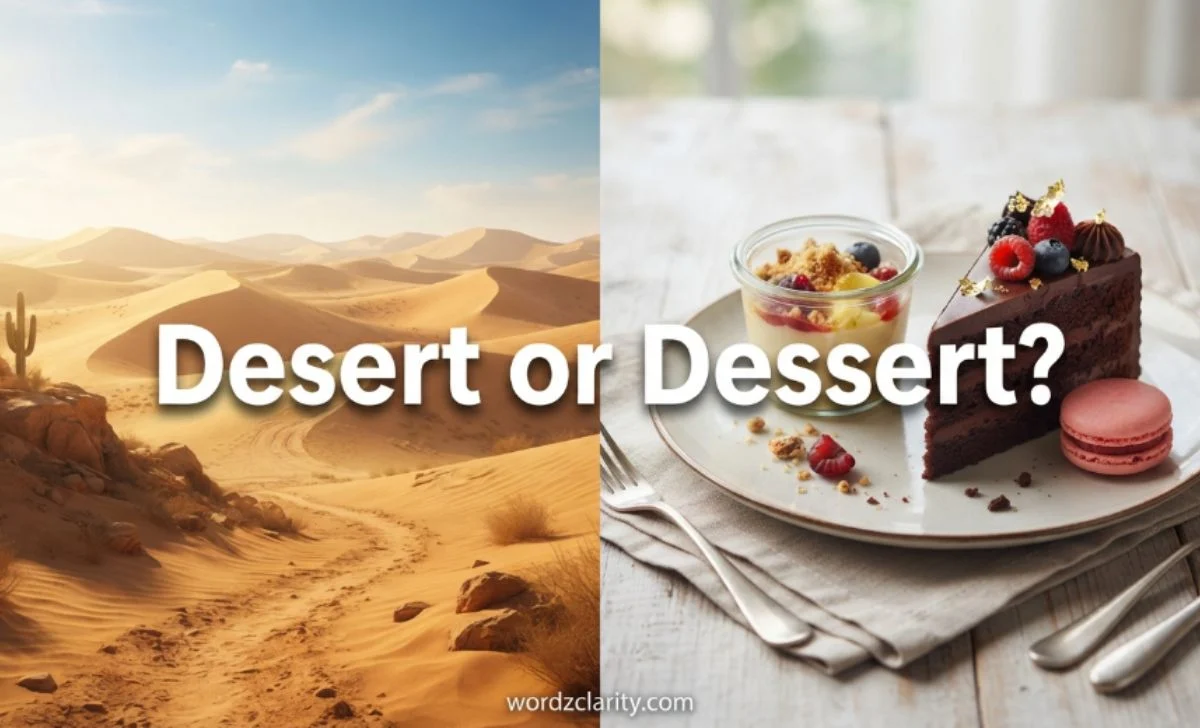
Desert or dessert? These two words are easy to mix up because they look almost identical, but their meanings are completely different.
A desert can be a dry region, such as the Sahara, while dessert is the sweet food served after a meal.
The confusion does not stop there. Desert can also be a verb meaning “to abandon,” and it appears in the expression “just deserts,” which has nothing to do with food. Knowing these different uses makes the spelling much easier to remember.
In this guide, you will learn how desert and dessert differ in meaning, pronunciation, grammar, and everyday usage, with clear examples that show exactly when each word belongs in a sentence.
Desert or Dessert: What’s the Difference?
The simplest distinction is this:
- Desert can mean a dry, usually arid region.
- Desert can also mean to abandon someone or something.
- Desert appears in “just deserts,” meaning something a person deserves.
- Dessert means a sweet dish or course served at the end of a meal.
The extra s in dessert is often what causes the confusion. A quick way to remember the spelling is to connect the two S’s with seconds: you may want a second helping of dessert.
However, spelling is only part of the story. Desert changes its pronunciation when its meaning changes, while dessert has its own pronunciation.
Understanding that difference helps you recognize these words when you hear them as well as when you see them in writing.
What Does “Desert” Mean?
The word desert has more than one meaning, and context tells you which one is intended.
Desert as a dry region
A desert is an area that receives very little precipitation. Deserts can have sand, rocks, mountains, or sparse vegetation. They are not necessarily hot; Antarctica, for example, is classified as a polar desert because of its extremely low precipitation.
The Sahara Desert is one of the best-known examples of a desert.
Consider these sentences:
The travelers crossed the desert before sunset.
Few plants can survive in such a dry desert environment.
The Sahara Desert covers a huge area of North Africa.
Here, desert is a noun referring to a type of geographical region.
Desert as a verb
Desert can also be a verb. In this use, it means to leave or abandon someone or something, particularly when there is an expectation that you should stay.
For example:
He refused to desert his family.
The soldier was accused of deserting his post.
She stayed with her team instead of deserting them when things became difficult.
This meaning has no connection with dry land. That is why context matters so much when reading or writing the word desert.
What Does “Dessert” Mean?
Dessert is a noun for food served at the end of a meal. Cake, ice cream, pie, pudding, and similar dishes can all be described as desserts.
For example:
We ordered chocolate cake for dessert.
Would you like some dessert?
The restaurant has several homemade desserts on its menu.
Unlike desert, dessert is normally used as a noun. If you are talking about the sweet course after dinner, lunch, or another meal, the correct spelling has two S’s.
A useful distinction is:
desert → dry land or abandon
dessert → sweet food
Desert and Dessert Pronunciation
Pronunciation adds another layer to this spelling confusion because desert has different stress patterns depending on its meaning.
When desert means a dry region, the stress falls on the first syllable:
DES-ert
The desert was almost completely silent.
When desert is a verb meaning to abandon, the stress moves to the second syllable:
de-SERT
He would never desert his friends.
Dessert is also pronounced:
de-SERT
We had ice cream for dessert.
So when speaking, the context helps distinguish the words:
DES-ert = a dry region
de-SERT = abandon
de-SERT = sweet food
This pronunciation difference is especially useful for English learners because desert and dessert may look confusing on the page but sound different when desert is used as a geographical noun.
Why Does “Dessert” Have Two S’s?
There is no need to memorize a complicated spelling rule. A simple mnemonic is enough:
You may want seconds of dessert, so remember the two S’s.
It is only a memory trick, not the historical reason for the spelling. Still, it can help prevent one of the most common mistakes:
❌ We had ice cream for desert.
✔️ We had ice cream for dessert.
When the sentence is about something sweet after a meal, dessert is the word you need.
Desert vs. Dessert: Quick Comparison
| Word | Meaning | Example |
|---|---|---|
| desert | A dry region | The camel crossed the desert. |
| desert | To abandon | He would never desert his family. |
| desert | Something deserved | He received his just deserts. |
| dessert | Sweet food after a meal | We ordered dessert. |
The important thing to remember is that desert has several meanings, while dessert is used for food. Once you recognize the context, choosing the correct spelling becomes much easier.
“Just Deserts” or “Just Desserts”?
One of the trickiest expressions involving these words is “just deserts.”
The phrase means that someone receives what they deserve, usually a consequence, reward, or punishment.
After years of treating his customers unfairly, the businessman finally got his just deserts.
It is easy to write just desserts because dessert is the more familiar word. However, the established expression is just deserts.
Here, deserts has nothing to do with cake, ice cream, or any other food. It comes from the noun desert, meaning something that is deserved.
So remember:
just deserts = something someone deserves
dessert = sweet food
“Desert Island” or “Dessert Island”?
The correct expression is desert island.
The two survivors were stranded on a desert island.
In this phrase, desert refers to an isolated or uninhabited place. It does not necessarily mean that the island is covered with sand.
You may also hear the phrase in a familiar hypothetical question:
If you were stranded on a desert island, what three things would you take?
Writing dessert island would be incorrect because dessert refers to food.
How Context Helps You Choose the Right Word
When you are unsure which spelling belongs in a sentence, look at what the word is describing.
Talking about a dry region
Use desert.
The road disappeared into the desert.
Talking about abandonment
Use desert.
He refused to desert his friends.
Talking about something deserved
Use deserts in the expression just deserts.
The dishonest manager got his just deserts.
Talking about food
Use dessert.
We ordered cheesecake for dessert.
This approach is much easier than trying to memorize two spellings without understanding their meanings.
Common Mistakes With Desert and Dessert
Because these words differ by only one letter, the wrong spelling can easily appear in otherwise correct writing.
Using “dessert” for a dry region
❌ The Sahara is a huge dessert.
✅ The Sahara is a huge desert.
The sentence refers to a geographical region, so desert is correct.
Using “desert” for food
❌ We had ice cream for desert.
✅ We had ice cream for dessert.
Ice cream is the sweet course served after a meal, so the word needs two S’s.
Using “dessert” as a verb
❌ He decided to dessert his family.
✅ He decided to desert his family.
Here, desert means to abandon.
Writing “just desserts”
❌ She got her just desserts.
✅ She got her just deserts.
The established expression is just deserts.
Writing “dessert island”
❌ They were stranded on a dessert island.
✅ They were stranded on a desert island.
The phrase refers to an isolated or uninhabited island.
Desert and Dessert in Everyday Situations
These words become easier to distinguish when you see them in ordinary situations.
Imagine you are having dinner at a restaurant. After the main course, the waiter might ask:
“Would you like to see the dessert menu?”
Later, you might read about a journey through North Africa:
“The route passes through the desert.”
In a completely different situation, a coach might say:
“You cannot desert your teammates when they need you.”
And when discussing the consequences of someone’s actions, you might hear:
“He got his just deserts.”
The words look similar, but their meanings are determined by the context.
Common Expressions With “Desert”
Understanding common word combinations can make desert easier to recognize in real writing.
Desert landscape
A desert landscape is the scenery or physical environment of a desert.
The desert landscape looked completely different at sunset.
Desert climate
A desert climate is characterized by very low precipitation.
Plants in a desert climate need ways to conserve water.
Desert wildlife
This refers to animals that live in desert environments.
The documentary explores how desert wildlife survives in harsh conditions.
Desert your responsibilities
Here, desert means to abandon your duties or obligations.
You cannot simply desert your responsibilities when things become difficult.
Desert your post
This expression means leaving a position or duty without permission.
The soldier was accused of deserting his post.
These examples show that desert is used in several contexts beyond geography.
How “Dessert” Is Used in Everyday English
Dessert is usually used when talking about the sweet part of a meal. It can refer to a single dish or to the final course as a whole.
We skipped the main course and went straight to dessert.
What did you have for dessert?
The chocolate cake was the best part of the meal.
You will also see the word used in phrases such as dessert menu, dessert course, and dessert table. In each case, the meaning remains the same: the food served or offered as dessert.
The important point is that dessert is a food word, and it always has two S’s.
Compare:
We walked across the desert before sunset.
We had ice cream for dessert.
The context makes the difference clear, even though the two words are pronounced similarly in some uses.
A Simple Way to Remember the Spelling
If you regularly confuse the spelling, use this familiar memory trick:
Dessert has two S’s because you may want seconds.
The idea is simple. You might want a second helping of your favorite dessert, so the word gets the extra S in your memory.
For example:
I enjoyed the dessert so much that I wanted seconds.
This is only a spelling mnemonic, not the historical reason for the word’s spelling. Its purpose is simply to make the difference easier to remember.
Desert or Dessert: Practice Your Choice
Choose the correct word for each sentence.
- We ordered cheesecake for ______.
- The travelers spent three days crossing the ______.
- He refused to ______ his family.
- The restaurant has an impressive ______ menu.
- The dishonest businessman got his just ______.
- They were stranded on a ______ island.
- Very little rain falls in a true ______ environment.
- She made a delicious chocolate ______.
Answers
- dessert
- desert
- desert
- dessert
- deserts
- desert
- desert
- dessert
The useful habit is to identify the meaning first. Once you know what the sentence is describing, the spelling usually becomes obvious.
FAQs
Is desert or dessert correct?
Both are correct words, but they have different meanings. Desert can refer to a dry region, mean “to abandon,” or appear in the phrase just deserts. Dessert means sweet food served at the end of a meal.
Is dessert spelled with one S or two?
Dessert is spelled with two S’s. A simple memory trick is to connect the extra S with seconds.
Is “just deserts” correct?
Yes. Just deserts is the standard expression. It means receiving something that a person deserves.
Is it “desert island” or “dessert island”?
The correct phrase is desert island. It refers to an isolated or uninhabited island.
Can desert be a verb?
Yes. Desert can be a verb meaning to leave or abandon someone or something.
How can I remember the difference between desert and dessert?
Think about the meaning first. Desert can refer to a dry region, abandonment, or something deserved. Dessert refers to food. For spelling, remember that dessert has two S’s because you may want seconds.
Final Verdict
Desert and dessert are both correct words, but they are used in different contexts.
Use desert for a dry region, such as the Sahara, or as a verb meaning “to abandon.” It also appears in the expression “just deserts,” meaning something a person deserves.
Use dessert when you mean a sweet dish served at the end of a meal.
The spelling is easier to remember with one simple trick: dessert has two S’s because you may want seconds.
So, if you’re talking about sand, abandonment, or what someone deserves, choose desert. If you’re talking about cake, ice cream, or another sweet dish, choose dessert.
Read More Blogs:
Coming, Not Comming: The English Rule Most Learners Miss
Stopped or Stoped? The Ultimate Guide to Correct English Spelling
Echoes or Echos: The Simple Grammar Rule Most Writers Miss
Is Ready or Not Cross-Platform? Everything You Need to Know