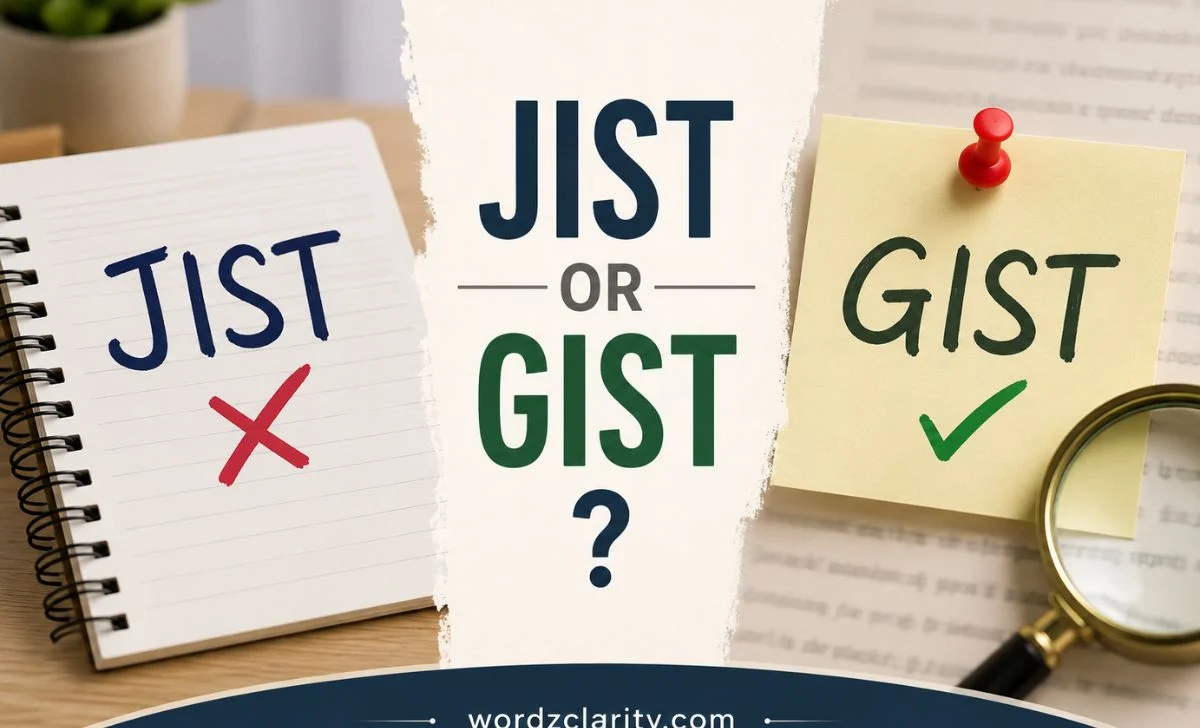
If you hear someone say “jist,” it is easy to assume the word is spelled jist. That pronunciation is exactly what makes this word confusing. In standard English, however, the correct spelling is gist, with a G.
The word usually means the main point, essential idea, or substance of something. For example, you might understand the gist of a conversation without remembering every detail.
Jist is generally a misspelling of gist, not an alternative spelling you should use in formal or everyday writing.
In this guide, we will look at the meaning, pronunciation, grammar, common expressions, examples, synonyms, and the reason gist sounds as though it begins with a J.
Jist or Gist: Which Spelling Is Correct?
Gist is the correct spelling in standard English.
Jist is generally considered a misspelling.
| Word | Correct? | Meaning |
|---|---|---|
| gist | Yes | The main point or essential idea |
| jist | No | Common misspelling of gist |
The confusion comes mainly from pronunciation. Gist begins with a sound like the j in jump, even though the word is written with g.
For example:
I didn’t understand every detail, but I got the gist.
Here, gist means the main idea or basic meaning.
So if you are writing about the central point of a conversation, article, argument, story, or explanation, use gist.
What Does “Gist” Mean?
Gist is a noun meaning the main point, essential idea, or basic meaning of something.
You can understand the gist of something without knowing every detail.
For example:
I read the report quickly, but I understood the gist.
This means the person understood what the report was mainly about, even if they did not study every part of it.
You can use gist when talking about many kinds of communication:
She explained the gist of the proposal to her manager.
I missed part of the conversation, so I asked Tom for the gist of it.
The article gives readers the gist of the new policy.
He understood the gist of the story but missed some important details.
The word is particularly useful when you want to distinguish the central idea from the smaller details surrounding it.
Why Is “Gist” Pronounced Like “Jist”?
This is the main reason people spell gist incorrectly.
The g in gist has a soft sound, represented in pronunciation as /dʒ/. It is the same sound you hear at the beginning of words such as:
- giant
- gentle
- general
- gym
So gist sounds roughly like “jist.”
That can make the spelling feel unusual when you first encounter the word.
Compare:
gist → sounds like “jist”
The important point is that pronunciation does not always tell you which letter to write. English has many words in which the same sound can be represented by different spellings.
For gist, the standard spelling is always G-I-S-T.
How to Use “Gist” in a Sentence
The most natural way to learn gist is to see how it works in real sentences.
The gist of something
The pattern “the gist of” is very common.
I understood the gist of the meeting.
Can you tell me the gist of the article?
She explained the gist of his argument.
We discussed the gist of the proposal before making a decision.
Here, gist refers to the central idea or substance of whatever follows.
The gist of it
You can also say “the gist of it.”
I don’t know all the details, but I understand the gist of it.
He gave me the gist of it during lunch.
This expression is useful when the specific subject has already been mentioned.
Give me the gist
In informal conversation, someone may ask:
Just give me the gist.
This means:
Tell me the main point without going into every detail.
For example, if a friend has just returned from a long meeting, you might say:
“I don’t have much time. Just give me the gist.”
“The Gist” or “A Gist”?
In ordinary English, the gist is the natural expression.
I understood the gist of the story.
She gave me the gist of the conversation.
What’s the gist of the article?
You will occasionally encounter gist in other grammatical constructions, but learners who are trying to express the main idea of something will usually need the pattern:
the gist of + noun
For example:
the gist of the story
the gist of the conversation
the gist of the argument
the gist of the message
This is one reason “the gist” appears so often in everyday English.
What Does “Get the Gist” Mean?
The expression “get the gist” means to understand the main idea or general meaning of something.
You do not necessarily understand every detail. You simply understand what matters most.
For example:
I didn’t read the whole email, but I got the gist.
Did you get the gist of what she was saying?
After a few minutes, I got the gist of the discussion.
Imagine that someone explains a complicated situation for ten minutes. You may not remember every name, date, or minor detail, but you understand what happened and why it matters.
You have got the gist.
This expression is common in both conversation and informal writing.
Gist vs. Summary: Are They the Same?
Gist and summary are related, but they are not always interchangeable.
A gist is the essential point or general idea.
A summary usually gives a condensed version of the main information.
For example:
I got the gist of the meeting.
This suggests that you understood the basic point.
But:
She sent me a summary of the meeting.
This suggests that she provided a shortened account of what was discussed, probably including several important points.
Think of it this way:
gist → What is the main point?
summary → What were the main points?
The distinction is not absolute in every context, but it is useful when choosing the more precise word.
Common Expressions With “Gist”
Several expressions occur naturally with gist.
The gist of the story
I understood the gist of the story, even though I didn’t finish the book.
The gist of the conversation
Can you tell me the gist of the conversation?
The gist of the argument
I understand the gist of your argument, but I disagree with your conclusion.
The gist of the article
The first paragraph gives you the gist of the article.
The gist of it
I don’t know all the technical details, but I understand the gist of it.
Get the gist
I didn’t catch every word, but I got the gist.
These patterns are more useful to remember than the word gist by itself because they show how native speakers commonly use it.
Is “Jist” Ever Correct?
For standard modern English, gist is the spelling you should use when you mean the main idea or essential point.
I understood the gist of the message.
Not:
I understood the jist of the message.
The spelling jist may appear in informal writing, historical material, names, or text that intentionally represents a person’s pronunciation, but it is not the standard spelling of the ordinary English noun gist.
For schoolwork, professional writing, emails, articles, and other formal contexts, use gist.
The Legal Meaning of “Gist”
Although most people encounter gist in everyday language, the word also has a specialized use in legal English.
In legal contexts, gist can refer to the essential grounds or substance of a legal action or claim.
For example:
The court considered the gist of the plaintiff’s claim.
This use is less common in ordinary conversation, but it helps explain why gist has a more formal sense related to the central substance of an issue.
You do not need the legal meaning to use the everyday word correctly, but recognizing it can help when reading legal documents or legal commentary.
Where Did the Word “Gist” Come From?
The unusual spelling of gist makes more sense when you look at its history.
The word came into English through Anglo-French legal language. Its earlier sense was connected with the place or grounds on which a legal action rested.
Over time, its meaning developed toward the idea of the essential point or substance of something.
That historical development is also why the modern word can be used both in ordinary language and in more specialized legal contexts.
The modern everyday meaning is much simpler: the main point or essential idea.
Common Mistakes With “Gist”
Mistake 1: Spelling it “jist”
❌ I didn’t understand the jist of the presentation.
✅ I didn’t understand the gist of the presentation.
The pronunciation may sound like jist, but the standard spelling is gist.
Mistake 2: Using the wrong article
❌ Give me a gist of the story.
✅ Give me the gist of the story.
When referring to the central idea of a specific thing, the gist of is the natural construction.
Mistake 3: Confusing gist with every detail
I know the gist, but I don’t remember all the details.
This is perfectly natural because gist refers to the essential idea, not a complete account.
Mistake 4: Treating “gist” as a verb
Gist is normally used as a noun in everyday English.
Instead of trying to turn it into a verb, use expressions such as:
I got the gist.
I understood the gist.
She explained the gist.
Gist Synonyms: What Can You Say Instead?
Depending on the context, several words can express a similar idea.
- main point
- main idea
- essence
- core
- substance
- central idea
- general idea
- key point
For example:
I got the gist of the discussion.
can become:
I understood the main point of the discussion.
However, these words are not identical in every situation. Gist is especially useful when you mean the essential meaning without all the surrounding detail.
Gist in Real-Life English
The word appears naturally in situations where people need to communicate information quickly.
At work
I have a meeting in five minutes. Can you give me the gist of the report?
In a conversation
I didn’t hear the whole story, but I got the gist.
While reading
I skimmed the article and got the gist.
During a presentation
The opening slide gives you the gist of the proposal.
Discussing an email
I read the message earlier. What’s the gist of the reply?
These examples show why gist is useful in everyday communication. It allows you to talk about understanding the core message without going through every detail.
Jist or Gist: Test Yourself
Choose the correct word in each sentence.
- I didn’t read the whole report, but I understood the ______.
- Can you give me the ______ of the conversation?
- She explained the ______ of the proposal in two minutes.
- I only skimmed the article, but I got the ______.
- What’s the ______ of his argument?
- I couldn’t remember every detail, but I understood the ______.
Answers
- gist
- gist
- gist
- gist
- gist
- gist
In every sentence, the word means the main point or essential idea.
FAQs
Is it “jist” or “gist”?
Gist is the correct spelling. Jist is generally a misspelling caused by the way gist is pronounced.
Is “jist” a real word?
It is not the standard spelling of the English word meaning “main idea” or “essential point.” In normal writing, use gist.
What does “gist” mean?
Gist means the main point, essential idea, or general meaning of something.
How do you pronounce “gist”?
Gist is pronounced with a soft g, so it sounds like “jist.”
Why does “gist” sound like “jist”?
The g in gist represents the /dʒ/ sound, the same sound heard at the beginning of words such as giant and gentle.
Is it “the gist” or “a gist”?
When referring to the main idea of a particular subject, the gist is the natural form.
I understood the gist of the story.
What does “get the gist” mean?
Get the gist means to understand the main idea or general meaning without necessarily knowing every detail.
What is a synonym for “gist”?
Depending on the context, synonyms include main point, main idea, essence, core, substance, and central idea.
Final Verdict:
When you mean the main point or essential idea of something, the correct spelling is gist. Although it sounds as if it begins with a J, the standard spelling begins with G.
That pronunciation is the main reason jist is such a common mistake. Once you connect the sound with the correct spelling, the word becomes much easier to remember.
So, if you are writing about the main idea of a story, conversation, article, meeting, or argument, use gist. If you see jist used with that meaning, it is generally a spelling error.
The simple rule is: gist is correct; jist is not the standard spelling.
If you are writing for school, work, or any other standard English context, choose gist, not jist.
The easiest rule to remember is:
It sounds like “jist,” but it is spelled “gist.”
Read More Blogs:
Pheonix or Phoenix: Which Spelling Is Correct?
Abley or Ably: The English Spelling Rule Most People Miss
Treet or Treat : The One Letter That Changes Everything
Mistakingly or Mistakenly: Which Word Is Correct?