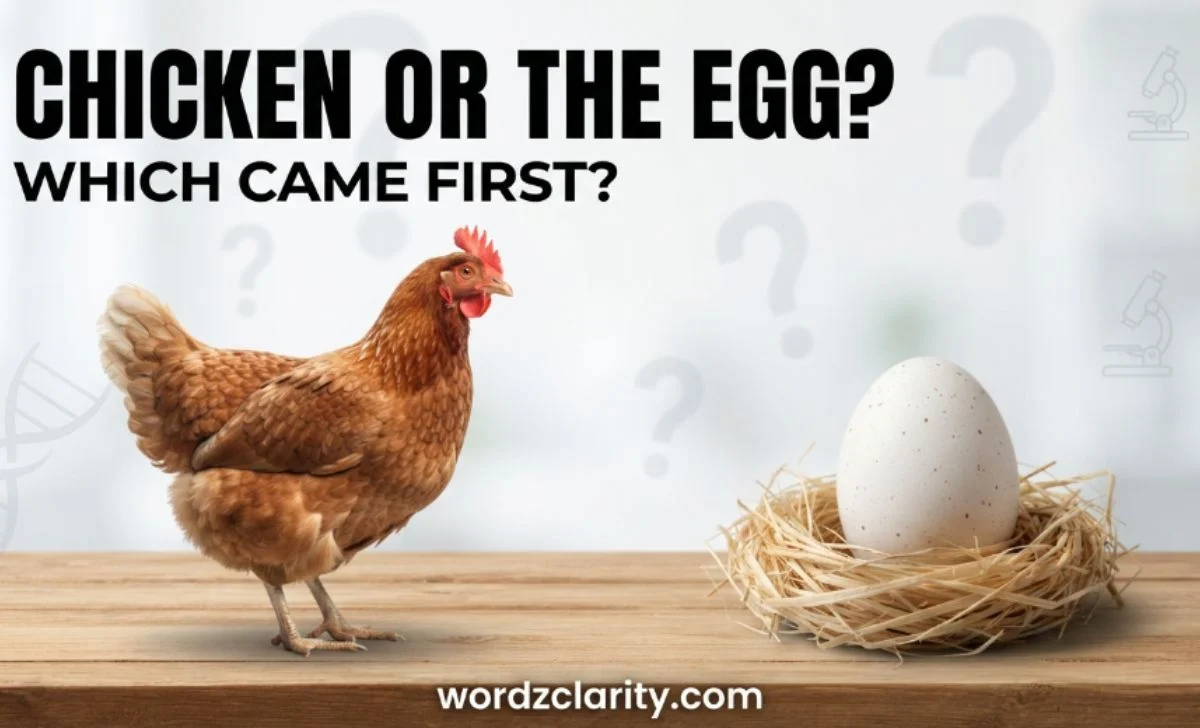
“Which came first, the chicken or the egg?” sounds like a simple question, but the answer depends on what you mean by egg and chicken.
If you mean eggs in general, the egg clearly came first because egg-laying animals existed long before chickens. If you mean the first egg containing a true chicken, evolutionary biology still points to the egg.
A bird that was almost, but not quite, a modern chicken laid an egg containing the first animal we would classify as a chicken. At the same time, the question has a deeper meaning in philosophy and everyday English.
It describes situations where two things depend on each other, making it difficult to identify which one started the chain. That is why the chicken-and-egg question has remained so memorable.
Chicken or the Egg: What Came First?
The egg came first.
From an evolutionary perspective, eggs existed hundreds of millions of years before modern chickens. Long before chickens appeared, many animals reproduced by laying eggs.
The first chickens also did not suddenly appear without ancestors. They evolved gradually from earlier birds through changes passed down across generations.
At some point, a bird that was extremely similar to what we would call a chicken produced an egg. Genetic changes during reproduction contributed to the development of the first organism that could reasonably be classified as a modern chicken.
So, if the question is asking which came first in evolutionary history, the egg has the stronger scientific answer.
But there is an important detail: the answer changes slightly depending on how you define a chicken egg.
Why the Egg Came Before the Chicken
The easiest way to understand the answer is to stop thinking about chickens for a moment.
Eggs are much older than chickens.
Fish, amphibians, reptiles, and early land animals existed long before the modern chicken. Egg-laying was already an established reproductive strategy before birds evolved.
Birds themselves appeared much later in evolutionary history. Modern chickens belong to the bird family and developed from earlier bird lineages.
That means the basic sequence looks something like this:
Egg-laying animals → early reptiles and birds → chicken ancestors → modern chicken
The exact evolutionary history is more complicated than a simple straight line, but the important point is clear: eggs did not originate with chickens.
Even shelled eggs appeared long before modern chickens.
So if someone asks:
“Did eggs exist before chickens?”
the answer is unquestionably yes.
What About the First Chicken Egg?
This is where the famous question becomes more interesting.
Suppose we define a chicken egg as:
an egg that contains a chicken.
In that case, the egg can come first.
A chicken’s ancestors gradually changed through evolution. At some point, an organism that was not quite identical to a modern chicken produced an egg containing the first animal that met our definition of a chicken.
The parents did not need to be modern chickens for the egg to contain the first chicken.
This is similar to how species evolve generally. There is rarely a single dramatic moment when one animal gives birth to an entirely unrelated new species. Instead, small genetic changes accumulate over many generations.
So the scientific explanation is not:
“A completely different animal suddenly laid a chicken.”
It is better understood as gradual evolutionary change.
The Definition Problem: What Counts as a Chicken Egg?
There are actually two possible meanings.
An egg laid by a chicken
If you define a chicken egg as an egg laid by a chicken, then the chicken must come first.
A chicken lays the egg, so logically:
chicken → chicken egg
An egg containing a chicken
If you define a chicken egg as an egg that contains a chicken, then the egg can come first.
The evolutionary sequence becomes:
near-chicken ancestor → egg → first chicken
This distinction explains why people can argue about the answer without necessarily disagreeing about the science.
They may simply be using different definitions.
Why Is the Chicken-and-Egg Question a Paradox?
The question is more than a biology puzzle.
It represents a problem of cause and effect.
If a chicken produces an egg, and that egg produces a chicken, which one should be considered the beginning?
The relationship can be represented as:
Chicken → Egg → Chicken → Egg → Chicken
There appears to be no obvious starting point.
This is why the question became a classic example of circular causation and the problem of identifying a first cause.
In philosophy, questions like this can lead to broader issues involving origins, dependence, and infinite regress.
The Ancient Philosophical Question
The chicken-and-egg problem is much older than the modern scientific debate.
Ancient philosophers considered whether the chicken or egg had a first beginning and what that would mean for the existence of living things.
Aristotle
Aristotle discussed the problem in the context of origins and whether there could be a first member of an apparently endless sequence.
His interest was not simply in poultry. The question raised a larger issue: if one thing always comes from another, where does the chain begin?
Plutarch
Later, Plutarch also discussed the chicken-and-egg problem as a philosophical question about beginnings.
This historical background helps explain why the phrase became more than a literal question about birds. It became a convenient way to discuss problems where two possible causes seem to depend on each other.
What Does “Chicken-and-Egg Problem” Mean?
In modern English, a chicken-and-egg problem is a situation in which two things depend on each other, making it difficult to determine which came first.
For example:
A new business needs customers to grow, but customers may want to see an established business before buying from it.
That is a chicken-and-egg problem.
The business needs customers, while the customers may need evidence that the business is established. Neither side provides an obvious starting point.
The expression is therefore often used metaphorically rather than literally.
Chicken or the Egg in Real-Life Situations
The phrase appears in many areas of everyday life.
Business
Imagine a company launching a new product.
It needs customers to generate revenue, but it may need revenue to develop a better product and attract more customers.
The company faces a chicken-and-egg problem: it needs users to improve the platform, but it needs a better platform to attract users.
Jobs and Experience
This is another familiar example.
Employers often want experience, but people need employment opportunities to gain that experience.
Getting your first job can feel like a chicken-and-egg situation because employers want experience and you need a job to get it.
Technology
A new social platform needs users to become useful. However, people may not join until enough other users are already there.
The platform is caught in a chicken-and-egg problem: users attract users, but it needs users before the network becomes valuable.
Marketing
A company may need brand awareness to attract customers, while it needs customers and sales to build brand awareness.
Building a new brand can create a chicken-and-egg dilemma between visibility and customer growth.
Education
Students sometimes face a similar problem when trying to enter competitive fields.
Employers ask for practical experience, while students need opportunities to gain that experience.
The expression works because the two sides are interdependent.
Chicken or the Egg vs. Chicken-and-Egg Problem
These expressions are closely related, but they are not used in exactly the same way.
“Which came first, the chicken or the egg?”
This is the famous literal question. It can be discussed as a scientific, philosophical, or logical problem.
“A chicken-and-egg problem”
This is normally a metaphor.
It describes a situation in which two conditions depend on one another, and there is no obvious starting point.
For example:
Which comes first, customer demand or production?
could be described as:
It’s a chicken-and-egg problem.
The first is a question. The second is a description of a situation.
Is “Chicken-and-Egg” an Idiom or a Paradox?
It can be understood in more than one way depending on context.
The original chicken-or-egg question is commonly treated as a philosophical riddle or paradox about origins and causation.
The expression chicken-and-egg is now widely used as a metaphor for a cause-and-effect dilemma.
For example:
We have a chicken-and-egg situation here.
The speaker is probably not talking about poultry. They mean that two factors depend on each other.
So calling it only an “idiom” or only a “paradox” can miss part of its usage. The literal question and the modern expression serve slightly different purposes.
Common Ways to Use “Chicken-and-Egg”
Here are some natural forms you may encounter.
Chicken-and-egg problem
Finding customers before launching the product is a chicken-and-egg problem.
Chicken-and-egg dilemma
The company faces a chicken-and-egg dilemma between hiring staff and increasing sales.
Chicken-and-egg situation
It’s a chicken-and-egg situation: you need experience to get hired, but you need to be hired to gain experience.
Chicken-and-egg question
The discussion raises the familiar chicken-and-egg question of which came first.
Which came first, the chicken or the egg?
Which came first, the chicken or the egg? It depends on how you define an egg.
These forms are all natural, but the hyphenated chicken-and-egg is commonly used when the phrase functions as a compound modifier.
Common Misunderstandings About the Question
“The chicken obviously came first because chickens lay eggs.”
That argument depends on defining a chicken egg as an egg laid by a chicken.
It does not answer the broader evolutionary question about eggs.
“The egg always came first.”
That is scientifically reasonable if egg means eggs in general, but the definition of chicken egg can change the wording of the question.
“A chicken suddenly evolved from a completely different animal.”
Evolution does not work that way.
Species change gradually across generations. The first organism we classify as a chicken would have had very close ancestors.
“It is only a joke.”
The question can certainly be used humorously, but its history includes serious philosophical discussion about causation and origins.
Why the Question Still Matters
The chicken-and-egg question remains popular because it captures a problem people encounter far beyond biology.
Many real situations involve two factors that reinforce one another:
more customers → more growth → more customers
more experience → better job opportunities → more experience
more users → more network value → more users
When neither side has an obvious starting point, calling it a chicken-and-egg problem communicates the difficulty immediately.
That is why the expression has survived even though modern evolutionary science gives us a strong answer to the literal question.
FAQs
Which came first, the chicken or the egg?
Scientifically, the egg came first. Eggs existed long before chickens. If you specifically define a chicken egg as an egg laid by a chicken, however, the chicken must come first by definition.
Did eggs exist before chickens?
Yes. Egg-laying animals existed millions of years before modern chickens evolved.
What came first according to evolution?
The egg came first. A chicken-like ancestor would have laid the egg from which the first organism classified as a chicken developed.
What is a chicken-and-egg problem?
It is a situation in which two things depend on each other, making it difficult to determine which came first or which caused the other.
Is “chicken-and-egg” an idiom?
Chicken-and-egg is a common English expression used metaphorically for a cause-and-effect dilemma. The original question also has a long philosophical history.
What is an example of a chicken-and-egg situation?
A common example is employment and experience: employers want experienced workers, but workers need jobs to gain experience.
Who discussed the chicken-and-egg problem in ancient philosophy?
Aristotle discussed the question in connection with origins and causation, and Plutarch later addressed it as a philosophical problem.
Is the chicken-and-egg question actually a paradox?
It can be treated as a paradox or philosophical puzzle because the two possibilities appear to depend on each other. In modern science, however, evolutionary biology provides a practical explanation for the literal question.
Final Verdict:
If the question is about eggs in general, the egg clearly came first. Egg-laying animals existed long before chickens evolved.
If the question is specifically about the first chicken, the egg still comes first under the evolutionary explanation: a chicken-like ancestor laid the egg from which the first chicken developed.
But the lasting appeal of the question is not only scientific. “Chicken-and-egg problem” has become a useful way to describe situations where two things depend on each other and neither has an obvious starting point.
So the best short answer is:
The egg came first , but the meaning of the question depends on how you define “chicken egg.”
Read More Blogs:
Pheonix or Phoenix: Which Spelling Is Correct?
Abley or Ably: The English Spelling Rule Most People Miss
Treet or Treat : The One Letter That Changes Everything
Mistakingly or Mistakenly: Which Word Is Correct?