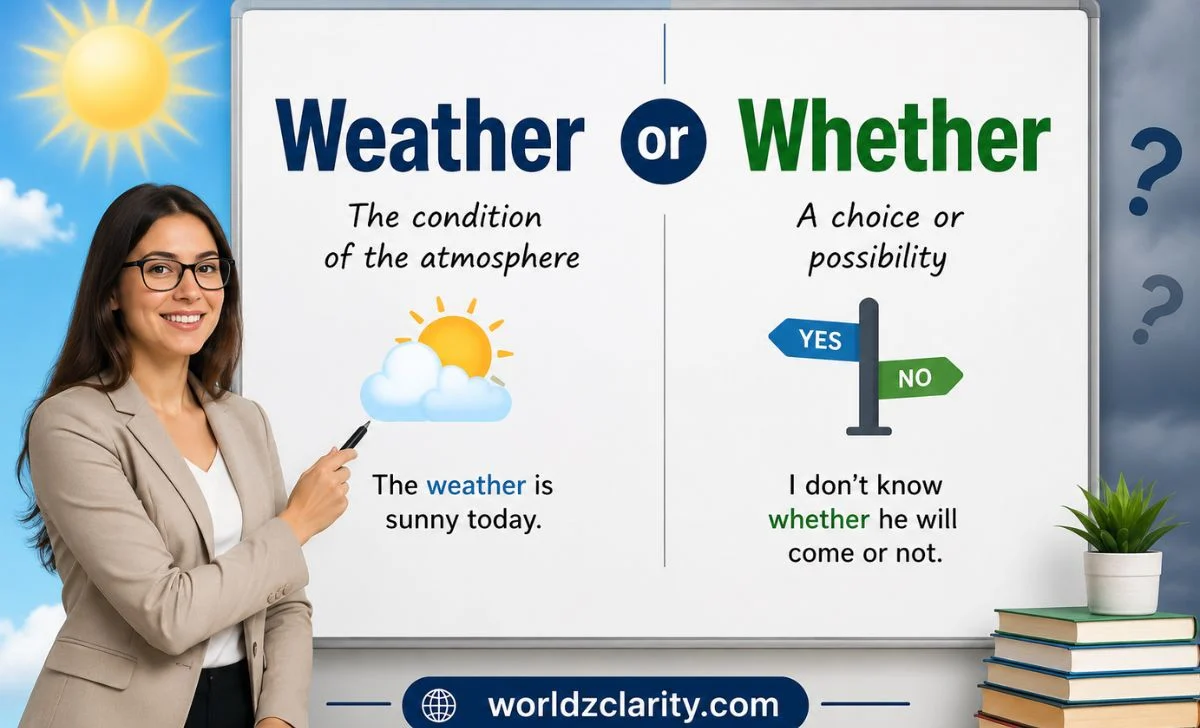
Weather and whether sound the same, but they have completely different meanings and grammatical roles. Weather usually refers to conditions in the atmosphere, such as rain, wind, temperature, or sunshine. Whether is used when talking about a choice, possibility, or uncertainty.
For example, you might say, “The weather is getting colder,” but “I don’t know whether she will come.” The pronunciation may cause confusion, especially when you are writing from something you have heard rather than seen.
The difference becomes easier once you look at what each word is doing in a sentence. This guide explains their meanings, grammar, pronunciation, common uses, and the situations in which writers most often confuse them.
Weather vs Whether at a Glance
| Word | Part of speech | Main meaning | Example |
|---|---|---|---|
| Weather | Noun, verb | Atmospheric conditions; to endure | The weather is warm today. |
| Whether | Conjunction | Choice, possibility, or uncertainty | I don’t know whether he will come. |
The simplest distinction is this:
Weather is connected with the atmosphere.
Whether is connected with a choice, possibility, or two alternatives.
The weather looks terrible today.
We haven’t decided whether to go.
These words are homophones, meaning they are pronounced alike but have different spellings and meanings.
What Does “Weather” Mean?
The most common use of weather is as a noun referring to the condition of the atmosphere at a particular time and place.
It can include:
- temperature
- rain
- snow
- wind
- clouds
- sunshine
- storms
- humidity
For example:
The weather is beautiful today.
We checked the weather before leaving home.
Bad weather delayed the flight.
The weather forecast says it will rain tonight.
Here, weather describes what is happening in the atmosphere.
Weather Is About Conditions, Not Just Rain
A common mistake is to think that weather only means rain or storms. It is much broader than that.
A bright, sunny afternoon has weather.
A cold winter morning has weather.
A windy day has weather.
A thunderstorm has weather.
Even an unusually hot or humid day is a description of the weather.
So if you are talking about temperature, rain, wind, sunshine, snow, clouds, or atmospheric conditions, the word you need is weather.
Weather as a Verb
Although most people first learn weather as a noun, it can also function as a verb.
As a verb, weather means to successfully endure or survive something difficult.
For example:
The company weathered the financial crisis.
She weathered months of criticism from the press.
The family weathered the difficult period together.
This meaning is different from the everyday noun referring to rain or temperature, but the connection is easy to understand: something that weathers a difficult situation manages to withstand it.
The verb is especially common in expressions such as:
weather the storm
The phrase can be literal:
The sailors managed to weather the storm.
But it is also frequently used figuratively:
The business survived the downturn and weathered the storm.
In the second sentence, storm refers to a difficult period rather than an actual weather event.
What Does “Whether” Mean?
Whether is a conjunction used to introduce a choice, alternative, or uncertainty.
For example:
I don’t know whether he is coming.
The speaker does not know which possibility is true: he may come, or he may not.
Another example is:
She is deciding whether to accept the job.
Here, whether introduces a decision between alternatives.
It can also appear when there are two clearly stated choices:
I can’t decide whether to travel by train or by bus.
We need to determine whether the problem is with the software or the hardware.
In all these examples, whether has nothing to do with rain, temperature, or atmospheric conditions.
Whether in Everyday Sentences
You will often see whether after verbs that involve decisions, knowledge, questions, or uncertainty.
Common examples include:
I don’t know whether he is available.
She asked whether we needed anything.
They haven’t decided whether to stay.
We need to find out whether the store is open.
He wasn’t sure whether the information was accurate.
Notice that these sentences are about knowing, asking, deciding, or determining between possibilities.
That is a useful clue when choosing between weather and whether.
Weather or Whether: Look at the Meaning
Because the two words sound identical, pronunciation alone cannot help you choose the spelling. The meaning of the sentence has to guide you.
Compare these examples:
The weather is too cold for a picnic.
This is about atmospheric conditions.
I don’t know whether we should have a picnic.
This is about a decision.
Now look at another pair:
We checked the weather before booking the trip.
We haven’t decided whether to book the trip.
The first sentence concerns conditions outside. The second concerns a choice.
This is why simply memorizing the spelling is less useful than understanding the role of each word.
How to Remember Weather vs Whether
A quick meaning-based test can help.
1. Think About the Atmosphere
If you are talking about:
- rain
- wind
- temperature
- sunshine
- snow
- storms
- clouds
- a forecast
use weather.
What’s the weather like today?
2. Think About a Choice
If the sentence involves:
- a decision
- uncertainty
- two possibilities
- an indirect yes/no question
- whether one thing is true or another is true
use whether.
I don’t know whether I should go.
A useful mental shortcut is:
Weather = conditions outside.
Whether = possibilities or choices.
This is more reliable than trying to remember the spelling from pronunciation alone.
Why Do Weather and Whether Sound the Same?
Weather and whether are homophones in standard English pronunciation. In other words, they are normally pronounced the same even though they have different spellings and meanings.
This is why the mistake is so common in writing.
Someone may hear:
“I don’t know whether he’ll come.”
and later write:
“I don’t know weather he’ll come.”
The speaker’s pronunciation does not provide enough information to determine the spelling. The writer has to recognize the meaning and grammatical function.
Other common English homophones include:
- there / their / they’re
- to / too / two
- your / you’re
- its / it’s
Weather / whether belongs to the same family of sound-alike words.
Weather in Real-Life Writing
Because weather is a common noun, it appears in many everyday contexts.
Travel
We checked the weather before our flight.
Bad weather caused several delays.
Outdoor Plans
The game will be canceled if the weather gets worse.
We can go hiking if the weather stays clear.
News and Forecasts
The weather forecast predicts heavy rain tonight.
Severe weather is expected across the region.
Everyday Conversation
How’s the weather where you are?
The weather has been unusually warm this week.
These examples all describe atmospheric conditions, so weather is the correct word.
Whether in Real-Life Writing
Whether is equally common, but it appears in a completely different kind of sentence.
Making a Decision
I’m not sure whether I should accept the offer.
Expressing Uncertainty
We don’t know whether the package has arrived.
Asking Indirectly
She asked whether I needed help.
Considering Alternatives
They must decide whether to repair the car or replace it.
Here, the word introduces a question, uncertainty, or alternative. None of these sentences concerns the atmosphere, so whether is required.
A Common Pattern: “Whether … or …”
One useful structure is:
whether … or …
It presents two alternatives.
For example:
I don’t know whether to stay or leave.
Whether you agree or disagree, the decision has been made.
We need to decide whether to buy a new computer or repair the old one.
The alternatives do not always have to be stated immediately.
Whether we go is still uncertain.
The key idea is that whether introduces a possibility or choice.
This is one of the clearest grammatical clues that you need whether, not weather.
Weather and Climate Are Not the Same
Another useful distinction is between weather and climate.
Weather describes atmospheric conditions over a relatively short period:
The weather is rainy this week.
Climate describes the typical weather patterns of a place over a much longer period.
The region has a hot, dry climate.
The two concepts are related, but they are not interchangeable.
You can talk about today’s weather, while discussing the long-term climate of a country or region.
This distinction is especially useful in academic, environmental, and news writing.
Common Collocations With “Weather”
Certain word combinations make the meaning of weather especially easy to recognize.
Common examples include:
- weather forecast
- weather conditions
- weather report
- bad weather
- severe weather
- extreme weather
- cold weather
- hot weather
- rainy weather
- sunny weather
- weather patterns
For example:
Check the weather forecast before you leave.
The event was canceled because of severe weather.
These expressions all refer to atmospheric conditions.
The word also appears in figurative expressions:
weather the storm
weather difficult conditions
weather a crisis
These uses come from the verb weather, meaning to endure or survive something challenging.
Whether or If: Can You Use Both?
One of the most useful things to understand about whether is its relationship with if. In many sentences, both words can introduce an indirect yes-or-no question.
For example:
I don’t know whether she is coming.
I don’t know if she is coming.
Both sentences are correct. They have essentially the same meaning: the speaker does not know if she will come.
The choice between whether and if becomes more important in certain grammatical structures.
1. When Both Forms Work
After verbs such as know, ask, wonder, and find out, both if and whether are often possible.
She asked if I needed help.
She asked whether I needed help.
We need to find out if the store is open.
We need to find out whether the store is open.
In everyday conversation, if is very common. Whether can sound slightly more formal and is often preferred in careful writing.
2. When “Whether” Is Better
Whether is especially useful when the sentence presents two alternatives.
I don’t know whether to stay or leave.
They must decide whether to repair the car or replace it.
We need to determine whether the problem is with the software or the hardware.
Here, whether works naturally because the sentence involves a choice between alternatives.
3. Whether Before a “To” Infinitive
One important grammatical pattern is:
whether + to + verb
For example:
I can’t decide whether to go.
She is considering whether to accept the offer.
He doesn’t know whether to call or wait.
In this structure, whether is the natural choice. We do not normally replace it with if:
❌ I can’t decide if to go.
✅ I can’t decide whether to go.
This is one of the clearest situations where knowing the difference between if and whether helps.
Whether or Not: The Correct Expression
Whether or not is a common expression used when the result remains the same regardless of which possibility is true.
For example:
I’ll go whether or not it rains.
This means that the speaker will go in either case: if it rains or if it does not rain.
Another example:
We need to finish the project whether or not the client approves it.
The decision does not depend on the client’s approval.
You can also place or not later in the sentence:
I’ll go whether it rains or not.
Both structures are correct:
whether or not it rains
whether it rains or not
The important point is that the spelling is whether, not weather, when you are expressing alternatives or uncertainty.
Weather or Not: Why This Mistake Happens
The phrase weather or not is one of the most common spelling mistakes involving these two words.
If you mean “regardless of whether something happens,” the correct expression is:
whether or not
For example:
I don’t know whether or not he will come.
Not:
❌ I don’t know weather or not he will come.
The mistake happens because weather and whether are pronounced alike. When people hear the phrase rather than see it in writing, it is easy to choose the wrong spelling.
There is, however, an interesting exception: weather or not can be grammatically meaningful when weather refers to actual atmospheric conditions.
For example:
We will continue the event, weather or not.
This can be understood literally as saying that the event will continue regardless of the weather. However, in ordinary writing, the sentence may sound unusual or ambiguous. A clearer version would be:
We will continue the event, whatever the weather.
Or:
We will continue the event whether or not the weather improves.
So if you are expressing choice, uncertainty, or alternatives, use whether.
Whether or Not vs Whether … or Not
Both forms are common, but they can appear in slightly different positions.
I don’t know whether or not she will attend.
I don’t know whether she will attend or not.
Both mean essentially the same thing.
The first places or not directly after whether. The second places it at the end of the clause.
Another example:
Whether or not we win, we will learn something from the experience.
Whether we win or not, we will learn something from the experience.
Both are natural.
In many cases, or not is optional because whether already introduces an alternative. But adding it can emphasize that both possibilities are being considered.
Common Mistakes With Weather and Whether
Because the words sound the same, most errors are spelling mistakes rather than pronunciation mistakes.
1. Using “Weather” for a Choice
Incorrect:
❌ I don’t know weather she will come.
Correct:
✅ I don’t know whether she will come.
The sentence is about uncertainty, not atmospheric conditions.
2. Writing “Weather or Not”
Incorrect when expressing an alternative:
❌ I don’t know weather or not they will agree.
Correct:
✅ I don’t know whether or not they will agree.
3. Using “Whether” for Atmospheric Conditions
Incorrect:
❌ I checked the whether before leaving.
Correct:
✅ I checked the weather before leaving.
The sentence refers to atmospheric conditions, so weather is required.
4. Confusing Weather With Climate
These words are related but have different meanings.
The weather is unusually cold this week.
The region has a cold climate.
Weather describes conditions over a relatively short period, while climate refers to longer-term patterns.
5. Forgetting the Verb “Weather”
Some writers know only the noun meaning of weather and miss sentences such as:
The company weathered the crisis.
Here, weathered means endured or survived. It has nothing to do with the forecast.
Weather, Whether, and Wether
There is a third word that is sometimes confused with these two: wether.
Unlike weather and whether, wether is not a common everyday word.
A wether is a castrated male sheep.
For example:
The farmer separated the wether from the flock.
So the three words have completely different meanings:
| Word | Meaning |
|---|---|
| Weather | Atmospheric conditions; also to endure something difficult |
| Whether | Introduces alternatives, choices, or uncertainty |
| Wether | A castrated male sheep |
For most English learners, weather and whether are the important pair to remember. Wether is mainly useful to recognize when reading specialized vocabulary related to sheep or farming.
Weather or Whether in Formal Writing
Both words are perfectly standard, but using the correct one is especially important in professional and academic writing because a spelling mistake can change the meaning of the sentence.
Compare:
The report examines whether the policy is effective.
with:
The report examines weather the policy is effective.
The second sentence contains a spelling error that makes the sentence look careless.
In formal writing, whether is often a good choice when introducing an indirect question or alternative:
The researchers examined whether the treatment produced consistent results.
The committee will decide whether the proposal should be approved.
At the same time, weather remains the correct word whenever the subject is atmospheric conditions:
The researchers recorded weather conditions throughout the study.
The surrounding context usually makes the correct spelling clear.
Real-Life Examples: Weather or Whether?
Seeing both words in natural contexts is often more useful than memorizing definitions.
1. Travel
We checked the weather before booking the outdoor tour.
We haven’t decided whether to book it yet.
The first sentence concerns conditions outside. The second concerns a decision.
2. Work
Bad weather delayed several employees.
The manager hasn’t decided whether the meeting should be postponed.
Again, the words perform completely different jobs.
3. Education
Students should check the weather before the field trip.
The teacher will decide whether the trip can go ahead.
4. Everyday Conversation
What’s the weather like today?
I don’t know whether I’ll go out tonight.
5. Business
The company managed to weather the economic downturn.
Investors are watching to see whether the company can remain profitable.
These examples also show why weather can appear in both literal and figurative contexts, while whether remains connected to alternatives and uncertainty.
A Quick Test Before You Write
If you are unsure which word belongs in a sentence, do not rely on pronunciation. Try replacing the word with something that reveals its meaning.
Test 1: Can You Replace It With “Atmospheric Conditions”?
If yes, use weather.
The weather is getting worse.
You could think of this as:
The atmospheric conditions are getting worse.
So weather is correct.
Test 2: Can You Replace It With “If”?
If the sentence is expressing uncertainty or an alternative, whether is probably the right choice.
I don’t know whether he will come.
You can understand this as:
I don’t know if he will come.
So whether is correct.
This simple test is more useful than trying to remember which spelling “looks right.”
FAQs
1. What is the difference between weather and whether?
Weather refers mainly to atmospheric conditions such as rain, wind, temperature, and sunshine. Whether introduces a choice, alternative, or uncertainty.
2. Are weather and whether pronounced the same?
Yes. In standard English, they are generally homophones, meaning they have the same pronunciation but different spellings and meanings.
3. Is “weather or not” correct?
Usually not when you mean “whether something is true or not.” In that sense, the correct expression is whether or not.
However, weather or not can have a literal meaning involving weather conditions, although clearer wording is often preferable.
4. Can “whether” mean “if”?
Yes. In many indirect questions, whether and if can both be used:
I don’t know whether she is coming.
I don’t know if she is coming.
However, whether is required or preferred in some structures, including whether + to-infinitive.
5. Is “whether or not” grammatically correct?
Yes. It is a standard construction used to refer to two possibilities.
We’ll continue whether or not they agree.
6. Can weather be a verb?
Yes. As a verb, weather means to endure or survive something difficult.
The company weathered the crisis.
7. What is the difference between weather and climate?
Weather describes atmospheric conditions over a shorter period, while climate describes the typical long-term weather patterns of a place.
8. What does “wether” mean?
Wether is a specialized noun referring to a castrated male sheep. It is different from both weather and whether.
Final Verdict:
The easiest way to remember these words is to focus on meaning, not sound.
Use weather when you are talking about atmospheric conditions such as rain, wind, temperature, sunshine, or storms. It can also be a verb meaning to endure or survive something difficult.
Use whether when you are discussing a choice, possibility, uncertainty, or alternative. It commonly appears in structures such as whether or not, whether … or …, and whether + to-infinitive.
So:
The weather is getting worse.
I don’t know whether we should leave.
The words sound alike, but their roles are completely different. Once you connect weather with atmospheric conditions and whether with choices or uncertainty, the spelling becomes much easier to get right.
Read More Blogs:
Peices or Pieces: The Spelling Mistake You Keep Making
People’s or Peoples’: Understanding the Correct Possessive Form
Sentence or Sentance: The Answer Every English Learner Needs
Sane or Sain: End the Confusion Once and for All