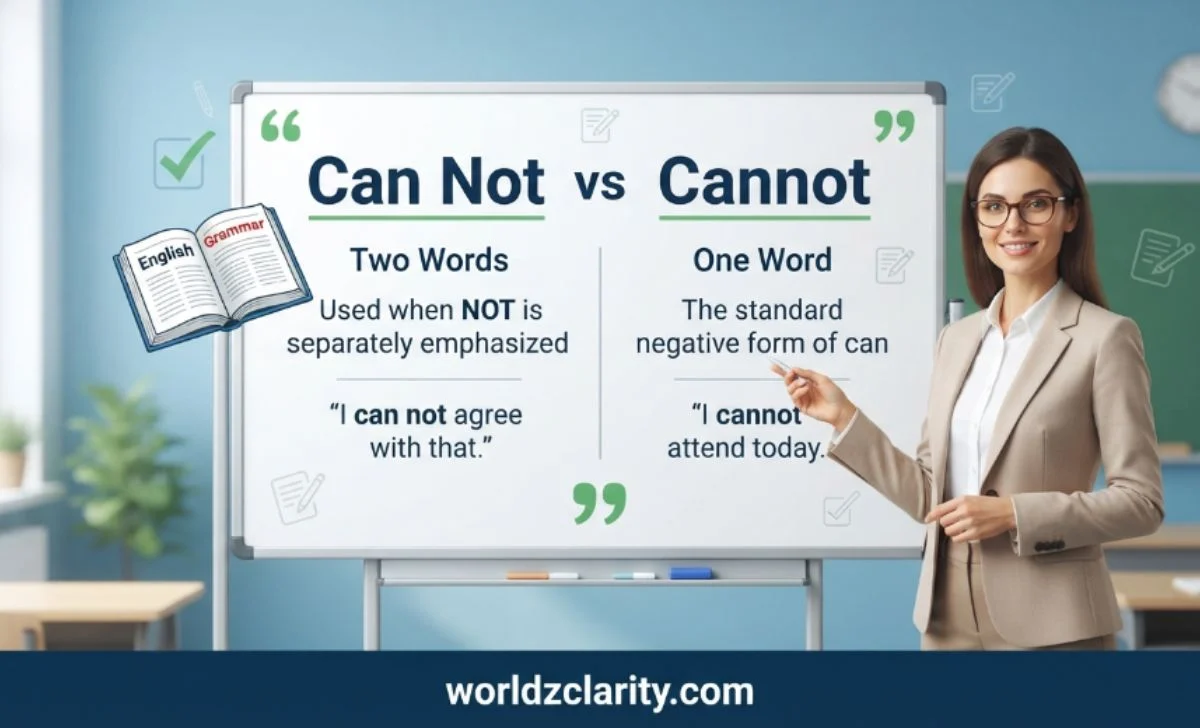
Have you ever typed “can not” and then wondered whether it should actually be “cannot”? The difference looks tiny, but English grammar does not always work the way spelling patterns suggest. While cannot and can not may appear interchangeable at first glance, they do not always serve the same grammatical purpose.
For most ordinary negative sentences, cannot is the correct form. If you mean that someone is unable to do something, something is impossible, or something is not allowed, use cannot.
For example, “I cannot attend the meeting” means “I am unable to attend the meeting.”
But there is an important exception. Can not can be correct when not belongs to a separate construction, especially not only … but also.
That is why simply saying that “can not” is always wrong would be inaccurate.
This guide explains the difference in plain English, shows how both forms work in real sentences, and gives you a simple rule you can use whenever you are unsure.
Quick Answer: Can Not or Cannot?
Cannot is the standard one-word negative form of can.
Use cannot when you mean:
- be unable to do something
- not be able to do something
- something is impossible
- something is not permitted
Examples:
- I cannot drive.
- She cannot attend the meeting.
- We cannot accept your application.
- You cannot park here.
- That cannot be true.
Can not is possible when can and not belong to separate parts of the sentence.
For example:
The software can not only edit photos but also create videos.
Here, not belongs to the construction not only … but also.
The simple rule
If you are simply making can negative:
Use “cannot.”
If not belongs to another grammatical structure:
“Can not” may be correct.
What Does “Cannot” Mean?
Cannot is a modal verb form used to express the negative of can.
Depending on the sentence, it can express several related ideas.
Inability
I cannot swim.
The speaker is unable to swim.
Lack of permission
You cannot enter this room.
The person does not have permission to enter.
Impossibility
That cannot be the answer.
The speaker believes that the answer is impossible or incorrect.
Negative possibility
She cannot be serious.
The speaker considers it impossible or extremely unlikely that she is serious.
So, although cannot is often translated simply as “not able to,” its actual meaning depends on context. Cambridge gives cannot as the negative form of can, including meanings related to being unable or not allowed to do something.
Why Is “Cannot” One Word?
This is one of the unusual features of English modal verbs.
You might expect the negative of can to be written as two words because many other verbs form negatives with not:
- will not
- should not
- could not
- would not
- might not
- must not
But can normally forms its full negative as:
cannot
Cambridge’s grammar guidance explicitly lists cannot as the uncontracted form of can + not.
So you should not try to create a general rule such as:
“Every verb followed by not must have a space.”
English does not work that neatly.
Compare
| Positive | Negative |
|---|---|
| can | cannot |
| could | could not |
| will | will not |
| should | should not |
| would | would not |
| must | must not |
This is simply one of those English forms worth remembering.
When Should You Use “Cannot”?
For ordinary negative statements, cannot should be your default choice.
Ability
I cannot lift this box.
Permission
Employees cannot use this entrance after 8 p.m.
Possibility
This cannot happen again.
Understanding
I cannot understand what he means.
Availability
She cannot come to the office tomorrow.
Business communication
Unfortunately, we cannot approve your request at this time.
In each example, cannot directly negates the ability, possibility, or permission expressed by can.
That is why writing can not in these sentences is usually considered incorrect or nonstandard.
Can “Can Not” Ever Be Correct?
Yes. This is where the topic becomes more interesting.
Although cannot is the standard negative form, can not can be grammatically correct when not has a separate role.
The clearest example is the construction:
not only … but also
For example:
This course can not only improve your grammar but also strengthen your writing.
The meaning is:
This course can improve your grammar, and it can also strengthen your writing.
Here, not is not simply turning can into a negative. It is part of not only … but also.
Cambridge describes not only … but also as a paired construction used to connect two related ideas.
More examples
The new phone can not only take better photos but also record high-quality video.
She can not only speak French but also write it fluently.
The training program can not only reduce costs but also improve productivity.
This website can not only explain grammar but also provide useful examples.
In these sentences, changing can not only to cannot only would not preserve the intended structure.
“Cannot” vs. “Can Not” in One Table
| Form | Use | Example |
|---|---|---|
| cannot | Ordinary negative of can | I cannot attend. |
| cannot | Lack of permission | You cannot enter. |
| cannot | Impossibility | That cannot be true. |
| can’t | Informal contraction of cannot | I can’t attend. |
| can not | Separate grammatical construction | You can not only read it but also edit it. |
The important thing is not the space itself. The important question is what grammatical job “not” is doing.
Real-World Examples
Knowing the rule is useful, but seeing it in everyday writing makes the difference much easier to remember.
In an Email
I’m sorry, but I cannot attend tomorrow’s meeting.
This is a normal negative statement.
In a Workplace Message
We cannot complete the project without the client’s approval.
Again, cannot is correct because the sentence means the team is unable to complete the project.
In an Academic Paper
The available evidence cannot prove that the two events are directly related.
The writer is saying that the evidence is insufficient to establish something.
On a Website
Visitors cannot access this page without signing in.
Here, cannot expresses a restriction.
In a Conversation
I can’t hear you. The connection is bad.
The informal contraction can’t sounds more natural in conversation.
In a Product Description
This device can not only charge your phone but also power small accessories.
Here, can not is part of not only … but also.
Cannot vs. Can’t
Another question often appears alongside can not or cannot:
Is “can’t” correct?
Yes.
Can’t is the contraction of cannot. Cambridge identifies can’t as the negative form used with can, while the full form cannot is available for formal contexts or emphasis.
Compare:
I cannot come tonight.
I can’t come tonight.
Both are grammatical.
The difference is mainly style.
Use “cannot” when:
- writing formally
- writing an academic paper
- preparing a professional document
- writing an official notice
- you want the full form for emphasis
Use “can’t” when:
- texting
- chatting
- speaking
- writing informally
- creating natural conversational dialogue
For example:
Formal:
We cannot guarantee delivery before Friday.
Informal:
Sorry, I can’t make it on Friday.
Neither sentence is wrong. They simply suit different situations.
Is “Can Not” Wrong?
Not always.
This is an important distinction because many grammar explanations oversimplify the issue by saying:
“Can not is always wrong.”
That is too broad.
When can not is being used as the ordinary negative of can, it should normally be written cannot.
For example:
❌ I can not attend the meeting.
✅ I cannot attend the meeting.
But when not belongs to a separate expression, can not can be correct:
✅ You can not only attend the meeting but also present your ideas.
The first sentence means the person is unable to attend.
The second says the person is able to attend and present.
That difference is grammatical, not merely stylistic.
A Useful Test for “Can Not” vs. “Cannot”
When you are unsure, do not look only at the two words.
Look at what comes after them.
Ask yourself:
Am I simply saying that someone cannot do something?
If yes, use cannot.
I cannot go.
She cannot drive.
We cannot wait.
He cannot understand the instructions.
Is “not” part of “not only … but also”?
If yes, can not may be the correct form.
She can not only sing but also dance.
The program can not only save time but also reduce errors.
This test handles most everyday cases.
Common Mistakes to Avoid
1. Writing “Can Not” for Every Negative Sentence
This is the most common mistake.
❌ We can not accept your request.
Better:
✅ We cannot accept your request.
The sentence simply expresses inability or refusal, so cannot is the standard form.
2. Thinking “Can Not” Is Never Correct
This goes too far in the opposite direction.
❌ The tool cannot only translate text but also summarize it.
Better:
✅ The tool can not only translate text but also summarize it.
The second sentence uses the not only … but also construction.
3. Assuming “Can’t” Is Incorrect
Can’t is not a spelling mistake.
I can’t come today.
It is simply the contracted form of cannot and is common in informal English. (Cambridge Dictionary)
4. Treating British and American English as Different Here
Unlike words such as colour/color or centre/center, this is not mainly a British-versus-American spelling issue.
Both varieties normally use cannot for the ordinary negative form of can.
British English vs. American English
There is no major spelling difference between British and American English in this case.
British English
I cannot attend the meeting.
American English
I cannot attend the meeting.
The spelling is the same.
The same applies to common forms such as:
- cannot
- can’t
- can not only … but also
So if you are writing for an American, British, Canadian, Australian, or international audience, you do not need to change cannot simply because of regional spelling.
Can Not or Cannot in Formal Writing
If you are unsure which form to use in a formal document, cannot is the safest choice when you mean the negative of can.
For example:
We cannot accept incomplete applications.
The research cannot establish a direct connection.
Employees cannot share confidential information.
The company cannot guarantee delivery on the requested date.
These sentences are clear, professional, and grammatically standard.
You can also use can’t in informal communication, but some organizations and academic styles prefer full forms.
So for a formal email, report, essay, or application, cannot is usually the better choice.
“Cannot” Does More Than Mean “Unable”
One reason this word appears so often is that can has several meanings.
1. Ability
She can swim.
Negative:
She cannot swim.
2. Permission
You can leave early.
Negative:
You cannot leave early.
3. Possibility
This can happen.
Negative contexts may use cannot to express impossibility:
That cannot happen.
4. Logical conclusion
He cannot be at home; I just saw him at the airport.
Here, the speaker is making a strong deduction.
So when you see cannot, do not automatically translate it as “unable.” Its exact meaning depends on the context.
Why “Can Not Only” Works
The structure becomes much clearer if you remove can.
Look at:
She can not only sing but also dance.
The central expression is:
not only sing but also dance
Adding can before it gives:
She can not only sing but also dance.
The not belongs to not only, not directly to can.
This is why the space is meaningful in this particular construction.
Cambridge’s grammar guidance confirms that not only … but also is used to connect two related ideas and can appear in a range of sentence structures.
Practical Examples You Can Copy
Business Email
Unfortunately, we cannot process your request until we receive the required documents.
Customer Service
We cannot issue a refund without proof of purchase.
Academic Writing
This evidence cannot establish a causal relationship.
Workplace Policy
Employees cannot access the system without authorization.
Conversation
I can’t remember where I put my keys.
Social Media
I can’t believe how quickly the weekend passed!
Marketing Copy
Our platform can not only save you time but also simplify your workflow.
Educational Writing
This lesson can not only improve your vocabulary but also help you use new words naturally.
Notice that the last two examples use can not because they contain the not only … but also structure.
Quick Decision Guide
Use this checklist before publishing your sentence.
Choose cannot if:
- you mean “not able to”
- you mean “not permitted to”
- you mean “impossible”
- you are simply negating can
- you are writing a formal sentence
Example:
I cannot attend the conference.
Choose can’t if:
- you want an informal contraction
- you are writing dialogue
- you are texting or chatting
Example:
I can’t attend tonight.
Choose can not when:
- not belongs to a separate grammatical construction
- especially not only … but also
Example:
The course can not only teach grammar but also improve your writing.
FAQs
1. Which is correct: “can not” or “cannot”?
For the ordinary negative form of can, cannot is correct.
I cannot go.
Can not is used in specific constructions where can and not have separate grammatical roles.
2. Is “cannot” one word?
Yes. When it is the standard negative form of can, cannot is written as one word. Cambridge explicitly lists it as the uncontracted form of can + not.
3. Is “can not” ever grammatically correct?
Yes. A common example is:
You can not only learn the rules but also practice them.
Here, not belongs to not only … but also.
4. Is “can’t” the same as “cannot”?
In ordinary negative statements, yes. Can’t is the contraction of cannot.
I cannot swim.
I can’t swim.
Both mean that the person is unable to swim.
5. Should I use “cannot” in an essay?
Yes. Cannot is a clear and standard choice for formal writing when you need the negative form of can.
6. Is “cannot” British or American English?
It is standard in both British and American English. This is not a spelling difference like colour/color.
7. Why do people write “can not”?
Sometimes writers use can not because they are forming a structure such as can not only … but also. In ordinary negative sentences, however, cannot is the standard form.
Conclusion
The choice between can not or cannot is easier once you stop treating it as a simple spelling question. In ordinary negative sentences, cannot is the standard form. Use it when you mean that someone is unable to do something, something is not permitted, or something is impossible. For example, “I cannot attend the meeting” and “You cannot park here” are both completely standard.
Can’t is the natural contraction of cannot and is especially common in conversation and informal writing. Can not, meanwhile, has a more specific role. It can be correct when not belongs to another part of the sentence, particularly the not only … but also construction.
There is no meaningful British-versus-American spelling difference to remember here. Both varieties normally use cannot for the ordinary negative form of can*.
So when you are writing and hesitate between the two, use the simple test: if you are just making “can” negative, choose “cannot.” If you see a structure such as not only … but also, examine the sentence before changing the spelling.
Read More Blogs:
Tying or Tieing: Which Spelling Is Correct in English?
Leaped or Leapt: Which Past Tense Form Should You Use?
Midday or Mid-Day: Which Spelling Should You Use?
Steer or Stear: Which Spelling Is Correct in English?