Have you ever stopped while writing an email or message and wondered whether it should be anytime or any time? Both forms are correct, but they do not always work in the same way.
The confusion comes from their similar meaning. In many sentences, anytime means “whenever,” while any time refers to time as a noun. The difference is small, but it matters in clear English writing.
You may see both forms in emails, websites, conversations, business documents, and everyday messages. Once you understand how each one works, choosing the right form becomes much easier.
This guide explains the difference between anytime and any time, shows you when to use each form, and gives practical examples you can use in real writing.
Quick Answer: Anytime or Any Time?
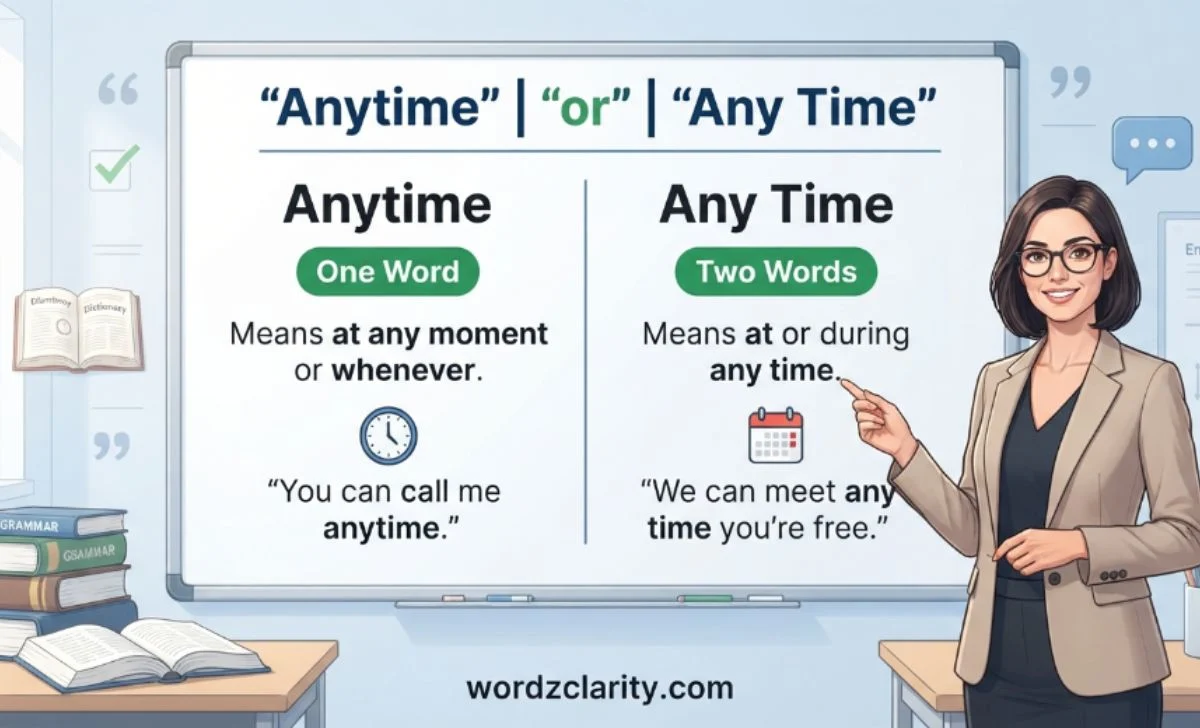
Anytime and any time are both correct. The right choice depends on the role of time in the sentence.
Use anytime when it means “whenever.”
- Call me anytime.
- You can visit anytime.
- Feel free to email me anytime.
Use any time when time is being used as a noun, especially when you mean an amount or period of available time.
- I don’t have any time today.
- Do you have any time for a meeting?
- We didn’t have any time to finish the work.
There is one especially useful rule:
After “at,” use “at any time.”
For example:
- You can cancel your membership at any time.
- Customers may contact us at any time.
- You can leave the program at any time.
A simple way to remember the difference is:
Anytime = whenever
Any time = time as a noun
At any time = standard two-word phrase
What Does “Anytime” Mean?
Anytime is generally an adverb. It tells us when something can happen without specifying a particular time.
For example:
Call me anytime.
This means:
Call me whenever you want.
Here, anytime tells us when the action can happen. It does not refer to an amount of time.
Other examples include:
- You can visit anytime.
- Send me the details anytime.
- We can talk anytime tomorrow.
- Stop by anytime you are nearby.
- You can ask questions anytime.
This usage is common in everyday English, especially in conversations, text messages, emails, social media, and friendly business communication.
“Anytime” as a Friendly Reply
You may also hear anytime used by itself as a response to “thank you.”
For example:
“Thanks for helping me.”
“Anytime!”
Here, anytime is a friendly response meaning something like “you’re welcome” or “I’m happy to help.”
It is especially common in casual conversation.
What Does “Any Time” Mean?
Any time is written as two words because time is functioning as a noun.
It often refers to an amount, period, or available portion of time.
For example:
I don’t have any time today.
The speaker is saying that no time is available.
More examples:
- Do you have any time this afternoon?
- I don’t have any time to finish the report.
- Did you spend any time on the project?
- Is there any time that works for you?
- We need any time you can spare.
Notice the difference:
Call me anytime.
Here, anytime means “whenever.”
But:
I don’t have any time.
Here, time is something the speaker has available or does not have available.
That grammatical difference explains why one version is written as one word and the other as two.
The “Whenever” Test
If you are unsure which form to use, try replacing anytime with whenever.
If the meaning still works, anytime is often the right choice.
For example:
You can call me anytime.
Try:
You can call me whenever.
The basic meaning remains clear.
Now look at:
I don’t have any time today.
Replace any time with whenever:
I don’t have whenever today.
That clearly does not work.
So any time is correct because time is being used as a noun.
This test is not a rule for every possible sentence, but it is a useful shortcut when you’re writing quickly.
Why “At Any Time” Uses Two Words
One of the most common mistakes is writing:
You can contact us at anytime.
In standard English, the preferred form is:
You can contact us at any time.
The same pattern appears in many formal sentences:
- You may cancel your order at any time.
- Users can change their password at any time.
- Employees may request assistance at any time.
- The company reserves the right to update its policy at any time.
The phrase at any time is especially common in professional, academic, legal, and business writing.
So when you see at, remember the two-word form:
at any time
This is one of the easiest rules to apply consistently.
Anytime vs. Any Time in Real-Life Examples
The difference becomes clearer when we look at situations where people actually use these expressions.
In a Text Message
You can call me anytime.
The meaning is “call whenever you want.”
In a Work Email
Do you have any time available for a quick meeting?
Here, the writer is asking whether the other person has some available time.
On a Business Website
Customers may cancel their subscription at any time.
The phrase follows at, so the two-word form is appropriate.
In Everyday Conversation
Come over anytime.
This is a casual invitation.
In Academic Writing
Participants could withdraw from the study at any time.
This is a formal construction referring to any possible point during the study.
In Customer Support
Please contact our support team at any time if you need assistance.
Again, the established phrase is at any time.
A Quick Comparison
| Feature | Anytime | Any time |
|---|---|---|
| Spelling | One word | Two words |
| Main function | Usually an adverb | Any + noun time |
| Common meaning | Whenever | An amount or period of time |
| Example | Call me anytime. | I don’t have any time. |
| Common in conversation | Yes | Yes |
| Common in formal writing | Yes, when grammatically appropriate | Very common |
| After “at” | Avoid | Use at any time |
The important point is that anytime is not simply the “correct” version of any time, and any time is not simply a more formal spelling of anytime.
They have different grammatical uses.
A Simple Rule to Remember
When you are unsure, ask yourself one question:
Does it mean “whenever”?
If yes, anytime will often be correct:
Message me anytime.
If you are talking about time as something available, limited, or used, choose any time:
I don’t have any time today.
And if the phrase follows at, use:
at any time
This small distinction will help you avoid most common mistakes with these two forms.
Common Mistakes With “Anytime” and “Any Time”
The biggest mistake is assuming that anytime and any time can always replace each other. They are closely related, but their grammatical roles are different.
Mistake 1: Writing “at anytime”
This is one of the most common errors.
❌ You can contact me at anytime.
✅ You can contact me at any time.
The phrase at any time is the standard construction, especially in formal and professional writing.
Mistake 2: Writing “I don’t have anytime”
When time means an amount of available time, use the two-word form.
❌ I don’t have anytime today.
✅ I don’t have any time today.
The same applies to sentences such as:
I didn’t have any time to finish the report.
Do you have any time this afternoon?
Mistake 3: Assuming “any time” is always better
Some writers use any time everywhere because they believe the two-word version is more formal.
That is not necessary.
For example:
Feel free to call me anytime.
This is natural and correct. Here, anytime means “whenever.”
Changing it to any time does not automatically make the sentence more professional.
Anytime vs. Whenever
Anytime and whenever can have very similar meanings.
Compare:
Call me anytime.
Call me whenever you need help.
Both sentences give the idea that there is no fixed time for the call.
However, whenever is often more natural when it introduces a complete clause:
Whenever you visit, we’ll have coffee.
Whenever you need assistance, send us a message.
Anytime usually works more simply as an adverb:
Call me anytime.
Visit anytime.
So, while the meanings overlap, their sentence structures are not always identical.
Is “Anytime” Formal English?
Yes. Anytime is an established English word and is not simply slang or an incorrect shortening of any time.
However, the context still matters.
In a friendly email, you can easily write:
Feel free to contact me anytime.
In a formal policy, you are more likely to see:
Customers may cancel their subscription at any time.
The second sentence uses any time because it follows at, not simply because formal English requires two words.
This distinction is important. Formality does not determine the spelling by itself. Grammar does.
Can “Anytime” Start a Sentence?
Yes, anytime can appear at the beginning of a sentence.
For example:
Anytime you need help, give me a call.
This usage is common, especially in informal and conversational English.
However, if you want to make the sentence completely straightforward, whenever can also work:
Whenever you need help, give me a call.
In some formal contexts, writers may prefer the second version because the relationship between the time condition and the main clause is very clear.
How to Choose the Right Form
Use this quick three-step check when you’re proofreading.
1. Try “whenever”
If you can replace the word with whenever, anytime is often appropriate.
You can call me anytime.
You can call me whenever.
2. Look at the noun “time”
If you’re talking about available time, time spent on something, or an amount of time, use any time.
I don’t have any time.
Did you spend any time there?
3. Check for “at”
If the phrase follows at, use:
at any time
For example:
You may return the product at any time.
These three checks handle most everyday cases.
Anytime or Any Time in Different Types of Writing
The correct form can appear in almost every kind of English writing. The key is the sentence structure.
Emails
Friendly:
You can reach me anytime if you have questions.
Professional:
Please let me know if you have any time available this week.
Business Documents
Customers may terminate the agreement at any time.
This construction is common in policies, terms and conditions, and other official documents.
Academic Writing
Participants were allowed to withdraw from the study at any time.
Academic writing often uses at any time because it describes a possible point during a study or process.
Websites
You can update your account information at any time.
This is common in help pages and account settings.
Social Media
Drop by anytime!
The one-word form feels natural because the message is short and conversational.
Practical Examples: Which Form Should You Use?
Here are some examples that show the difference at a glance.
| Sentence | Correct Form | Why? |
|---|---|---|
| Call me ___ you need help. | anytime | Means “whenever.” |
| I don’t have ___ today. | any time | Refers to available time. |
| You may leave ___ any time. | at any time | Standard phrase after “at.” |
| Come over ___. | anytime | Means “whenever you want.” |
| Do you have ___ for lunch? | any time | Refers to available time. |
| Customers can cancel ___ any time. | at any time | Standard construction. |
A Few Useful Rewrites
Sometimes the easiest way to avoid confusion is to rewrite the sentence.
Instead of:
You can contact me at anytime.
Write:
You can contact me at any time.
Or:
You can contact me whenever you need help.
Instead of:
I don’t have anytime.
Write:
I don’t have any time.
Or:
I’m not available right now.
Good writing is not about forcing one spelling everywhere. It is about choosing the form that communicates the intended meaning naturally.
FAQs
1. Is “anytime” one word?
Yes. Anytime is a standard English word when it functions as an adverb, usually meaning “whenever.”
Example:
You can call me anytime.
2. Is “any time” also correct?
Yes. Any time is correct when time functions as a noun.
Example:
I don’t have any time today.
It is also used in the standard phrase at any time.
3. Should I write “at anytime” or “at any time”?
Use at any time.
For example:
You may contact the office at any time.
This is the standard form in modern formal and professional English.
4. Is “anytime” more informal than “any time”?
Not necessarily. Anytime is a standard word. The choice depends mainly on grammar and sentence structure rather than simply on whether the writing is formal or informal.
5. Can I say “Thanks ,anytime”?
Yes. Anytime! is a common informal response to “thank you.”
It means that you were happy to help.
6. Is “I don’t have anytime” correct?
No, not in standard English.
Use:
I don’t have any time.
Here, time is a noun referring to available time.
7. Can “anytime” mean “whenever”?
Yes. This is one of its main uses.
Come anytime.
means:
Come whenever you want.
Final Thoughts
The difference between anytime and any time becomes much easier once you stop thinking of them as two spellings of exactly the same word.
Use anytime when it functions as an adverb and means “whenever”:
Feel free to call me anytime.
Use any time when time is functioning as a noun:
I don’t have any time today.
And remember the particularly useful construction:
at any time
This form is common in professional, academic, business, and everyday writing.
When you’re unsure, try the “whenever” test. If whenever fits naturally, anytime may be the right choice. If you’re talking about time as something available, limited, or spent, choose any time.
The goal is not to memorize every possible sentence. Once you understand the grammatical difference, you’ll be able to make the correct choice naturally.
Read More Blogs:
Everyone or Every One: Which One is Correct and Why?
An Unique or A Unique: Which Article Is Correct?
Weiner or Wiener: Here’s the Correct Spelling (With Examples)
Aide or Aid: Which Word Is Right for Your Sentence?