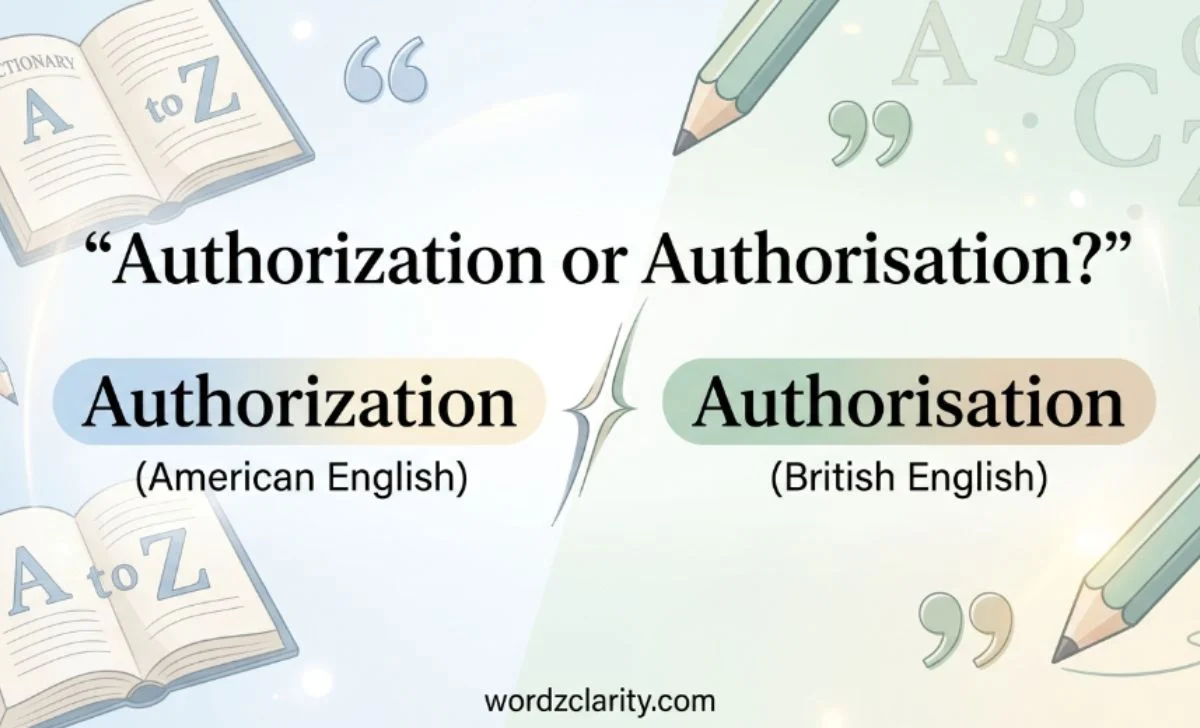
If you have ever wondered whether authorization or authorisation is the correct spelling, you are not alone. Both forms are widely used, but they belong to different English spelling conventions. Authorization is the standard spelling in American English, while authorisation is commonly preferred in British English.
Both words have the same meaning and are used when talking about official permission, approval, or the right to do something.
This difference also appears in related words such as authorize or authorise and authorized or authorised. Knowing which form matches your audience can help you write more accurately and consistently.
In this guide, we will explain the difference between authorization and authorisation, show real examples, discuss authorization letters, and explain how these words differ from authentication.
Quick Answer
Both authorization and authorisation are correct.
- Authorization = American English
- Authorisation = British English
For example:
American English:
The manager gave me authorization to access the files.
British English:
The manager gave me authorisation to access the files.
There is no difference in meaning. The difference is simply a regional spelling preference.
If you are writing for a U.S. audience, choose authorization. If you are following British English, choose authorisation.
Authorization vs Authorisation
The main difference between authorization and authorisation is the use of z versus s.
American English generally prefers the -ize and -ization spellings:
- authorize
- authorization
- authorized
- authorizing
British English commonly uses:
- authorise
- authorisation
- authorised
- authorising
Here is a simple comparison:
| American English | British English |
|---|---|
| authorize | authorise |
| authorization | authorisation |
| authorized | authorised |
| authorizing | authorising |
Both spelling systems are accepted. Therefore, authorisation is not a misspelling of authorization, and authorization is not an incorrect form simply because British English uses authorisation.
The important thing is to choose one style and use it consistently.
What Does Authorization or Authorisation Mean?
Authorization or authorisation means official permission to do something. It can also refer to the act of giving someone the power or permission to take a particular action.
For example:
You need authorization to access the company’s financial records.
This means you need official permission before you can access them.
Another example is:
The employee received authorisation to enter the restricted area.
Here, authorisation means that the employee was officially permitted to enter.
The word is common in business, banking, government, law, technology, education, and other formal settings.
Authorize or Authorise: Which Is Correct?
If you are unsure about authorise or authorize, the same British-versus-American rule applies.
Authorize is the standard American English form.
Authorise is commonly used in British English.
For example:
The manager authorized the payment.
American English
The manager authorised the payment.
British English
Both sentences mean that the manager officially gave permission for the payment.
The related noun follows the same pattern:
The manager gave authorization for the payment.
The manager gave authorisation for the payment.
Keep the word family consistent
If you choose American English, use:
authorize → authorization → authorized → authorizing
If you choose British English, use:
authorise → authorisation → authorised → authorising
Avoid switching between the two styles without a reason.
Authorization or Authorisation Letter
An authorization letter is a written document that gives another person permission to perform a specific task or act on your behalf.
In British English, it is commonly written as an authorisation letter.
An authorization letter may be used when someone needs to:
- collect documents
- receive a package
- submit paperwork
- represent another person
- complete an administrative task
- handle a specific transaction
Simple Authorization Letter Example
Subject: Authorization Letter
I hereby authorize Ahmed Khan to collect my documents on my behalf. He is permitted to receive the documents and complete the necessary acknowledgment process.
Sincerely,
Junaid Tariq
For British English, you could write:
I hereby authorise Ahmed Khan to collect my documents on my behalf.
The spelling changes, but the meaning stays the same.
A formal authorization letter should clearly identify the person giving permission, the person receiving it, and the specific task being authorized.
“I Hereby Authorize” or “I Hereby Authorized”?
The correct phrase is usually “I hereby authorize” when you are granting permission through the statement.
For example:
I hereby authorize Sarah to collect the documents on my behalf.
Here, authorize is the present-tense verb.
If you are talking about something that happened in the past, use authorized:
I authorized Sarah to collect the documents yesterday.
In British English:
I hereby authorise Sarah to collect the documents.
and:
I authorised Sarah to collect the documents yesterday.
So, “I hereby authorized” is generally not correct when you are using the phrase to grant permission at that moment.
Authorization vs Authentication
One of the most important related questions is authorisation vs authentication.
These terms are especially common in technology and cybersecurity, but they do not mean the same thing.
Authentication asks:
Who are you?
It verifies a person’s identity.
Authorization asks:
What are you allowed to do?
It determines what an authenticated user can access or perform.
For example, when you log into an online account, the system may first verify your identity using a password or another security method. That is authentication.
Afterward, the system may determine whether you are allowed to view certain files or perform certain actions. That is authorization.
A simple way to remember the difference is:
Authentication = identity
Authorization = permission
Confusing these terms can make technical writing unclear, so use them carefully.
Authorization Examples in Everyday Writing
The word appears in many professional situations.
Business
The manager provided authorization for the purchase.
Banking
The transaction requires authorization before it can be completed.
Workplace
Only authorized employees may access these records.
Government
The agency received authorization to begin the project.
Technology
The application requires user authorization before accessing the account.
Legal writing
Written authorization is required before the information can be released.
Academic writing
The researchers obtained authorization before accessing the restricted database.
In British English, these examples can use authorisation instead.
Authorization vs Permission
Authorization and permission are closely related, but they do not always sound equally natural.
Permission is a more general and everyday word.
Authorization usually sounds more formal and official.
Compare:
My parents gave me permission to go outside.
with:
The employee received authorization to access the database.
The first sentence describes ordinary permission. The second involves an official access process.
For casual situations, permission is often the better choice. For formal procedures, systems, organizations, or official decisions, authorization is often more appropriate.
Authorization vs Approval
Authorization and approval can also overlap, but they emphasize different ideas.
Approval generally means that someone agrees that something is acceptable.
Authorization usually means that someone gives official permission or power to proceed.
For example:
The manager approved the proposal.
This means the manager agreed with the proposal.
The manager authorized the purchase.
This means the manager gave permission for the purchase to take place.
In some situations, both words can be used:
The director approved the project and authorized the team to begin work.
This clearly separates approval from permission to act.
Common Phrases With Authorization
Learning common word combinations can help you use the word naturally.
Some frequently used phrases include:
- written authorization
- prior authorization
- official authorization
- authorization letter
- authorization form
- authorization request
- authorization code
- authorization process
- authorization required
- authorization granted
- authorization denied
- authorization to access
- authorization from the manager
Examples:
Written authorization is required.
The request is waiting for authorization.
Please complete the authorization form.
The user does not have authorization to access the file.
These phrases are especially common in business, finance, administration, and technology.
Common Mistakes to Avoid
1. Thinking authorisation is always wrong
It is not. Authorisation is a standard British English spelling.
2. Thinking authorization is informal
It is not. Authorization is the standard American spelling and is commonly used in formal documents.
3. Mixing spelling styles
Avoid unnecessary combinations such as:
The manager authorised the request and provided authorization.
Choose one spelling style for the document.
4. Confusing authorization with authentication
Remember:
Authentication verifies identity.
Authorization determines permission.
5. Using authorization when permission is more natural
For casual situations, permission may sound better.
Can I have permission to use your computer?
This is more natural than using the highly formal authorization in an ordinary conversation.
Which Spelling Should You Use?
Your audience should determine your choice.
| Audience or style | Preferred spelling |
|---|---|
| United States | authorization |
| American business | authorization |
| American academic writing | authorization |
| United Kingdom | authorisation |
| British business | authorisation |
| British academic writing | authorisation |
| International audience | Either, but remain consistent |
If your article or website follows American English, use authorization throughout.
If it follows British English, use authorisation throughout.
You should also keep related forms consistent. For example, an American English document would normally use authorize and authorized, while a British English document would commonly use authorise and authorised.
FAQs
1. Is authorization or authorisation correct?
Both are correct. Authorization is the American English spelling, while authorisation is commonly used in British English.
2. Is authorization American or British?
Authorization is the standard American English form. British English commonly uses authorisation.
3. Is authorisation a misspelling?
No. Authorisation is a legitimate British English spelling.
4. What does authorization mean?
Authorization means official permission, approval, or the right to perform a particular action.
5. What is an authorization letter?
An authorization letter is a written document giving another person permission to perform a specified task or act on your behalf.
6. Is “I hereby authorize” correct?
Yes. I hereby authorize is a correct formal phrase used when granting permission. British English commonly uses I hereby authorise.
7. What is the difference between authorization and authentication?
Authentication verifies a user’s identity, while authorization determines what that user is allowed to access or do.
8. Should I use authorize or authorise?
Use authorize in American English and authorise in British English.
9. Are authorization and authorisation pronounced differently?
They are generally pronounced the same. The main difference is their spelling.
10. Which spelling should I use in formal writing?
Use the spelling that matches your audience and style guide. Choose authorization for American English and authorisation for British English.
Conclusion
Both authorization and authorisation are correct spellings, but they belong to different regional varieties of English. Authorization is the standard American English form, while authorisation is commonly preferred in British English. Both words mean official permission, approval, or the right to perform an action.
The same spelling difference appears in related forms: authorize/authorise, authorized/authorised, and authorizing/authorising. If you are writing for American readers, use the z forms. For British readers, use the s forms. Most importantly, remain consistent throughout your document or website.
If you are writing an authorization letter, business email, academic paper, legal document, or technical article, choose the spelling that matches your target audience.
And remember the difference between authorization and authentication: authentication verifies identity, while authorization determines permission.
Read More Blogs:
- High School or Highschool: Which Spelling Is Correct?
- Skill Set or Skillset: Which Spelling Is Correct?
- Photoshoot or Photo Shoot: Which Spelling Is Correct?
- Never Mind or Nevermind: British and American English Explained