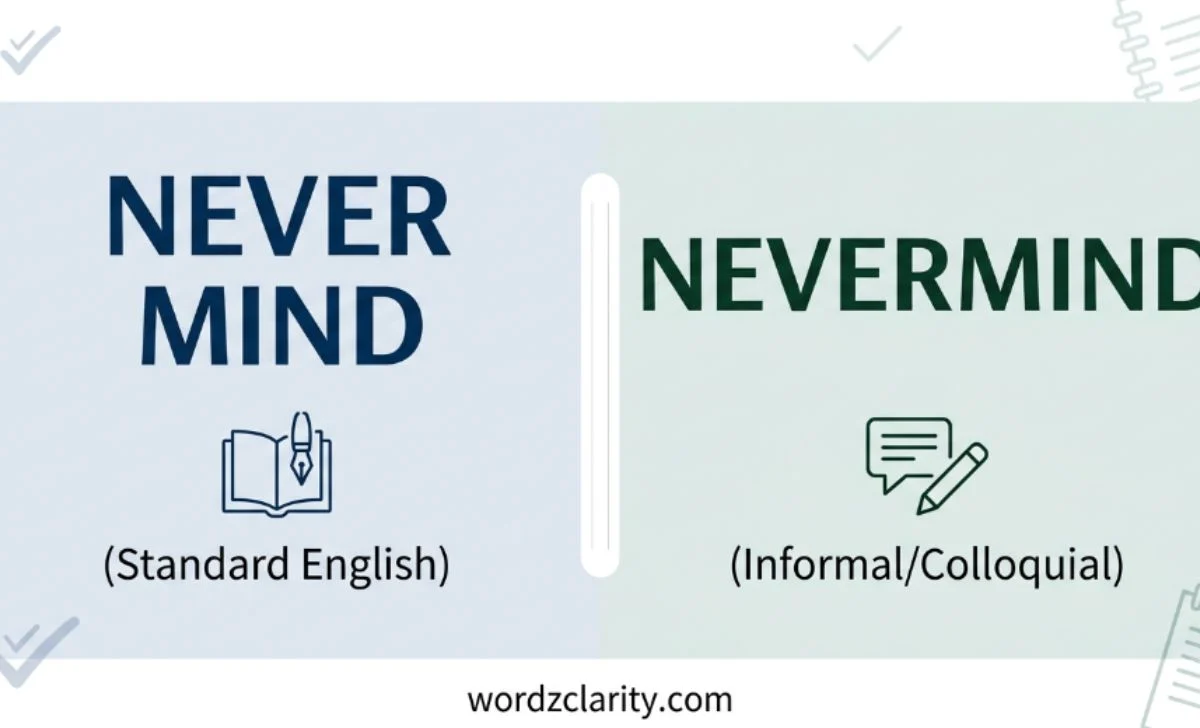
English has many expressions that sound natural when spoken but become confusing when written. “Never mind” or “nevermind” is one of them.
Because the two forms sound exactly the same, it is easy to wonder whether they are simply two spellings of the same expression or whether there is a real difference between them.
In most everyday English, the correct choice is never mind , two separate words. It is commonly used to tell someone not to worry, to ask them to disregard something, or to mean that a previous question or statement is no longer important.
It can also introduce a comparison meaning “let alone” or “much less.” The closed form nevermind does exist, but it has a much narrower and more specialized use as a noun, particularly in older or regional American English.
In this guide, you will learn the difference between never mind and nevermind, when to use each form, common mistakes, examples, regional usage, and practical rules for choosing the right spelling.
Quick Answer
Never mind is the standard form for most modern English writing.
Use never mind when you mean:
- “Do not worry.”
- “Forget what I said.”
- “Ignore that.”
- “It does not matter.”
- “Let alone” or “much less.”
Examples
- Never mind; I found my phone.
- Never mind about the mistake.
- Never mind what he said.
- I cannot afford a small car, never mind a new one.
The one-word form, nevermind, also exists, but its use is much more limited. Dictionaries record it as a noun meaning attention, concern, heed, or business, often in expressions such as “pay someone no nevermind.” This use is generally regional, dialectal, informal, or old-fashioned.
So, if you are writing an email, essay, article, report, website, or professional message, never mind is usually the safest choice.
| Form | Main use | Recommended? |
|---|---|---|
| never mind | Disregard something, do not worry, let alone | Yes |
| nevermind | Noun meaning attention, concern, or business | Limited/specialized |
Never Mind or Nevermind: What Is the Difference?
The main difference is grammatical rather than simply visual.
Never mind is normally a two-word phrase. It functions in several common ways. You can use it to tell someone not to worry, withdraw something you just said, or show that one thing is even more difficult or unlikely than another.
For example:
Never mind; everything will be fine.
Here, the speaker is telling someone not to worry.
You can also say:
Never mind the broken glass.
This means the broken glass should not receive attention or concern.
Another common construction is:
I cannot understand the instructions, never mind explain them.
In this sentence, never mind has the sense of “let alone” or “much less.” Merriam-Webster specifically records this use.
By contrast, nevermind can function as a noun in certain dialectal or older expressions. For example:
Pay him no nevermind.
Here, nevermind means attention or heed.
That noun use is quite different from the everyday expression never mind.
When Should You Use “Never Mind”?
For almost all ordinary situations, use never mind as two words.
1. To Mean “Do Not Worry”
One of the most common uses is to reassure someone.
- Never mind; it was only a small mistake.
- Never mind about the delay.
- Never mind, we can fix it later.
- Never mind what happened yesterday.
In these examples, the expression tells someone that they do not need to be concerned.
2. To Mean “Forget It”
You can use never mind when you no longer want an answer to a question or no longer want to discuss something.
For example:
Can you tell me where the report is? Never mind, I found it.
The speaker initially asks a question but then realizes that the answer is no longer necessary.
Other examples include:
- I wanted to ask you something, but never mind.
- Never mind what I said earlier.
- Never mind; I will handle it myself.
- Never mind the question. We have already solved the problem.
3. To Mean “Ignore That”
Sometimes never mind tells the listener to disregard a particular thing.
- Never mind that comment.
- Never mind the typo in the first paragraph.
- Never mind the noise outside.
- Never mind his complaint.
This use is especially common in conversation.
4. To Mean “Let Alone”
This is another important use that learners sometimes miss.
In this construction, never mind introduces something that is even more difficult, unlikely, or extreme.
For example:
I cannot afford a used car, never mind a new one.
The speaker cannot afford a used car, so affording a new car is even less realistic.
More examples:
- She can barely walk, never mind run.
- I do not have time for breakfast, never mind lunch.
- He cannot solve the easy problem, never mind the difficult one.
- We can barely finish one project, never mind three.
Here, never mind can be replaced by expressions such as let alone, much less, or not to mention.
Is “Nevermind” a Real Word?
Yes, nevermind is found in dictionaries, but that does not mean it is an interchangeable replacement for never mind.
This distinction is important.
Merriam-Webster explains that nevermind is a noun meaning “concern” and records it in expressions such as “pay him no nevermind.” It also notes that the two-word never mind is more common.
Dictionary.com likewise lists nevermind as an American noun, particularly in older usage, with meanings such as attention, heed, notice, business, or responsibility.
Collins also identifies the noun as dialectal, old-fashioned, or informal depending on the variety of English.
Therefore, nevermind is not simply the “wrong spelling” in every possible context. It has a legitimate dictionary history. However, its modern usage is much narrower than never mind.
“Never Mind” as a Phrase
The expression never mind is much more common in everyday English.
It can appear at the beginning, middle, or end of a sentence depending on its function.
At the beginning
Never mind, I can do it myself.
After a statement
I was going to call you, but never mind.
Before a noun
Never mind the cost; we need the equipment.
Before a verb phrase
I can barely finish this task, never mind complete another one.
The surrounding context makes the intended meaning clear.
“Nevermind” as a Noun
The one-word spelling becomes relevant when it acts as a noun.
For example:
Pay him no nevermind.
Here, nevermind refers to attention or concern.
Another traditional-style example is:
It’s no nevermind of yours.
In this construction, the word means something like “your business” or “your concern.”
However, these expressions are not typical choices for modern standard professional English. They may appear in regional speech, literature, historical writing, or deliberately informal dialogue.
Collins lists the noun as dialectal or old-fashioned in American English and notes related British usage as informal.
For most modern writing, a clearer alternative is preferable:
- Pay him no nevermind. → Do not pay attention to him.
- It’s no nevermind of yours. → It’s none of your business.
Never Mind vs. Nevermind: Comparison Table
| Feature | Never mind | Nevermind |
|---|---|---|
| Spelling | Two words | One word |
| Common modern use | Very common | Uncommon |
| Typical grammar | Phrase/conjunction-like expression | Noun |
| Meaning | Do not worry, disregard, let alone | Attention, concern, business |
| Formal writing | Suitable | Usually avoid |
| Academic writing | Suitable when appropriate | Rare |
| Everyday conversation | Very common | Rare |
| Regional/dialectal use | Broad | More restricted |
| Meaning “forget it” | Yes | Not the safest standard form |
| Meaning “let alone” | Yes | No |
The key point is simple: do not choose between them based only on whether you like one-word or two-word spellings. Choose according to meaning and grammatical function.
Never Mind or Nevermind in American English
American English uses never mind extensively as a two-word phrase.
For example:
- Never mind, I’ll call tomorrow.
- Never mind about the appointment.
- I cannot finish this today, never mind the second project.
The closed noun nevermind has also existed in American English, especially in regional or older usage. Dictionary sources continue to record that sense.
There is also a modern tendency for people online to write nevermind as one word when they mean “forget it.” Merriam-Webster notes that the closed form is increasingly seen in the imperative use, although never mind remains more common.
This means you may encounter:
Nevermind, I figured it out.
in informal online communication.
Readers will usually understand it, but if your goal is careful, standard English, Never mind, I figured it out remains the safer choice.
Never Mind or Nevermind in British English
In British English, never mind is the normal spelling for the common phrase.
For example:
- Never mind; we’ll try again tomorrow.
- Never mind about the weather.
- I can’t afford the basic model, never mind the expensive one.
The noun nevermind is also recorded, but Collins labels its British use as US informal and gives it specialized meanings involving importance or attention.
Therefore, British writers should not assume that because nevermind appears in dictionaries, it is the normal spelling of the everyday phrase.
Regional comparison
| Variety | Everyday phrase | Closed noun |
|---|---|---|
| American English | never mind | nevermind appears in specialized/regional use |
| British English | never mind | nevermind is uncommon and specialized |
| International English | never mind | Usually best avoided |
For an international audience, never mind is the clearest option.
Which Form Should You Use?
A simple rule can solve most spelling questions:
If you mean “forget it,” “do not worry,” “ignore that,” or “let alone,” write never mind.
Use “never mind” in:
- Emails
- School assignments
- Essays
- Reports
- Business writing
- Websites
- Articles
- News-style writing
- Professional communication
- General conversation
Use “nevermind” only when:
- You are discussing the noun itself.
- You are reproducing dialect or historical language.
- You are intentionally preserving a regional expression.
- You are quoting a source that uses the closed form.
- You understand the specialized grammatical use.
Common Mistakes With “Never Mind”
Mistake 1: Writing “nevermind” to mean “forget it”
A common informal sentence is:
Nevermind, I found the keys.
Although this spelling appears in modern online communication, never mind is the safer standard choice.
Better:
Never mind, I found the keys.
Mistake 2: Assuming every dictionary word is equally common
The fact that nevermind appears in dictionaries does not make it interchangeable with never mind.
Dictionary entries can preserve regional, historical, dialectal, or specialized vocabulary.
Mistake 3: Using “nevermind” in formal writing
In a school essay or business report, the phrase will usually be clearer as two words.
Instead of:
Nevermind the previous figures.
write:
Never mind the previous figures.
Or, for a more formal tone:
Please disregard the previous figures.
Mistake 4: Confusing spelling with meaning
The question is not simply:
“Which spelling looks right?”
The better question is:
“What does the expression mean in this sentence?”
If the meaning is “do not worry,” “forget it,” or “let alone,” use never mind.
Never Mind in Everyday Conversation
The phrase is extremely useful in spoken English because it can communicate several related ideas.
Example 1: Changing your mind
A: Where did you put my book?
B: I don’t know.
A: Never mind. I found it.
Here, the speaker no longer needs an answer.
Example 2: Reassuring someone
A: I’m sorry I made a mistake.
B: Never mind. We can fix it.
Here, never mind means the mistake is not important enough to worry about.
Example 3: Ending a question
A: Can you help me with this?
B: Sure. What’s wrong?
A: Never mind. I figured it out.
The speaker withdraws the request.
Example 4: Comparing difficulty
A: Can you finish the first report today?
B: Probably not.
A: Then we cannot finish the second one, never mind the third.
Here, never mind means “let alone.”
Never Mind in Emails and Business Writing
In casual workplace communication, never mind is perfectly natural.
For example:
Never mind about the earlier email. I have attached the correct file.
Or:
Never mind the previous version. Please use the updated document attached below.
However, in very formal communication, a more precise expression may be better.
| Casual | More formal |
|---|---|
| Never mind the previous file. | Please disregard the previous file. |
| Never mind; I fixed it. | The issue has now been resolved. |
| Never mind about my earlier message. | Please disregard my earlier message. |
| Never mind the delay. | Please do not be concerned about the delay. |
This is not because never mind is grammatically incorrect. It is simply a matter of tone and precision.
Never Mind in Academic Writing
Academic writing generally favors precise language.
You can use never mind when quoting dialogue or discussing language, but it may sound conversational in formal academic prose.
For example:
“Never mind” is commonly used to tell someone to disregard a previous statement.
That sentence is perfectly appropriate because the phrase itself is the subject of discussion.
However, instead of:
Never mind the first result; the second result is more important.
an academic writer might prefer:
The first result is less relevant than the second.
The choice depends on the tone and purpose of the writing.
Never Mind in Websites and Social Media
Online communication is where the confusion between never mind and nevermind becomes especially noticeable.
People often shorten or combine words in casual digital communication. You may therefore see:
- nevermind
- nvm
- nm
- never mind
The abbreviations nvm and nm are informal and are mainly associated with texting and internet communication. Merriam-Webster also discusses these shortened forms alongside never mind and nevermind.
For casual texting, readers usually understand:
nvm, I got it
But for professional websites, educational content, business posts, and edited articles, spelling out never mind is clearer.
How to Remember the Correct Spelling
Use this simple memory trick:
“Never mind” means “never give your mind to it” or “do not worry about it.”
Because it is functioning as a phrase, keep the words separate.
Think:
Never + mind
not:
Nevermind
when you mean “forget it,” “do not worry,” or “let alone.”
A second useful test is to replace the expression with “forget it.”
If the replacement works, never mind is almost certainly the form you want.
Example
Never mind, I found my wallet.
Replace it:
Forget it, I found my wallet.
The meaning works, so use never mind.
Synonyms for “Never Mind”
The best synonym depends on the context.
When it means “forget it”
- Forget it
- Ignore it
- Disregard it
- Leave it
- Don’t worry about it
it means “do not worry”
- Don’t worry
- It’s okay
- No problem
- It’s all right
- Don’t concern yourself
When it means “let alone”
- Let alone
- Much less
- Still less
- Not to mention
For example:
I cannot afford a used car, never mind a new one.
can become:
I cannot afford a used car, let alone a new one.
Merriam-Webster lists let alone, much less, and still less among related expressions for this use.
Is “Never Mind” One Word or Two?
For normal modern usage, never mind is two words.
This is the answer to the most common version of the spelling question.
Use:
Never mind
when you mean:
- Forget it.
- Do not worry.
- Ignore that.
- It does not matter.
- Let alone.
Use:
Nevermind
only for the specialized noun sense or when intentionally reproducing a particular regional, dialectal, or informal usage.
Is “Nevermind” a Misspelling?
It depends on the context.
If someone writes:
Nevermind, I found my keys.
they are using the closed form for the common phrase never mind. In careful standard writing, the two-word form is preferable.
But calling nevermind an absolute misspelling would be too broad because dictionaries record nevermind as a noun with meanings related to attention, concern, or business.
Therefore:
- As a replacement for the everyday phrase: usually not recommended.
- As a specialized noun: legitimate in certain varieties and contexts.
- In formal writing: use never mind for the common expression.
Practical Rule for Writers
When you are unsure, follow this three-step test:
Step 1: Ask what you mean
Do you mean “forget it” or “do not worry”?
If yes, write never mind.
Step 2: Ask whether it means “let alone”
If yes, write never mind.
I cannot lift this box, never mind carry it upstairs.
Step 3: Ask whether it is a noun meaning attention or concern
If yes, nevermind may be appropriate in a specialized dialectal or historical expression.
Pay it no nevermind.
If you are writing for a general audience, however, a clearer modern alternative such as attention, concern, or business may be better.
Final Comparison
| Sentence | Correct choice | Why |
|---|---|---|
| Never mind, I found it. | ✅ Never mind | Means “forget it” |
| Never mind about the mistake. | ✅ Never mind | Means “do not worry” |
| Never mind what he said. | ✅ Never mind | Means “ignore” |
| I cannot run, never mind sprint. | ✅ Never mind | Means “let alone” |
| Pay him no nevermind. | ✅ Nevermind | Specialized noun |
| Nevermind, I’ll do it. | ⚠️ Usually avoid | Closed form is not the standard choice for this everyday phrase |
| Please disregard the message. | ✅ Formal alternative | More precise in formal contexts |
FAQs
1. Is “never mind” or “nevermind” correct?
Never mind is the standard choice for most everyday uses. Nevermind exists as a specialized noun, especially in older or regional American usage, but it should not normally replace the common two-word phrase.
2. Is “nevermind” one word or two?
Nevermind is one word, but never mind is two words. They are not simply interchangeable spellings because they can have different grammatical functions and meanings.
3. Is “nevermind” acceptable in formal writing?
Generally, use never mind when you mean “forget it,” “do not worry,” or “let alone.” The noun nevermind is uncommon and specialized, so it is usually best avoided in ordinary formal writing.
4. Does “never mind” mean “forget it”?
Yes. In everyday conversation, never mind can tell someone to disregard something that was previously said or asked.
Can you help me? Never mind; I solved it.
5. Does “never mind” mean “let alone”?
Yes. It can introduce something that is even more difficult or unlikely.
I cannot afford a used car, never mind a new one.
This use is similar to let alone and much less.
6. Is “nevermind” a real English word?
Yes, dictionaries record nevermind as a noun meaning attention, heed, concern, or business, particularly in regional, dialectal, or older expressions. That does not make it the normal spelling of the everyday phrase never mind.
7. Which form should I use in an essay or email?
Use never mind when the phrase means “forget it,” “do not worry,” or “let alone.” In very formal writing, you may sometimes choose a more precise alternative such as please disregard, do not be concerned, or let alone, depending on the sentence.
Conclusion
When deciding between never mind or nevermind, the safest rule is straightforward: use never mind as two words for almost all ordinary modern English.
This form works when you mean “forget it,” “do not worry,” “ignore that,” or “let alone.” It is appropriate in conversation, emails, websites, school writing, business communication, and most other everyday contexts.
Nevermind is not simply a universally wrong spelling. Dictionaries record it as a noun meaning attention, concern, heed, or business, especially in older, regional, or dialectal expressions. However, this use is uncommon today and should not normally replace the standard phrase.
So, if you are unsure which version to write, choose never mind. It is the clearest and most widely accepted form. Remember the simple rule: “Forget it” = never mind; specialized noun usage = nevermind. Following that distinction will help you avoid one of the most common word-spacing mistakes in English.
Read More Blogs:
- Website or Web Site: Which Form Is Correct in Modern English?
- Kilm or Kiln: Understanding the Correct Spelling and Meaning
- Milwaukee or Makita: Which Brand Is Better for Your Tools?
- Boxers or Trunks: Which Underwear Style Is Better for You?