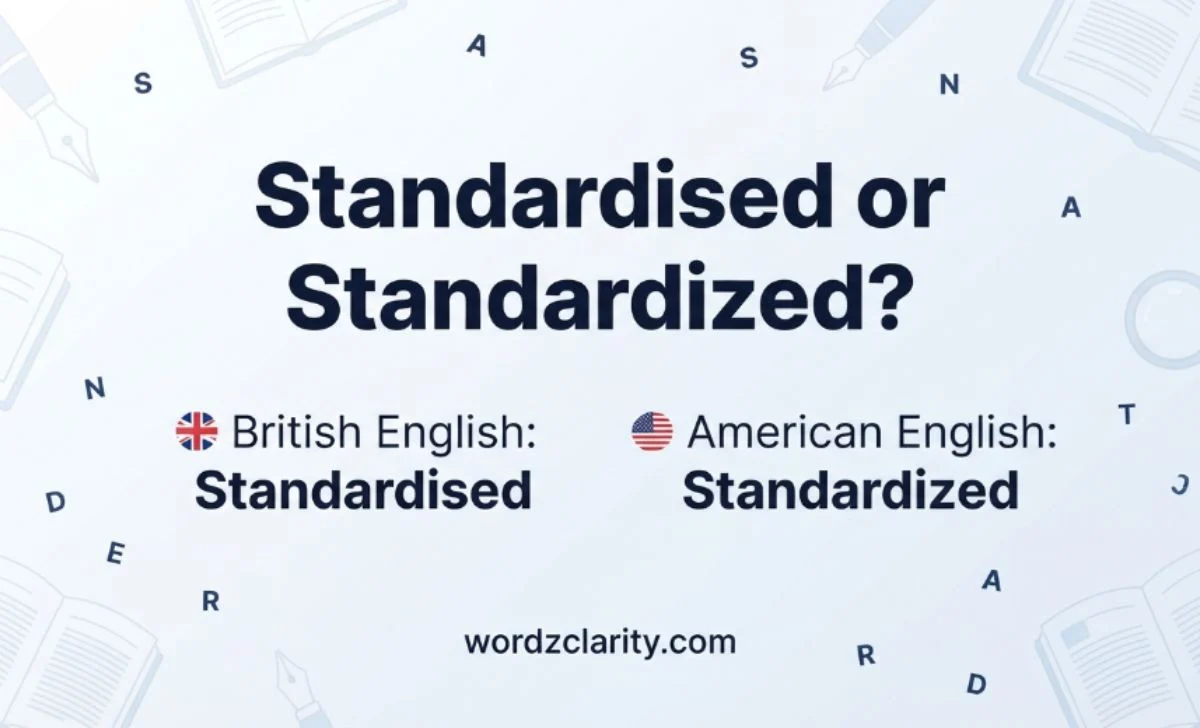
Standardised and standardized are easy to confuse because they mean exactly the same thing. The only real difference is the spelling convention used by different varieties of English.
If you are writing an essay, report, email, or website content, the choice usually depends on whether you are following British or American English.
Standardised is commonly used in British English, while standardized is the usual American English spelling. Both forms come from the verb standardise/standardize, meaning to make something follow an agreed standard or set of rules.
This distinction matters when you want your writing to look consistent and natural. You may see both spellings in professional and academic writing, so knowing when to use each one can prevent unnecessary spelling mistakes.
Below, we will look at the difference, meaning, grammar, and practical use of both forms.
Quick Answer: Standardised or Standardized?
Both standardised and standardized are correct.
- Standardised → commonly used in British English
- Standardized → standard American English spelling
- Both mean made consistent with an established standard
- Both have the same grammatical function
- The difference is mainly the -ise/-ize spelling
For example:
The company has standardized its procedures.
This is the usual American spelling.
The company has standardised its procedures.
This is the common British spelling.
There is no difference in meaning between the two sentences.
What Does Standardised or Standardized Mean?
Standardised/standardized is the past tense and past participle of standardise/standardize.
It means that something has been changed, designed, or organized according to a particular standard.
For example:
The school has standardized its testing system.
This means the school has made its testing system follow a common set of rules or requirements.
The word can describe many things, including:
- procedures
- tests
- measurements
- products
- processes
- forms
- equipment
- data
- operating methods
Consider this example:
The company standardized its customer service procedures.
The sentence means that the company created a consistent way for employees to handle customer service.
The same idea can be expressed with the British spelling:
The company standardised its customer service procedures.
Standardised vs Standardized: The Main Difference
The main difference is regional spelling, not meaning.
American English generally uses -ize in this type of word:
standardize → standardized
British English commonly uses -ise:
standardise → standardised
The same pattern appears in several familiar words.
| American English | British English |
|---|---|
| standardized | standardised |
| standardized system | standardised system |
| standardize | standardise |
| organization | organisation |
| recognize | recognise |
| realize | realise |
So, if you see standardised in a British publication and standardized in an American publication, neither writer has necessarily made a mistake.
When Should You Use “Standardized”?
Use standardized when your writing follows American English.
This is the natural choice for most US-focused academic, business, technical, and general writing.
For example:
The company has standardized its hiring process.
The researchers used a standardized test.
All employees must follow the standardized procedure.
The software uses a standardized data format.
If your document already uses American spellings such as organization, recognize, and analyze, then standardized will fit naturally with the rest of the writing.
Common American English forms
| Form | Spelling |
|---|---|
| Base verb | standardize |
| Third person | standardizes |
| Past tense | standardized |
| Present participle | standardizing |
| Past participle | standardized |
When Should You Use “Standardised”?
Use standardised when you are following British English spelling.
For example:
The company has standardised its hiring process.
The researchers used a standardised test.
All employees must follow the standardised procedure.
The software uses a standardised data format.
The grammar and meaning remain the same. Only the spelling changes.
Common British English forms
| Form | Spelling |
|---|---|
| Base verb | standardise |
| Third person | standardises |
| Past tense | standardised |
| Present participle | standardising |
| Past participle | standardised |
Which One Should You Use?
The best choice depends on the English style required for your writing.
| Writing situation | Preferred form |
|---|---|
| American English | standardized |
| British English | standardised |
| US academic writing | standardized |
| UK academic writing | standardised |
| US business writing | standardized |
| UK business writing | standardised |
| International writing | Choose one style and stay consistent |
If your employer, university, publisher, or client has a style guide, follow that first.
For an international audience, you generally do not need to use both spellings. Choose one English variety and apply it consistently.
Why Does English Have Both Spellings?
The -ize/-ise difference is part of a wider pattern in English spelling.
Many English verbs have developed two accepted forms, with American English often favoring -ize and British English commonly using -ise.
For example:
organize / organise
recognize / recognise
realize / realise
standardize / standardise
This does not mean that British English never uses -ize. Some British dictionaries and style systems accept or prefer -ize forms. However, -ise is very common in everyday British writing.
That is why both standardised and standardized can be correct, depending on the spelling system being followed.
Standardised or Standardized in Real Writing
The difference becomes clearer when you see both forms in normal contexts.
Business writing
American English:
The company has standardized its hiring procedures.
British English:
The company has standardised its hiring procedures.
Academic writing
American English:
The researchers used a standardized questionnaire.
British English:
The researchers used a standardised questionnaire.
Technical writing
American English:
The software follows a standardized data format.
British English:
The software follows a standardised data format.
American English:
We have standardized the process to reduce errors.
British English:
We have standardised the process to reduce errors.
In each pair, the meaning stays the same.
Common Mistakes to Avoid
The biggest mistake is treating one spelling as universally correct.
If you normally use American English, standardised may look unusual, but that does not make it a spelling error.
Likewise, if you normally use British English, standardized is not automatically wrong.
Another common problem is mixing spelling styles in the same document.
For example:
The organization has standardized its procedures.
This is consistent with American English.
A British-style version would be:
The organisation has standardised its procedures.
Both are clear, but the second follows a consistent British spelling pattern.
When writing professionally, consistency makes your work look more polished.
How the Word Changes in a Sentence
The spelling difference continues through the different forms of the verb.
| American English | British English |
|---|---|
| standardize | standardise |
| standardizes | standardises |
| standardized | standardised |
| standardizing | standardising |
For example:
The company standardizes its procedures every year.
The company standardised its procedures last year.
The team is standardizing the testing process.
The grammar does not change between American and British English. Only the spelling of the -ize/-ise ending changes.
Standardized or Standardised in Academic Writing
Both forms are suitable for academic writing. The important point is to follow the spelling system required by your institution or publication.
An American-style paper might say:
The study used a standardized method to collect the data.
A British-style paper might say:
The study used a standardised method to collect the data.
The word is especially common when discussing standardized tests, procedures, measurements, methods, and research tools.
If you are submitting academic work, check the required style guide rather than changing the spelling based on personal preference.
Standardized or Standardised in Professional Writing
In business and professional writing, the word often describes a process that has been made consistent across a company, department, or system.
For example:
We need a standardized process for handling customer complaints.
A British company may write:
We need a standardised process for handling customer complaints.
Both sentences are natural. The choice depends on the company’s English style.
The same applies to technical documents, policies, training materials, and internal guidelines.
Standardized vs Standardised Pronunciation
The two spellings are generally pronounced the same way.
The difference you see on the page does not normally create a different pronunciation. This makes standardised/standardized a spelling issue rather than a pronunciation issue.
So if you hear the word in conversation, you usually cannot tell which spelling the speaker would use in writing.
Standardized vs Standardised Test
You may come across the phrase standardized test more often in American sources, while British sources may use standardised test.
For example:
Students took a standardized test at the end of the year.
British spelling:
Students took a standardised test at the end of the year.
Here, the adjective describes a test that follows a consistent method, format, or set of conditions.
The same distinction appears with other phrases:
- standardized procedure / standardised procedure
- standardized method / standardised method
- standardized system / standardised system
- standardized format / standardised format
- standardized measurement / standardised measurement
How to Keep Your Writing Consistent
You do not need to memorize every -ize/-ise word. Instead, look at the spelling style already used in your document.
If you have written:
organization
recognize
standardize
then standardized will usually fit your American-style spelling.
If your document uses:
organisation
recognise
standardise
then standardised will normally fit the British style.
A useful habit is to choose your English variety before editing a long document. That way, you are less likely to switch between regional spellings later.
Is “Standardised” a Misspelling?
No. Standardised is a valid spelling used in British English and other varieties influenced by British spelling.
Likewise, standardized is not a mistake. It is the standard American spelling.
The important distinction is:
standardized = American English
standardised = commonly used British English
There are exceptions and differences between individual style guides, especially in British English. However, this basic rule is enough for most everyday writing.
FAQs
1. Is standardized or standardised correct?
Both are correct. Standardized is the standard American spelling, while standardised is commonly used in British English.
2. Is “standardised” British English?
Yes. Standardised is a common British English spelling of the past form of standardise.
3. Is “standardized” American English?
Yes. Standardized is the usual American English spelling.
4. Which spelling should I use in a UK essay?
If your essay follows British English, standardised is generally the natural choice. If your institution requires a particular style guide, follow its rules.
5. Does standardized mean the same as standardised?
Yes. Both words have the same meaning. They indicate that something has been made consistent with an established standard.
6. Should a website use standardized or standardised?
Use the form that matches your website’s target audience and overall spelling style. A US-focused site will normally use standardized, while a UK-focused site will commonly use standardised.
Final Verdict
Standardised and standardized are both correct. The difference is mainly regional spelling.
If you follow American English, use standardized.
If you follow British English, standardised is the common choice.
The word itself does not change meaning, grammar, or normal pronunciation. What matters is consistency. If your document uses American spellings such as organization and recognize, standardized will fit. If it uses British forms such as organisation and recognise, standardised will fit better.
You also do not need to worry when you see the other form in a reliable source. It may simply reflect a different English convention.
For most writers, the easiest rule is:
US English → standardized
British English → standardised
Choose the form that suits your readers, follow any required style guide, and use that spelling consistently throughout your work.
Read More Blogs:
Is Ready or Not Cross-Platform? Everything You Need to Know
Brasil or Brazil: Differences, Meaning, and When to Use Each
Swam or Swum: Which Is Correct? Grammar Rules, Meaning
Roster vs Roaster: Don’t Make This Common Mistake