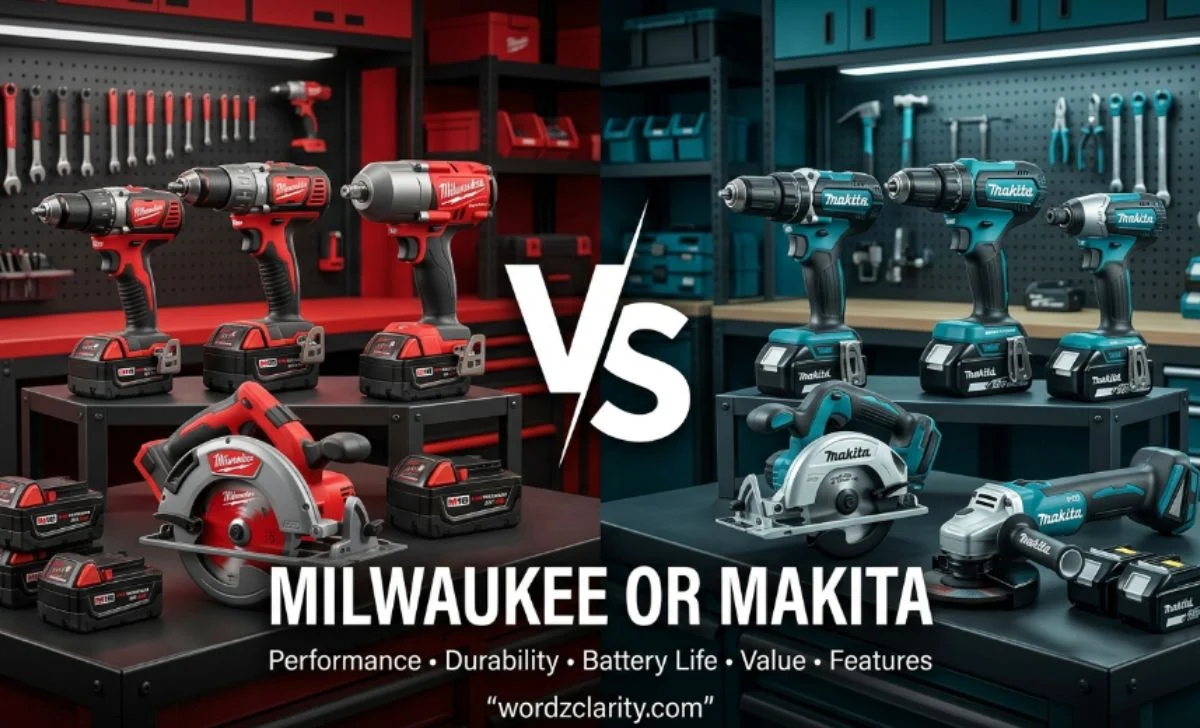
Choosing between Milwaukee and Makita can be surprisingly difficult. Both brands have strong reputations, large tool ranges, and loyal users across construction, woodworking, maintenance, and DIY work.
If you are searching for “Milwaukee or Makita,” you may be trying to decide which brand offers better performance, battery life, durability, value, or overall versatility.
The right answer, however, depends on what you expect from your tools and how often you use them.
Milwaukee is widely associated with powerful cordless equipment and a broad professional lineup, while Makita is known for refined tool design, efficient motors, and a long-established cordless ecosystem.
This guide compares the two brands in practical terms so you can choose the one that fits your work.
Quick Answer:
If you want a simple answer, neither Milwaukee nor Makita is universally better. Each brand has strengths that may make it more suitable for a particular type of user.
Milwaukee is often a strong choice for professionals who want high-performance cordless tools, extensive trade-specific equipment, and a large battery platform.
Makita is an excellent option for users who value tool balance, efficient performance, ergonomics, and a broad range of cordless and outdoor equipment.
A simple comparison looks like this:
| Feature | Milwaukee | Makita |
|---|---|---|
| Professional use | Excellent | Excellent |
| Cordless range | Very extensive | Very extensive |
| Battery platforms | M12 and M18 | LXT and XGT |
| Ergonomics | Strong | Strong |
| Heavy-duty tools | Excellent | Excellent |
| Outdoor equipment | Excellent | Excellent |
| DIY use | Excellent | Excellent |
| Tool selection | Very broad | Very broad |
| Best choice | High-output professional work | Balanced performance and versatility |
The better brand depends on your specific tools, workload, budget, and battery system.
Milwaukee vs Makita: What Is the Real Difference?
Milwaukee and Makita compete in many of the same categories, including drills, impact drivers, saws, grinders, rotary hammers, sanders, outdoor equipment, and specialty tools.
The biggest difference is not simply that one brand is “better.” Their product strategies and ecosystems have developed in somewhat different directions.
Milwaukee has built a particularly strong identity around professional cordless tools. Its M12 and M18 systems cover a wide range of compact and high-powered equipment. The brand also offers many trade-specific products rather than focusing only on basic tools.
Makita has a long history in power tools and has developed major cordless platforms including 18V LXT and 40V XGT. Its product range also extends into outdoor equipment, making the brand relevant to contractors, woodworkers, landscapers, and serious home users.
For someone buying a single drill, the difference may not be dramatic. However, the decision becomes much more important when you plan to build an entire tool collection.
Milwaukee: What Is It Known For?
Milwaukee Tool is an American power-tool brand with a particularly strong presence in professional construction and industrial applications.
The company has invested heavily in cordless technology and trade-specific products. Its tool lineup includes equipment designed for electricians, plumbers, mechanics, builders, remodelers, and other professionals.
One of Milwaukee’s biggest advantages is the depth of its cordless ecosystem.
The M12 Platform
The M12 system uses a compact 12V battery platform.
Its smaller size makes it useful when access, weight, and portability matter. M12 tools are especially attractive for tasks where a full-size drill or impact tool would be unnecessarily bulky.
Examples include:
- Compact drills
- Installation tools
- Inspection equipment
- Small impact tools
- Specialty trade equipment
- Compact lighting
The main advantage is convenience. A small battery platform can make a noticeable difference when a tool is carried or used throughout the day.
The M18 Platform
M18 is Milwaukee’s larger cordless system and contains a much wider selection of high-performance tools.
It includes products such as:
- Drills
- Impact drivers
- Circular saws
- Reciprocating saws
- Grinders
- Rotary hammers
- Sanders
- Lighting
- Outdoor equipment
- Specialty professional tools
For a contractor who wants to build one cordless collection, this broad compatibility can be a major benefit.
Milwaukee’s Trade-Focused Approach
Another important characteristic is Milwaukee’s focus on specialized professional equipment.
Instead of offering only common tools, the company has developed products for particular jobs and industries.
That can be valuable when your work requires more than a basic drill, saw, or grinder.
For example, a professional may prefer a platform that includes specialized plumbing, electrical, mechanical, or installation equipment alongside standard power tools.
Makita: What Is It Known For?
Makita is a Japanese power-tool manufacturer with a long history in the industry.
The company has developed a reputation for combining performance with relatively refined ergonomics and tool design. Its cordless range is especially important to modern users.
Makita’s major battery ecosystems include 18V LXT and 40V XGT.
Makita 18V LXT
The 18V LXT system is one of Makita’s most established cordless platforms.
It covers a large selection of tools and equipment, including:
- Drills
- Impact drivers
- Circular saws
- Reciprocating saws
- Sanders
- Grinders
- Rotary hammers
- Outdoor equipment
- Vacuums
- Lighting
One of the major advantages of a mature battery platform is choice. Once you own compatible batteries and chargers, adding another tool becomes easier.
Makita 40V XGT
Makita’s XGT platform is designed for applications that demand more power.
It provides a higher-voltage cordless ecosystem for heavier-duty equipment without requiring users to move back to traditional corded tools for every demanding task.
The XGT range is particularly relevant to professionals who want substantial cordless performance while remaining within the Makita ecosystem.
Milwaukee vs Makita Battery Systems
Battery compatibility should be one of the first things you consider before choosing a brand.
A cordless tool is not simply a tool. Once you start buying several products, the batteries and chargers become part of the investment.
Milwaukee’s major systems include:
- M12
- M18
Makita’s major systems include:
- 18V LXT
- 40V XGT
These systems are not interchangeable across brands.
A Milwaukee battery cannot simply be used with a Makita tool, and a Makita battery cannot be used directly with a Milwaukee tool.
This means your first purchase can influence future purchases.
Why the Battery Platform Matters
Suppose you already own several Milwaukee M18 batteries.
Buying another M18 tool may make financial sense because you can use the batteries you already have.
The same principle applies to a Makita LXT or XGT owner.
Therefore, instead of asking only:
“Which brand makes the better drill?”
consider asking:
“Which battery ecosystem makes more sense for the tools I plan to buy over the next few years?”
That question can lead to a much better decision.
Milwaukee vs Makita for Professional Use
Both brands are capable of meeting professional demands, but the ideal choice depends heavily on the trade.
A contractor who needs specialized cordless equipment may find Milwaukee particularly attractive because of its extensive professional-focused lineup.
A carpenter or woodworker who prioritizes balance, handling, and a broad collection of cordless equipment may find Makita equally compelling.
Neither brand should be treated as a universal winner.
For Construction
Both brands offer powerful saws, drills, impact drivers, grinders, and other equipment used in construction.
Milwaukee may appeal to users who want a very extensive professional ecosystem.
Makita can be attractive to users who already work within its LXT or XGT system.
For Woodworking
Woodworkers often care about:
- Tool balance
- Vibration
- Control
- Cutting performance
- Dust management
- Battery runtime
- Ergonomics
Makita has a strong presence in woodworking and offers a broad range of equipment suited to this type of work.
Milwaukee also offers capable woodworking tools, especially for users already invested in its cordless ecosystem.
For Mechanics
Mechanics may place greater emphasis on compact tools, torque, access, and specialty equipment.
Milwaukee has a particularly broad selection of compact and trade-specific products, making it a strong option for automotive and mechanical applications.
However, Makita also provides a substantial selection of cordless tools for maintenance and repair work.
Milwaukee or Makita for DIY Users?
For occasional DIY projects, either brand can provide more capability than most homeowners actually need.
The more important question is whether you intend to buy several tools.
If you only need a drill once or twice a year, spending heavily on a professional ecosystem may not be necessary.
But if you regularly work on home improvement projects, a cordless platform can become useful.
For example, a homeowner might eventually want:
- A drill
- An impact driver
- A circular saw
- A reciprocating saw
- A light
- A sander
- An outdoor tool
Once several tools are involved, battery compatibility becomes much more important than the difference between individual models.
Which Brand Has Better Tool Quality?
It is difficult to declare one brand the overall winner for quality.
Both Milwaukee and Makita produce professional-grade tools, but individual models can differ considerably.
A better way to evaluate quality is to examine the specific tool you intend to buy.
Look at:
- Motor performance
- Build quality
- Ergonomics
- Weight
- Battery requirements
- Warranty
- Available accessories
- Replacement parts
- Local service
- Reviews from experienced users
A particular Milwaukee tool may be better suited to your job than its Makita equivalent, while a Makita product may be the stronger choice in another category.
That is why brand loyalty alone should not determine every purchase.
Milwaukee vs Makita: Ergonomics and Comfort
Comfort becomes increasingly important when a tool is used for several hours.
Two tools can have similar performance specifications but feel completely different in the hand.
Factors worth considering include:
- Grip shape
- Weight distribution
- Trigger position
- Handle size
- Battery placement
- Vibration
- Overall length
Makita has a strong reputation for attention to ergonomics, while Milwaukee also places significant emphasis on professional usability.
The best choice depends partly on the individual user.
If possible, hold both tools before purchasing. A tool that feels comfortable in a store may also reduce fatigue during long work sessions.
Which Is More Powerful: Milwaukee or Makita?
There is no reliable brand-wide answer.
Power depends on the specific tool and model, not simply the logo printed on it.
A high-output Milwaukee tool may outperform a particular Makita model in one application. A Makita XGT tool may provide stronger performance than a smaller Milwaukee model in another.
Battery voltage alone also does not tell the complete story.
Real-world performance depends on factors such as:
- Motor design
- Battery capacity
- Electronics
- Gear system
- Tool design
- Load
- Material being worked
- Application
Therefore, comparing exact models is more useful than asking which entire brand is more powerful.
Milwaukee vs Makita for Battery Life
Battery runtime also varies by tool and battery.
A compact drill performing light fastening work can consume considerably less energy than a circular saw cutting dense material.
For this reason, battery capacity should not be viewed in isolation.
When comparing batteries, consider:
- Capacity
- Tool efficiency
- Workload
- Battery age
- Temperature
- Continuous versus intermittent use
For frequent professional use, having multiple batteries can be more practical than trying to find one battery with the longest possible runtime.
A rotating system allows one battery to charge while another is being used.
What Should You Consider Before Choosing?
Before choosing Milwaukee or Makita, make a short list of your actual needs.
1. Identify Your Main Tools
Start with the tools you use most often.
If you mainly need a drill and impact driver, your decision may be different from someone building a complete construction setup.
2. Check the Battery Ecosystem
Look at the tools you may buy later.
Do not choose a battery platform only because of one attractive tool.
3. Compare Exact Models
Brand-level comparisons can hide important differences.
Compare the exact Milwaukee and Makita models you are considering.
4. Consider Weight
If you use the tool for long periods, weight can affect fatigue.
5. Check Local Support
Availability of batteries, accessories, replacement parts, and service can vary by location.
6. Consider Your Budget
The cheapest tool is not always the best value, especially if you expect to use it regularly for years.
Think about the total cost of the system rather than the price of one tool.
Milwaukee or Makita: Which Offers Better Value?
Value is more than the price printed on a product page. A tool can cost more initially but provide better value if it fits your work, lasts well, and shares batteries with tools you already own.
Milwaukee and Makita both occupy the professional end of the power-tool market, so comparing only the cheapest available model from each brand can give you a misleading picture.
Instead, consider the complete ownership cost:
| Factor | Why It Matters |
|---|---|
| Tool price | Determines your initial investment |
| Batteries | Can become a major part of the system cost |
| Charger | Important when expanding your collection |
| Accessories | Blades, bits, discs, and other parts add to long-term cost |
| Warranty | Provides additional protection |
| Service | Useful when equipment needs repair |
| Compatibility | Reduces the need to buy duplicate batteries |
| Expected workload | Helps determine whether professional equipment is worthwhile |
For a professional, paying more for the right platform can make sense because the tool may be used every day.
For a casual homeowner, a large professional ecosystem may provide more capability than necessary.
The best value is therefore the system that matches your actual workload.
Battery Ecosystem: Milwaukee M12 and M18 vs Makita LXT and XGT
The battery system is one of the biggest reasons users stay with a particular brand.
Once you own several batteries, chargers, and cordless tools, changing platforms can become expensive.
Milwaukee has two major cordless families:
- M12 for compact equipment
- M18 for larger 18V equipment
Makita’s major systems include:
- 18V LXT
- 40V XGT
These platforms serve different purposes, so it would be inaccurate to compare them simply by voltage.
Milwaukee M12 vs Makita 18V LXT
M12 is smaller and designed around compact cordless equipment.
LXT, meanwhile, is a larger 18V platform with an extensive selection of tools.
They are therefore not direct equivalents.
A compact M12 tool may be preferable when size and accessibility matter. An 18V LXT tool may be more appropriate when you need a broader range of conventional cordless equipment.
Milwaukee M18 vs Makita XGT
M18 and XGT are both used for demanding applications, but their ecosystems have different designs and product selections.
When comparing them, focus on the exact tool rather than assuming that a higher voltage automatically means better performance.
The right question is:
Which platform gives you the tools you actually need?
Milwaukee or Makita for Construction?
Construction professionals often need tools that can handle repetitive, demanding work.
Important factors include:
- Power
- Runtime
- Durability
- Battery availability
- Tool selection
- Ergonomics
- Jobsite reliability
- Specialty equipment
Milwaukee is a particularly compelling choice for users who want a large professional ecosystem with many trade-specific products.
Makita is also well suited to construction and offers a broad range of cordless equipment through its established platforms.
If your work requires specialized equipment, make a list of those tools before selecting a battery system.
For example, a contractor might need:
- Hammer drill
- Impact driver
- Circular saw
- Reciprocating saw
- Grinder
- Rotary hammer
- Work light
- Vacuum
If one ecosystem provides nearly everything on your list, that can be more valuable than choosing a brand based on one individual tool.
Which Is Better for Woodworking?
Woodworking places different demands on power tools.
A woodworker may care more about control, precision, handling, vibration, and dust collection than maximum torque.
Makita has a long-standing presence in woodworking and offers tools for cutting, sanding, drilling, and finishing.
Milwaukee also provides a strong selection for carpentry and construction-related woodworking.
For a serious woodworker, consider:
- Balance — A well-balanced tool can be easier to control.
- Weight — Lower weight may reduce fatigue.
- Cutting performance — The right saw matters more than the brand name.
- Dust management — Useful for indoor work.
- Battery runtime — Important during long sessions.
- Blade compatibility — Check the accessories you already use.
A tool that feels comfortable during detailed work can be more useful than one that simply has a higher advertised performance figure.
Milwaukee or Makita for Mechanics?
Mechanics have different priorities from carpenters and general contractors.
Compact dimensions, access, torque, speed control, and specialty tools can all matter.
Milwaukee has developed a particularly broad selection of tools aimed at automotive and mechanical applications. Its compact cordless products can be useful where space is limited.
Makita also offers cordless equipment for repair and maintenance work.
If you work around vehicles regularly, do not compare only drills and impact drivers. Look at the full range of tools available for your specific tasks.
For example, consider whether the ecosystem includes the equipment you may need later for:
- Fasteners
- Tight spaces
- Cutting
- Grinding
- Lighting
- Inspection
- Maintenance
Your future tool needs should influence today’s purchase.
Which Brand Is Better for Outdoor Power Equipment?
Outdoor equipment is another area where battery platforms can make a major difference.
Depending on the ecosystem and market, both Milwaukee and Makita offer cordless products for outdoor work.
These may include:
- String trimmers
- Blowers
- Chainsaws
- Hedge trimmers
- Outdoor lighting
- Other landscaping equipment
Battery-powered outdoor tools can be convenient because they eliminate fuel mixing, reduce routine engine maintenance, and can be quieter than many gas-powered alternatives.
However, heavy outdoor work can place substantial demands on batteries.
If you already own a compatible battery system, staying with that ecosystem can simplify your equipment collection.
Milwaukee vs Makita for Beginners
If you are buying your first serious cordless tools, choosing a platform is more important than choosing a single tool.
A beginner might start with:
- Drill
- Impact driver
- Two batteries
- Charger
- Basic accessories
Later, the collection can grow.
That is why it is worth asking what you might buy two or three years from now.
If you choose Milwaukee, you may build around M12 and M18 products.
If you choose Makita, you may build around LXT or XGT depending on your needs.
There is no universally correct starting point.
The better approach is to identify your projects first and then select the ecosystem that supports them.
Are Milwaukee and Makita Batteries Interchangeable?
No. Milwaukee and Makita batteries are not directly interchangeable.
Milwaukee batteries are designed for Milwaukee platforms, while Makita batteries are designed for Makita systems.
This matters because batteries can become a significant investment when you own several cordless tools.
Do not assume that a similar voltage rating makes batteries compatible.
Battery design involves more than voltage. Physical connections, electronics, communication systems, protection features, and tool compatibility all matter.
For safety and reliability, use batteries and chargers designed for the appropriate platform.
Does Makita Make Better Tools Than Milwaukee?
Not across the entire product range.
Both brands have strong products, and individual models can perform differently.
A better comparison looks at the particular category.
For example, you might compare:
- One drill against another drill
- One impact driver against another impact driver
- One circular saw against another circular saw
Then evaluate specifications, ergonomics, reviews, warranty, accessories, and price.
This method avoids turning a complicated product decision into a simple brand-versus-brand argument.
The same principle applies to professional users.
A contractor should select the equipment that best supports the work rather than assuming every product from one manufacturer will outperform every product from another.
Does Milwaukee Make Better Tools Than Makita?
The same answer applies in reverse.
Milwaukee has many highly capable tools, but that does not mean every Milwaukee product is automatically the best choice.
Product generations change. Tool categories have different design priorities, and users have different requirements.
A Milwaukee tool may be the better option for one application, while a Makita tool may be more suitable for another.
That is why model-level comparison beats brand-level assumptions.
Before buying, compare the exact products available in your market.
Milwaukee vs Makita: Common Buying Mistakes
Choosing a tool platform can become expensive if you make the decision too quickly.
Here are some common mistakes worth avoiding.
Buying Only Because of Brand Reputation
A famous brand does not automatically make every product the best option for your particular job.
Ignoring Future Purchases
Buying one cordless tool without considering future equipment can leave you with a battery system that does not suit your long-term needs.
Comparing Voltage Alone
Voltage is only one part of tool performance.
Motor design, electronics, battery technology, gearing, and application all matter.
Choosing the Cheapest Kit
A low-priced starter kit may look attractive, but check what is included and whether those tools are suitable for your workload.
Ignoring Ergonomics
If you use a tool for several hours, comfort can be just as important as raw output.
Forgetting Accessories
Blades, bits, discs, batteries, chargers, and other accessories can affect the real cost of ownership.
How to Choose Between Milwaukee and Makita
Use this simple decision process.
Step 1: List Your Main Jobs
Write down what you actually do.
For example:
- Home repairs
- Carpentry
- Construction
- Automotive work
- Woodworking
- Landscaping
Step 2: List the Tools You Need
Do not start with the brand.
Start with the equipment.
Step 3: Check Both Ecosystems
Find out which brand offers the tools you need.
Step 4: Compare Exact Models
Look beyond the logo.
Compare weight, performance, runtime, dimensions, features, warranty, and price.
Step 5: Consider Your Existing Batteries
If you already own several compatible batteries, staying within that platform may provide better value.
Step 6: Think Long Term
Ask what tools you are likely to purchase later.
This prevents an expensive platform switch.
Milwaukee vs Makita: At-a-Glance Comparison
| Category | Milwaukee | Makita |
|---|---|---|
| Professional construction | Excellent | Excellent |
| Cordless ecosystem | M12/M18 | LXT/XGT |
| Compact tools | Strong | Strong |
| Heavy-duty equipment | Strong | Strong |
| Woodworking | Excellent | Excellent |
| Automotive applications | Very strong | Strong |
| Outdoor equipment | Strong | Strong |
| Ergonomics | Very good | Very good |
| Specialty tools | Extensive | Extensive |
| Best for | Trade-focused professional users | Versatile professional and serious DIY users |
This table should be treated as a general guide rather than a substitute for comparing specific models.
FAQs
1. Is Milwaukee better than Makita?
Neither brand is automatically better. Milwaukee may suit users who want a large professional and specialty-tool ecosystem, while Makita can be attractive for users who value its cordless platforms, ergonomics, and broad product range.
2. Is Makita a professional brand?
Yes. Makita produces tools designed for professional applications across construction, woodworking, maintenance, and outdoor work.
3. Can Milwaukee batteries fit Makita tools?
No. Milwaukee and Makita use separate battery ecosystems, so their batteries are not directly interchangeable.
4. Which is better for DIY, Milwaukee or Makita?
Either can work well for DIY projects. If you expect to buy several cordless tools, choose the platform with the products, batteries, and accessories that best match your future projects.
5. Which brand has more cordless tools?
Both manufacturers offer extensive cordless ranges. The exact selection depends on the battery platform, tool category, and market where you live.
6. Should I buy Milwaukee or Makita if I am starting from scratch?
Start by listing the tools you need now and may need later. Then compare the relevant Milwaukee and Makita ecosystems instead of choosing solely by reputation.
7. Is voltage the most important factor when comparing these brands?
No. Voltage alone does not determine real-world performance. The motor, electronics, battery, gearing, design, workload, and exact model all affect results.
Final Verdict:
The answer depends on what you do with your tools.
Milwaukee is an excellent choice for professionals who want a deep cordless ecosystem, strong specialty-tool coverage, and equipment aimed at demanding trade applications.
Its M12 and M18 platforms also give users options ranging from compact tools to powerful jobsite equipment.
Makita is equally worthy of consideration. Its LXT and XGT systems provide broad cordless coverage, while the brand’s focus on ergonomics and versatile equipment makes it appealing to professionals, woodworkers, contractors, and serious DIY users.
If you already own batteries from either brand, staying within that ecosystem may be the most practical decision. If you are starting from zero, compare the exact tools you need rather than choosing based on brand reputation alone. Milwaukee or Makita is ultimately a personal decision shaped by your work, budget, preferred tools, and long-term plans.
Read More Blogs:
- Honor or Honour: Right Spelling in American and British English
- Humour or Humor: Which Spelling Is Correct?
- Optimize or Optimise: American and British Spelling Compared