Have you ever typed “truely” and then stopped because it did not look quite right? You are not alone. The word true makes “truely” seem like the obvious spelling, but English does not always form adverbs exactly the way we expect.
This is why truely or truly is a common spelling question.
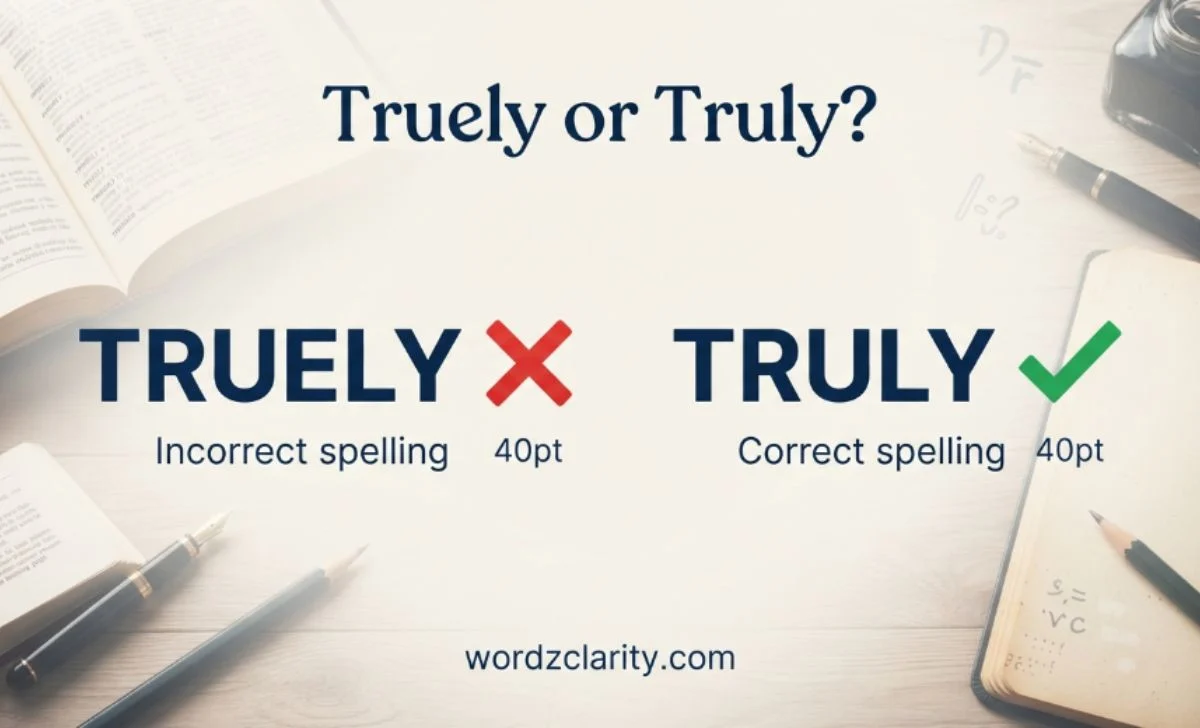
The correct spelling is truly. The spelling truely is a common misspelling and is not accepted in standard English.
Truly is an adverb that means “in a real or genuine way,” “very,” or “sincerely,” depending on the sentence. You can use it in everyday conversations, emails, essays, business writing, and formal documents.
In this guide, you will learn why truly is correct, why truely is wrong, how the word is pronounced, how it is used in sentences, and a few simple tricks to remember the spelling.
Quick Answer: Truely or Truly?
Truly is the correct spelling.
Truely is a common spelling mistake.
| Spelling | Correct? | Example |
|---|---|---|
| Truly | ✅ Yes | I truly appreciate your help. |
| Truely | ❌ No | I truely appreciate your help. |
The important point is that truly drops the “e” from true before adding the “-ly” ending.
Correct:
- truly
- true
- truth
- truthful
Incorrect:
- truely ❌
For example:
She is truly happy with the result.
Not:
She is truely happy with the result. ❌
If you are writing for school, work, a website, or a formal audience, always use truly.
Why Is “Truly” Correct?
The confusion comes from the word true.
Normally, when we turn an adjective into an adverb, we often add -ly:
- quick → quickly
- slow → slowly
- careful → carefully
- honest → honestly
So it is natural to think:
true + ly = truely
However, English spelling has an important exception here.
When true becomes an adverb, the final e is removed before -ly is added:
true → truly
This spelling has been established in standard English for a long time.
The same pattern can be seen in a few other words where the spelling changes when a suffix is added. English spelling is based on historical patterns as well as simple letter-by-letter rules, so not every word follows the most obvious formula.
That is why truly may look unusual at first, but it is the standard form.
What Does “Truly” Mean?
Truly is an adverb. Its exact meaning depends on the context.
It can mean genuinely, really, sincerely, or in fact.
1. Truly meaning “genuinely”
When something is genuine or sincere, truly can emphasize that fact.
She truly cares about her students.
This means that her concern is genuine.
I truly believe you made the right decision.
Here, truly emphasizes that the belief is sincere.
2. Truly meaning “really”
Sometimes truly is used to emphasize how something feels or appears.
This is truly amazing.
The speaker is saying that something is really amazing.
It was a truly beautiful evening.
Here, truly strengthens the adjective beautiful.
3. Truly meaning “in fact”
The word can also emphasize that something is actually the case.
He is truly one of the best players on the team.
The speaker is strongly stating that this is genuinely true.
4. Truly meaning “sincerely”
In personal or formal communication, truly can express sincerity.
I truly appreciate your support.
This tells the reader that the appreciation is genuine.
Truly: Pronunciation and Part of Speech
Truly is pronounced approximately like:
TROO-lee
Its pronunciation is close to the word true, followed by a light -ly sound.
The word has two syllables:
truly → troo-lee
It is an adverb because it describes or modifies a verb, adjective, or another adverb.
For example:
I truly understand your concern.
Here, truly modifies the verb understand.
She is truly talented.
Here, truly adds emphasis to the adjective talented.
Why Do People Write “Truely”?
If truely is wrong, why do so many people write it?
The answer is simple: the spelling looks logical.
The adjective is:
true
Many learners naturally assume that adding -ly gives:
true + ly = truely
That seems reasonable because many English adverbs are formed by simply adding -ly.
For example:
- quiet → quietly
- serious → seriously
- normal → normally
- polite → politely
However, true follows a different spelling pattern.
The correct transformation is:
true → truly
The final e disappears.
Another reason for the mistake is pronunciation. Truly does not clearly tell a writer that the e from true has disappeared. When people hear the word rather than see it, they may mentally connect it with true + ly.
This makes truely an understandable mistake, but it is still incorrect in standard English.
Truely vs Truly: Side-by-Side Comparison
The easiest way to remember the difference is to compare the two forms directly.
| Feature | Truly | Truely |
|---|---|---|
| Standard spelling | ✅ Yes | ❌ No |
| Dictionary form | Yes | No |
| Part of speech | Adverb | — |
| Based on | True | True |
| Meaning | Genuinely, really, sincerely | — |
| Suitable for formal writing | Yes | No |
| Common mistake | No | Yes |
Examples
Correct:
I truly enjoyed the experience.
Incorrect:
I truely enjoyed the experience.
Correct:
She truly understands the problem.
Incorrect:
She truely understands the problem.
Correct:
We are truly grateful for your support.
Incorrect:
We are truely grateful for your support.
Is “Truely” Ever Correct?
No. Truely is not the standard spelling of the English adverb.
You may see truely on websites, social media posts, informal messages, comments, or other user-generated content. Its appearance in those places does not make it correct.
It is usually just a spelling error.
If you are checking your own writing and see truely, replace it with truly.
Remember:
truely = misspelling
truly = correct spelling
There is no standard English situation where you should choose truely instead of truly.
How to Use “Truly” in a Sentence
Because truly is an adverb, it can appear in several positions.
Before a verb
I truly appreciate your kindness.
We truly value your opinion.
She truly understands what happened.
Before an adjective
The view was truly spectacular.
He is a truly remarkable person.
It was a truly difficult decision.
At the beginning of a sentence
Sometimes truly is placed at the beginning to add emphasis.
Truly, this was an unforgettable experience.
This style is less common in everyday conversation but can work well in formal, literary, or expressive writing.
At the end of a sentence
It can also appear later in a sentence when the context allows it.
I believe you, truly.
This often gives the sentence an emotional or sincere tone.
Common Examples of “Truly”
Here are some natural examples you might encounter in everyday English.
Everyday conversation
I truly don’t know what happened.
She truly loves her new job.
You are truly lucky.
I truly hope everything works out.
Emails
Thank you. I truly appreciate your quick response.
We truly value your feedback.
I am truly sorry for the inconvenience.
Business writing
Our company truly values customer satisfaction.
We are truly grateful for your continued support.
This opportunity is truly important to our team.
Academic writing
The study provides a truly useful explanation of the issue.
The results are truly significant when viewed in context.
In academic writing, however, truly should not be used simply to make a claim sound stronger. Academic writers usually need evidence to support strong statements.
Social media
Truly one of the best days of my life!
I am truly grateful for everyone who supported me.
This place is truly beautiful.
Truly vs Really: Are They the Same?
Truly and really can have similar meanings, but they are not always interchangeable.
Both can be used for emphasis:
She is really talented.
She is truly talented.
Both sentences say that she is very talented.
However, truly can sound more sincere, serious, or heartfelt.
Compare:
I really appreciate your help.
I truly appreciate your help.
The first is completely natural in everyday conversation. The second can sound more heartfelt or deliberate.
Really is generally more common in casual speech, while truly can add a stronger sense of sincerity or emphasis.
Truly vs Truthfully
These two words are related, but they are not exactly the same.
Truly generally means genuinely, really, or sincerely.
Truthfully means honestly or according to the truth.
Compare:
I truly care about you.
This emphasizes genuine feeling.
Truthfully, I didn’t expect this result.
This means the speaker is being honest about what happened.
Another example:
She truly enjoyed the movie.
She genuinely enjoyed it.
Truthfully, she didn’t enjoy the movie.
The speaker is honestly stating that she did not enjoy it.
Choosing between these words depends on what you want to express.
Common Mistakes With “Truly”
The biggest mistake is adding an e.
Mistake 1: Writing “truely”
❌ I truely appreciate your help.
✅ I truly appreciate your help.
Mistake 2: Assuming every word keeps its final “e”
The spelling rule is not always as simple as adding -ly.
For true, remember:
true → truly
not:
true → truely
Mistake 3: Confusing spelling with pronunciation
Because truly sounds connected to true, some writers automatically include the e when spelling it.
Try to remember the written form rather than spelling it based only on sound.
Mistake 4: Using “truly” when “truthfully” is intended
These words can overlap, but they are not identical.
If you mean honestly, truthfully may be the better choice.
If you mean genuinely or really, truly is usually appropriate.
A Simple Trick to Remember “Truly”
Here is an easy memory trick:
True loses its “e” to become truly.
Think of it this way:
TRUE – E + LY = TRULY
You do not need to memorize a complicated spelling rule.
Just remember:
True becomes truly.
The word truly contains tru, not true.
Quick memory test
Which one looks right?
- truely
- truly
Choose:
TRULY ✅
If you remember that true loses the e, you are much less likely to make the mistake.
Truly in Formal and Informal Writing
Truly is acceptable in both formal and informal English.
You can use it in:
- personal emails
- professional emails
- essays
- articles
- reports
- speeches
- business communication
- conversations
- social media
- creative writing
However, the tone can change depending on the sentence.
Professional
We truly appreciate your patience.
This is polite and natural.
Personal
I truly miss those days.
This sounds emotional and sincere.
Formal
The findings truly demonstrate the importance of early intervention.
This is possible, although formal academic writing should avoid unnecessary emphasis.
Casual
That was truly wild!
This is more expressive and conversational.
Is “Truly” British or American English?
Truly is used in both British English and American English.
There is no British-versus-American spelling difference here.
| English variety | Correct spelling |
|---|---|
| British English | truly |
| American English | truly |
| Canadian English | truly |
| Australian English | truly |
| International English | truly |
So you do not need to change the spelling based on your audience.
Whether you are writing for readers in the United States, the United Kingdom, Canada, Australia, or elsewhere, truly is the standard spelling.
This is different from words such as:
- color / colour
- center / centre
- organize / organise
With truly, there is no comparable regional spelling choice.
“Truly” in Different Types of Writing
Understanding how the word works in different situations can help you use it naturally.
In an email
I truly appreciate you taking the time to help me.
This sounds polite and sincere.
In a job application
I am truly interested in contributing to your organization.
It can express genuine interest, although it should be supported by specific reasons.
In customer service
We truly value your feedback.
This is a common professional expression.
In an essay
The experience truly changed the way she viewed the issue.
Here, truly adds emphasis.
In a news-style sentence
The event was truly unexpected.
It emphasizes the surprising nature of the event.
In conversation
Do you truly believe that?
Here, truly can emphasize that the speaker is asking whether someone genuinely believes something.
When Should You Avoid “Truly”?
Although truly is correct, that does not mean you need to use it everywhere.
Too much emphasis can make writing sound exaggerated.
Compare:
We truly value your feedback.
This is natural.
But:
We truly, genuinely, honestly, and sincerely value your feedback.
This sounds repetitive and unnatural.
Good writing is not about using more emphasis. It is about choosing the right word when emphasis is actually useful.
In professional or academic writing, use truly when it adds meaning. Remove it when the sentence works just as well without it.
For example:
The results truly show the importance of the study.
If the evidence clearly shows this, you may simply write:
The results show the importance of the study.
The second version is often stronger because it is more direct.
Quick Comparison: True, Truly, Truth, and Truthful
These words are related, but each has a different grammatical role.
| Word | Part of speech | Meaning | Example |
|---|---|---|---|
| true | Adjective | Correct, real, genuine | The story is true. |
| truly | Adverb | Genuinely, really, sincerely | I truly believe you. |
| truth | Noun | What is real or correct | Tell me the truth. |
| truthful | Adjective | Honest; telling the truth | She is a truthful person. |
| truthfully | Adverb | Honestly; according to the truth | Truthfully, I was surprised. |
Seeing the family of words together makes the difference easier to understand.
Five Easy Sentences to Remember
If you want to memorize the correct spelling, start with these:
- I truly appreciate your help.
- She truly cares about her family.
- This is truly amazing.
- We are truly grateful for your support.
- I truly believe that you can do it.
Notice that every example uses truly, never truely.
How to Correct “Truely” in Your Writing
If you are editing an article, email, essay, or document, search for truely.
Replace every standard-English use of truely with:
truly
For example:
Before:
I truely enjoyed working with your team.
After:
I truly enjoyed working with your team.
Before:
We truely appreciate your support.
After:
We truly appreciate your support.
This is a simple correction, but it can make your writing look much more polished.
FAQs
1. Is “truely” a real word?
No. Truely is a common misspelling of truly. It may appear in informal or user-generated writing, but it is not the standard spelling used in edited English.
2. Why is truly spelled without an e?
The word truly comes from true, but the final e is dropped when the adverb is formed. Therefore, the standard spelling is truly, not truely.
3. Is truly an adverb?
Yes. Truly is an adverb. It can modify a verb, adjective, or another expression to show that something is genuine, real, sincere, or strongly emphasized.
4. Is truly the same as really?
They can have similar meanings, especially when used for emphasis. However, truly can sound more sincere or heartfelt, while really is often more common in everyday conversation.
5. Is truly used in British English?
Yes. Truly is the standard spelling in British English. It is also the standard spelling in American, Canadian, and Australian English.
6. How do you remember the spelling of truly?
Remember this simple pattern:
true → truly
Think of it as true without the e, plus ly.
7. What is the opposite of truly?
There is no single direct opposite in every context. Depending on the sentence, words such as falsely, untruthfully, or insincerely may express an opposite idea.
Conclusion
When choosing between truely or truly, the correct answer is simple: truly is the standard English spelling. Truely is a common misspelling and should be avoided in edited writing.
The confusion usually comes from the word true. It is easy to assume that adding -ly gives truely, but the final e is dropped, giving us truly. The word can mean genuinely, really, sincerely, or in fact, depending on the context.
You can use truly in everyday conversation as well as emails, business writing, essays, articles, and other formal or informal situations. It is also spelled the same way in British and American English, so there is no regional version to choose.
The easiest rule to remember is:
TRUE → TRULY
Whenever you are tempted to write truely, stop and remove the e. Once you remember that small spelling change, this common mistake becomes easy to avoid.
Read More Blogs: