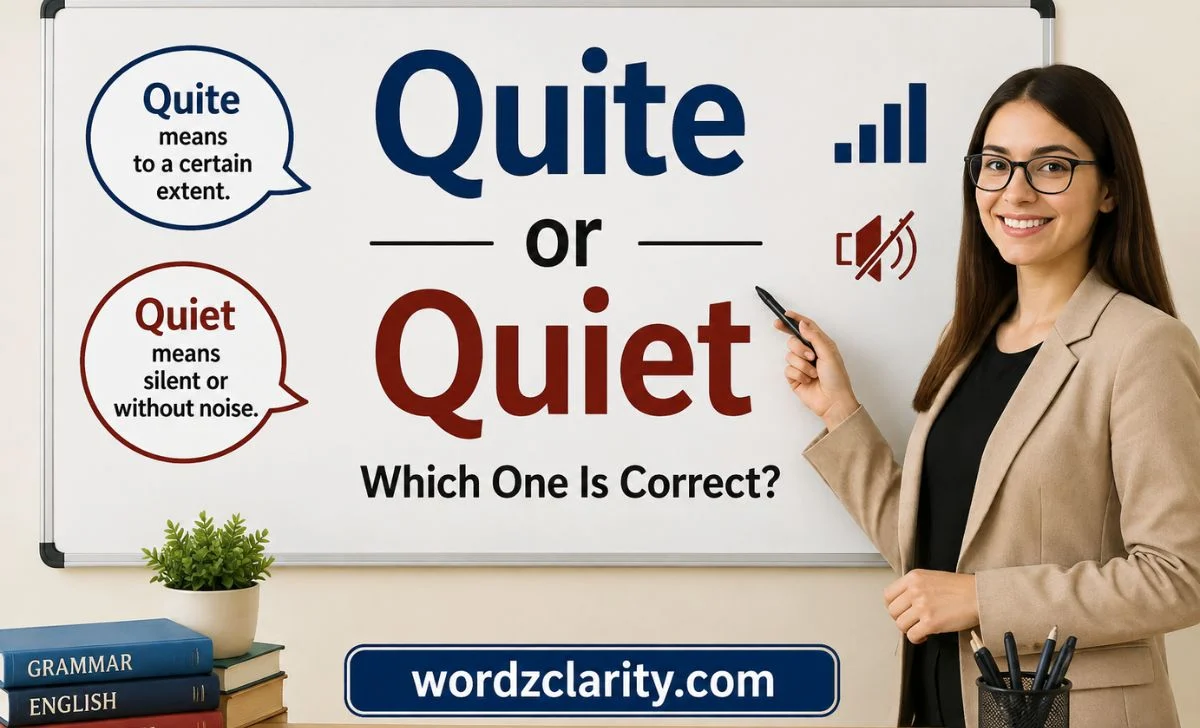
Quite and quiet are easy to confuse because they look very similar. However, they have different meanings and are used in different ways.
Quite is used to show degree or emphasis. For example, you can say, “The movie was quite good.”
Quiet is used when talking about little or no noise. For example, “The room was quiet.”
The difference is simple once you know what each word means. In this guide, you will learn when to use quite and quiet, how to pronounce them, the common mistakes to avoid, and how both words are used in everyday English.
Quite or Quiet: Quick Answer
Both words are correct.
The difference is their meaning.
Quite means something like fairly, rather, or very.
The movie was quite good.
Quiet means having little or no noise.
The room was quiet.
So, the easiest rule is:
Quite = degree
Quiet = little noise
That one rule will help you choose the right word in most situations.
What Do Quite and Quiet Mean?
Quite and quiet have different meanings, even though their spelling is very similar.
Quite is an adverb. It adds degree or emphasis to a sentence.
The movie was quite good.
The test was quite difficult.
She speaks quite clearly.
The exact meaning of quite depends on the context. It can suggest fairly, rather, very, or completely.
Quiet is usually an adjective. It describes little noise, calmness, or low activity.
The library was quiet.
We found a quiet café.
It was a quiet evening.
It can also describe someone who does not talk much:
He is a quiet person.
Unlike quite, quiet can also be used as a noun or verb:
I enjoy the quiet.
The teacher tried to quiet the class.
A simple way to remember the difference is:
Quite → degree or emphasis
Quiet → little noise, calmness, or low activity
It means there were not many customers.
You can also say:
It has been a quiet week at work.
Here, quiet means there has not been much activity.
Quite vs. Quiet: The Difference
| Word | Meaning | Example |
|---|---|---|
| Quite | Shows degree or emphasis | The film was quite good. |
| Quiet | Means little or no noise | The room was quiet. |
There is also a grammar difference.
Quite is mainly an adverb.
Quiet is mainly an adjective.
For example:
The exam was quite difficult.
But:
The classroom was quiet.
You cannot switch the words and keep the same meaning.
How Do You Pronounce Quite?
Quite has one syllable.
Its pronunciation is:
/kwaɪt/
It sounds similar to:
- bite
- light
- night
- right
For example:
The book is quite interesting.
Say it as one sound:
quite
How Do You Pronounce Quiet?
Quiet normally has two syllables.
Its pronunciation is:
/ˈkwaɪ.ət/
A simple way to say it is:
KWI-et
Listen to the difference:
quite → one syllable
quiet → two syllables
This is a useful clue when speaking. If you hear the extra syllable, the word is probably quiet.
When Should You Use Quite?
Use quite when you want to describe the degree of something.
It is common before adjectives.
The room is quite small.
The movie was quite funny.
The problem is quite serious.
The answer is quite simple.
It can also describe the degree of an adverb.
She answered quite quickly.
He explained the idea quite clearly.
A simple question can help:
Am I talking about how much or how strongly?
If yes, quite is often the right choice.
When Should You Use Quiet?
Use quiet when you are talking about sound, talking, or activity.
For example:
The baby is quiet now.
The office is quiet today.
We found a quiet café.
I like this quiet neighborhood.
You can also use it for a peaceful period:
We had a quiet weekend.
The weekend may not have been completely silent. It simply means that it was calm and not very busy.
Common Mistakes With Quite and Quiet
These two words are often mixed up in everyday writing.
“Please be quite”
Wrong:
Please be quite.
Right:
Please be quiet.
The sentence is about noise. So, use quiet.
“The movie was quiet good”
Wrong:
The movie was quiet good.
Right:
The movie was quite good.
Here, quite describes the degree of good.
“A quite place”
Wrong:
We need a quite place.
Right:
We need a quiet place.
The writer means a place with little noise.
“Quiet difficult”
Wrong:
The task was quiet difficult.
Right:
The task was quite difficult.
The sentence is about the level of difficulty.
Quite and Quiet in Everyday English
You will see these words in many normal situations.
At school
Please be quiet during the test.
The test was quite difficult.
At work
We need a quiet room for the meeting.
The new system is quite useful.
In conversation
“Did you like the restaurant?”
“Yes. It was quite good.”
Or:
“Where should we sit?”
“Let’s find somewhere quiet.”
In an email
I am quite happy with the results.
But:
Could we have the meeting in a quiet room?
The meaning does not change just because the setting changes.
Can Quite and Quiet Appear Together?
Yes.
In fact, this is a good way to understand the difference.
The library was quite quiet this morning.
Here, the two words have different jobs.
Quite shows the degree.
Quiet describes the lack of noise.
Another example:
The neighborhood is quite quiet at night.
This means the neighborhood is very calm or has very little noise.
So, seeing quite quiet together is perfectly normal.
What Does “Quite a” Mean?
You may also see quite before a or an.
For example:
It was quite a surprise.
That was quite a difficult question.
She had quite an interesting experience.
The basic pattern is:
quite + a/an + adjective + noun
Here, quite adds emphasis.
It still has nothing to do with silence.
Quiet Can Be a Noun or Verb
Quiet is not limited to adjective use.
It can also be a noun.
I enjoy the quiet of the countryside.
Here, quiet means a peaceful or silent state.
It can also be a verb:
The teacher tried to quiet the class.
This means the teacher tried to make the class less noisy.
Another form is:
The crowd quieted after the announcement.
These uses all connect to the idea of calmness or reduced noise.
A Simple Way to Remember the Difference
Do not focus only on the spelling.
Think about the meaning.
If the sentence is about noise or calm, use quiet.
a quiet room
a quiet street
a quiet evening
If the sentence is about degree, use quite.
quite good
quite difficult
quite expensive
quite interesting
When you remember these two ideas, the spelling becomes much easier.
Quite = degree
Quiet = little noise
That is the main difference between the two words.
British English and American English: Does “Quite” Change?
Quite is used in both British English and American English. The spelling stays the same.
The main difference is how strong the word can sound in certain sentences.
In British English, quite can often mean fairly or rather:
The film was quite good.
This can suggest that the film was good, but not necessarily excellent.
In American English, quite can sometimes sound stronger, especially with certain adjectives:
The film was quite good.
The speaker may be suggesting that the film was very good.
The meaning still depends on the speaker and the context. So, you should not assume that quite always means exactly the same thing as very.
Does “Quiet” Change Between US and UK English?
No.
Quiet has the same basic meaning in both varieties of English.
The library is quiet.
We found a quiet place to eat.
Whether you are writing for readers in the United States, the United Kingdom, Canada, Australia, or another English-speaking country, quiet keeps the same spelling.
Why “Quite” Can Be Confusing
The word quite has a wider range of meaning than quiet.
For example:
The answer is quite good.
This could mean fairly good in one situation and very good in another.
But quiet is much more straightforward:
The room is quiet.
The main idea is clear: there is little noise.
This is one reason English learners sometimes find quite harder to understand than quiet.
How Quite Works With Different Words
The meaning of quite can become clearer when you look at the word that follows it.
Quite + adjective
The house is quite old.
The road is quite narrow.
The question is quite difficult.
The weather is quite pleasant.
Here, quite changes the degree of the adjective.
Quite + adverb
She spoke quite slowly.
He explained the problem quite clearly.
They arrived quite early.
In these examples, quite modifies an adverb rather than an adjective.
Quite + a/an
It was quite a surprise.
He made quite a mistake.
She had quite an unusual experience.
This pattern is common in everyday English and formal writing.
Words That Commonly Follow “Quiet”
Quiet usually appears before a noun when it is used as an adjective.
Some common combinations are:
- quiet room
- quiet place
- quiet street
- quiet neighborhood
- quiet voice
- quiet evening
- quiet morning
- quiet night
- quiet person
- quiet area
These are natural phrases because quiet describes the level of noise, activity, or conversation.
For example:
We booked a quiet room at the hotel.
She spoke in a quiet voice.
It is a quiet neighborhood.
I had a quiet evening at home.
Quite or Quiet in Formal Writing
Both words are perfectly acceptable in formal writing.
The important thing is to use the correct one.
Academic writing
The results were quite significant.
The study found a quiet environment helpful for concentration.
The first sentence uses quite to show degree. The second uses quiet to describe the environment.
Business writing
The new process is quite effective.
We need a quiet space for the interview.
Professional emails
I am quite pleased with the progress.
Could you arrange a quiet room for the meeting?
Neither word is informal or incorrect. Their suitability depends on the meaning of the sentence.
Quite or Quiet in Social Media and Casual Writing
Informal writing often contains spelling mistakes because people type quickly.
That makes quite and quiet easy to mix up.
For example:
This place is quite beautiful.
Here, quite is correct because the writer is describing the degree of beauty.
But:
This place is so quiet.
Here, quiet is correct because the writer is talking about the lack of noise.
The same distinction applies to text messages, comments, captions, and online posts.
Common Expressions With Quiet
Some phrases with quiet are so common that they are worth learning as complete expressions.
Keep quiet
Please keep quiet while the presentation is running.
This means to avoid making noise or talking.
Be quiet
Please be quiet during the movie.
Quiet down
The children finally quieted down.
This means they became less noisy.
A quiet life
She prefers a quiet life in the countryside.
Here, quiet suggests a peaceful lifestyle rather than complete silence.
The quiet before the storm
This is a common expression for a calm period before something active, difficult, or dramatic happens.
These expressions can help you remember that quiet is connected with calmness and reduced noise or activity.
A Common Trap: “Quite” Does Not Always Mean “Very”
This is one of the most important points about quite.
It is tempting to memorize:
quite = very
But that shortcut is not always accurate.
Consider:
The room is quite small.
Depending on the speaker and context, this may mean the room is fairly small, rather small, or noticeably small.
Now consider:
You are quite right.
Here, quite can sound much stronger. It may mean that the person is completely or entirely right.
So, context matters.
Instead of translating quite into one fixed word every time, think of it as a word that can express degree or emphasis.
A Common Trap: “Quiet” Does Not Mean “Boring”
Another useful point is that quiet does not automatically mean boring.
For example:
We had a quiet weekend.
This could mean the weekend was peaceful and relaxing.
It does not mean that nothing enjoyable happened.
Similarly:
It is a quiet town.
This can suggest a peaceful place with less traffic and fewer crowds.
The meaning comes from the context.
How to Proofread Quite and Quiet
If you often make this mistake while writing, use a quick proofreading check.
Step 1: Read the whole sentence
Do not look at the spelling alone.
Ask what the sentence is trying to say.
Step 2: Look at the meaning
Is the sentence about:
- degree?
- noise?
- calmness?
- activity?
If it is about degree, check quite.
If it is about noise or calmness, check quiet.
Step 3: Read it aloud
Pronunciation can help.
Quite has one syllable.
Quiet normally has two.
Step 4: Check the word after it
If you have written:
quite difficult
that makes sense.
If you have written:
quiet difficult
something is probably wrong.
If you have written:
quiet room
that makes sense.
This simple check can catch many spelling mistakes before you send an email, submit an assignment, or publish a post.
Quite or Quiet: Quick Practice
Choose the correct word.
- The library was very ______.
- The new course is ______ challenging.
- We found a ______ hotel near the beach.
- She is ______ confident about the decision.
- Please ______ down while the speaker is talking.
- It was ______ an interesting conversation.
- The office was unusually ______ today.
- The two answers are ______ different.
Answers
- quiet
- quite
- quiet
- quite
- quiet
- quite
- quiet
- quite
A simple pattern appears in every answer:
Quiet connects with noise, calmness, or reduced activity.
Quite connects with degree or emphasis.
FAQs
1. Is “quite” a correct English word?
Yes. Quite is a standard English word. It is usually an adverb used to express degree or emphasis.
The book was quite interesting.
2. Is “quiet” a correct English word?
Yes. Quiet is also a standard English word. It usually describes something with little or no noise.
The room was quiet.
3. Are quite and quiet homophones?
No. They are not homophones because they are pronounced differently.
Quite has one syllable, while quiet normally has two.
4. Can I use “quite” to mean “silent”?
No.
Use quiet when you mean that something has little or no noise.
Please be quiet.
5. Can “quiet” mean someone does not talk much?
Yes.
He is a quiet person.
It can describe someone who is reserved or not very talkative.
6. Is “quite good” the same as “very good”?
Not always.
The strength of quite depends on context and the variety of English being used. It can mean fairly, rather, or something stronger in some contexts.
7. Which is correct: “quite a” or “quiet a”?
The correct expression is quite a.
It was quite a surprise.
Quiet a is incorrect when you mean degree or emphasis.
Conclusion
Choosing between quite and quiet is easy when you focus on their meanings. Quite is used to show degree or emphasis, while quiet describes little noise, calmness, or a person who does not talk much.
For example, “The movie was quite good” uses quite to describe degree, while “The room was quiet” uses quiet to describe sound.
Their pronunciation is also different, which can help you remember them. If you are unsure, ask yourself what the sentence means.
Read More Blogs:
Headcount vs Head Count: Meaning and Grammar Explained
More Than or More Then: What Is the Correct Usage and Why It Matters
Sang or Sung: Difference Explained With Easy Examples For 2026
Began or Begun: What’s the Correct Usage in English Grammar?