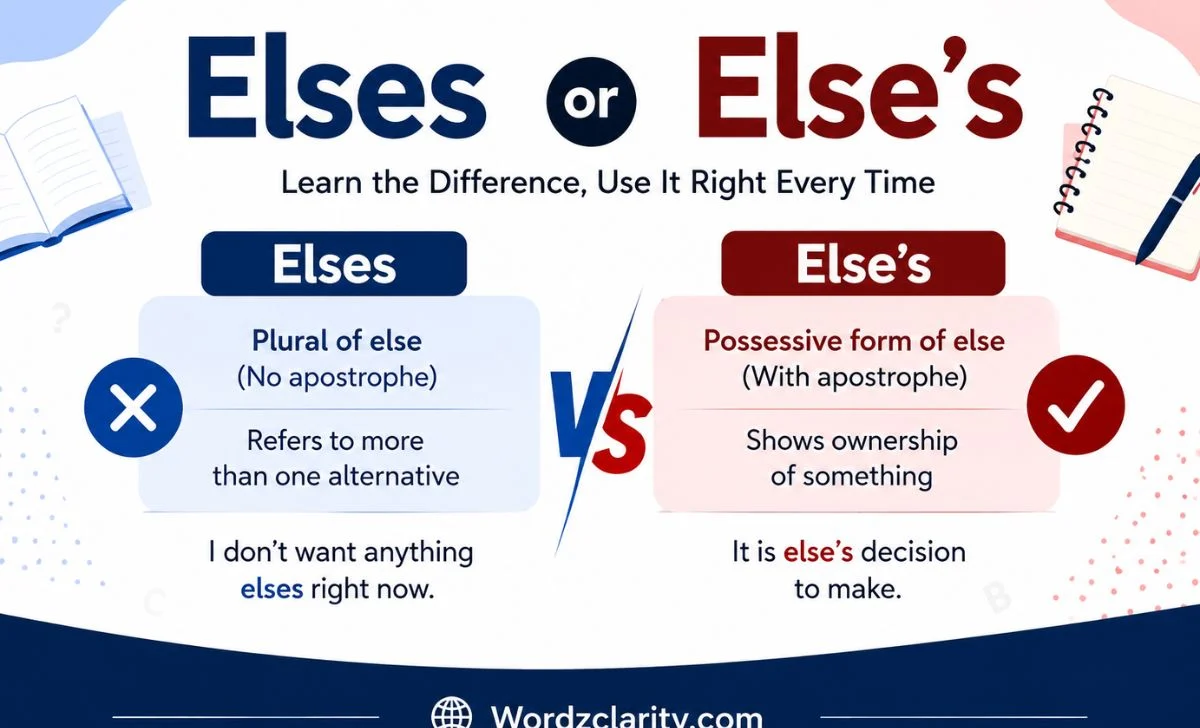
Have you ever wondered whether the correct form is “elses” or “else’s”? The difference may look minor, but the apostrophe changes the grammatical role of the word.
This question often comes up in phrases such as someone else’s, everyone else’s, and something else’s.
Writers may leave out the apostrophe because else’s sounds almost the same when spoken. However, standard English follows a simple rule: use else’s when you need to show possession or association.
Elses is generally not the correct form for this purpose. In this article, you’ll learn the difference between elses and else’s, understand when the apostrophe is needed, and see clear examples that make the rule easy to remember.
Quick Answer:
Else’s is the correct form when else is used to show possession or association.
Elses is generally incorrect when you mean that something belongs to another person or thing.
| Form | Correct use | Example |
|---|---|---|
| else | Refers to another person, thing, or option | Who else is coming? |
| else’s | Shows possession or association | This is someone else’s bag. |
| elses | Not the standard possessive form | ❌ Someone elses bag |
The basic rule is:
else + ’s = else’s
For example:
- Someone else’s phone is ringing.
- I used someone else’s computer.
- We considered everyone else’s opinions.
- Is this somebody else’s jacket?
- That was nobody else’s responsibility.
So, if you are asking “Is it elses or else’s?”, choose else’s when you are expressing possession.
What Does “Else’s” Mean?
Else’s is the possessive form of else. It is used when something belongs to, comes from, or is associated with another person or thing.
The word else generally means another, additional, or different from the person or thing already mentioned.
Compare these two sentences:
Someone else called me.
Here, someone else means another person.
Someone else’s phone called me.
Here, someone else’s tells us that the phone belongs to another person.
The apostrophe and s make the difference.
Another example:
Everyone else agreed.
This refers to other people.
Everyone else’s answer was different.
This refers to the answers belonging to those people.
More examples
- This is someone else’s book.
- I borrowed somebody else’s pen.
- We should respect everyone else’s opinion.
- You cannot use anyone else’s account.
- That was nobody else’s decision.
- The damage may have been caused by something else’s sharp edge.
These are all examples of the possessive construction else’s.
Is “Elses” a Word?
If you are using elses as the possessive form of else, it is not standard English.
For example:
❌ This is someone elses car.
The correct version is:
✅ This is someone else’s car.
The same rule applies to other expressions:
❌ Everyone elses opinion matters.
✅ Everyone else’s opinion matters.
❌ I read somebody elses message.
✅ I read somebody else’s message.
The apostrophe is necessary because the phrase expresses possession or association.
It is also important not to treat elses as the normal plural form of else. English normally uses different constructions instead, such as:
- other people
- other people’s
- someone else
- someone else’s
- other things
- something else
- something else’s
Therefore, don’t simply add s to else when you want to express possession.
Else vs. Else’s
The difference becomes easier when you look at the grammatical job each form performs.
Else
Use else when you mean another person, thing, option, or possibility.
Examples:
- Who else is coming?
- What else do you need?
- Would you like anything else?
- Is there anyone else available?
- Where else can we go?
In these sentences, else does not show possession.
Else’s
Use else’s when you want to show possession or association.
Examples:
- This is someone else’s problem.
- I found somebody else’s wallet.
- We should consider everyone else’s needs.
- That isn’t my responsibility; it is someone else’s.
- The final decision was nobody else’s.
A useful comparison is:
| Else | Else’s |
|---|---|
| Who else came? | Whose bag is this? Someone else’s. |
| What else do you need? | I used someone else’s computer. |
| Is anyone else here? | We respected everyone else’s decision. |
| Something else happened. | Something else’s movement caused the noise. |
The apostrophe signals the possessive form.
Someone Else vs. Someone Else’s
This is one of the most common places where writers make mistakes.
Someone else
Someone else means another person.
Someone else will answer the question.
There is no possessive meaning.
Someone else’s
Someone else’s means belonging to another person.
Someone else’s answer was correct.
The difference is clear:
- Someone else = another person
- Someone else’s = belonging to another person
Consider these examples:
Someone else answered the phone.
I answered someone else’s phone.
In the first sentence, someone else is the person who performed the action.
In the second, someone else’s identifies the owner of the phone.
Everyone Else vs. Everyone Else’s
The same principle applies to everyone else and everyone else’s.
Everyone else refers to all the other people in a particular group.
Everyone else left early.
Everyone else’s indicates possession or association.
Everyone else’s work was completed.
More examples:
- Everyone else agreed with the plan.
- We considered everyone else’s suggestions.
- Everyone else was ready.
- Her score was higher than everyone else’s.
- Everyone else’s opinion deserves consideration.
A common mistake is to write everyone elses.
❌ Everyone elses work was finished.
✅ Everyone else’s work was finished.
The apostrophe should appear before the s in else’s.
Somebody Else’s and Anyone Else’s
Other indefinite pronouns follow the same pattern.
Somebody else’s
Use this when something belongs to another person.
- Is this somebody else’s seat?
- She borrowed somebody else’s laptop.
- That was somebody else’s responsibility.
Anyone else’s
Use this when referring to possession by any other person.
- You should not access anyone else’s account.
- I don’t want to take anyone else’s place.
- This decision should not affect anyone else’s rights.
The structure remains consistent:
somebody else + ’s → somebody else’s
anyone else + ’s → anyone else’s
Nobody Else’s
Nobody else’s is another common possessive construction.
It means that something belongs to no other person.
Examples:
- This isn’t nobody else’s problem.
- The responsibility is nobody else’s.
- The decision was nobody else’s to make.
A more natural sentence in many contexts would be:
The responsibility belongs to nobody else.
But nobody else’s is perfectly useful when the possessive construction fits the sentence.
For example:
This responsibility is nobody else’s.
Here, else’s shows possession or responsibility.
Something Else vs. Something Else’s
The possessive form can also occur with something else, although it is less common than someone else’s.
Something else
Use something else to mean another thing or an alternative.
- I need something else.
- Let’s discuss something else.
- Would you like something else to eat?
Something else’s
Use something else’s when showing possession or association.
For example:
The scratch may have been caused by something else’s sharp edge.
Here, else’s indicates that the sharp edge belongs to or is associated with another thing.
This distinction is useful because adding an apostrophe is not simply a spelling choice. It changes the grammatical function of the phrase.
Why Do Writers Write “Elses”?
The mistake usually happens because the apostrophe is easy to miss, especially when writing quickly.
There are several reasons for this confusion.
The pronunciation is similar
When people say else’s, the apostrophe is not pronounced as a separate sound. In normal speech, the phrase can sound like:
else’s
Because there is no spoken punctuation mark, writers sometimes leave out the apostrophe.
“Else” already ends in a letter
Writers may also think that adding s to else naturally produces elses. However, possessive forms require the apostrophe:
else’s
not:
elses
Longer phrases make the mistake easier
The error is especially common in phrases such as:
- someone else’s
- somebody else’s
- everyone else’s
- anybody else’s
- nobody else’s
Because these phrases contain several words, writers may focus on the main noun and forget the apostrophe.
Common Mistakes With “Elses or Else’s”
1. Someone elses
❌ I borrowed someone elses book.
✅ I borrowed someone else’s book.
2. Everyone elses
❌ Everyone elses opinion was considered.
✅ Everyone else’s opinion was considered.
3. Somebody elses
❌ That is somebody elses phone.
✅ That is somebody else’s phone.
4. Anyone elses
❌ Don’t use anyone elses password.
✅ Don’t use anyone else’s password.
5. Confusing “else” with “else’s”
❌ Who else’s coming to the meeting?
If you mean Who is coming to the meeting?, the correct sentence is:
✅ Who else is coming to the meeting?
Here, else is not possessive.
A Simple Way to Remember the Rule
Use this two-question test:
1. Do you mean another person or thing?
Use else.
Who else is coming?
2. Do you mean something belonging to another person or thing?
Use else’s.
Someone else’s car is outside.
This simple distinction covers most everyday uses.
Remember:
Another person → someone else
Something belonging to another person → someone else’s
Another thing → something else
Something associated with another thing → something else’s
Once you understand this pattern, the difference between elses or else’s becomes much easier to recognize.
How to Use “Else’s” Correctly in Different Situations
Understanding the basic difference between else and else’s is only the first step. The next question is how else’s works in real sentences. You may see it in casual conversations, emails, business writing, academic work, websites, and social media.
The key remains the same: else’s is used when the phrase has a possessive meaning. It can appear after words such as someone, somebody, anyone, anybody, everyone, everybody, nobody, something, and anything.
One useful feature of English is that else’s can sometimes appear without a noun after it. For example, “My answer is different from everyone else’s.” In this case, else’s stands for something that belongs to the other people, such as their answers or opinions.
When Should You Use “Else’s”?
Use else’s when you are talking about something belonging to, connected with, or associated with another person or thing.
For example:
- I borrowed someone else’s pen.
- We considered everyone else’s suggestions.
- That is somebody else’s responsibility.
- Don’t use anyone else’s account.
- The choice is nobody else’s to make.
In each example, else’s has a possessive function.
A helpful way to identify it is to ask “Whose?”
Whose pen did you borrow?
Someone else’s.
Whose suggestions did you consider?
Everyone else’s.
Whose account should you not use?
Anyone else’s.
If the answer expresses ownership or association, else’s is usually the appropriate form.
Can “Else’s” Stand Alone?
Yes. Else’s does not always need a noun immediately after it.
For example:
My opinion is different from everyone else’s.
The noun opinion is understood from the sentence. The full meaning is:
My opinion is different from everyone else’s opinion.
More examples:
- I chose my seat instead of someone else’s.
- Her answer was different from everybody else’s.
- This laptop is mine, not somebody else’s.
- The responsibility is nobody else’s.
- Your idea is better than anyone else’s.
This is called an independent possessive or absolute possessive construction. The noun does not need to be repeated because the context makes the meaning clear.
Compare the two forms
I used someone else’s computer.
Here, the noun computer appears after the possessive phrase.
I used my computer, not someone else’s.
Here, computer is understood and does not need to be repeated.
Both constructions are grammatical.
“Else’s” in Everyday Conversation
In everyday speech, else’s is especially common in phrases involving comparison or ownership.
For example:
Is this yours or someone else’s?
Why are you using someone else’s phone?
What do you think everyone else’s reaction will be?
Her opinion matters just as much as anyone else’s.
These sentences sound natural because the possessive relationship is clear.
However, avoid adding else’s where no possession is intended.
For example:
❌ Who else’s going to the party?
If you mean Which other person is going?, write:
✅ Who else is going to the party?
But this sentence is different:
✅ Who else’s invitation did you receive?
Here, else’s is correct because it means the invitation belonging to another person.
This distinction is particularly important because else’s and else is can sound similar in fast speech.
“Else’s” in Emails
In professional emails, correct apostrophe usage helps make your writing clear and polished.
Example 1
I believe this document belongs to someone else, so I have not made any changes to it.
Example 2
Please check whether this is someone else’s file before making edits.
Example 3
We have reviewed everyone else’s comments and will update the document accordingly.
Example 4
I don’t want to make changes to anyone else’s work without permission.
These examples show that else’s can fit naturally into professional communication without sounding unusual.
“Else’s” in Business Writing
Business writing often discusses responsibility, ownership, decisions, and ideas. These contexts naturally create situations where possessive forms are useful.
For example:
The issue was caused by someone else’s error.
We should not use another department’s information without permission.
The team considered everyone else’s recommendations.
This is not someone else’s responsibility; it belongs to our department.
The final decision should not depend entirely on anyone else’s opinion.
Here, else’s communicates association or responsibility rather than simple physical ownership.
That is important because possession in English does not always mean that someone literally owns an object.
For example:
someone else’s mistake
does not mean the mistake is a physical possession. It means a mistake made by another person.
Similarly:
everyone else’s opinion
means the opinions of all the other people.
“Else’s” in Academic Writing
The possessive form can also be useful in essays, reports, research discussions, and other academic writing.
Examples:
Students should evaluate their own arguments rather than simply accepting someone else’s conclusion.
The researcher compared the results with everyone else’s findings.
One person’s interpretation may differ from somebody else’s.
The writer should distinguish between their own ideas and someone else’s ideas.
In academic writing, else’s can help avoid unnecessarily repeating a noun.
Compare:
My interpretation differs from the interpretation of every other researcher.
A more concise version is:
My interpretation differs from everyone else’s.
The second sentence is shorter while keeping the meaning clear.
“Else’s” in Social Media and Informal Writing
You may also see else’s in posts, comments, messages, and online discussions.
Examples:
Don’t judge someone else’s choices.
Everyone else’s photos look amazing!
I accidentally took someone else’s bag.
Your opinion is no more important than anyone else’s.
That’s somebody else’s problem, not mine.
Although social media is informal, the standard apostrophe rule remains the same.
The fact that people sometimes write elses online does not make it the standard possessive spelling.
“Else’s” vs. “Someone’s”
A useful comparison is between someone’s and someone else’s.
Someone’s
Someone’s means something belongs to an unspecified person.
Someone’s phone is ringing.
We do not know who owns the phone.
Someone else’s
Someone else’s means something belongs to another person rather than the person currently being discussed.
Someone else’s phone is ringing.
The context suggests that the phone belongs to another person.
Compare:
| Phrase | Meaning |
|---|---|
| someone’s phone | A phone belonging to an unspecified person |
| someone else’s phone | A phone belonging to another person |
| someone’s opinion | An unspecified person’s opinion |
| someone else’s opinion | Another person’s opinion |
This is why else adds an important meaning to the sentence.
“Else’s” vs. “Other People’s”
In many cases, else’s can express an idea similar to other people’s, but the two structures are not always interchangeable.
For example:
I should respect other people’s opinions.
This is a general statement about other people.
You could also say:
I should respect everyone else’s opinions.
The second expression usually refers to other people within a particular context or group.
Similarly:
Don’t take other people’s belongings.
and:
Don’t take someone else’s belongings.
Both can be correct, but the intended meaning may differ slightly.
Someone else’s often points to another particular person, while other people’s can refer more generally to people other than the speaker or group being discussed.
Is “Else’s” a Contraction?
This is an important point because the apostrophe can sometimes be misunderstood.
In else’s, the ’s is normally a possessive marker, not a contraction.
For example:
someone else’s book
means:
the book belonging to someone else.
It does not mean else is.
However, ’s can represent is or has in other English constructions.
For example:
She’s happy.
Here, she’s means she is.
He’s finished.
Here, he’s can mean he has.
But:
someone else’s book
uses ’s to show possession.
This difference is important when learning apostrophe usage.
“Else’s” or “Else Is”?
Sometimes the real confusion is not elses vs. else’s, but else’s vs. else is.
Consider:
Who else is coming?
Here, else is means that another person is coming.
You should not write:
❌ Who else’s coming?
But consider:
Who else’s car is parked outside?
Here, else’s is correct because the question is asking about a car belonging to another person.
Compare
| Incorrect/Correct | Meaning |
|---|---|
| ❌ Who else’s coming? | Incorrect if you mean “Who else is coming?” |
| ✅ Who else is coming? | Which other person is coming? |
| ✅ Who else’s car is outside? | Whose other person’s car is outside? |
The noun after else’s often makes the possessive meaning obvious.
How to Pronounce “Else’s”
Else’s is commonly pronounced approximately like “ELS-iz” in ordinary English speech.
The exact pronunciation can vary slightly depending on accent and speaking speed, but the important point for spelling is that the apostrophe is not separately pronounced.
This is one reason writers may type elses instead of else’s.
For writing, however, pronunciation should not determine the spelling. When the phrase is possessive, keep the apostrophe:
someone else’s
not:
someone elses
A Practical Editing Trick
If you have written elses, stop and check the phrase around it.
Ask:
Is “else” showing possession?
If yes, change it to:
else’s
For example:
someone elses idea ❌
becomes:
someone else’s idea ✅
Then ask:
Does “else” simply mean another?
If yes, leave it without an apostrophe:
Who else knows? ✅
What else do you need? ✅
Is anyone else coming? ✅
This quick check can catch most errors.
Quick Comparison: Else, Else’s, and Else Is
| Form | Function | Example |
|---|---|---|
| else | Another/additional person or thing | What else do you need? |
| else’s | Possession or association | This is someone else’s idea. |
| else is | The words else + is | Someone else is waiting. |
| elses | Generally not the standard possessive spelling | ❌ Someone elses idea |
This table is worth remembering because these forms can look or sound confusing when used quickly.
Final Rule to Remember
The simplest rule is:
Use “else” for another person or thing. Use “else’s” when showing possession or association.
Examples:
- Who else is coming?
- What else do you need?
- Someone else’s phone is ringing.
- Everyone else’s work is complete.
- This idea is somebody else’s.
- Your answer is different from anyone else’s.
And remember:
❌ someone elses book
✅ someone else’s book
The apostrophe is not optional when else’s is being used as a possessive form.
Examples, Common Questions, and Final Usage Guide
The difference between elses and else’s becomes much easier once you see the forms in complete sentences. In most cases, the apostrophe is needed because else’s shows possession or association. This is especially common after words such as someone, somebody, anyone, everyone, nobody, and something.
For example, “Someone else called” simply identifies another person, while “Someone else’s phone rang” identifies the phone as belonging to that person. You may also see else’s at the end of a sentence when the noun is understood, as in “My answer is different from everyone else’s.” This part focuses on practical examples, common mistakes, quick usage tests, and frequently asked questions so you can confidently choose the correct form in everyday and formal writing.
“Elses or Else’s” in Real Sentences
Seeing the two forms in context is one of the easiest ways to understand the difference.
Everyday conversation
Who else is coming with us?
Is this someone else’s jacket?
Does anybody else’s opinion matter here?
What else do you want?
I accidentally picked up someone else’s phone.
The first and fourth examples use else because there is no possessive meaning. The other examples use else’s because something belongs to or is associated with another person.
In emails
I believe this document belongs to someone else.
Please make sure you are not editing someone else’s file.
We have considered everyone else’s suggestions.
I do not want to change anybody else’s work without permission.
In business writing
The error appears to have resulted from someone else’s decision.
We should consider everyone else’s concerns before proceeding.
This information should not be shared through anyone else’s account.
In academic writing
Students should distinguish their own ideas from someone else’s.
The findings differed from everyone else’s results.
The researcher considered somebody else’s interpretation before reaching a conclusion.
On websites and social media
Your privacy matters just as much as everyone else’s.
Never share someone else’s personal information without permission.
That is somebody else’s content, not yours.
These examples demonstrate that the same grammatical rule applies across different types of writing.
Correct and Incorrect Examples
| Incorrect | Correct |
|---|---|
| Someone elses phone is ringing. | Someone else’s phone is ringing. |
| I borrowed somebody elses pen. | I borrowed somebody else’s pen. |
| Everyone elses opinion matters. | Everyone else’s opinion matters. |
| Don’t use anyone elses account. | Don’t use anyone else’s account. |
| It was nobody elses fault. | It was nobody else’s fault. |
| The idea was someone elses. | The idea was someone else’s. |
The pattern is consistent: when else is possessive, place the apostrophe before the s.
“Else’s” at the End of a Sentence
One detail that often confuses writers is that else’s can appear at the end of a sentence without a noun following it.
For example:
My answer is different from everyone else’s.
The noun answer is understood.
The sentence could be expanded to:
My answer is different from everyone else’s answer.
But repeating answer is unnecessary, so English allows the shorter form.
More examples include:
- This seat is mine, not someone else’s.
- Her opinion was different from everybody else’s.
- Your responsibility is not anyone else’s.
- The final choice should be yours, not somebody else’s.
- His approach was different from everyone else’s.
This is completely different from writing elses.
❌ everyone elses
✅ everyone else’s
What About “Everyone Else’s”?
Everyone else’s is one of the most frequently searched forms because it combines everyone, else, and a possessive ’s.
The correct spelling is:
everyone else’s
Not:
❌ everyone elses
For example:
Her performance was stronger than everyone else’s.
This means:
Her performance was stronger than the performance of everyone else.
Another example:
We need to respect everyone else’s opinions.
Here, everyone else’s identifies the opinions as belonging to the other members of the group.
Remember the structure
everyone + else + ’s
→ everyone else’s
The words remain separate. Only else receives the possessive ending.
What About “Someone Else’s”?
The same rule applies to someone else’s.
Correct:
someone else’s
Incorrect:
❌ someone elses
Examples:
- That is someone else’s property.
- I found someone else’s wallet.
- Don’t take someone else’s belongings.
- We should not use someone else’s work without permission.
- The mistake was caused by someone else’s actions.
You can also use it without repeating the noun:
My laptop is newer than someone else’s.
The noun laptop is understood.
What About “Somebody Else’s”?
Somebody else’s follows exactly the same pattern.
Examples:
This is somebody else’s seat.
I accidentally opened somebody else’s email.
That decision should not affect somebody else’s rights.
The blue jacket is somebody else’s.
The apostrophe belongs between else and s.
What About “Anyone Else’s”?
Use anyone else’s when something belongs to or is associated with another person.
Examples:
Don’t use anyone else’s password.
Your opinion is as important as anyone else’s.
We should not make decisions about anyone else’s personal information.
Again:
anyone + else + ’s
→ anyone else’s
What About “Nobody Else’s”?
The phrase nobody else’s is also grammatically correct when possession or responsibility is being expressed.
Examples:
This responsibility is nobody else’s.
The decision was nobody else’s to make.
The property is nobody else’s.
However, sentence structure matters. Do not automatically add else’s after nobody.
Compare:
Nobody else knows the answer.
Here, there is no possession.
Nobody else’s answer was correct.
Here, else’s is possessive because it identifies whose answer is being discussed.
A Fast Way to Check Your Writing
If you are unsure about elses or else’s, use this simple method.
Step 1: Find “else”
Look at the sentence and identify what comes after else.
Step 2: Ask “whose?”
If the sentence answers whose?, you probably need the possessive form else’s.
For example:
Whose phone is this?
Someone else’s.
So:
✅ someone else’s phone
If the sentence does not involve possession, you probably need else.
For example:
Who else is coming?
Here, else simply means another person.
Step 3: Never remove the apostrophe from a possessive form
If you have:
someone else’s
do not write:
someone elses
The apostrophe is part of the correct spelling.
When “Else’s” Is Not the Right Choice
Although else’s is a valid possessive construction, it should not be inserted whenever else appears.
For example:
❌ What else’s do you need?
Instead:
✅ What else do you need?
Similarly:
❌ Who else’s going to attend?
If you mean Who else is going to attend?, write:
✅ Who else is going to attend?
But:
✅ Who else’s presentation are we discussing?
is correct because else’s indicates possession of the presentation.
The noun or context often makes the difference obvious.
“Elses or Else’s” Grammar Rule in One Table
| Situation | Correct form | Example |
|---|---|---|
| Another person | else | Who else is here? |
| Another thing | else | What else do you need? |
| Possession by another person | else’s | Someone else’s bag |
| Possession by another group | else’s | Everyone else’s opinion |
| Possessive form standing alone | else’s | This bag is someone else’s |
| Possessive spelling without apostrophe | ❌ elses | Avoid it |
This table captures the main rule without requiring you to memorize complicated grammar terminology.
FAQs
1. Is “elses” correct English?
Elses is generally not correct when you are trying to express possession with else. The standard possessive form is else’s.
For example:
❌ someone elses book
✅ someone else’s book
2. Is “else’s” grammatically correct?
Yes. Else’s is grammatically correct when it functions as a possessive form.
For example:
That is someone else’s problem.
It can also stand alone:
That problem is someone else’s.
3. Is “someone else’s” correct?
Yes. Someone else’s is a standard possessive construction.
I borrowed someone else’s car.
It means the car belongs to another person.
4. Is “everyone else’s” correct?
Yes. Everyone else’s is correct when you are referring to something belonging to or associated with all the other people in a particular context.
We considered everyone else’s opinions.
5. Should I write “someone elses” or “someone else’s”?
Write someone else’s.
The apostrophe is required because the phrase is possessive.
❌ Someone elses idea
✅ Someone else’s idea
6. Can “else’s” be used without a noun?
Yes. When the noun is clear from context, else’s can stand alone.
My answer is different from everyone else’s.
The understood noun is answer.
7. Is “else’s” a contraction of “else is”?
No, not when it expresses possession.
In:
someone else’s car
the ’s is a possessive marker.
By contrast, in:
someone else is coming
there is no apostrophe because is is a separate verb.
Conclusion
The difference between elses or else’s is simple once you understand the role of the apostrophe. Else is used when you mean another person, thing, option, or possibility, while else’s is used to show possession or association.
That is why someone else’s, everyone else’s, somebody else’s, and anyone else’s are correct forms. Elses is not the standard spelling for these possessive constructions. Remember that else’s can also appear by itself when the noun is understood, as in “My answer is different from everyone else’s.” When proofreading, ask yourself whether you are answering the question “whose?” If the answer involves else, use else’s.
This simple test will help you avoid the most common apostrophe mistake and use the correct form confidently in both casual and formal English.
Read More Blogs:
- Bachelor’s Degree or Bachelors Degree: Which Is Correct?
- Enquiry vs Inquiry: The Complete Guide to Meaning and Usage