Have you ever wondered whether to write enquiry or inquiry when asking for information? You are not alone. These two words look and sound almost identical, and in many situations, they can refer to the same basic idea: asking for information or seeking an answer.
However, their spelling and typical usage can vary depending on the type of English you are using and the context.
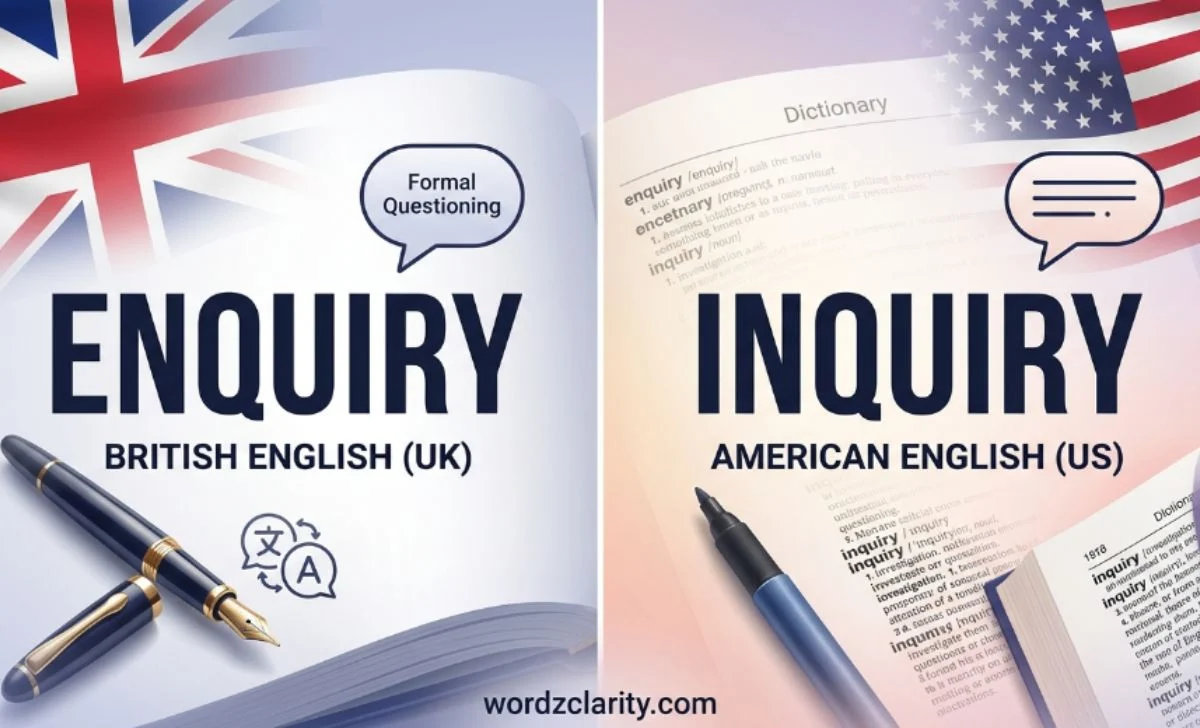
In British English, enquiry is commonly used for a general request for information, while inquiry is also used, particularly for a formal investigation. In American English, inquiry is the standard spelling for both general questions and investigations.
This guide explains the difference between enquiry and inquiry, their meanings, British and American usage, related verb forms, common mistakes, and practical examples. By the end, you will know which form to choose for emails, business writing, academic work, and everyday communication.
Quick Answer
Both enquiry and inquiry are correct English words. The main difference is regional spelling and, in some varieties of English, usage.
- Enquiry is more common in British English when referring to a general request for information.
- Inquiry is the standard form in American English.
- Inquiry is also widely used in British English, especially for a formal investigation.
- Enquire is the related British English verb, while inquire is standard in American English.
Simple examples
British English:
I sent an enquiry about the course fees.
American English:
I sent an inquiry about the course fees.
For a formal investigation:
The government launched an inquiry into the incident.
So, if you are writing for a US audience, use inquiry. If you are writing for a UK audience and simply asking for information, enquiry is often the natural choice.
What Does Enquiry Mean?
Enquiry is a noun meaning a request for information, a question, or an attempt to obtain details about something.
It is particularly common in British English.
For example:
I made an enquiry about the available apartments.
Here, the person is simply asking for information. There is no suggestion of a formal investigation.
Other examples include:
- I sent an enquiry about the application process.
- The hotel received several enquiries about room availability.
- Please contact our office for further enquiries.
- She made an enquiry about the course schedule.
- We received an enquiry from a potential customer.
The plural form of enquiry is enquiries.
The company received hundreds of enquiries after launching the new service.
What Does Inquiry Mean?
Inquiry can mean a request for information, a question, or a formal investigation.
It is the standard spelling in American English and is also used in British English.
For a simple request:
I made an inquiry about the delivery date.
For a formal investigation:
An official inquiry was launched after the accident.
The plural form is inquiries.
The department received several inquiries from customers.
The meaning of inquiry therefore depends partly on context. It can describe something as simple as asking a question or something much more serious, such as an official investigation.
Enquiry vs Inquiry: What Is the Difference?
The difference between enquiry and inquiry is mainly connected with regional English and context.
| Word | Common usage | Example |
|---|---|---|
| Enquiry | General request for information, especially in British English | I made an enquiry about the course. |
| Inquiry | General request or formal investigation | I made an inquiry about the course. |
| Inquiry | Formal investigation | The committee opened an inquiry. |
In everyday British English, enquiry can sound natural when someone is asking for information.
I have an enquiry about your services.
However, inquiry is often preferred when referring to an official or formal investigation.
The government ordered an inquiry into the matter.
This distinction is useful, but it should not be treated as an absolute rule. British English uses inquiry more broadly than the simple “question versus investigation” rule sometimes suggests.
Is Enquiry British English or American English?
Enquiry is strongly associated with British English.
It is commonly found in the UK and other varieties of English influenced by British spelling conventions.
For example:
Please send your enquiry to our customer service team.
In American English, the same sentence would normally use inquiry:
Please send your inquiry to our customer service team.
This spelling difference is similar to other British and American variations, such as:
- colour / color
- favour / favor
- organise / organize
- centre / center
Therefore, if your writing follows British English conventions, enquiry may be appropriate for a general request for information.
Is It Inquiry or Enquiry in the US?
In the United States, inquiry is the standard spelling.
American English generally does not use enquiry in standard modern writing.
For example:
I have an inquiry about my order.
Please direct your inquiry to the appropriate department.
The customer submitted an inquiry through the website.
If you are writing an American business email, website, report, or academic document, inquiry is the safer and more conventional choice.
US English examples
- customer inquiry
- sales inquiry
- product inquiry
- general inquiry
- inquiry form
- inquiry email
- formal inquiry
- congressional inquiry
British English: Enquiry or Inquiry?
British English can use both forms.
For a general request for information, enquiry is traditionally common:
I would like to make an enquiry about your services.
For an official investigation, inquiry is often used:
The committee conducted an inquiry into the allegations.
However, inquiry can also appear in British English for general requests. Modern British usage does not always maintain a strict separation between the two words.
This means that saying “enquiry is always for questions and inquiry is always for investigations” is too simplistic.
A better rule is:
Use the spelling that matches your regional English and follow the established spelling used by the organization or publication you are writing for.
Enquire or Inquire: Which Verb Should You Use?
Enquire and inquire are the related verbs.
Their usage generally follows the same British-American pattern.
Enquire
Enquire is particularly common in British English.
I would like to enquire about the available courses.
She enquired about the price.
Inquire
Inquire is the standard American English form.
I would like to inquire about the available courses.
She inquired about the price.
Verb comparison
| British English | American English |
|---|---|
| enquire | inquire |
| enquired | inquired |
| enquiring | inquiring |
| enquiry | inquiry |
| enquiries | inquiries |
The safest approach is consistency. If your document follows American English, use inquire/inquiry. If it follows British English, enquire/enquiry may be appropriate for general requests.
Enquiry or Inquiry in Business Writing
Both forms can appear in business communication, but your choice should depend on your target audience.
British business writing
Thank you for your enquiry regarding our services.
We will respond to your enquiry within two working days.
Please complete the enquiry form below.
American business writing
Thank you for your inquiry regarding our services.
We will respond to your inquiry within two business days.
Please complete the inquiry form below.
For an international company, consistency matters more than trying to mix both spellings.
If a company’s website uses enquiry, follow that spelling in related communications. If it uses inquiry, maintain the same convention.
Enquiry or Inquiry in Emails
The correct choice in an email depends on the variety of English you are using.
British English email
Subject: Enquiry About Course Fees
Dear Admissions Team,
I am writing to make an enquiry about the fees for the upcoming course.
American English email
Subject: Inquiry About Course Fees
Dear Admissions Team,
I am writing to make an inquiry about the fees for the upcoming course.
Both sentences are understandable. The difference is primarily spelling and regional convention.
Enquiry or Inquiry in a Sentence
Here are practical examples showing how both words work.
Enquiry examples
- I sent an enquiry about the job opening.
- She made an enquiry about the delivery schedule.
- We received an enquiry from a new customer.
- Please contact us if you have any further enquiries.
- His enquiry was answered by the support team.
- The website includes a form for general enquiries.
Inquiry examples
- I sent an inquiry about the job opening.
- She made an inquiry about the delivery schedule.
- We received an inquiry from a new customer.
- Please contact us if you have any further inquiries.
- His inquiry was answered by the support team.
- The committee began an inquiry into the issue.
Notice that inquiry can naturally describe both an ordinary request and a formal investigation.
Formal Inquiry vs General Enquiry
Context can help you decide which word sounds most appropriate.
General request
A customer might ask:
I have an enquiry about your return policy.
This means the customer wants information.
Formal investigation
A government body might announce:
An inquiry has been launched into the matter.
Here, inquiry refers to a formal investigation.
This distinction is particularly useful in British English, where enquiry and inquiry may be used differently according to context.
Common Mistakes With Enquiry and Inquiry
Because the words are so similar, several mistakes are common.
Mistake 1: Treating one spelling as universally correct
It is incorrect to assume that only enquiry or only inquiry is correct.
Both are established English words.
Mistake 2: Using British spelling in an American document
If you are writing for an American audience, inquiry is the normal choice.
Avoid switching between:
customer enquiry
and
customer inquiry
within the same document unless there is a specific reason.
Mistake 3: Mixing related verb forms
Try not to write:
I would like to enquire about your service. Please submit an inquiry.
This combination is not necessarily grammatically wrong, but it can create unnecessary inconsistency in a document.
Choose a regional style and maintain it.
Mistake 4: Assuming inquiry always means investigation
Inquiry can simply mean a question or request for information.
For example:
I made an inquiry about the price.
This does not mean that an investigation took place.
Enquiry and Inquiry Plural Forms
The plural forms are different.
| Singular | Plural |
|---|---|
| enquiry | enquiries |
| inquiry | inquiries |
Examples:
We received several enquiries from customers.
We received several inquiries from customers.
A common spelling mistake is writing inquirys or enquirys. These forms are incorrect.
For nouns ending in -y, the plural normally changes y to ies.
Which One Should You Use?
The best choice depends on your audience and the context.
Use “enquiry” when:
- You are following British English.
- You are making a general request for information.
- Your organization traditionally uses British spelling.
- Your audience is mainly in the UK or another region using British conventions.
Use “inquiry” when:
- You are writing American English.
- You are referring to a formal investigation.
- Your organization uses American spelling.
- You are writing for an audience accustomed to the -inquiry form.
For international writing
If your audience is international, inquiry may be more widely recognizable because it is the standard form in American English and is also used in British English.
However, if your website or organization consistently follows British English, enquiry can be an appropriate choice for general information requests.
Enquiry or Inquiry: A Practical Comparison
| Feature | Enquiry | Inquiry |
|---|---|---|
| Part of speech | Noun | Noun |
| Basic meaning | Request for information | Request for information or investigation |
| British English | Common | Also used |
| American English | Uncommon | Standard |
| Formal investigation | Less typical | Common |
| Plural | Enquiries | Inquiries |
| Related verb | Enquire | Inquire |
| Common business use | UK-oriented | US-oriented and widely used internationally |
The key point is that these words are not simply a correct-versus-incorrect pair. Both are legitimate spellings, but their frequency and preferred contexts differ.
Enquiry or Inquiry: What Should You Write?
When choosing between them, ask two simple questions:
1. Who is going to read your writing?
If your audience is American, choose inquiry. If your audience is British, enquiry may be preferable for a general request.
2. What does your organization normally use?
If your company consistently uses “customer enquiries,” do not suddenly change it to “customer inquiries” in one document.
Consistency creates a more professional impression.
For example, a UK-based company might write:
For further enquiries, please contact our support team.
A US-based company might write:
For further inquiries, please contact our support team.
Both are perfectly understandable.
Quick Tips for Remembering the Difference
You do not need to memorize a complicated rule.
Remember these three points:
- Enquiry is strongly associated with British English.
- Inquiry is the standard American spelling.
- Inquiry is also used in British English, particularly for formal investigations.
For the verbs:
- British: enquire
- American: inquire
For the plurals:
- enquiries
- inquiries
If you are unsure, check the English style used by your target audience or organization and stay consistent.
FAQs
1. Is “enquiry” or “inquiry” correct?
Both enquiry and inquiry are correct. Enquiry is especially common in British English for general requests for information, while inquiry is standard in American English and is also widely used in British English.
2. What is the difference between “enquiry” and “inquiry”?
The main difference is regional usage. Enquiry is commonly associated with British English, while inquiry is the standard American spelling. In British English, inquiry is also frequently used for formal investigations.
3. Is it “inquiry” or “enquiry” in the US?
In American English, inquiry is the standard spelling. Enquiry is not normally used in standard American writing.
4. Which is correct in British English: “enquiry” or “inquiry”?
Both can be correct. Enquiry is commonly used for a general request for information, while inquiry is often associated with formal investigations. However, the distinction is not absolute.
5. Should I use “enquire” or “inquire”?
Use enquire when following British English conventions, particularly for general requests. Inquire is the standard American form and is also used in British English.
6. How do you use “enquiry” in a sentence?
You can write: “I am writing to make an enquiry about the course fees.” Here, enquiry means a request for information.
7. Are “enquiry” and “inquiry” the same?
They overlap in meaning and can both refer to a request for information. Their main difference is regional preference and, in some British contexts, the distinction between a general enquiry and a formal inquiry.
Conclusion
Enquiry or inquiry is not a matter of one spelling being right and the other being wrong. Both are legitimate English words, but the preferred form depends on regional convention and context. Enquiry is particularly common in British English when someone is making a general request for information, while inquiry is the standard spelling in American English.
In British English, inquiry is also widely used, especially when referring to a formal investigation.
If you are writing for a US audience, inquiry is the safest choice. For UK readers, enquiry is natural for everyday information requests, although inquiry is also correct in many contexts. The related verbs follow a similar pattern: enquire is common in British English, while inquire is standard in American English.
Most importantly, choose the form that matches your audience and maintain that spelling consistently throughout your writing.
Read More Blogs:
- Honor or Honour: Right Spelling in American and British English
- Saviour or Savior: what is the difference between these words
- Optimize or Optimise: American and British Spelling Compared
- Summarize or Summarise: What is the correct word for use