The word so looks simple, but knowing where to place a comma around it can be surprisingly confusing.
Should you write “I was tired, so I went home” or “I was tired so, I went home”? What about starting a sentence with “So”? Should it be followed by a comma? And does the rule change when you use so that?
The answer depends on how so is being used in the sentence. In some sentences, a comma belongs before so because it joins two independent clauses.
In others, a comma after so may be used when it works as an introductory word or conversational transition. However, putting a comma after so simply because it appears at the beginning of a sentence is not always necessary.
This guide explains the main rules in plain English. You will learn when to use a comma before so, when a comma can appear after so, when you should use no comma at all, and how to punctuate common constructions such as so that and so…that.
Quick Answer: Do You Put a Comma Before or After So?
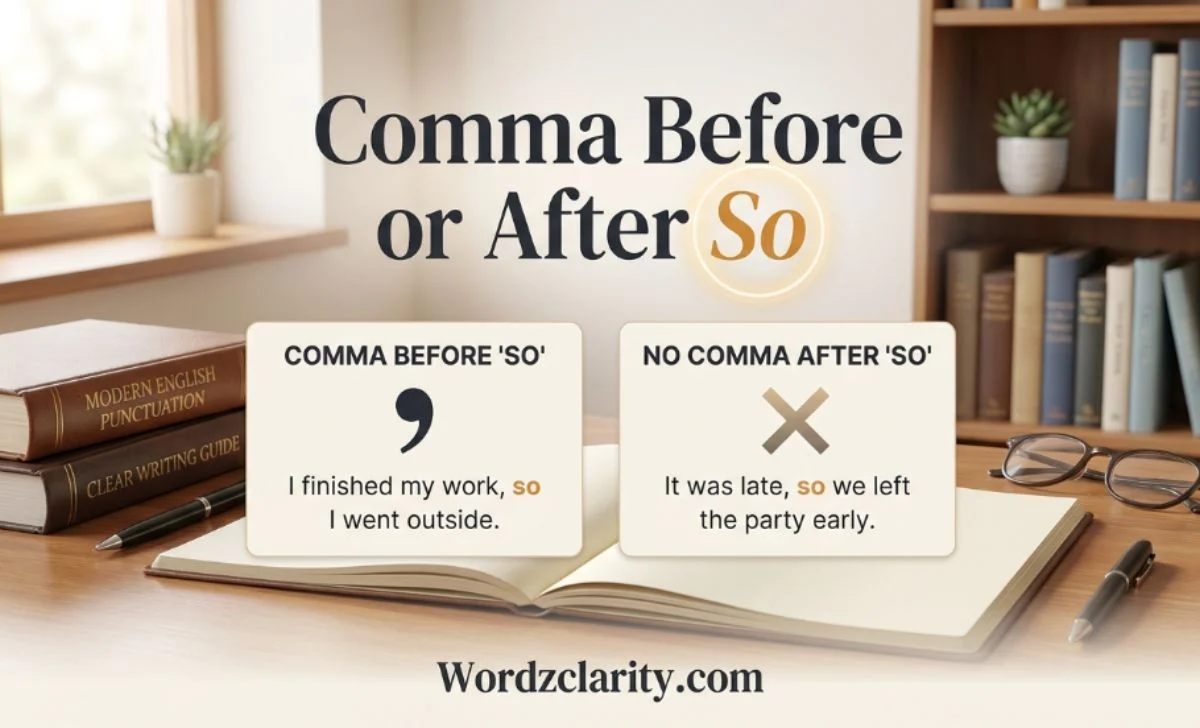
When so joins two complete independent clauses and means “therefore” or “as a result,” a comma normally goes before so.
Example:
I was tired, so I went to bed.
Both parts can stand alone:
- I was tired.
- I went to bed.
Because so connects the two independent clauses, the comma comes before it.
A comma after so is a different issue. When so begins a sentence as an introductory or conversational word, a comma may sometimes follow it:
So, what should we do next?
However, the comma is often unnecessary when so is closely connected to the rest of the sentence:
So what should we do next?
The key is to identify what job so is doing.
| Use of “so” | Typical punctuation | Example |
|---|---|---|
| Joins two independent clauses | Comma before so | It was raining, so we stayed inside. |
| Starts a conversational sentence | Comma may be used | So, what happened? |
| Means “to such an extent” | Usually no comma | She was so tired that she slept early. |
| Part of “so that” | Usually no comma | I left early so that I could arrive on time. |
| Begins a result statement | Often no comma | So I decided to wait. |
When to Put a Comma Before So
The most common situation is when so is a coordinating conjunction connecting two independent clauses.
An independent clause contains a subject and a verb and can function as a complete sentence.
Consider:
The store was closed, so we went home.
The sentence contains two complete thoughts:
- The store was closed.
- We went home.
So connects them and shows a cause-and-effect relationship. The comma goes before so.
More Examples
I missed the bus, so I called a taxi.
She studied hard, so she passed the exam.
The weather was terrible, so the game was canceled.
He forgot his password, so he could not log in.
We arrived late, so the meeting had already started.
In each example, so connects two independent clauses.
A Simple Test
When you are unsure whether you need a comma before so, try replacing so with therefore.
For example:
The road was blocked, so we took another route.
The meaning is similar to:
The road was blocked; therefore, we took another route.
This can help you recognize that so is functioning as a connector between two complete thoughts.
When You Do Not Need a Comma Before So
A comma is not automatically required before so every time it appears in a sentence.
If so does not join two independent clauses, you will often leave the comma out.
For example:
I was so tired that I went straight to bed.
Here, so means “to such an extent.” It is part of the structure so…that, not a coordinating conjunction connecting two independent clauses.
Another example is:
She spoke so quietly that nobody heard her.
There is no comma before so.
Compare These Sentences
I was tired, so I went home.
Here, so means therefore/as a result and joins two independent clauses.
I was so tired that I went home.
Here, so means to such an extent, and the sentence uses the so…that construction.
The difference in meaning determines the punctuation.
Comma Before So When It Means “Therefore”
One of the easiest ways to understand the comma-before-so rule is to focus on meaning.
When so means something like:
- therefore
- as a result
- consequently
- for that reason
and connects two independent clauses, a comma normally comes before it.
Examples in Everyday Writing
Email:
The deadline has changed, so please send your documents by Friday.
Business writing:
Sales increased this quarter, so the company plans to expand the team.
Academic writing:
The sample size was small, so the results should be interpreted carefully.
Conversation:
I forgot my wallet, so you will have to pay this time.
Website content:
The product is currently unavailable, so we recommend checking back later.
Social media:
The weather is perfect, so we are heading to the beach!
The same basic punctuation principle applies across these contexts.
Can You Put a Comma After So at the Beginning of a Sentence?
Yes, but not every sentence beginning with so needs a comma.
This is one of the most common points of confusion.
When so is used as an introductory or conversational transition, writers sometimes separate it from the rest of the sentence with a comma:
So, what do you think?
So, where do we go from here?
So, let me explain what happened.
The comma creates a small pause and can make the sentence sound more conversational.
However, you can also write:
So what do you think?
So where do we go from here?
So let me explain what happened.
These versions are also natural.
Why Is the Comma Optional?
At the beginning of a sentence, so can perform several jobs. It may introduce a conclusion, transition into a new point, or simply sound conversational.
Compare:
So, what happened next?
The comma highlights so as an introductory transition.
But:
So what happened next?
Here, so is closely connected to the question.
Neither punctuation choice automatically makes the sentence grammatically wrong. Context, rhythm, emphasis, and style all matter.
“So, I Decided…” vs. “So I Decided…”
Both forms can be found in standard writing:
So, I decided to leave.
So I decided to leave.
The version with a comma creates a stronger pause. It can sound more deliberate or conversational.
The version without a comma is tighter:
So I decided to leave.
For most ordinary writing, you do not need to insert a comma after so simply because it starts the sentence.
Practical Tip
Ask yourself:
Is “so” acting as a separate introductory transition, or is it directly connected to the sentence that follows?
If it feels like a separate transition, a comma may improve the rhythm:
So, here is what we need to do.
If it is tightly connected to the following clause, leave it alone:
So we need to leave now.
Comma Before So vs. Comma After So
The two punctuation patterns serve different purposes.
Comma Before So
Use a comma before so when it joins two independent clauses.
The train was delayed, so we arrived late.
Comma After So
A comma after so can be used when so functions as an introductory or conversational transition.
So, what happens next?
But remember that the comma is not required in every sentence beginning with so.
So what happens next?
This is also acceptable.
Side-by-Side Comparison
| Sentence | Why? |
|---|---|
| I was hungry, so I made dinner. | So joins two independent clauses. |
| So, what should we eat? | So is used as an introductory transition. |
| So what should we eat? | So is closely connected to the question. |
| She was so hungry that she ate quickly. | So means “to such an extent.” |
| I left early so that I would not be late. | So that expresses purpose. |
What About “So That”?
The phrase so that often causes another punctuation question.
When so that introduces a purpose clause, you generally do not put a comma before it when the purpose clause is closely connected to the main clause.
For example:
I left early so that I could catch the train.
She saved money so that she could buy a car.
He lowered his voice so that nobody would hear him.
A comma is usually unnecessary.
Why?
The so that clause explains the purpose of the action in the main clause. It is closely connected to the sentence.
However, punctuation can change when a clause is placed first or when a writer deliberately creates a strong break.
For example:
So that everyone could hear, the speaker used a microphone.
Here, the introductory clause comes before the main clause, so the comma separates the introductory clause from the main clause.
“So” vs. “So That”
Do not confuse these two constructions.
So Meaning “Therefore”
It was getting dark, so we went home.
Here, so connects two results or ideas.
So That Meaning “In Order That”
We left early so that we could get home before dark.
Here, so that explains the purpose.
The punctuation is different because the grammatical structure is different.
What About “So…That”?
Another common structure is so…that.
It expresses a degree or result:
The movie was so boring that I fell asleep.
The box was so heavy that I could not lift it.
She was so excited that she could hardly speak.
In these sentences, so is not joining two independent clauses. Therefore, you normally do not put a comma before so.
Incorrect:
The movie was, so boring that I fell asleep.
Correct:
The movie was so boring that I fell asleep.
The same pattern applies to many sentences:
He was so tired that he could barely keep his eyes open.
The water was so cold that nobody wanted to swim.
The test was so difficult that many students needed extra time.
Common Mistakes With Commas and So
Understanding the rules is easier when you know the mistakes to avoid.
1. Putting the Comma After So Instead of Before It
A common mistake is:
I was tired so, I went home.
The comma is in the wrong position when so joins two independent clauses.
Better:
I was tired, so I went home.
2. Adding a Comma Before Every So
Not every so requires a comma.
Incorrect:
She was so happy, that she started crying.
Better:
She was so happy that she started crying.
Here, so…that is a single grammatical structure.
3. Adding a Comma After Every Sentence-Initial So
Some writers automatically write:
So, I went home.
This is not necessarily wrong, but the comma is not required simply because so appears first.
You can write:
So I went home.
The best choice depends on the role of so, the intended pause, and the style of the writing.
4. Using a Comma Splice
A comma splice occurs when two independent clauses are incorrectly joined with only a comma.
For example:
I was tired, I went home.
The comma alone is not enough.
You could write:
I was tired, so I went home.
Or:
I was tired; I went home.
Or:
I was tired. I went home.
Adding so gives the reader a clear cause-and-effect relationship.
How the Rule Works in Formal Writing
In professional and academic writing, clarity should come before trying to follow a mechanical rule.
When so connects two independent clauses, the comma-before-so construction is clear and standard:
The results were inconsistent, so the researchers conducted another test.
In formal writing, avoid adding unnecessary commas simply because a pause feels natural when reading aloud.
For example:
The researchers were so concerned that they repeated the experiment.
There is no comma before so because it is part of the so…that structure.
Likewise:
The researchers repeated the experiment so that they could verify the results.
No comma is normally needed before so that.
Examples of Using Commas With So
The comma rule stays the same across different types of writing. When so joins two independent clauses, place a comma before it.
Here are some examples:
Email:
I will be out of the office tomorrow, so please contact Maria if you need immediate assistance.
Business writing:
Costs have increased significantly, so management is reviewing the current budget.
Academic writing:
The evidence was limited, so further research is needed.
Everyday conversation:
I was running late, so I took a taxi.
News writing:
Heavy rain flooded several roads, so local officials advised drivers to avoid the area.
Website content:
This item is currently out of stock, so check back soon for an update.
Social media:
We finished the project early, so it is time to celebrate!
When So Starts a Sentence
When so begins a sentence, the punctuation can be different. A comma may be used when so acts as a conversational transition:
So, what should we do next?
The comma creates a short pause after so. However, the comma can also be left out:
So what should we do next?
Both versions are acceptable. The choice often depends on the tone, rhythm, and style of the writing.
A Quick Decision Guide
When you see so, do not immediately search for a comma. First determine its grammatical role.
Step 1: Does So Connect Two Complete Clauses?
If yes, and so means “therefore” or “as a result,” use a comma before it.
The store was closed, so we went somewhere else.
Step 2: Does So Mean “To Such an Extent”?
If yes, you normally do not use a comma.
The store was so crowded that we left.
Step 3: Is So Beginning a Sentence as a Transition?
A comma may be used for a conversational pause:
So, what do you want to do?
But it can also be omitted:
So what do you want to do?
Step 4: Is It “So That”?
Usually, no comma is needed when so that introduces a closely connected purpose clause.
I wrote it down so that I would not forget.
Step 5: Is the Sentence Using “So…That”?
Usually, no comma is needed.
She was so nervous that she could not speak.
Quick Reference Table
| Situation | Comma? | Example |
|---|---|---|
| Two independent clauses joined by so | Yes, before so | It was late, so we left. |
| So meaning “to such an extent” | Usually no | He was so tired that he slept. |
| So that showing purpose | Usually no | I called so that you would know. |
| So…that showing result | Usually no | It was so cold that we stayed inside. |
| Sentence begins with conversational so | Optional depending on style | So, what happened? |
| Sentence begins with tightly connected so | Usually no comma needed | So what happened? |
A Simple Way to Remember the Rule
Here is an easy memory trick:
Complete clause + so + complete clause = comma before so.
I was hungry, so I ate.
But:
So + adjective/adverb + that = usually no comma.
I was so hungry that I ate quickly.
And:
Sentence-initial conversational so = comma may be used, but it is not automatic.
So, what now?
or
So what now?
This three-part rule handles most everyday questions about commas and so.
Final Tips for Using So Correctly
Before adding a comma, look at the meaning and structure of the sentence rather than the word so alone.
Keep these points in mind:
- Use a comma before so when it joins two independent clauses.
- Do not automatically put a comma before so when it means “to such an extent.”
- Do not automatically put a comma after so just because it begins a sentence.
- A comma after sentence-initial so can be useful when so acts as a separate conversational transition.
- So that normally does not need a comma when it introduces a closely connected purpose clause.
- So…that normally does not take a comma before so.
- In formal writing, choose punctuation that makes the sentence clear and easy to read.
- When in doubt, identify the grammatical job so is performing before deciding where the comma belongs.
FAQs
1. Should there always be a comma before so?
No. A comma usually comes before so when it joins two independent clauses and means “therefore” or “as a result.” Other uses of so, such as so…that, generally do not require a comma.
2. Should I put a comma after so at the beginning of a sentence?
Not always. A comma can follow sentence-initial so when it works as an introductory or conversational transition, as in “So, what should we do?” However, “So what should we do?” is also acceptable.
3. Is “I was tired, so I went home” correct?
Yes. So connects two independent clauses, and the comma correctly appears before so.
4. Is there a comma before “so that”?
Usually not when so that introduces a closely connected purpose clause.
I left early so that I could catch the bus.
The comma is normally unnecessary.
5. Is there a comma before so in “so tired that”?
No. In a sentence such as “She was so tired that she fell asleep,” so…that expresses degree and result. A comma is normally not used.
6. Can a sentence start with so?
Yes. Starting a sentence with so is common, especially in conversational and modern writing. Whether you use a comma afterward depends on how so functions and the style you want.
7. Which is correct: “So, what do you think?” or “So what do you think?”
Both can be correct. The comma creates a slight pause after so, while the version without the comma treats so as more closely connected to the question. Choose the version that best fits your tone and context.
Conclusion
The question of whether to use a comma before or after so becomes much easier once you identify the role of so in the sentence.
When so connects two independent clauses and means “therefore” or “as a result,” place a comma before it: “The weather was bad, so we stayed home.” This is the most important rule to remember.
A comma after so at the beginning of a sentence is different. When so works as a conversational or introductory transition, a comma may be used: “So, what happens next?” But it is not automatically required, and “So what happens next?” is also perfectly natural.
Finally, watch out for so that and so…that. These structures normally do not take a comma before so. Instead of memorizing every example, focus on the meaning and grammatical structure. Once you know what so is doing, choosing the correct comma placement becomes much more straightforward.
Read More Blogs:
- Shined or Shone: Which is correct and use for which porpuse?
- Fourth or Forth: A Simple Guide to the Difference
- Period Before or After Quotation Marks? The Complete Guide
- Cure or Queue: Meaning, Difference, and Correct Usage