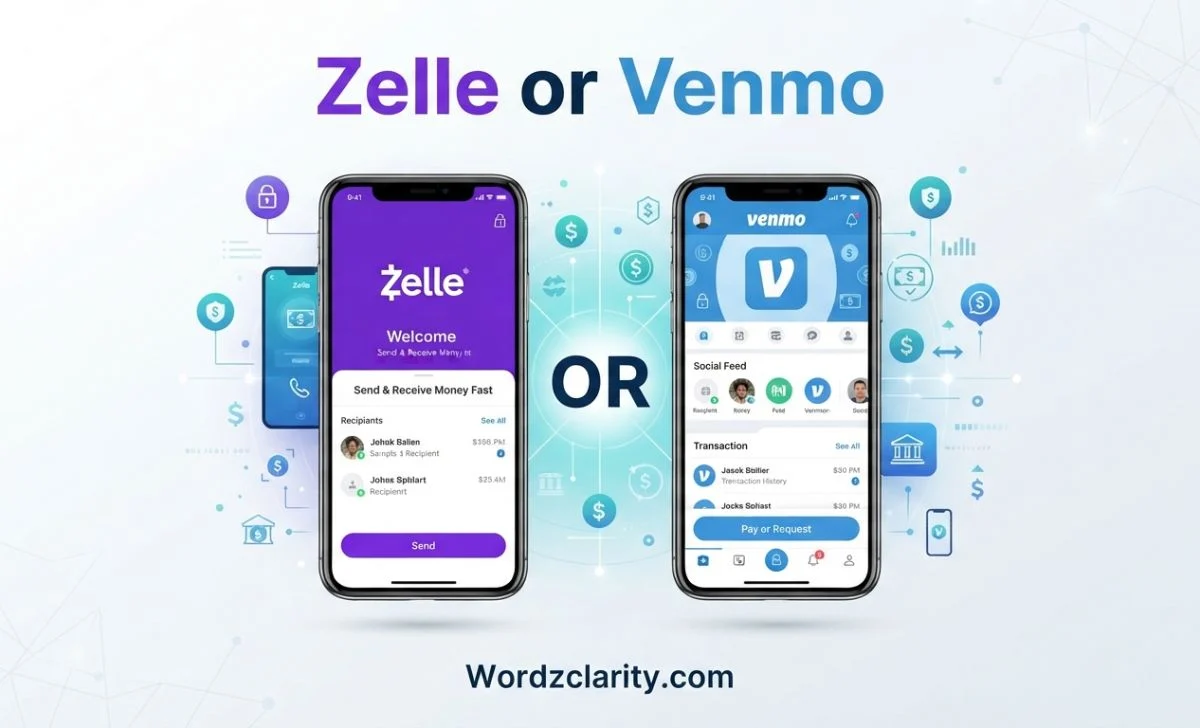
Choosing between Zelle or Venmo can be confusing because both services let you send and receive money, but they are designed differently. Zelle is closely tied to participating U.S. banks and credit unions, while Venmo is an app-based payment service that can hold money in a Venmo balance.
That difference affects almost everything else: how quickly money reaches your bank, what fees you may pay, how limits work, and which service makes more sense for everyday payments.
If you are deciding between Zelle and Venmo for paying a friend, splitting a bill, sending rent, receiving money, or moving funds to your bank, the better choice depends on what you need.
This guide compares Zelle vs. Venmo by fees, speed, limits, safety, privacy, bank access, and common situations. It also explains which service is better for specific types of payments and whether you can use both.
Zelle or Venmo: Quick Answer
Zelle is a better fit for direct bank-to-bank payments, while Venmo is a better fit for an app-based payment experience. The right choice depends on how you want to send, receive, and access your money.
With Zelle, money moves directly between eligible U.S. bank accounts. When both users are enrolled, payments typically arrive within minutes.
With Venmo, money you receive can remain in your Venmo balance. You can use that balance for eligible payments or transfer the money to a linked bank account or eligible debit card. Venmo also offers free standard transfers and paid instant transfers.
In simple terms: Choose Zelle for straightforward bank-to-bank payments. Choose Venmo if you prefer keeping money in an app and using additional payment features.
| Category | Better choice |
|---|---|
| Direct bank-to-bank payments | Zelle |
| Money going directly into a bank account | Zelle |
| Keeping a balance inside an app | Venmo |
| Social payment features | Venmo |
| Splitting everyday expenses | Venmo |
| Avoiding an instant cash-out fee | Zelle |
| Flexible payment funding | Venmo |
| Paying someone you already trust | Either |
| Bank-integrated payments | Zelle |
| App-based wallet experience | Venmo |
There is no single winner for everyone. The right choice depends on how you want your money to move.
What Is Zelle?
Zelle is a digital payment network that lets people send and receive money through participating U.S. banks and credit unions.
Its main purpose is simple: move money directly between eligible bank accounts.
You generally enroll through your bank or credit union’s mobile app or online banking system. You can then use an eligible U.S. mobile number or email address to send money to an enrolled recipient. Zelle says transactions to enrolled users typically occur within minutes.
One important point often missed in older comparison articles is that Zelle’s standalone consumer app stopped supporting sending and receiving money on April 1, 2025. Zelle now focuses on access through participating financial institutions.
That makes Zelle different from Venmo.
With Zelle, the money is designed to move directly between bank accounts rather than sit in a Zelle wallet.
Example
Suppose you owe your friend $100.
You open Zelle through your participating bank, select your friend, enter $100, and send it.
If the recipient is enrolled, the money typically goes directly to the recipient’s eligible bank account.
What Is Venmo?
Venmo is an app-based payment service that lets people send and receive money using linked payment methods and a Venmo balance.
You can use a linked bank account, debit card, credit card, or available Venmo balance for eligible payments. Venmo also allows received money to remain in your Venmo account until you spend it or transfer it to a linked bank account or eligible debit card.
This gives Venmo a different feel from Zelle.
For example, if someone sends you $200 through Venmo, you can leave that money in your Venmo balance and use it for another eligible payment. You can also transfer it to your bank.
Venmo offers:
- Person-to-person payments
- Payment requests
- Venmo balance
- Bank transfers
- Instant transfers
- Debit-card options
- Business profiles
- Merchant payment features
Venmo is part of the broader PayPal ecosystem, while Zelle is operated by Early Warning Services.
Zelle vs. Venmo: How Do They Work Differently?
The biggest difference is where the money goes and how the service connects to your bank.
How Zelle works
Zelle is primarily a bank-connected payment network.
The basic process is:
- Open Zelle through a participating bank or credit union.
- Enroll an eligible U.S. mobile number or email.
- Choose an enrolled recipient.
- Enter the amount.
- Send the payment.
- The money goes directly to the recipient’s eligible bank account.
Zelle says enrolled transactions typically occur within minutes.
How Venmo works
Venmo works through a Venmo account.
The basic process is:
- Open Venmo.
- Choose the recipient.
- Enter the payment amount.
- Send the payment.
- The money appears in the recipient’s Venmo balance.
- The recipient can spend it through Venmo or transfer it to a linked bank account or eligible debit card.
Venmo specifically explains that money received from other users remains in the Venmo account until the user spends or transfers it.
Why this difference matters
If your main goal is:
“I want the money to go directly into my bank.”
Zelle may be the simpler option.
If your goal is:
“I want to receive money in an app and decide later whether to spend it or transfer it.”
Venmo may be more convenient.
Zelle vs. Venmo Fees
Fees are one of the most common reasons people search for Zelle vs. Venmo fees.
For basic personal payments, both can be inexpensive, but the circumstances are different.
Zelle Fees
Zelle typically does not charge consumers a fee to send or receive money. However, your bank or credit union may have its own fee policy. Check with your financial institution to confirm whether any charges apply to your Zelle transactions.
This is one of Zelle’s biggest advantages.
Venmo fees
Venmo currently lists:
- $0 for sending money using a Venmo balance, bank account, or debit card
- 3% for sending money using a credit card
- $0 for a standard bank transfer
- 1.75% for an instant transfer, with a $0.25 minimum and $25 maximum
So the important distinction is not simply:
“Is Venmo free?”
Instead, ask:
How are you funding the payment, and how quickly do you need the money in your bank?
Fee comparison
| Transaction | Zelle | Venmo |
|---|---|---|
| Basic personal payment | Typically no consumer fee | Usually $0 |
| Credit-card-funded payment | Not the normal Zelle model | 3% |
| Standard transfer to bank | Direct bank transfer | $0 |
| Instant Venmo transfer | Not applicable in the same way | 1.75% |
| Bank-specific fees | Possible | Subject to Venmo’s applicable fees |
For someone who frequently uses instant Venmo transfers, those fees can add up.
Which Is Faster: Zelle or Venmo?
Both can move money quickly, but Zelle has a major advantage when the goal is direct bank-to-bank delivery.
Zelle says transactions between enrolled consumers typically occur within minutes.
Venmo payments can appear in a recipient’s Venmo account quickly, but getting that money from Venmo into a bank account depends on the transfer method.
Venmo currently offers:
- Instant transfer: typically within 30 minutes
- Standard transfer: typically 1–3 business days
Instant transfers carry a 1.75% fee, while standard transfers are free.
Example
Imagine someone sends you $500 through Venmo.
The payment can be available in your Venmo account, but if you want it in your bank immediately, you may choose an instant transfer and pay the applicable fee.
With Zelle, the service is designed to send the payment directly to the recipient’s eligible bank account.
Winner for direct bank access: Zelle.
Zelle vs. Venmo Limits
Limits are another area where people often make the wrong comparison.
There is not one universal Zelle limit.
Zelle states that your financial institution determines the limits for sending and receiving money.
That means your Zelle limit can differ from another person’s limit because you use different banks or credit unions.
Venmo has its own limits, and they can depend on identity verification and the type of transaction.
For personal Venmo profiles, an unverified user currently has a weekly spending limit of $299.99. After identity verification, Venmo says it is possible to send up to $60,000 per week, although other limits can apply to specific transfers.
For bank transfers, Venmo currently lists:
- Up to $999.99 per rolling week without identity verification
- Up to $19,999.99 per rolling week after verification
- A $5,000 maximum per individual bank transfer for verified users
These limits can change, so users should check the current limits shown by their financial institution or account.
Which is better for large payments?
There is no universal winner.
Zelle may be convenient for larger payments if your bank gives you a suitable limit.
Venmo may work for larger payments if your account is verified and the transaction falls within the applicable limits.
For either service, never assume that another person’s limit applies to your account.
Which Is Safer: Zelle or Venmo?
The question “Which is safer, Zelle or Venmo?” does not have a simple one-word answer.
Both services use security measures, but the biggest risk with P2P payments is often sending money to the wrong person or falling for a scam.
Zelle safety
Zelle strongly recommends sending money only to people you know and trust.
It also warns users to treat Zelle payments like cash. Once an authorized payment has been sent to an enrolled recipient, it generally cannot be canceled.
Zelle does not offer purchase protection for transactions such as buying an item from a stranger.
Venmo safety
Venmo also has security controls, but users should not assume that using a payment app automatically protects every purchase or payment.
A payment app should not be treated like a credit card.
If a stranger says:
“Send me the payment through Venmo or Zelle, and I will ship the item.”
you should be cautious.
Common payment scams
Watch for:
- Fake customer-support messages
- Fake refunds
- Impersonation
- Online marketplace scams
- Fake rental listings
- “Accidental payment” scams
- Prize scams
- Requests to send money urgently
- Fake invoices
- Requests for verification codes
A simple safety rule
Only send money when you know who you are paying and why you are paying them.
Double-check the recipient’s email address, phone number, username, or other payment identifier before confirming.
Zelle vs. Venmo for Privacy
Privacy is another difference worth considering.
Venmo has traditionally emphasized social interactions around payments, while Zelle is more focused on direct bank-to-bank transactions.
If you prefer a straightforward payment experience without making payments part of a social feed, Zelle may feel simpler.
With either service, however, you should review the current privacy and transaction-visibility settings before using the account.
Do not assume that a payment app works exactly like your bank’s private transaction history.
Zelle or Venmo for Paying Friends?
Both work well for paying friends.
Your choice depends on how your friend prefers to receive money.
Choose Zelle if:
- You both have participating banks or credit unions.
- You want the money to go directly to a bank account.
- You want a simple bank-integrated payment.
- You want to avoid Venmo’s instant-transfer fee.
Choose Venmo if:
- You and your friends already use Venmo.
- You like app-based payments.
- You regularly split expenses.
- You want to keep a Venmo balance.
For a simple payment such as:
“I owe you $40 for dinner.”
either service can work.
Zelle or Venmo for Rent?
For rent, the answer depends on the landlord or property manager and the payment terms.
If the landlord accepts Zelle and you are paying a trusted recipient, Zelle can be convenient because the money goes directly to the recipient’s bank account.
Venmo can also be useful if the landlord accepts it and the transaction is appropriate under Venmo’s rules.
However, don’t choose a payment method merely because someone asks you to use it.
Verify the recipient and payment instructions first.
For a rental deposit or other large payment to someone you have never met, consider whether a payment method with stronger buyer or transaction protections would be more appropriate.
Zelle or Venmo for Business?
Both services can have business-related uses, but their features are not identical.
Zelle offers business functionality through participating financial institutions, and Zelle says business fees and limits depend on the financial institution.
Venmo offers business profiles with separate limits and features. For example, verified Venmo business profiles currently have separate weekly payment and bank-transfer limits from personal profiles.
For a small business, consider:
- Payment fees
- Customer convenience
- Transaction limits
- Record keeping
- Refund policies
- Payment protection
- Business-profile requirements
- Your bank’s rules
A business should not choose a payment platform based only on whether sending money is free.
Does Bank of America Use Zelle or Venmo?
Bank of America supports Zelle for peer-to-peer payments.
Bank of America customers can use Zelle through the Bank of America mobile app and Online Banking. They can send and receive money between eligible U.S. bank accounts.
Bank of America does not charge a fee for sending or receiving money with Zelle through its platform.
This is an important difference between Zelle and Venmo. Zelle is available through participating banks and credit unions. Venmo is a separate payment app.
So, if you have a Bank of America account, you can use Zelle directly through your bank’s app or Online Banking. You do not need a separate Venmo account to send or receive money with Zelle.
Zelle vs. Venmo vs. Cash App
Cash App is another major name in the P2P payment market.
The three services have different strengths.
| Feature | Zelle | Venmo | Cash App |
|---|---|---|---|
| Main model | Bank-connected payments | App-based payment service | Broader financial app |
| Direct bank focus | Strong | Moderate | Moderate |
| In-app balance | No traditional Zelle balance | Yes | Yes |
| Social features | Limited | Stronger | Some |
| Best known for | Bank-to-bank transfers | Everyday/social payments | Broader money features |
| Best choice for | Direct bank payments | App-based payments | Users wanting broader app features |
If your main question is Zelle or Venmo, however, Cash App should remain a secondary comparison rather than taking over the article.
Which Is More Popular: Zelle or Venmo?
It is difficult to answer this with one simple number because popularity can mean different things.
You could compare:
- Number of users
- Active users
- Transaction volume
- Total money transferred
- Number of participating banks
- Consumer awareness
Zelle has extensive reach through participating financial institutions. Zelle says its network is available through more than 2,400 banking and credit-union apps.
Venmo, meanwhile, has a large standalone app-based ecosystem.
So instead of saying one service is automatically “more popular,” it is more useful to ask:
Which service is more convenient for the people you actually pay?
If your friends all use Venmo, Venmo may be more useful to you. If your bank already integrates Zelle and your recipients use it, Zelle may be easier.
Pros and Cons of Zelle
Zelle Pros
- Direct bank-to-bank payments
- Typically fast
- Usually no consumer fee
- Built into participating banking apps
- No separate traditional wallet balance
- Convenient for trusted recipients
- Good for people who want money directly in their bank
Zelle Cons
- Availability depends on participating banks or credit unions
- Limits depend on the financial institution
- Not designed for strangers or risky purchases
- Payments to enrolled recipients generally cannot be canceled
- No purchase protection for typical Zelle transactions
Pros and Cons of Venmo
Venmo Pros
- Easy app-based experience
- Money can remain in your Venmo balance
- Free standard bank transfers
- Instant transfers are available
- Multiple funding methods
- Useful for splitting everyday expenses
- Business profiles are available
- Strong ecosystem for app-based payments
Venmo Cons
- Instant bank transfers have a fee
- Credit-card-funded payments have a fee
- Limits vary by account status and transaction type
- Money received may need to be transferred separately to your bank
- Users still need to watch for scams and incorrect recipients
Zelle or Venmo: Which Should You Choose?
The best choice depends on what you want the payment service to do.
Choose Zelle if:
- You want direct bank-to-bank payments.
- Your bank or credit union supports Zelle.
- You want money to reach your bank without moving it from an app balance.
- You are paying someone you know and trust.
- You want to avoid Venmo’s instant-transfer fee.
Choose Venmo if:
- You prefer a standalone payment app.
- You want to keep money in an app balance.
- You frequently split bills with friends.
- You want multiple funding options.
- You want the option of instant or standard transfers.
- You need Venmo’s business or app-based features.
Can you use both?
Yes. There is no need to choose only one.
You might use Zelle for direct bank payments and Venmo for friends or situations where you prefer its app-based features.
The important thing is to understand where your money is going, what fees apply, and what protections are available before you send a payment.
FAQs
Is Zelle or Venmo better?
Zelle is generally better for direct bank-to-bank payments, while Venmo is generally better for an app-based wallet and social payment experience. The better option depends on your bank, recipient, fees, and intended use.
Which is safer, Zelle or Venmo?
Neither should be treated as automatically safe for every transaction. Both should be used carefully, especially when dealing with strangers. Zelle specifically advises users to send money only to people they know and trust and warns that authorized payments may not be canceled.
Which is cheaper, Zelle or Venmo?
For basic personal payments, both can be free. Zelle typically has no consumer fee, although your bank may set fees. Venmo charges $0 for payments funded by a bank, debit card, or Venmo balance, but it charges 3% for credit-card-funded payments and 1.75% for instant transfers.
Which is faster, Zelle or Venmo?
Zelle transactions between enrolled users typically occur within minutes. Venmo payments can be available in the Venmo account quickly, while moving money to a bank can take 1–3 business days with a standard transfer or typically around 30 minutes with an instant transfer.
Can you send money from Zelle to Venmo?
No, Zelle and Venmo are separate payment systems. You cannot normally send a Zelle payment directly to a person’s Venmo account. If you need to move money between the services, you generally need to use an eligible bank account as an intermediary rather than treating Zelle and Venmo as connected wallets.
Can you send money from Venmo to Zelle?
Not directly. Venmo and Zelle do not function as linked payment networks. A user would generally need to move money through an eligible bank account before using the other service.
Is Zelle better than Venmo for large payments?
It depends on your bank’s Zelle limits and your Venmo account limits. Zelle limits are determined by the financial institution, while Venmo limits depend partly on identity verification and the type of transaction.
Conclusion:
So, Zelle or Venmo—which one should you use? The answer depends less on which brand is “better” and more on how you want your money to move.
Zelle is the stronger choice for straightforward bank-to-bank payments. It is integrated into participating financial institutions, and payments to enrolled users typically reach their bank accounts within minutes. It can be especially convenient when you already bank with a financial institution that supports Zelle.
Venmo is the stronger choice for an app-based payment experience. You can keep money in your Venmo balance, make payments using several funding methods, and choose between standard and instant bank transfers. Standard transfers are free, while instant transfers currently carry a 1.75% fee.
Neither service should be used carelessly with strangers. Before sending money, verify the recipient and understand the transaction.
For most people, the simplest rule is: use Zelle when you want direct bank-to-bank payments, and use Venmo when you want the flexibility of an app-based payment balance and broader payment features.
Read More Blogs
- One in the Same or One and the Same: Which Is Correct?
- Homey or Homie: Meaning, Difference, Spelling, and Usage
- Lefty or Leftie: How to Spell It and Use It Correctly
- Emcee or MC: Meaning, Difference, Spelling, and Usage