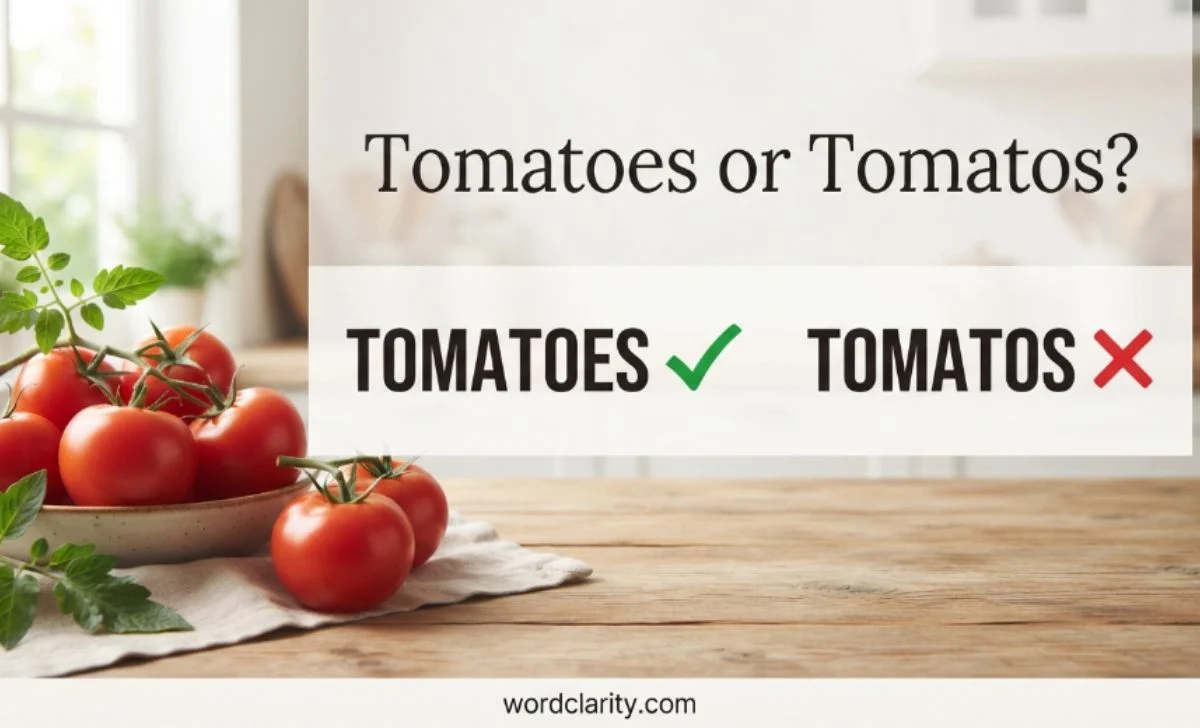
Tomatoes or tomatos? If you have ever been unsure about this spelling, you are not alone. The word tomato looks like many other nouns that form their plural by adding -s. That can make tomatos seem correct at first glance.
But there is a small spelling change to remember.
The correct plural of tomato is tomatoes. The spelling tomatos is incorrect in standard English.
This question comes up often in recipes, food blogs, gardening articles, school assignments, and everyday writing. Once you know the rule, it is easy to get right.
In this guide, you will learn why tomatoes is correct, why tomatos is a common mistake, how the plural is formed, and whether British and American English use the same spelling.
Quick Answer: Tomatoes or Tomatos?
Tomatoes is the correct spelling.
Tomatos is a misspelling.
Here is the difference:
| Form | Status | Example |
|---|---|---|
| tomato | Correct singular | I bought one tomato. |
| tomatoes | Correct plural | I bought five tomatoes. |
| tomatos | Incorrect | I bought five tomatos. |
Use tomato when you mean one.
She cut one tomato.
Use tomatoes when you mean more than one.
She cut three tomatoes.
So, the correct pattern is:
tomato → tomatoes
Why Is “Tomatoes” Correct?
The mistake is easy to understand.
Most English nouns form their plural by adding -s.
For example:
- apple → apples
- book → books
- car → cars
- orange → oranges
It may seem logical to write:
tomato → tomatos
But standard English uses -es with tomato.
So the correct form is:
tomato → tomatoes
This is simply the established plural form of the word.
You do not need to change the pronunciation or meaning. You only need to remember the spelling.
Tomato vs Tomatoes
The difference is based on number.
Tomato means one.
There is a tomato on the plate.
Tomatoes means two or more.
There are three tomatoes on the plate.
Compare these examples:
| Singular | Plural |
|---|---|
| one tomato | two tomatoes |
| a tomato | several tomatoes |
| this tomato | these tomatoes |
| that tomato | those tomatoes |
The spelling changes only when you make the noun plural.
Why Do People Write “Tomatos”?
The main reason is the normal English plural rule.
People often learn:
Add -s to make a noun plural.
That rule works for many common words.
For example:
- cat → cats
- pen → pens
- chair → chairs
- phone → phones
So someone may naturally write:
tomato → tomatos
The problem is that tomato uses a different plural ending.
It takes -es:
tomato → tomatoes
This is why tomatos is a common spelling mistake. It follows a pattern that works for many other English words, but not for this one.
Words That Work Like “Tomato”
One easy way to remember tomatoes is to connect it with potatoes.
Both words have a similar plural spelling:
tomato → tomatoes
potato → potatoes
You can remember them together:
Tomatoes and potatoes
There are a few other common nouns that also take -es:
| Singular | Plural |
|---|---|
| tomato | tomatoes |
| potato | potatoes |
| hero | heroes |
| echo | echoes |
However, be careful with nouns ending in -o.
They do not all follow the same pattern.
For example:
- photo → photos
- piano → pianos
- radio → radios
- video → videos
So you should not assume that every -o word needs -es. It is better to learn the common plural form of each word.
Is “Tomatos” Ever Correct?
No. Tomatos is not the standard spelling.
You may see it online from time to time. Someone might use it in a social media post, comment, message, or poorly edited article.
That does not make it correct.
If you are writing something that needs proper English, use tomatoes.
Incorrect
The recipe needs four tomatos.
Correct
The recipe needs four tomatoes.
The difference is only two letters, but the second sentence uses the accepted spelling.
Tomatoes in British and American English
There is no spelling difference between British and American English here.
Both use:
tomato for one
and:
tomatoes for more than one
| English variety | Singular | Plural |
|---|---|---|
| British English | tomato | tomatoes |
| American English | tomato | tomatoes |
| Canadian English | tomato | tomatoes |
| Australian English | tomato | tomatoes |
So you do not need to choose a different spelling based on your audience.
Whether you are writing for readers in the UK or the US, tomatoes is correct.
This is different from words such as:
- color / colour
- center / centre
- favorite / favourite
With tomatoes, there is only one standard plural spelling.
How to Use “Tomatoes” in Everyday Sentences
Tomatoes is a plural noun. Use it when you are talking about more than one tomato.
In conversation
I need some tomatoes.
These tomatoes are fresh.
How many tomatoes should we buy?
The tomatoes are still green.
In shopping
I bought six tomatoes from the market.
The store has fresh tomatoes today.
These tomatoes are cheaper.
In gardening
We planted tomatoes last spring.
The tomatoes are growing quickly.
These plants produce large tomatoes.
In cooking
Chop two tomatoes.
Add the tomatoes to the pan.
Roast the tomatoes for 20 minutes.
The recipe calls for three tomatoes.
In each example, tomatoes refers to more than one individual tomato.
“Tomato” Can Also Describe Another Noun
There is one useful point that often causes confusion.
Tomato can be used before another noun to describe something related to tomatoes.
For example:
- tomato sauce
- tomato soup
- tomato juice
- tomato plant
- tomato paste
- tomato salad
Notice that tomato stays singular in these expressions.
For example:
I made tomato sauce.
We do not normally write:
I made tomatoes sauce. ❌
Why?
Because tomato is not the main noun here. It describes the type of sauce.
The same applies to:
tomato soup
tomato juice
tomato plant
So, do not make tomato plural just because the food may contain several tomatoes.
Tomatoes in Recipes
Recipes are a good place to see the difference.
When you are talking about individual fruits, use tomatoes for more than one:
Chop three tomatoes.
Slice two tomatoes.
Add four tomatoes to the bowl.
But when tomato describes another ingredient or dish, the singular form is often used:
Add tomato sauce.
Serve with tomato soup.
Prepare a fresh tomato salad.
Compare:
Three tomatoes = three individual fruits.
Tomato sauce = a type of sauce.
This small difference helps you choose the right form naturally.
A Simple Trick to Remember “Tomatoes”
Still forgetting whether to write tomatos or tomatoes?
Use this simple trick:
Think of tomatoes and potatoes together.
Tomato → tomatoes
Potato → potatoes
Both end with -oes in the plural.
You can also remember this short rule:
Tomato takes -es in the plural.
So:
tomato + es = tomatoes
Not:
tomato + s = tomatos
If you remember the phrase “tomatoes and potatoes,” the correct spelling becomes much easier to recall.
Quick Check
Before moving on, test yourself.
Which sentence is correct?
A. I bought four tomatos.
B. I bought four tomatoes.
The answer is:
B. I bought four tomatoes. ✅
Another one:
A. The recipe needs two tomato.
B. The recipe needs two tomatoes.
The answer is:
B. The recipe needs two tomatoes. ✅
The rule is simple:
One tomato.
Two tomatoes.
Common Mistakes With “Tomatoes”
The most common mistake is writing tomatos instead of tomatoes.
Mistake 1: Leaving out “e”
❌ I bought five tomatos.
✅ I bought five tomatoes.
The plural needs -es.
Mistake 2: Using an apostrophe
Some writers use an apostrophe when they only want to make the word plural.
❌ We bought three tomato’s.
✅ We bought three tomatoes.
An apostrophe does not normally make a noun plural.
The apostrophe has a different job.
For example:
The tomato’s skin was soft.
Here, tomato’s shows possession. It refers to something connected with one tomato.
Tomatoes, Tomato’s, or Tomatoes’?
These three forms look similar, but they have different jobs.
| Form | Use | Example |
|---|---|---|
| tomato | One tomato | I ate a tomato. |
| tomatoes | More than one | I bought tomatoes. |
| tomato’s | Belonging to one tomato | The tomato’s skin is thin. |
| tomatoes’ | Belonging to several tomatoes | The tomatoes’ colors are different. |
The easiest one to remember is:
tomatoes = plural
So if you simply mean more than one, do not use an apostrophe.
How Is “Tomatoes” Pronounced?
The spelling is the same in British and American English, but the pronunciation can differ.
In American English, tomatoes is commonly pronounced like:
tuh-MAY-tohz
In British English, you may commonly hear:
tuh-MAH-tohz
The spelling does not change.
This is useful to remember because English can have different pronunciations for the same written word.
So:
tomatoes is the spelling in both varieties of English.
Where Does the Word “Tomato” Come From?
The word tomato has a long history.
The tomato plant originated in the Americas. The English word came through Spanish tomate, which is linked to an Indigenous word from the Nahuatl language.
As the fruit spread to Europe and other parts of the world, the word became part of many languages.
English eventually settled on:
tomato
and its standard plural:
tomatoes
The spelling is not a recent change. It is the established form used in standard English.
Tomatoes in Different Types of Writing
You will see tomatoes in many kinds of writing.
In emails
Could you please buy some tomatoes on your way home?
This is a simple everyday use.
In business writing
Our supplier delivers fresh tomatoes every morning.
Here, tomatoes refers to multiple items.
In academic writing
The researchers studied the growth of tomato plants under different conditions.
Notice that the sentence uses tomato plants, not tomatoes plants.
The word tomato describes the type of plant.
In news writing
Local farmers reported a strong harvest of tomatoes this year.
On websites
Learn how to grow tomatoes in small spaces.
On social media
Fresh tomatoes from the garden! 🍅
All of these examples use the standard spelling.
“Tomato” or “Tomatoes” as a Modifier?
This is an important point for writers.
A noun can sometimes be used to describe another noun. When this happens, the first noun often stays singular.
For example:
- tomato sauce
- tomato soup
- tomato plant
- tomato juice
- tomato paste
- tomato seeds
Even if a sauce contains many tomatoes, we normally say:
tomato sauce
not:
tomatoes sauce ❌
The same idea applies to tomato plant.
You might have many plants:
We planted five tomato plants.
Not:
We planted five tomatoes plants. ❌
The main noun is plants. The word tomato tells us what kind of plants they are.
Tomatoes in Food and Cooking
Food writing uses the word tomatoes very often.
Here are some natural examples:
Slice two tomatoes for the salad.
Add the chopped tomatoes to the pan.
Roast the tomatoes with garlic.
Remove the seeds from the tomatoes.
The soup is made with fresh tomatoes.
Store the tomatoes at room temperature.
When the sentence refers to several individual fruits, tomatoes is the right form.
However, the singular form can describe a food:
tomato soup
tomato sauce
tomato paste
This difference is easy once you look at the role of the word in the sentence.
Tomato Varieties and Types
The plural tomatoes can refer to many kinds of tomatoes.
For example:
- cherry tomatoes
- Roma tomatoes
- beefsteak tomatoes
- grape tomatoes
- heirloom tomatoes
- green tomatoes
You might write:
The market sells several types of tomatoes.
Or:
I bought cherry tomatoes for the salad.
Here, tomatoes is plural because the sentence refers to multiple fruits.
You can also use tomato before a noun:
tomato varieties
tomato seeds
tomato plants
Again, the form depends on how the word is being used.
A Useful Comparison With Other “-O” Words
One reason tomatoes can be confusing is that English does not use one plural rule for every word ending in -o.
Compare these examples:
| Singular | Plural |
|---|---|
| tomato | tomatoes |
| potato | potatoes |
| hero | heroes |
| echo | echoes |
| photo | photos |
| piano | pianos |
| radio | radios |
| video | videos |
This means you should not use a rule like:
“Every word ending in -o takes -es.”
That would be incorrect.
For example:
photo → photos
not:
photoes
Likewise:
piano → pianos
not:
pianoes
For common words such as tomato, the best approach is to learn the accepted plural form.
How to Avoid Writing “Tomatos”
A few simple habits can help.
1. Remember the plural as a whole
Instead of thinking:
tomato + something
remember:
tomatoes
This makes spelling faster.
2. Connect it with “potatoes”
Think:
tomatoes and potatoes
Both use -oes.
3. Check the ending
If you are writing tomatos, stop and look at the ending.
The correct spelling has:
t-o-m-a-t-o-e-s
4. Proofread before publishing
If you write recipes, food articles, or gardening content, search your document for:
tomatos
If you find it, change it to:
tomatoes
This quick check can prevent an easy spelling error from appearing in published content.
Is “Tomatoes” Singular or Plural?
Tomatoes is plural.
The singular form is:
tomato
The plural form is:
tomatoes
Compare:
This tomato is ripe.
These tomatoes are ripe.
The words around the noun can also help you identify the number.
Singular
- a tomato
- one tomato
- this tomato
- that tomato
Plural
- two tomatoes
- many tomatoes
- these tomatoes
- those tomatoes
- several tomatoes
For example:
This tomato looks fresh.
But:
These tomatoes look fresh.
The verb also changes in some sentences because the subject changes from singular to plural.
Can “Tomatoes” Refer to Different Varieties?
Yes.
Tomatoes can refer to several individual fruits, several types, or a group of tomatoes in general.
For example:
The store sells different varieties of tomatoes.
This could include Roma, cherry, grape, and other types.
You can also say:
Tomatoes are widely used in cooking.
Here, tomatoes refers to the fruit in general.
So the plural form is not limited to a specific number.
Practical Writing Tips
If you often write about food, gardening, recipes, or everyday topics, keep these points in mind:
- Use tomato for one.
- Use tomatoes for more than one.
- Do not write tomatos.
- Do not use tomato’s as the normal plural.
- Remember tomato → tomatoes.
- Use tomato when it describes another noun, such as tomato sauce.
- Remember that British and American English both use tomatoes.
The key spelling is simple:
tomatoes
Once you learn it, there is no need to hesitate between tomatoes and tomatos.
FAQs
1. What is the correct plural of tomato?
The correct plural is tomatoes.
One tomato.
Two tomatoes.
Tomatos is a misspelling.
2. Why is “tomatoes” spelled with “es”?
Tomato is one of the common English nouns ending in -o that traditionally takes -es in the plural. Therefore, the standard spelling is tomatoes.
3. Is “tomatos” an accepted spelling?
No. Tomatos is not the standard plural form of tomato. Use tomatoes in correct English.
4. Is “tomato’s” the plural form?
No. Tomato’s usually shows possession.
For example:
The tomato’s color is bright red.
For a normal plural, write:
The tomatoes are ripe.
5. Do British people spell it “tomatoes”?
Yes. Tomatoes is the standard spelling in British English. American English uses the same spelling.
6. Is the pronunciation of “tomatoes” different in British and American English?
Yes, the pronunciation can differ. American English commonly uses a pronunciation similar to tuh-MAY-tohz, while British English commonly uses tuh-MAH-tohz. The spelling remains tomatoes.
7. How can I remember “tomatoes”?
Think of tomatoes and potatoes. Both plural forms end in -oes:
tomato → tomatoes
potato → potatoes
This is an easy way to avoid writing tomatos.
Conclusion
When choosing between tomatoes or tomatos, always choose tomatoes. It is the standard plural form of tomato, while tomatos is a common spelling mistake.
The confusion comes from a simple reason. Many English nouns become plural by adding -s, so tomatos can look natural. However, tomato uses -es in its standard plural form.
The rule is easy to remember:
tomato → tomatoes
The same spelling is used in both British and American English. There is no regional version to choose.
Also remember that tomatoes, tomato’s, and tomatoes’ have different grammatical roles. Use tomatoes for the plural, tomato’s for possession involving one tomato, and tomatoes’ for possession involving several tomatoes.
If you are writing a recipe, article, email, school assignment, or website, tomatoes is the form you want. A simple memory trick is to pair it with potatoes. Both end in -oes.
So the answer is clear: tomatoes is correct; tomatos is not.
Read More Blogs:
Chicken or the Egg: Which Came First? Science, Evolution
Can Not vs Cannot: Understanding the Difference With Examples
Anytime vs. Any Time: The Simple Rule to Get It Right
Quite vs Quiet: Definitions, Examples, and Grammar Rules