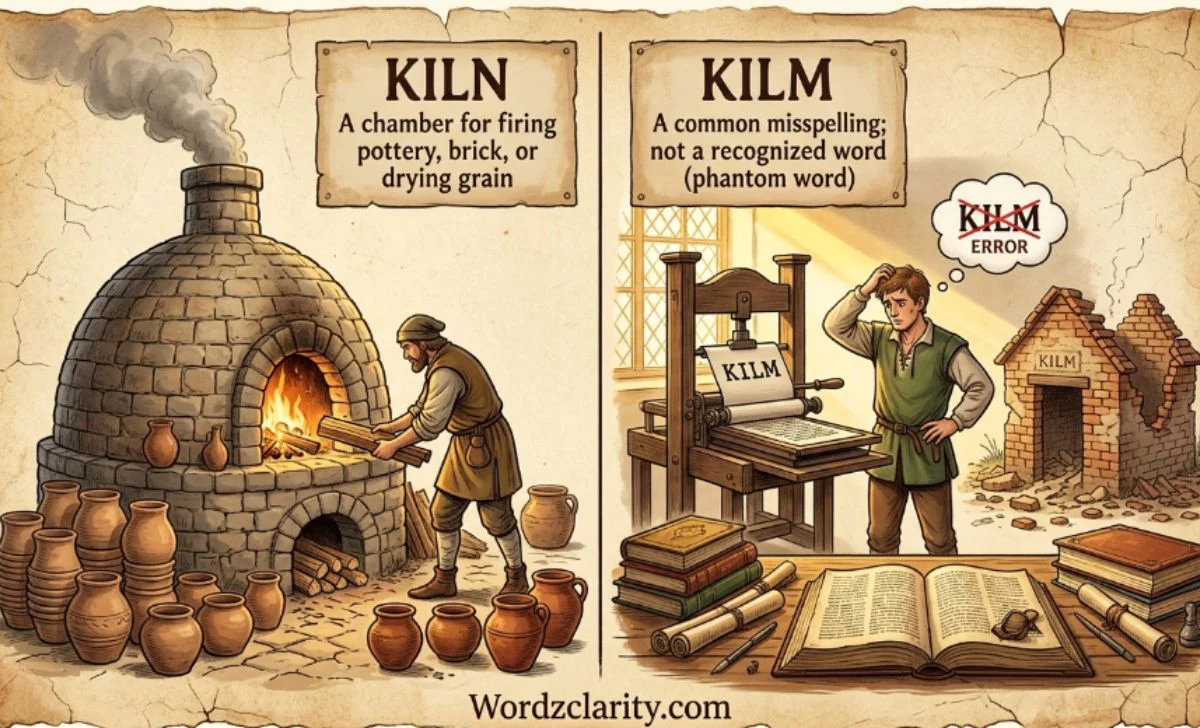
If you are unsure whether kilm or kiln is the correct spelling, you are not alone. The two forms look similar, but only one is the standard English word for a furnace or chamber used for high-temperature heating.
The correct spelling is kiln. It is commonly used when talking about pottery, ceramics, bricks, tiles, wood, and industrial materials.
The confusion often comes from pronunciation because the written l is not clearly heard in the word.
As a result, some people write kilm when they are actually referring to a kiln. In this guide, you will learn the difference between the two forms, how to pronounce kiln, where the word comes from, and how to use it correctly in everyday and professional writing.
Quick Answer: Kilm or Kiln?
Kiln is the correct spelling.
A kiln is a furnace or enclosed chamber designed to produce controlled, high temperatures. It is often used to fire pottery and ceramics, manufacture bricks and tiles, dry wood, and process other materials.
Kilm is generally a misspelling of kiln.
| Word | Correct? | Meaning |
|---|---|---|
| Kiln | Yes | A furnace or chamber used for controlled heating |
| Kilm | No | Usually a misspelling of kiln |
For example:
The artist placed the bowls in the kiln.
Not:
The artist placed the bowls in the kilm.
If you are writing for school, business, a website, or any professional audience, always use kiln.
What Does Kiln Mean?
A kiln is a specially designed chamber used to heat materials at controlled temperatures. Its purpose depends on the industry.
Pottery makers use kilns to fire clay and ceramic pieces. Brick manufacturers use them to heat and harden bricks. Woodworkers may use kilns to reduce moisture in timber.
For example:
The ceramic artist placed the finished bowls in the kiln.
The word can also appear in technical fields. You may see phrases such as industrial kiln, ceramic kiln, brick kiln, and wood kiln.
So, kiln is not limited to pottery. It is a useful word in manufacturing, construction, woodworking, engineering, and other technical areas.
Why Do People Write Kilm Instead of Kiln?
The main reason is pronunciation.
Kiln has an unusual spelling because the written form does not perfectly match the way many speakers pronounce it. The l is not clearly heard as a separate sound, so someone who knows the word only from speech may spell it incorrectly.
That can lead to forms such as kilm.
However, kilm is not the standard spelling of the furnace.
Compare:
The pottery was fired in a kiln. ✓
The pottery was fired in a kilm. ✗
The easiest way to remember the difference is to focus on the final letters:
KILN = correct
KILM = incorrect
How Do You Pronounce Kiln?
The pronunciation of kiln is another reason the spelling can be confusing.
It is commonly pronounced approximately like “kill,” although the exact pronunciation can vary slightly by accent. The word is often represented as /kɪln/ in phonetic notation.
The important point is that you should not try to spell the word only from its sound.
When you hear:
“kiln”
remember the written form:
kiln
The l belongs in the spelling even though it may not be clearly noticeable in speech.
This is similar to other English words whose spelling preserves letters that are not strongly heard in modern pronunciation.
Is Kiln British or American English?
Kiln is used in both British and American English. There is no standard British spelling kilm and American spelling kiln distinction.
| English variety | Standard spelling |
|---|---|
| British English | kiln |
| American English | kiln |
| Canadian English | kiln |
| Australian English | kiln |
Therefore, your choice does not depend on where your readers live.
Whether you are writing for a British, American, or international audience, kiln is the appropriate spelling.
The issue here is correct spelling versus misspelling, not regional variation.
Kiln vs. Kilm: What Is the Difference?
The difference is straightforward.
Kiln is a standard English noun. It names a furnace or chamber used for controlled heating.
Kilm is generally an incorrect spelling used when someone intends to write kiln.
| Feature | Kiln | Kilm |
|---|---|---|
| Standard English | Yes | No |
| Correct spelling | Yes | No |
| Meaning | High-temperature furnace or chamber | Usually intended to mean kiln |
| Used in formal writing | Yes | No |
| British/American variation | No | No |
There is no separate definition you need to learn for kilm when discussing pottery or industrial heating.
Common Mistakes With Kiln
The most common mistake is simply replacing the final n with m.
Incorrect:
The clay was placed in the kilm.
Correct:
The clay was placed in the kiln.
Another mistake is leaving out the l because it is not clearly heard in pronunciation.
The correct spelling remains:
kiln
It is also incorrect to assume that kilm is an informal or regional version of the word. It is not the standard British or American spelling.
When writing professionally, spelling the word correctly is especially important. A mistake on a business website, product page, technical document, or academic assignment can make the writing look less polished.
How Is Kiln Used in Real Writing?
The word kiln appears in many types of writing, from casual conversations to technical documents.
In a pottery studio, someone might say:
The kiln needs to cool before we open it.
In a business email, you could write:
Please confirm whether the kiln is ready for the next batch.
Technical writing may use the word more formally:
The material was heated in a controlled kiln.
A product description might say:
Each ceramic piece is fired in a high-temperature kiln.
You can also find kiln in academic and website content:
The samples were heated in a laboratory kiln.
Choosing the right kiln can improve firing results.
These examples show that kiln is used naturally in both everyday and professional English. The meaning stays the same: it refers to a chamber designed for controlled heating.
Where Does the Word Kiln Come From?
Kiln is an old English word with a long history. Earlier forms included kilne, and the word developed over time as English spelling and pronunciation changed.
Its history is also connected with the Latin word culina, meaning a kitchen or cooking place.
The modern spelling may look unusual because English spelling often preserves older forms even when pronunciation changes.
For modern writers, however, the practical point is simple:
Kiln is the established standard spelling.
Knowing the history can explain why the word looks different from the way it sounds, but you do not need to memorize its historical forms to use it correctly.
Kiln in Different Fields
The word kiln is used in several industries, although the basic idea remains the same: controlled heating.
Pottery and ceramics
Pottery makers use kilns to fire clay and ceramic objects.
The artist fired the cups in an electric kiln.
Brick and tile production
Manufacturers use industrial kilns to heat and harden products.
The bricks were moved into the kiln for firing.
Wood processing
Kilns can remove moisture from wood under controlled conditions.
The lumber was kiln-dried before it was sold.
Industrial manufacturing
Large kilns can be used for high-temperature processing.
The factory installed a new kiln to improve production.
These different uses show that kiln is a practical word in both everyday and specialized English.
Kiln-Dried: A Common Expression
One common expression you may encounter is kiln-dried.
It usually describes wood that has been dried in a kiln under controlled conditions to reduce its moisture content.
For example:
The furniture was made from kiln-dried wood.
We ordered kiln-dried timber for the project.
When kiln-dried appears before a noun as a compound adjective, the hyphen makes the relationship between the words clear.
Common examples include:
- kiln-dried wood
- kiln-dried timber
- kiln-dried lumber
This expression is especially common in woodworking, construction, furniture, and building-related content.
Kiln in Professional Writing
If your work involves pottery, construction, manufacturing, engineering, or materials, you may use kiln regularly.
For example, a business website might say:
Our facility uses energy-efficient kilns to reduce production costs.
A technical document could state:
The kiln temperature must remain within the specified range.
An academic paper might use:
The ceramic samples were heated in a kiln under controlled conditions.
A product page could say:
This handmade vase is fired in a high-temperature ceramic kiln.
The word fits naturally into each context because it has a clear technical meaning.
Is Kilm Ever an Accepted Spelling?
For standard English, kilm should not be used as an alternative spelling of kiln.
You may occasionally encounter kilm online in search queries, comments, or other user-generated content. However, seeing an incorrect form online does not make it a standard spelling.
If you are writing for a professional audience, use kiln.
This applies to:
- Business websites
- Product descriptions
- School assignments
- University papers
- Technical documents
- Professional emails
- News articles
- Instruction manuals
Using the standard spelling keeps your writing clear and credible.
How to Avoid the Kilm Mistake
The simplest way to remember the word is to connect its spelling with its meaning.
Think:
A kiln is a furnace.
Then remember the spelling:
K-I-L-N
You can also learn the word through familiar phrases:
- pottery kiln
- ceramic kiln
- brick kiln
- industrial kiln
- kiln-dried wood
- kiln-fired pottery
Seeing kiln in these common combinations makes the spelling easier to remember.
Most importantly, do not rely entirely on pronunciation. The sound does not clearly reveal every letter in the written word.
Kiln vs. Oven: Are They the Same?
A kiln and an oven both use heat, but they are not normally the same thing.
An oven is commonly used for cooking food or heating materials. A kiln is designed for controlled heating processes, often at much higher temperatures.
For example:
The cake was baked in an oven.
The clay pot was fired in a kiln.
The correct choice therefore depends on what you are describing.
If you mean a chamber used to fire ceramics, produce bricks, dry wood, or carry out similar high-temperature processes, kiln is the appropriate word.
FAQs
1. Is “kilm” a correct spelling?
No. When you mean the furnace used for pottery, ceramics, bricks, wood, or other materials, the standard spelling is kiln.
2. Why is kiln spelled with an L?
The spelling comes from older forms of the word. Although the l is not strongly heard in pronunciation, it remains part of the standard written form.
3. How do you pronounce kiln?
It is commonly pronounced approximately like “kill.” Pronunciation can vary slightly by accent.
4. Is kiln a British or American word?
Kiln is standard in both British and American English. There is no standard regional spelling kilm.
5. What is a kiln used for?
A kiln is used for controlled heating. Common uses include firing pottery and ceramics, making bricks and tiles, drying wood, and processing industrial materials.
6. What does kiln-dried mean?
Kiln-dried means that wood or another material has been dried in a kiln under controlled conditions.
7. How can I remember the spelling?
Remember the final letters: LN. Think KILN, not KILM. Familiar phrases such as kiln-dried wood can also help.
Conclusion
When choosing between kilm or kiln, the correct spelling is kiln. It refers to a furnace or enclosed chamber used for controlled heating, especially in pottery, ceramics, brick production, wood drying, and industrial work.
Kilm is generally a misspelling caused by the unusual relationship between the word’s pronunciation and its written form.
The easiest way to remember kiln is to focus on its final letters: LN, not LM. The word is standard in both British and American English, so there is no regional spelling choice to make.
Whether you are writing a school assignment, business email, product description, technical document, or website article, kiln is the correct professional choice. Once you connect the word with familiar phrases such as kiln-dried wood and pottery kiln, its spelling becomes much easier to remember and use correctly.
Read More Blogs:
Saviour or Savior: what is the difference between these words
Honor or Honour: Right Spelling in American and British English
Labelling or Labeling: Which Spelling Should You Choose?