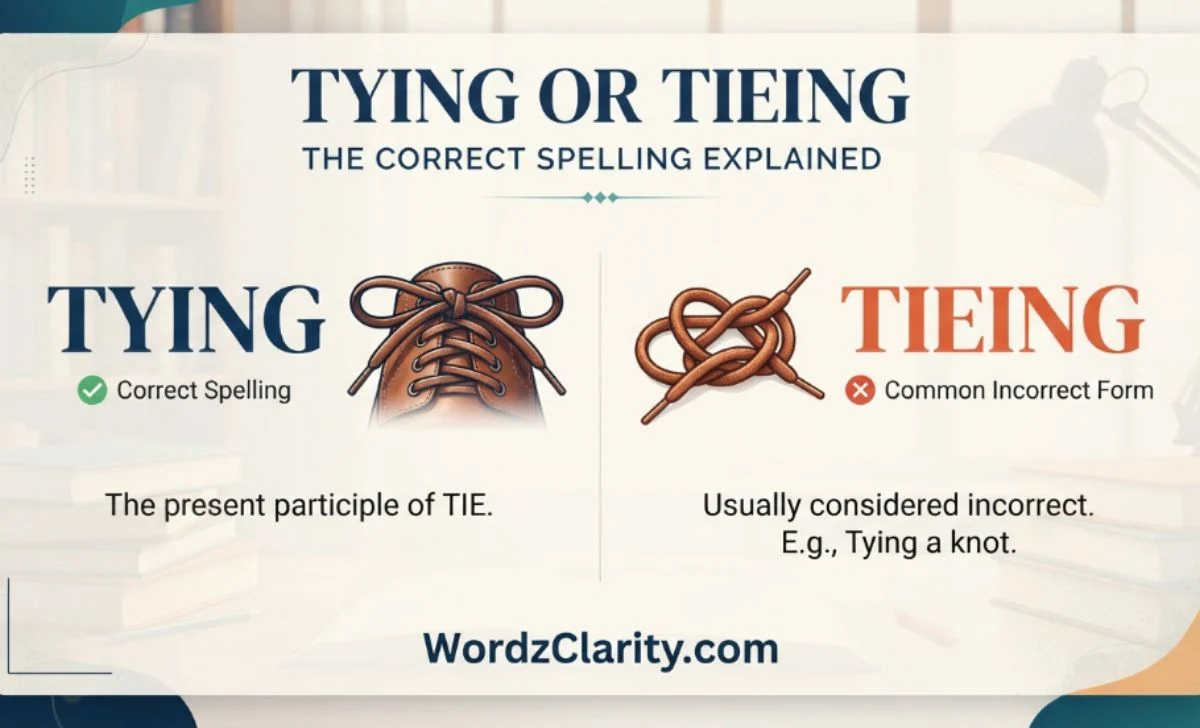
If you are unsure whether tying or tieing is correct, the standard spelling in modern English is tying. It is the present participle of tie and describes actions such as tying shoelaces, making knots, or connecting things.
Cambridge lists tying as the present participle of tie, while Merriam-Webster also records tieing as a variant. This explains why you may occasionally see both forms. However, tying is the form most readers expect in standard contemporary writing.
The confusion comes from English spelling rules. Many verbs simply take -ing, but verbs ending in -ie follow a different pattern. The -ie changes to y before -ing, giving us tying. For everyday, academic, and professional writing, tying is the clear choice.
Tying or Tieing: What Is the Standard Form?
Tying is the standard form used in current English.
For example:
- She is tying her shoes.
- He is tying a knot in the rope.
- They are tying the packages with string.
- We are tying the boat to the dock.
The spelling tieing can also be found in dictionaries as a variant. Merriam-Webster specifically lists tieing alongside tying, but tying is the form most readers will expect to see.
That distinction matters because saying that tieing does not exist at all would be too broad. If your goal is clear, conventional modern writing, however, tying is the better choice.
Quick comparison
| Spelling | Status | Best choice for normal writing |
|---|---|---|
| tying | Standard form | Yes |
| tieing | Recorded variant | Usually avoid |
So if you are writing a school assignment, website article, report, email, or other everyday text, use tying.
Why Is It Spelled “Tying”?
The answer comes from the way English handles verbs that end in -ie.
When tie takes the -ing ending, the final ie changes to y.
The transformation looks like this:
tie + ing → tying
The same pattern appears in other familiar verbs:
- lie → lying
- die → dying
- tie → tying
This is why the expected spelling is not tieing.
It is useful to think of tying as a spelling change rather than simply the word tie with four extra letters added. The base verb changes slightly before the participle ending is attached.
For learners, that small distinction explains most of the confusion around these two spellings.
The Spelling Pattern Behind Tying
English has several spelling rules that affect how a verb changes before a suffix is added. One useful pattern involves verbs ending in -ie.
With common verbs such as tie, lie, and die, the final ie becomes y when -ing is added.
| Base verb | Present participle |
|---|---|
| tie | tying |
| lie | lying |
| die | dying |
Consider the sentences:
Maria is tying her hair back.
The dog is lying beside the door.
The leaves are dying in the heat.
The spelling changes in each case.
This gives you a useful memory pattern:
tie → tying
lie → lying
die → dying
If you remember these together, the correct spelling becomes much easier to recognize.
What Does “Tying” Mean?
Tying is the present participle of tie. The verb has several meanings, but its most familiar sense is to fasten or secure something with a cord, string, rope, ribbon, or similar material. Cambridge gives tying as the present participle and defines tie in this sense as fastening things together or holding them with string or another material.
For example:
- She is tying her shoelaces.
- He is tying the ribbon around the box.
- They are tying the rope to a tree.
- I am tying the package before sending it.
The word can also describe a connection that is not physical.
For example:
The report is tying the new findings to earlier research.
Here, tying means connecting one idea with another.
The spelling does not change when the meaning changes.
Tie, Ties, Tied, and Tying
Looking at the complete verb forms can make the spelling easier to understand.
| Verb form | Example |
|---|---|
| tie | Please tie the rope. |
| ties | She ties her hair every morning. |
| tied | He tied the package securely. |
| tying | She is tying the package now. |
Notice that tying is the only form in this group where the spelling changes from the base word.
The past forms are:
tie → tied
The third-person singular form is:
tie → ties
And the present participle is:
tie → tying
Cambridge lists the verb forms as tying for the present participle and tied for both the past tense and past participle.
This is also why it helps to learn the word as a complete verb rather than memorizing one spelling in isolation.
Why “Tieing” Looks So Natural
The spelling tieing seems logical because English often forms the -ing version of a verb by simply adding the suffix.
For example:
- read → reading
- walk → walking
- talk → talking
- jump → jumping
- clean → cleaning
A writer may therefore apply the same idea to tie:
tie + ing = tieing
That looks reasonable at first sight.
However, English spelling does not work through one single rule for every verb. Some words undergo changes when suffixes are added.
With tie, the familiar modern form is:
tie → tying
The same pattern helps explain:
lie → lying
and
die → dying
Once you recognize this group, tying becomes easier to remember.
Tying or Tieing in Everyday Sentences
The best way to see the difference is to use tying naturally in different situations.
Fastening something
I am tying my shoelaces.
Making a knot
He is tying a knot in the rope.
Securing an object
They are tying the boxes together.
Using a ribbon
She is tying a ribbon around the gift.
Connecting ideas
The researcher is tying the results to previous studies.
Sports
The team is tying the score late in the game.
The verb tie has meanings beyond physically fastening something. It can refer to making an equal score or connecting things conceptually as well. Cambridge includes both the fastening sense and the competition-related sense.
In every case, the present participle is written tying.
Common Mistakes With the Word
The most common error is writing tieing when the intended form is the normal present participle tying.
Here are some examples:
| Less preferred | Standard form |
|---|---|
| She is tieing her shoes. | She is tying her shoes. |
| He is tieing the rope. | He is tying the rope. |
| We are tieing the packages. | We are tying the packages. |
| They were tieing the boat. | They were tying the boat. |
For ordinary modern writing, choosing tying avoids confusion and follows the form most readers and learners expect.
It is also worth remembering that tieing is not simply a nonexistent word. Major dictionary evidence shows that it has been recorded as a variant. Merriam-Webster gives tying first and lists tieing as an alternative pronunciation/spelling form.
That is a more accurate explanation than calling every occurrence of tieing an absolute spelling error.
Tying vs. Tieing: Which Should You Choose?
If you need one clear answer, choose tying.
It is the form used by Cambridge for the present participle of tie, and Merriam-Webster lists it as the main form while recording tieing as a variant.
Use tying when you want your writing to look natural and familiar to a broad English-speaking audience.
For example:
The children are tying balloons to the chairs.
This is the spelling most readers will recognize immediately.
You do not need to use tieing simply because it appears logical from the base word. English spelling sometimes preserves or changes letters in ways that are not obvious from pronunciation alone.
The practical rule is simple:
For standard everyday writing, write “tying.”
A Simple Memory Trick
If you regularly hesitate between the two forms, remember this short sequence:
IE changes to Y before ING.
Then apply it to the verb:
tie → tying
You can reinforce the pattern with:
lie → lying
die → dying
Think of the three words as a small spelling family.
Whenever you start writing tieing, stop and check the ending. The letters ie should become y in the familiar standard form:
tying
This takes less effort than trying to remember the spelling from scratch each time.
What You Should Remember
There are three points worth keeping in mind:
- Tying is the standard and preferred spelling in modern English.
- Tieing is recorded as a variant, so it is too strong to describe it as a word that never exists.
- For normal writing, tying is the clearest and safest choice.
The spelling pattern is:
tie → tying
And the same idea appears in:
lie → lying
die → dying
Once you understand the spelling change, the choice between tying and tieing becomes much easier.
Tying or Tieing in British and American English
One useful point about tying is that there is no major British-versus-American spelling split here.
Unlike words such as colour/color or organise/organize, this is not a case where one spelling belongs to British English and another belongs to American English.
Both varieties commonly use tying.
| Variety | Preferred form |
|---|---|
| British English | tying |
| American English | tying |
| General international English | tying |
So, if you are writing for readers in the UK, US, Canada, Australia, or another English-speaking region, tying is the practical choice.
The difference between tying and tieing is therefore mainly about the spelling form itself, not about regional English.
Tying or Tieing in English
In English, tying is the standard spelling of the present participle of tie. It is used when someone is fastening something, making a connection, or reaching the same score in a competition.
The spelling tieing may also appear because it follows the idea of adding -ing directly to the word tie. However, tying is the form normally used in modern English.
For example:
- She is tying her shoes.
- He is tying a knot.
- The teams are tying the game.
- They are tying the knot next summer.
So, if you are learning English or writing for a general audience, use tying rather than tieing.
Is “Tieing” a Real Word?
This question is slightly more complicated than simply saying yes or no.
Tieing is recorded in some dictionaries as a variant form, but tying is the standard form most writers should use.
That distinction is important.
If someone asks, “Which spelling should I use in an article, essay, email, or report?” the answer is straightforward:
Use tying.
Merriam-Webster records tieing as a variant, while Cambridge uses tying for the present participle of tie.
Therefore, seeing tieing somewhere does not automatically mean the writer invented the word. However, it is not the form most readers expect in contemporary standard writing.
For practical purposes:
- tying = normal and preferred
- tieing = uncommon recorded variant
This explains why different sources may appear to give slightly different answers.
How Is Tying Pronounced?
The spelling can be confusing, but the pronunciation is much simpler.
Tying is pronounced like “tie-ing” as the sounds flow together.
It comes from the verb tie, so the first part retains the sound of tie.
For example:
She is tying her shoes.
The word does not sound like a completely different verb. The spelling change mainly happens in writing.
This is another reason learners may naturally write tieing: they can hear the base word tie followed by the sound associated with -ing.
English spelling, however, does not always represent every part of a word in the most obvious way.
Tying the Knot: A Common Expression
You will often see tying in the expression “tying the knot.”
The phrase traditionally means getting married.
For example:
They are tying the knot next summer.
Here, tying comes from the same verb tie. The expression is figurative rather than a reference to literally making a knot.
You may also encounter the phrase in headlines, invitations, wedding articles, and everyday conversation.
For example:
After several years together, they decided to tie the knot.
If you are writing the expression with the -ing form, the correct spelling remains:
tying the knot
not:
tieing the knot
This is a useful real-world example because the phrase is common enough to make the spelling easier to remember.
Tying Up: Another Common Use
The verb tie also appears in the phrasal verb tie up.
Depending on context, tie up can mean physically securing something or completing something.
For example:
She is tying up the package.
Here, the meaning is literal.
But consider:
I need to tie up a few loose ends before I leave.
In this sentence, the phrase means finishing the remaining tasks.
The -ing form can also appear:
He spent the morning tying up loose ends.
Notice that tying keeps the same spelling even when the verb is part of a phrasal expression.
Tying in Sports and Competitions
Tie has another important meaning: having the same score or result as another competitor.
For example:
The teams are tying at two goals each.
Or:
The players are tying for first place.
In this context, tying does not involve rope, string, or knots. It refers to an equal result.
This broader meaning is useful because it shows that the spelling is connected to the verb itself, not to one particular definition.
Whether tie means fastening something, connecting ideas, or reaching an equal score, its present participle remains:
tying
Tying or Tieing Synonyms
The best synonym for tying depends on what the word means in a sentence. It can describe fastening something, connecting ideas, or reaching an equal score.
When Tying Means Fastening
Use these alternatives when tying means securing something with a rope, string, or similar material:
- fastening — securing something in place
- securing — making something fixed or safe
- binding — holding things together
- wrapping — covering or enclosing something
For example:
She is fastening the package with string.
When Tying Means Connecting
When tying means connecting ideas, events, or information, suitable alternatives include:
- connecting
- linking
- relating
- associating
- joining
For example:
The report is linking the new findings to earlier research.
When Tying Means Having an Equal Score
In sports or competitions, tying can mean reaching the same score or result. Depending on the context, alternatives may include:
- drawing
- equaling
- matching
- leveling
For example:
The team is leveling the score in the final minutes.
There is no single synonym that works in every sentence. Choose the alternative according to the meaning of tying in that context.
Tying Ideas Together
Another common use is figurative.
Writers often use tie to describe a relationship between ideas, events, evidence, or information.
For example:
The conclusion is tying several arguments together.
Or:
The article does a good job of tying the examples to the main point.
Here, tying means connecting related things.
This usage appears frequently in formal and professional English, but the spelling does not change.
The same word can therefore describe a physical action and an abstract connection:
- tying a rope
- tying two ideas together
That flexibility is one reason the word appears in many different types of writing.
Tying vs. Tied: Do Not Mix Them Up
Another common source of confusion is the difference between tying and tied.
They are both forms of tie, but they serve different grammatical purposes.
Tying
Tying is the present participle.
She is tying her shoes.
It can also function as a gerund:
Tying a secure knot takes practice.
Tied
Tied is the past tense and past participle.
He tied the rope yesterday.
The package was tied securely.
A simple way to remember the difference is:
tying = action in progress or gerund
tied = completed action or past form
Using the wrong form can change the grammar of the sentence even when the basic meaning remains clear.
Why Lie Becomes Lying but Tie Becomes Tying
Learners sometimes remember lying but still hesitate over tying.
The reason is that both words follow the same spelling pattern.
Compare:
lie → lying
tie → tying
The final ie changes to y before -ing.
The same pattern appears in:
die → dying
These examples are useful because they provide a familiar reference point.
If you already know that lieing is not the normal spelling of lying, you can apply the same pattern to tie.
That gives you:
tie → tying
Rather than:
tie → tieing
What About “Vying”?
Another word can help explain why this spelling pattern is worth learning: vie → vying.
For example:
Several companies are vying for the contract.
The base verb is vie, and its present participle is vying.
So you can remember a small group:
- tie → tying
- lie → lying
- die → dying
- vie → vying
These words do not all have the same meaning, but they share a useful spelling pattern.
Learning them together can make the rule easier to recall when writing.
Examples You Can Use Correctly
Here are several natural examples showing how tying works in different contexts.
Personal use
I am tying my shoes before the walk.
Home
She is tying the curtains back.
Travel
We are tying the luggage securely.
Outdoor activities
He is tying the rope to the post.
Crafts
The children are tying colorful ribbons together.
Work
The manager is tying the new plan to the company’s goals.
Research
The study is tying the results to earlier findings.
Competition
Both teams are tying for second place.
These examples show that the word works naturally in many settings without changing its spelling.
A Useful Rule for English Learners
If English spelling often causes confusion, it helps to learn patterns rather than memorize every word separately.
For tie, remember:
Base verb: tie
Add -ing: change ie to y
Result: tying
You can then compare it with:
lie → lying
die → dying
vie → vying
This approach is more useful than simply memorizing a list of exceptions.
When you encounter another unfamiliar verb, you can check whether it follows the same pattern rather than assuming that every -ing form is created by direct addition.
Tying or Tieing Quiz
Test your understanding of tying and tieing with these quick questions.
1. Choose the correct spelling
She is ___ her shoes before leaving.
- A. tieing
- B. tying
Answer: B. tying
2. Choose the correct form
The teams are ___ the score late in the game.
- A. tying
- B. tieing
Answer: A. tying
3. Complete the sentence
They are ___ the knot next month.
- A. tieing
- B. tying
Answer: B. tying
4. Which spelling is standard?
- A. tieing
- B. tying
Answer: B. tying
5. What happens to “ie” when “tie” takes “-ing”?
- A. It stays unchanged
- B. It changes to “y”
Answer: B. It changes to “y”
The key pattern to remember is:
tie → tying
The same spelling change appears in lie → lying and die → dying.
FAQs
1. Is tying or tieing correct?
Tying is the standard and preferred spelling for normal modern English. Tieing is also recorded as a less common variant in some dictionary sources.
2. Why does tie become tying?
The final -ie changes to y before the -ing ending:
tie → tying
The same pattern appears in lie → lying and die → dying.
3. Is tieing always wrong?
Not necessarily. Tieing has been recorded as a variant, so calling it completely nonexistent would be inaccurate. However, tying is the standard choice for ordinary contemporary writing.
4. Do Americans spell it tying?
Yes. Tying is the normal spelling in American English.
5. Do British writers use tying too?
Yes. British English also uses tying. There is no major UK/US spelling difference for this word.
6. Is tying a verb?
Yes. It is the present participle of the verb tie. It can also function as a gerund, depending on how it is used in a sentence.
7. What is the past tense of tie?
The past tense is tied.
For example:
She tied the rope to the fence.
8. What is the easiest way to remember tying?
Remember this pattern:
IE → Y before -ING
So:
tie → tying
You can reinforce it with:
lie → lying
die → dying
Final Answer:
If you need to choose one spelling, choose tying.It is the standard form used for the present participle of tie, and it is the spelling readers are most likely to expect in contemporary English. Although tieing has been recorded as a variant, it is much less common and is not the form most writers should choose when aiming for clear, conventional English.
The spelling becomes easier once you remember the pattern:
tie → tying
The final -ie changes to y before -ing. The same pattern appears in lie → lying, die → dying, and vie → vying.
So whether you are writing about tying shoelaces, tying a knot, tying ideas together, or tying a score, tying is the practical spelling to use.
Read More Blogs:
- Milwaukee or Makita: Which Brand Is Better for Your Tools?
- Weren’t or Wasn’t: How to Choose the Correct Form
- Boxers or Trunks: Which Underwear Style Is Better for You?
- Skill Set or Skillset: Which Spelling Is Correct?
- Photoshoot or Photo Shoot: Which Spelling Is Correct?