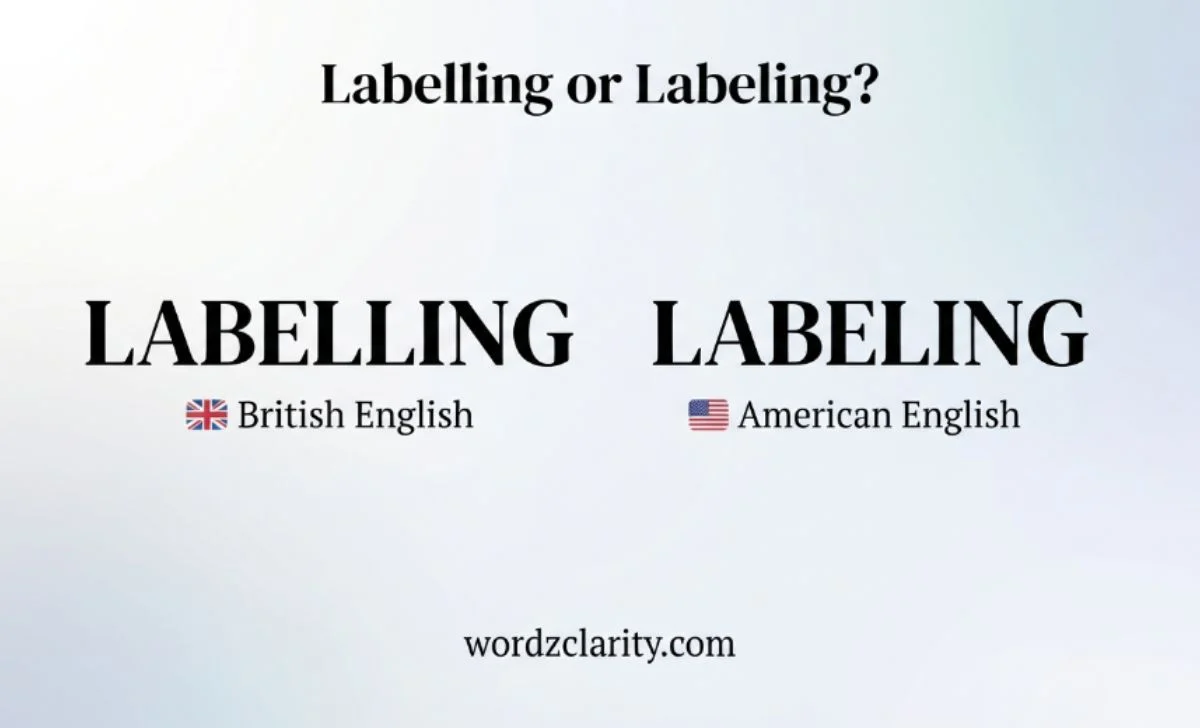
If you are unsure whether to write labelling or labeling, the good news is that both spellings are correct. The difference is based on the variety of English you are using.
Labelling is the standard spelling in British English, while labeling is the standard spelling in American English. Both forms come from the verb label, which means to attach a label to something or to describe or classify someone or something.
The confusion usually comes from the extra l. When a word ends in a consonant and is followed by -ing, British and American English sometimes use different spelling rules. In this case, British English commonly doubles the final l, giving us labelling, while American English usually keeps one l, giving us labeling.
Quick Answer: Labelling or Labeling
Both labelling and labeling are correct.
The choice depends on the English variety:
| Spelling | Main English variety | Example |
|---|---|---|
| Labelling | British English | The company is labelling the boxes. |
| Labeling | American English | The company is labeling the boxes. |
The meaning is exactly the same.
For example:
British English:
The factory is labelling each package.
American English:
The factory is labeling each package.
Both sentences mean that the factory is putting labels on the packages.
The same regional difference appears in the past tense and past participle:
- British: labelled
- American: labeled
It also appears in related forms:
- British: labelling
- American: labeling
So the easiest answer is:
Use “labelling” in British English and “labeling” in American English.
What Does Labelling or Labeling Mean?
Labelling and labeling are forms of the verb label.
To label something can mean to put a physical label on it.
For example:
The staff are labelling the boxes before shipping them.
Here, the workers are attaching labels to the boxes.
The word can also have a more general meaning. To label someone or something can mean to describe or classify them in a particular way.
For example:
It is unfair to label someone as lazy without knowing their situation.
In this meaning, no physical label is involved. The word refers to assigning a description or category to someone.
The two spellings have the same meanings:
- labelling = British English
- labeling = American English
There is no difference in definition.
Why Is It Labelling in British English but Labeling in American English?
The difference comes from spelling conventions used in British and American English.
The verb label ends in a single l. When the suffix -ing is added, British English commonly doubles the final l:
label + ing → labelling
American English generally does not double the final l in this word:
label + ing → labeling
This difference is part of a wider pattern involving final consonants.
Compare:
| British English | American English |
|---|---|
| labelling | labeling |
| labelled | labeled |
| travelling | traveling |
| travelled | traveled |
| cancelling | canceling |
| cancelled | canceled |
However, spelling rules are not completely identical across all words. For example, both British and American English use beginning, running, and stopping.
So it is better to learn the common patterns rather than assume that every word ending in l must follow exactly the same rule.
Labelling in British English
Labelling is the usual British English spelling.
It is commonly found in writing from the United Kingdom and in other contexts that follow British spelling conventions.
Examples include:
- product labelling
- food labelling
- package labelling
- warning labelling
- chemical labelling
- data labelling
- classroom labelling
Examples in sentences
The company is labelling its new products.
Proper labelling is important for food safety.
The teacher is labelling each diagram.
Staff are labelling the boxes before delivery.
The researchers are labelling the samples carefully.
In all of these examples, labelling follows British spelling.
Labeling in American English
Labeling is the standard American English spelling.
It is commonly used in the United States in business, education, science, technology, packaging, and everyday writing.
Examples
The company is labeling its new products.
Proper labeling is important for food safety.
The teacher is labeling each diagram.
Staff are labeling the boxes before delivery.
The researchers are labeling the samples carefully.
The meaning is identical to the British examples. Only the spelling changes.
A Side-by-Side Comparison:
| Feature | Labelling | Labeling |
|---|---|---|
| Main variety | British English | American English |
| Base verb | label | label |
| Present participle | labelling | labeling |
| Past tense | labelled | labeled |
| Meaning | Same | Same |
| Pronunciation | Essentially the same | Essentially the same |
| Correct spelling? | Yes | Yes |
| Common in UK writing | Yes | Less common |
| Common in US writing | Less common | Yes |
This makes the difference easy to remember:
British: labelling
American: labeling
What About Labelled and Labeled?
The same spelling difference appears in the past tense and past participle.
British English uses:
labelled
American English uses:
labeled
British examples
The box was labelled as fragile.
The teacher labelled the diagram.
The samples were clearly labelled.
American examples
The box was labeled as fragile.
The teacher labeled the diagram.
The samples were clearly labeled.
Again, both forms are correct within their respective spelling systems.
If your article uses British English, do not write labelling in one paragraph and labeled in another unless there is a specific reason.
A consistent British version would use:
labelling, labelled
A consistent American version would use:
labeling, labeled
Why Does the Extra “L” Matter?
The extra l is easy to miss because the pronunciation does not change.
Look at these forms:
label → labelling
and
label → labeling
The spelling difference is small, but it can reveal which English variety the writer is following.
This is similar to other British and American spelling differences:
- travelling / traveling
- cancelling / canceling
- modelling / modeling
- signalling / signaling
- labelled / labeled
However, there are important exceptions and style differences, so these pairs should not be treated as one universal rule for every English word.
The safest approach is to check the standard spelling used in the English variety you are writing.
Which Spelling Should You Use?
Your audience should determine your choice.
Use “labelling” for British English
Choose labelling when your writing follows British English conventions.
For example:
The new rules require clearer product labelling.
This is appropriate for a UK-focused document.
Use “labeling” for American English
Choose labeling when your writing follows American English conventions.
For example:
The new rules require clearer product labeling.
This is the standard American form.
What if your audience is international?
If you write for an international audience, choose one spelling system and use it consistently.
For example, if your website follows British English, use:
- labelling
- labelled
- travelling
- cancelled
- colour
If it follows American English, use:
- labeling
- labeled
- traveling
- canceled
- color
Consistency is more important than trying to use both spellings.
Labelling or Labeling in Business Writing
The word is common in business because companies label products, packages, documents, files, and data.
British English
The new product labelling requirements will take effect next month.
Employees are responsible for labelling all packages correctly.
Clear labelling helps customers identify the product.
American English
The new product labeling requirements will take effect next month.
Employees are responsible for labeling all packages correctly.
Clear labeling helps customers identify the product.
Both versions are professional.
The choice should follow the regional English used by the company or publication.
Labelling or Labeling in Academic Writing
Both forms can appear in academic writing.
For example, a British academic paper might say:
The study examines the effects of political labelling on public opinion.
An American paper might say:
The study examines the effects of political labeling on public opinion.
The same applies to science and research:
British:
The researchers began labelling the samples before testing.
American:
The researchers began labeling the samples before testing.
If you are submitting academic work, always follow the spelling convention required by your university, professor, journal, or style guide.
Labelling or Labeling in Science and Technology
The word is also common in scientific and technical writing.
Researchers may label:
- samples
- diagrams
- cells
- data
- images
- variables
- files
- experimental groups
For example:
British English
The researchers are labelling each sample with a unique code.
American English
The researchers are labeling each sample with a unique code.
In machine learning and data science, data labeling is a common American English expression. British English sources may use data labelling.
The concept remains the same.
Labelling or Labeling in Product Packaging
Product packaging is another area where the word appears frequently.
You might read:
- product labelling
- food labelling
- package labelling
- nutritional labelling
or, in American English:
- product labeling
- food labeling
- package labeling
- nutritional labeling
For example:
British:
Accurate food labelling helps consumers make informed choices.
American:
Accurate food labeling helps consumers make informed choices.
The spelling should match the regional style of the document.
Labelling or Labeling in Emails
The word can appear naturally in professional emails.
British English
We have finished labelling the documents and will send them this afternoon.
American English
We have finished labeling the documents and will send them this afternoon.
Another example:
British:
Please make sure all files are correctly labelled.
American:
Please make sure all files are correctly labeled.
If your workplace uses a specific English style, follow it throughout your emails and other documents.
Labelling or Labeling in Everyday Conversation
The word is also used in ordinary conversations.
For example:
Why are you labelling everything?
British English:
Why are you labelling everything?
American English:
Why are you labeling everything?
Or:
The boxes need to be labelled.
British:
The boxes need to be labelled.
American:
The boxes need to be labeled.
The pronunciation is essentially the same, so people normally notice the difference only when the word is written.
Common Mistakes With Labelling and Labeling
The most common errors happen when writers mix spelling systems.
Mistake 1: Thinking “labelling” is wrong
It is not.
Labelling is the standard British spelling.
Mistake 2: Thinking “labeling” is wrong
It is also not wrong.
Labeling is the standard American spelling.
Mistake 3: Mixing labelled and labeled
A document that uses both forms without a reason can look inconsistent.
For example:
We are labeling the products, but all products must be labelled before shipping.
If the document follows American English, a consistent version would be:
We are labeling the products, but all products must be labeled before shipping.
If it follows British English:
We are labelling the products, but all products must be labelled before shipping.
Mistake 4: Applying the rule to every word
Do not assume that every British word ending in -lling becomes -ling in American English or that every American spelling needs an extra l in British English.
English spelling has exceptions and word-specific patterns.
It is better to learn common pairs and check uncertain words.
Labelling or Labeling: Which One Is More Common?
Neither spelling is universally more common because the answer depends on the English-speaking region.
Labeling is more common in American English because it follows the standard US spelling.
Labelling is more common in British English because it follows the standard UK spelling.
Online content can make this seem confusing because websites are read globally. A British website may use labelling, while an American website may use labeling, even when both are discussing exactly the same subject.
Therefore, frequency alone does not tell you which spelling is correct for your writing.
The better question is:
Which regional English standard does my audience expect?
A Simple Way to Remember the Difference
There is an easy memory trick.
Think of the two forms as:
British English = labelling
American English = labeling
The British form keeps the extra l.
You can connect it with similar spelling pairs:
| British | American |
|---|---|
| labelling | labeling |
| labelled | labeled |
| travelling | traveling |
| travelled | traveled |
| cancelling | canceling |
| cancelled | canceled |
| modelling | modeling |
| signalling | signaling |
This pattern can help, but remember that spelling conventions are not perfectly predictable.
If you are writing for a particular publication or organization, its style guide should always take priority.
How to Keep Your Writing Consistent
If you write articles, reports, emails, or website content regularly, consistency is important.
Follow these steps:
1. Choose your English variety
Decide whether your document follows British or American English.
2. Check related spellings
If you use labelling, check words such as labelled and labelling. If you use labeling, use labeled consistently.
3. Watch for other regional differences
Look for words such as:
- colour/color
- favour/favor
- behaviour/behavior
- travelling/traveling
- cancelled/canceled
4. Follow your organization’s style
A company, university, newspaper, or publisher may have its own preferred style.
5. Proofread before publishing
A simple search for both spellings can quickly reveal accidental inconsistencies.
This is especially useful for long documents.
Labelling or Labeling: Practical Comparison
| Context | British English | American English |
|---|---|---|
| Present participle | labelling | labeling |
| Past tense | labelled | labeled |
| Package | labelling packages | labeling packages |
| Product information | product labelling | product labeling |
| Food information | food labelling | food labeling |
| Data | data labelling | data labeling |
| Diagram | labelling a diagram | labeling a diagram |
| Sample | labelling a sample | labeling a sample |
| Document | labelling a document | labeling a document |
The meaning remains unchanged throughout.
Is “Labelling” More Correct Than “Labeling”?
Labelling is more appropriate in British English, but it is not more correct worldwide.
Likewise, labeling is the standard American form, but that does not make it the only correct spelling.
English has multiple accepted regional standards.
For example:
- British: labelling
- American: labeling
A British editor would normally expect labelling, while an American editor would normally expect labeling.
Neither editor is using an inferior form of English. They are following different spelling conventions.
Can You Use Labelling and Labeling in the Same Article?
Usually, you should not.
If your article is written in British English, use labelling consistently.
If your article is written in American English, use labeling consistently.
There are exceptions. For example, you may deliberately mention both spellings when writing an article about the difference between them. You might also preserve the original spelling in a direct quotation.
Outside those situations, switching between the forms can make your writing look careless.
FAQs
1. Is labelling or labeling correct?
Both are correct. Labelling is the standard British English spelling, while labeling is the standard American English spelling.
2. Is labeling American spelling?
Yes. Labeling is the standard spelling used in American English.
3. Is labelling British spelling?
Yes. Labelling is the standard British English spelling.
4. Is labelled or labeled correct?
Both are correct. British English generally uses labelled, while American English uses labeled.
5. Why does British English have two l’s in labelling?
British English commonly doubles the final l when forming this word, giving labelling. American English normally uses labeling.
6. Which spelling should I use in a US essay?
Use labeling if your essay follows American English. If your school or institution has a specific style guide, follow its requirements.
7. Which spelling should I use for a UK audience?
Use labelling for a UK audience when following standard British English spelling.
Final Verdict:
So, labelling or labeling , which spelling should you use?
The answer depends on the English variety you are following. Labelling is the standard British English spelling, while labeling is the standard American English spelling. Both forms are correct, and both have exactly the same meaning.
The difference comes from regional spelling conventions. British English commonly doubles the final l in this form, producing labelling. American English generally keeps one l, producing labeling.
The same distinction appears in the past tense: British English uses labelled, while American English uses labeled.
For professional writing, academic work, websites, emails, and business documents, the most important rule is consistency. Choose the spelling that matches your audience, organization, or style guide, and use that form throughout your document.
In short: use “labelling” in British English and “labeling” in American English. Neither is a misspelling.
Read More Blogs:
Quite vs Quiet: Definitions, Examples, and Grammar Rules
Truely or Truly: A Simple Guide to the Correct Spelling