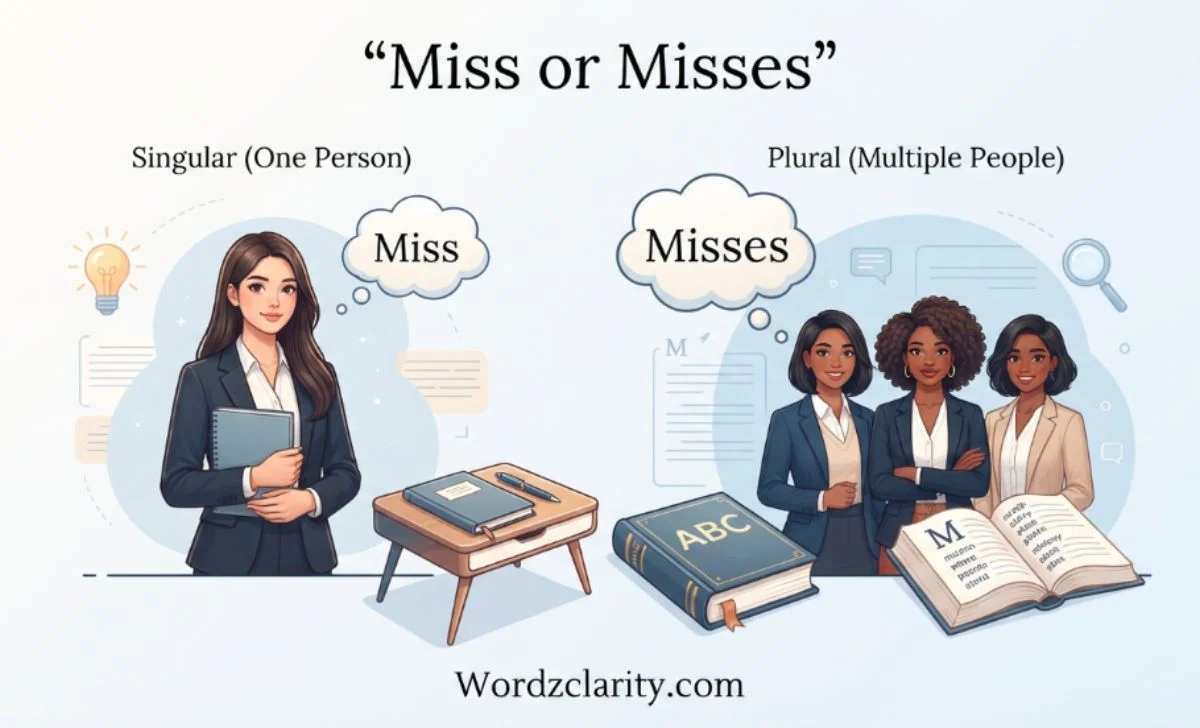
Miss and misses come from the same English verb, but they do not always work in the same sentence. The choice depends mainly on the subject and the grammar of the sentence. For example, we write, “I miss my family,” but “Sarah misses her family.” This small change is a common part of English grammar.
There is also another use of Miss that can cause confusion. As a title, Miss can appear before a woman’s name, such as Miss Carter. In addition, Ms. and Mrs. are common titles with different uses. The word misses can also sound similar to Mrs. in everyday speech, even though the two forms are completely different in writing.
This guide explains miss or misses in simple English. You will learn the difference between the two verb forms, how to use them in questions and negative sentences, and why miss becomes misses. You will also see how Miss, Ms., and Mrs. differ, with practical examples for everyday, academic, and professional writing.
Quick Answer
Use miss with I, you, we, and they in the present simple.
Use misses with a singular third-person subject in the present simple. This includes a person’s name or a singular noun.
| Subject | Correct form | Example |
|---|---|---|
| I | miss | I miss my family. |
| You | miss | You miss your friends. |
| We | miss | We miss our teacher. |
| They | miss | They miss the old days. |
| He | misses | He misses his family. |
| She | misses | She misses her friends. |
| It | misses | The arrow misses the target. |
| Sarah | misses | Sarah misses her hometown. |
There is one more important point. Miss can also be a title before a woman’s name:
Miss Taylor is our new teacher.
So, when choosing between miss and misses as a verb, check the subject first.
What Does Miss Mean?
The verb miss has several common meanings. It can mean feeling the absence of someone, failing to catch something, failing to attend an event, or failing to hit or reach a target.
For example:
I miss my parents.
We do not want to miss the bus.
I do not want to miss the meeting.
The player missed the target.
The exact meaning depends on the context.
Miss Can Mean Feel Someone’s Absence
One common use of miss is to feel that someone or something is absent.
For example:
I miss my sister.
We miss our old friends.
They miss their hometown.
In these sentences, miss means to feel sadness because a person, place, or time is no longer present.
Miss Can Mean Fail to Catch Something
We can also use miss when someone fails to catch a bus, train, flight, or another form of transport.
I missed the bus this morning.
We do not want to miss the train.
The passengers almost missed their flight.
In these examples, miss is the base form, while missed is the past form.
Miss Can Mean Fail to Attend Something
Another common meaning is to fail to attend an event, class, meeting, or activity.
I missed the meeting yesterday.
We cannot miss the final presentation.
The student does not want to miss class.
The meaning here is different from feeling someone’s absence. Still, the same verb miss is used.
Miss Can Mean Fail to Hit Something
The verb can also describe something that fails to hit its target.
The ball missed the goal.
The arrow missed the target.
The shot misses the center of the target.
Thus, miss can describe people, transport, events, targets, and many other situations.
What Does Misses Mean?
Misses is the third-person singular present form of miss.
In simple terms, use misses when one person, animal, thing, or named subject performs the action in the present simple.
Examples include:
Sarah misses her family.
The student misses an important detail.
The player misses the target.
The report misses a key point.
The company misses its sales target.
Although miss and misses look different, they are forms of the same verb.
The main pattern is:
I miss.
We miss.
They miss.
Sarah misses.
The company misses.
This pattern is similar to many other English verbs.
I work → The team works
We play → The child plays
They need → The customer needs
I miss → Sarah misses
Why Does Miss Become Misses?
The spelling changes because of the way English forms the third-person singular present tense.
The verb miss ends in ss. For this type of verb, English normally adds -es.
So:
miss → misses
The same pattern appears in words such as:
- kiss → kisses
- pass → passes
- dress → dresses
- guess → guesses
- miss → misses
Therefore, misses is the correct form after a singular third-person subject in the present simple.
For example:
The child misses the bus.
Not:
The child miss the bus.
When Should You Use Miss?
Use miss with I, you, we, and they in the present simple.
For example:
I miss my hometown.
You miss the main point.
We miss our old teacher.
They miss their friends.
However, miss can also follow a helping or modal verb.
For example:
The passenger might miss the train.
We could miss the deadline.
They will miss the meeting.
The team may miss the target.
In these sentences, the main verb stays in its base form. So we use miss, not misses.
When Should You Use Misses?
Use misses when a singular third-person subject takes the present simple form.
Common examples include:
The student misses an important detail.
Maria misses her family.
The player misses the target.
The bus driver misses the turn.
The company misses its monthly goal.
A simple test can help. Replace the subject with he, she, or it in your mind. If the sentence needs misses, the original singular subject also needs misses.
For example:
Daniel misses his hometown.
Daniel is one person, so the sentence follows the same pattern as:
He misses his hometown.
Miss or Misses in Questions
Questions often cause mistakes because do and does change the verb structure.
After do or does, use the base form miss.
Correct:
Do you miss your old school?
Does the student miss the bus?
Do they miss living there?
Does Maria miss her hometown?
Incorrect:
Does Maria misses her hometown?
The reason is simple: does already shows the third-person singular form. As a result, the main verb returns to its base form.
The same rule works in negative sentences.
She does not miss the old routine.
The student does not miss class often.
The company does not miss important deadlines.
Not:
The company does not misses important deadlines.
Miss or Misses After Modal Verbs
Modal verbs also take the base form of the main verb.
Common modal verbs include:
- can
- could
- may
- might
- should
- will
- would
- must
Therefore, write:
She might miss the train.
The team could miss the deadline.
We should not miss this opportunity.
The driver may miss the exit.
Do not write:
She might misses the train.
The modal verb already controls the grammar, so miss remains unchanged.
Miss or Misses in Common Sentences
The following examples show the difference in everyday English.
| Sentence | Correct form | Reason |
|---|---|---|
| I miss my family. | miss | I takes the base form. |
| We miss our friends. | miss | We takes the base form. |
| They miss the bus. | miss | They takes the base form. |
| Sarah misses her family. | misses | Sarah is singular. |
| The child misses the train. | misses | The child is singular. |
| Does Sarah miss you? | miss | Does takes the third-person marking. |
| Sarah might miss the train. | miss | Might takes the base verb. |
This table gives you the main rule at a glance.
Miss as a Title
Miss can also be a title placed before a woman’s name.
For example:
Miss Carter is my English teacher.
I spoke with Miss Brown yesterday.
Miss Johnson will lead the class.
Traditionally, Miss has been used for an unmarried woman or girl. However, title preferences can vary. In modern English, it is better to use the title a person prefers rather than make assumptions.
When Miss is used as a title, it starts with a capital letter.
Miss Taylor
Miss Wilson
Miss Sarah Jones
This use is different from the verb miss.
Compare:
I miss Sarah.
Miss Sarah is our teacher.
In the first sentence, miss is a verb. In the second, Miss is part of a title.
Miss vs. Ms. vs. Mrs.
Miss, Ms., and Mrs. are common titles for women. However, they have different traditional uses.
| Title | Common use |
|---|---|
| Miss | Traditionally used for an unmarried woman or girl |
| Ms. | Used without showing marital status |
| Mrs. | Traditionally used for a married woman |
Miss
Miss is traditionally used for an unmarried woman or girl.
Miss Adams teaches English.
Ms.
Ms. does not show whether a woman is married.
Ms. Adams manages the department.
It is often a good choice in professional writing when a person’s preferred title is not known.
Mrs.
Mrs. is traditionally used for a married woman.
Mrs. Adams lives next door.
In modern English, people may choose the title they prefer. When possible, use the title a person uses for themselves.
Today, however, title choice can depend on personal preference. When possible, use the form a person uses for themselves.
Miss vs. Ms.
The main difference is whether marital status is traditionally part of the title.
Miss has traditionally been linked with an unmarried woman.
Ms. does not show marital status.
For example:
Miss Davis teaches English.
Ms. Davis manages the department.
In a professional setting, Ms. is often a practical choice when the preferred title is unknown.
Miss vs. Mrs.
Traditionally, the difference is:
Miss → unmarried woman
Mrs. → married woman
For example:
Miss Wilson is the new teacher.
Mrs. Wilson is the school principal.
However, modern professional writing does not require a writer to guess someone’s marital status. For that reason, Ms. is often used when marital status is not relevant.
Misses vs. Mrs.
Misses and Mrs. can sound similar in many varieties of English. However, they are different in both spelling and grammar.
Compare:
The student misses the bus.
Mrs. Brown teaches English.
The first sentence uses misses as a verb. The second uses Mrs. as a title.
As a result, context is important when listening to these words. In writing, their different spellings make the meaning clear.
How to Pronounce Miss, Misses, Mrs., and Ms.
These forms have different pronunciations.
| Word | Common pronunciation | Function |
|---|---|---|
| miss | /mɪs/ | Verb or title |
| misses | /ˈmɪsɪz/ | Verb |
| Mrs. | /ˈmɪsɪz/ | Title |
| Ms. | /mɪz/ | Title |
For example:
I miss you.
Sarah misses you.
Miss has one syllable, while misses has two.
Because misses and Mrs. can have similar pronunciations, learners sometimes confuse them. The spelling and sentence context show which word is meant.
Does Miss Take a Period?
The title Miss is normally written without a period.
Correct:
Miss Brown
Not:
Miss. Brown
However, punctuation for other titles can vary by style and region.
For example, American English commonly uses Mrs., while British English often writes Mrs without a period.
Therefore, always follow the style used by your publication, school, workplace, or audience.
British vs. American English
The basic grammar of miss and misses is the same in British and American English.
Both varieties use:
I miss you.
She misses you.
Does the student miss the class?
The main difference is more likely to appear in punctuation for titles.
| Title | American English | British English |
|---|---|---|
| Miss | Miss | Miss |
| Mrs. | Mrs. | Mrs |
| Ms. | Ms. | Ms |
| Mr. | Mr. | Mr |
Different style guides may use different punctuation rules. The best approach is to choose one style and use it consistently.
Miss or Misses in Emails
The same grammar rule applies in emails.
Use miss when the subject is I, you, we, or they:
I miss working with the team.
We do not want to miss the deadline.
Use misses when a singular subject takes the present simple form:
The client misses the deadline regularly.
The system misses some important details.
When addressing someone, the word may instead be a title:
Dear Ms. Carter,
Dear Miss Carter,
For professional messages, Ms. is often a neutral option when the person’s preferred title is unknown.
Miss or Misses in Academic Writing
Academic writing follows the same grammar rules as everyday English.
For example:
The study misses an important factor.
Researchers should not miss this distinction.
The article misses several key sources.
Students sometimes miss important details.
Formal writing does not change the subject-verb rule. Therefore, do not use misses simply because the sentence sounds academic.
Miss or Misses in Business Writing
Business writing also follows the same pattern.
We cannot miss the deadline.
The company misses its quarterly target.
Our team does not want to miss the opportunity.
The supplier misses several delivery dates.
The level of formality does not decide between miss and misses. Instead, the subject and sentence structure decide.
Miss or Misses in Conversation and Social Media
Both forms appear often in casual English.
I miss you.
She misses you too.
We miss hanging out together.
My brother misses his old friends.
Social media may contain informal grammar, but standard English still follows the same subject-verb pattern.
For example:
We miss you!
is standard, while:
She miss you!
should be:
She misses you!
Common Mistakes With Miss and Misses
“I Misses You”
Incorrect:
I misses you.
Correct:
I miss you.
The subject I takes the base form.
“She Miss Her Family”
Incorrect:
She miss her family.
Correct:
She misses her family.
The singular subject requires misses in the present simple.
“They Misses the Train”
Incorrect:
They misses the train.
Correct:
They miss the train.
The subject they takes miss, not misses.
“Does She Misses You?”
Incorrect:
Does she misses you?
Correct:
Does she miss you?
After does, use the base form miss.
“She Might Misses the Bus”
Incorrect:
She might misses the bus.
Correct:
She might miss the bus.
After might, the main verb stays in its base form.
Confusing Misses With Mrs.
Do not use misses as another spelling of Mrs.
The child misses the bus.
Here, misses is a verb.
Mrs. Brown teaches English.
Here, Mrs. is a title.
Although the words can sound similar, their meanings are not the same.
A Simple Way to Remember Miss or Misses
Use these three checks whenever you are unsure.
1. Check the subject
If the subject is I, you, we, or they, use miss.
We miss our friends.
If the subject is one person, one thing, or a singular name, use misses in the present simple.
Emma misses her family.
2. Look for a helping verb
After do, does, did, can, could, may, might, should, will, and similar verbs, use miss.
Does Emma miss her family?
Emma might miss the train.
3. Check whether “Miss” is a title
When Miss appears before a person’s name, it may be a title.
Miss Brown
This is different from the lowercase verb miss.
Miss or Misses: Quick Comparison
| Feature | Miss | Misses |
|---|---|---|
| Base verb | Yes | No |
| Present simple with I | Yes | No |
| Present simple with you | Yes | No |
| Present simple with we | Yes | No |
| Present simple with they | Yes | No |
| Present simple with singular subject | No | Yes |
| Used after does | Yes | No |
| Used after might | Yes | No |
| Can be a title | Yes, Miss | No |
The main pattern is easy to remember:
I miss.
We miss.
They miss.
Sarah misses.
The company misses.
FAQs
Is “misses” a correct word?
Yes. Misses is a standard English word. It is commonly used as the third-person singular present form of miss.
The child misses the bus.
What is the difference between miss and misses?
Miss is the base form of the verb. Misses is normally used with a singular third-person subject in the present simple.
I miss you.
Maria misses you.
Should I write “I miss” or “I misses”?
Write I miss.
I miss my friends.
The subject I takes the base form miss.
Should I write “she miss” or “she misses”?
Write she misses.
She misses her parents.
The subject is singular, so the present simple form is misses.
Is “misses” the same as “Mrs.”?
No. Misses is normally a verb form, while Mrs. is a title traditionally used for a married woman. The two can sound similar, but they have different spellings and meanings.
Should I use Miss or Ms.?
Traditionally, Miss is associated with an unmarried woman, while Ms. does not show marital status. In professional writing, Ms. is often a neutral option when the preferred title is unknown.
Does “Miss” have a period?
Normally, no. Write Miss Brown, not Miss. Brown. Punctuation for other titles can vary between American and British English.
Conclusion
The difference between miss or misses is mainly a grammar question. Use miss with I, you, we, and they in the present simple. Use misses with a singular third-person subject, such as a person’s name or a singular noun. For example, “I miss my friends” and “Sarah misses her friends” are both correct.
The form also changes when another verb comes before it. After does, can, might, will, and other helping or modal verbs, use miss rather than misses. For instance, “Does Sarah miss the city?” is correct, while “Does Sarah misses the city?” is not.
Finally, remember that Miss can also be a title. In that use, it is capitalized and appears before a name. It is different from Ms. and Mrs., which have their own traditional uses. Once you check the subject, the helping verb, and the context, choosing between miss and misses becomes much easier.
Read More Blogs
- Canvas vs. Canvass: A Clear Guide to Their Meanings
- Censored vs. Sensored: How to Tell These Words Apart
- Complaint or Complain: Which Word Should You Use?
- Versus or Verses: How to Tell the Difference and Use Correctly