Have you ever typed a sentence like “I want too go” and suddenly wondered whether to or too is correct? These two tiny words cause a surprisingly large number of mistakes. They sound alike in most varieties of English, but they have completely different jobs in a sentence.
The good news is that the difference between to and too is much easier to understand than it first appears. To is commonly used as a preposition or as part of an infinitive verb.
Too is an adverb that usually means “also” or “more than necessary.” Once you understand these basic roles, choosing the correct word becomes much more natural.
This guide explains to or too with clear rules, examples, common phrases, and practical tips. You will learn how to use each word in everyday conversations, emails, academic writing, business communication, websites, and social media.
You will also see why phrases such as “I need to,” “you too,” “too late,” and “I love you too” use different forms.
Quick Answer
Use to when you are talking about direction, a recipient, a relationship, purpose, or an infinitive verb.
I am going to school.
I want to learn English.
Give the letter to Sarah.
Use too when you mean “also” or “more than necessary.”
I want to come too.
Here, too means “also.”
This bag is too expensive.
Here, too means “more than is acceptable or wanted.”
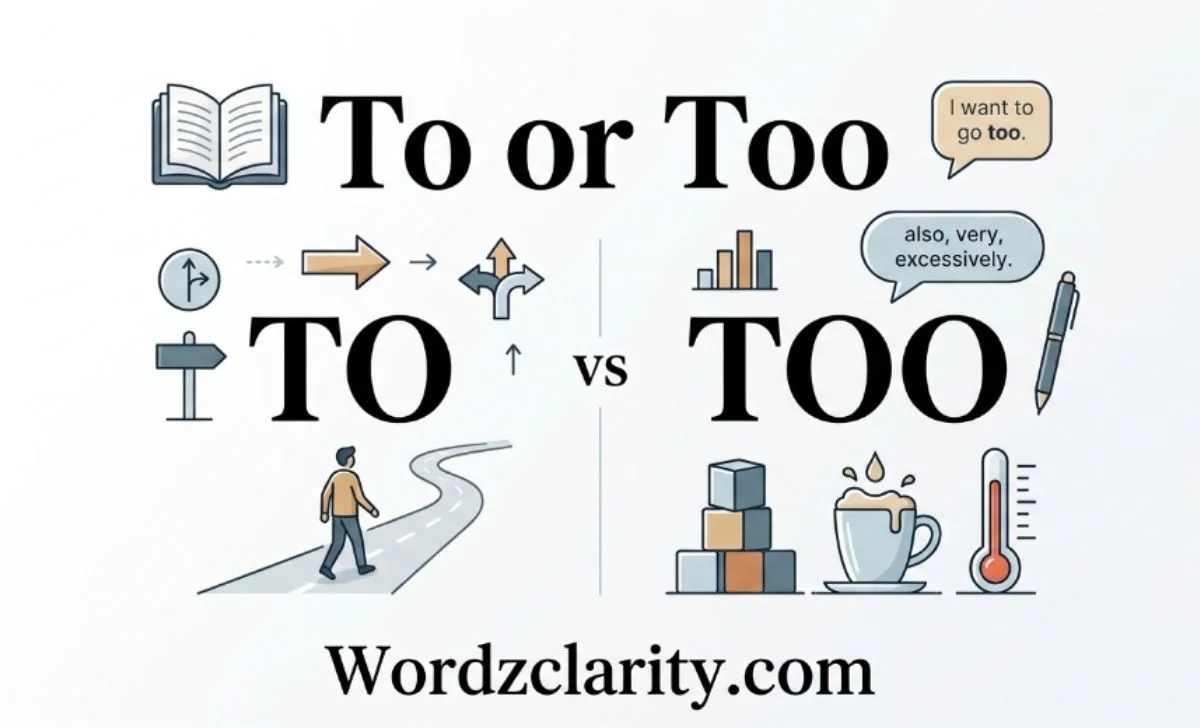
The easiest rule
To = direction, connection, or infinitive
Too = also or excessively
There is also a useful memory trick: too has an extra “o.” Think of that extra letter as something extra.
What Does “To” Mean?
To is one of the most frequently used words in English. It has several grammatical functions, but two are especially important.
It can work as a preposition, or it can mark an infinitive verb.
To as a Preposition
As a preposition, to can show movement, direction, connection, or a recipient.
Examples:
We drove to the airport.
She walked to the store.
Please send the email to me.
He spoke to his manager.
I gave the book to my brother.
They moved to London.
In these examples, to connects one part of the sentence to another.
To Before a Verb
To is also used before the base form of a verb to create an infinitive.
Examples:
I want to study.
She needs to leave.
We plan to travel.
He hopes to win.
They decided to wait.
This pattern is extremely common:
to + base verb
For example:
- to go
- to see
- to learn
- to write
- to work
- to help
- to understand
- to improve
So if you are writing “I need ___ finish this,” the correct choice is to:
I need to finish this.
Not:
I need too finish this.
What Does “Too” Mean?
Too is an adverb with two main meanings.
The first is “also” or “as well.”
The second is “more than necessary, wanted, or suitable.”
Too Meaning “Also”
When too means “also,” it adds another person, thing, or situation.
Examples:
I like coffee too.
She is coming too.
I want one too.
He speaks Spanish too.
You can join us too.
In many sentences, too appears near the end.
Compare:
I like this book too.
This means:
I also like this book.
Too Meaning “Excessively”
Too can also describe something that goes beyond a suitable or desired level.
Examples:
The coffee is too hot.
This box is too heavy.
It is too late.
The room is too small.
The movie was too long.
That car is too expensive.
Here, too means more than necessary or acceptable.
This use commonly appears before adjectives and adverbs.
To vs. Too: The Main Difference
The simplest way to compare the words is to look at their grammatical roles.
| Word | Main function | Meaning | Example |
|---|---|---|---|
| To | Preposition / infinitive marker | Direction, connection, or action | I want to go. |
| Too | Adverb | Also / excessively | I want to go too. |
| Too | Adverb | More than necessary | It is too expensive. |
Consider these two sentences:
I want to go.
Here, to introduces the verb go.
I want to go too.
Here, too means also.
Both words can appear in the same sentence:
I want to go too.
This is one of the easiest ways to see why they cannot simply be treated as interchangeable spellings.
To or Too Examples
Examples are one of the best ways to learn the difference.
Examples With “To”
I need to finish my work.
She went to the office.
He wants to become a teacher.
Please give this to John.
We listened to the speaker.
They decided to stay.
I would like to ask a question.
Examples With “Too”
I need some help too.
She went too.
He wants to become a teacher too.
This suitcase is too heavy.
The water is too cold.
We arrived too late.
Notice that to and too may appear close together, but they perform different jobs.
I want to go too.
The first word introduces the verb. The second means “also.”
“I Need To” or “I Need Too”?
The correct phrase is:
I need to
This is because to comes before the verb that follows.
Examples:
I need to study.
I need to call my doctor.
I need to finish this report.
I need to leave now.
I need to buy some groceries.
“I need too” is normally incomplete when you are trying to say that you need to do something.
However, too can be correct if it means “also”:
I need to go too.
Here, too means that the speaker also needs to go.
“I Would Like To” or “I Would Like Too”?
The standard expression is:
I would like to
Use to before the verb.
I would like to speak with you.
I would like to order lunch.
I would like to learn more.
I would like to apply for the position.
If you mean “also,” too can appear later:
I would like to come too.
The distinction is simple:
I would like to + verb
I would like to join.
I would like to + verb + too
I would like to join too.
“I Love You To” or “I Love You Too”?
When someone says:
I love you.
A natural response is:
I love you too.
Here, too means “also.”
It means:
I also love you.
Using to would change the construction and normally would not express the intended meaning.
This is a common example of how too can mean “also.”
Other examples include:
I miss you too.
I like you too.
I enjoyed the movie too.
I want to go too.
“You To” or “You Too”?
The correct choice depends on what you mean.
You Too = You Also
Have a great day!
You too!
Here, too means “you also.”
Another example:
I hope you have fun.
You too!
You To = A Relationship or Direction
To can be correct when it connects you with another word.
I spoke to you yesterday.
I sent the message to you.
I wanted to tell you something.
So:
You too = you also
to you = direction, recipient, or relationship
“Too Late” or “To Late”?
The correct expression is:
too late
Not:
to late
Too late means later than the appropriate or useful time.
Examples:
It is too late to change the plan.
We arrived too late to see the beginning.
I realized it was too late to call.
The same pattern applies to many expressions:
- too early
- too long
- too far
- too difficult
- too expensive
- too slow
- too quickly
For example:
You are too early.
The store is too far away.
This question is too difficult.
“Too Much” or “To Much”?
The correct expression is:
too much
Use it when talking about an excessive amount of something that is normally uncountable.
Examples:
I have too much work.
There is too much noise.
He drinks too much coffee.
That costs too much money.
“To much” is incorrect when you mean “an excessive amount.”
Too Much vs. Too Many
Use too much with uncountable nouns:
too much water
too much time
too much money
Use too many with countable nouns:
too many people
too many questions
too many books
too many emails
This distinction is useful because too remains the same in both expressions.
Common Uses of “To”
Some phrases contain to so regularly that they are worth learning as complete patterns.
Direction
Go to school.
Drive to work.
Travel to another country.
Recipient
Give it to me.
Send the file to her.
Explain the problem to them.
Communication
Talk to your manager.
Listen to the teacher.
Speak to your parents.
Infinitive
Want to learn.
Need to work.
Try to understand.
Plan to travel.
Hope to win.
Like to read.
These patterns account for a large amount of everyday use.
Common Uses of “Too”
The most useful too patterns are equally easy to recognize.
Too = Also
Me too.
You too.
I want one too.
She is coming too.
He likes football too.
Too = Excessively
Too expensive
Too difficult
Too loud
Too fast
Too late
Too much
Too many
The position of too can often help you identify its meaning.
Too Before an Adjective or Adverb
When too means “more than necessary,” it commonly appears before an adjective or adverb.
Examples:
The bag is too heavy.
She is too tired to work.
He drives too quickly.
The music is too loud.
This test is too difficult.
The basic structure is:
too + adjective/adverb
Examples:
- too expensive
- too expensive to buy
- too difficult
- too difficult to understand
- too slowly
- too quickly
Common Mistakes With To and Too
Because the words sound alike, writers often type the wrong one.
Mistake 1: “I want too go.”
Incorrect:
I want too go.
Correct:
I want to go.
Why? To is introducing the verb go.
Mistake 2: “I like it to.”
If you mean “I also like it,” write:
I like it too.
Mistake 3: “It is to expensive.”
Incorrect:
It is to expensive.
Correct:
It is too expensive.
Here, too means “more expensive than appropriate.”
Mistake 4: “I have to much work.”
Incorrect:
I have to much work.
Correct:
I have too much work.
Mistake 5: “Nice too meet you.”
Incorrect:
Nice too meet you.
Correct:
Nice to meet you.
The word to introduces the verb meet.
Real-World Examples
Understanding these words in different types of writing can make the rules easier to apply.
In Emails
I would like to confirm our meeting.
Please send the document to me.
I would like to attend too.
In Business Writing
The new policy is too expensive to implement.
The change may require us to update the system.
The manager spoke to the team.
In Academic Writing
Researchers need to collect more data.
The sample was too small for a reliable conclusion.
These results may apply to other groups too.
In Conversations
I want to go home.
Me too.
Are you going to the party?
Yes, I am going too.
On Websites
Click here to learn more.
This page is too long to read comfortably.
On Social Media
I want to see this movie too.
That was too funny!
These examples show that the same rules work across different forms of communication.
To vs. Too: A Simple Comparison Table
| Situation | Correct word | Example |
|---|---|---|
| Before a verb | To | I want to eat. |
| Showing direction | To | Go to school. |
| Showing a recipient | To | Give it to me. |
| Meaning “also” | Too | I want it too. |
| Meaning “excessively” | Too | It is too expensive. |
| Excessive amount, uncountable | Too much | Too much work |
| Excessive number, countable | Too many | Too many people |
| Later than appropriate | Too late | It is too late. |
| Earlier than expected | Too early | You are too early. |
A Quick Test for Choosing To or Too
When you are unsure, use this three-step test.
Step 1: Is a verb coming after the word?
If yes, to is often correct.
I want to leave.
She needs to study.
We plan to travel.
Step 2: Can you replace the word with “also”?
If yes, use too.
I want one too.
Replace it:
I also want one.
The meaning stays the same.
Step 3: Does it mean “more than necessary”?
If yes, use too.
The coffee is too hot.
The bag is too heavy.
The price is too high.
This simple test handles most everyday examples.
How to Remember To vs. Too
The extra o in too can help you remember its two common meanings.
Think:
Too = extra
It can mean something is extra or excessive:
The box is too heavy.
It can also mean someone or something is included in addition:
I want to come too.
By contrast, to is the shorter word used for direction, relationships, and infinitive verbs:
Go to work.
Talk to me.
I want to learn.
Memory shortcut
To → one “o” → movement or action
Too → two “o”s → also or extra
It is not a complete grammar rule, but it is an excellent spelling reminder.
Do British and American English Use Different Forms?
No. Unlike words such as color/colour or organize/organise, there is no standard British-versus-American spelling difference between to and too.
Both British English and American English use:
to
and
too
with the same basic meanings.
The same is true in other major varieties of English. Whether you are writing for readers in the United States, United Kingdom, Canada, Australia, or another English-speaking region, the standard distinction remains the same.
What changes is not the spelling but the context and grammar.
Practical Writing Tips
Use these habits to avoid mistakes:
- Look at the word after it. If a base verb follows, to is often needed.
- Try replacing too with “also.” If the sentence still makes sense, too is probably correct.
- Try replacing too with “excessively.” If that works, use too.
- Learn common expressions as phrases, such as too much, too many, and too late.
- Remember “have to,” “need to,” “want to,” and “would like to.”
- Remember “me too” and “you too” when you mean “also.”
- Proofread carefully because spell-checkers may not catch a wrong word that is correctly spelled.
The last point is important. To and too are both correctly spelled words, so a spell-checker may not recognize that you used the wrong one for the meaning you intended.
FAQs
1. What is the difference between to and too?
To is commonly used for direction, relationships, recipients, and infinitive verbs. Too usually means “also” or “more than necessary.”
I want to leave.
I want to leave too.
2. Is it “I need to” or “I need too”?
The correct expression is “I need to” when another verb follows.
I need to study.
Too can appear later if it means “also”:
I need to study too.
3. Is it “I would like to” or “I would like too”?
Use “I would like to” before a verb.
I would like to speak with you.
If you mean “also,” use too separately:
I would like to come too.
4. Is it “I love you too” or “I love you to”?
If you mean “I also love you,” the correct expression is “I love you too.”
I love you.
I love you too.
5. Is it “too late” or “to late”?
The correct phrase is “too late.”
We arrived too late.
Here, too means later than appropriate.
6. Is it “too much” or “to much”?
The correct phrase is “too much” when you mean an excessive amount.
I have too much work.
There is too much noise.
7. Is “you too” correct?
Yes. You too is correct when you mean “you also.”
Have a nice weekend!
You too!
But to you is also correct in a different grammatical construction:
I sent the message to you.
Conclusion
The difference between to and too is simple once you focus on what each word does. To is commonly used as a preposition for direction, connection, or a recipient, and it also introduces an infinitive verb. For example, we say “go to school,” “talk to me,” and “I want to learn.”
Too is an adverb with two main meanings. It can mean “also,” as in “I want to come too,” or it can mean “more than necessary,” as in “The bag is too heavy.” This explains common expressions such as “me too,” “you too,” “too much,” “too many,” and “too late.”
When you are unsure, check the meaning rather than the pronunciation. If the word introduces a verb or shows direction, to is usually right. If it means also or excessively, choose too.
Finally, remember the extra o in too as a clue for something extra. With these simple patterns, you can avoid most to or too mistakes in everyday writing.
Read More Blogs:
- Authorization or Authorisation: Which Spelling Is Correct?
- Acknowledgment or Acknowledgement: Which Spelling Is Correct?
- Ambience or Ambiance: Which Spelling Is Correct?