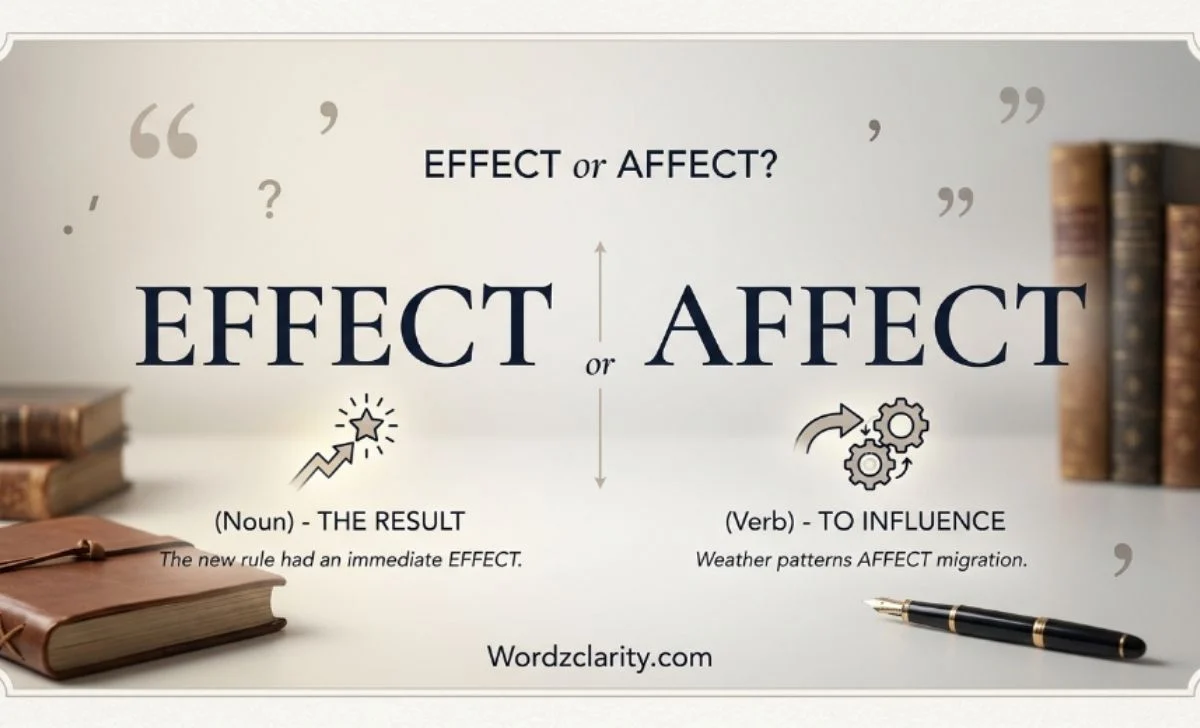
If you have ever stopped while writing a sentence and wondered whether you should use effect or affect, you are not alone. These two words are among the most commonly confused words in English. They look and sound similar, but they usually play different grammatical roles and have different meanings.
The confusion becomes even greater in phrases such as “have an effect,” “affect someone,” “side effect,” and “cause and effect.” In most everyday writing, affect is used as a verb meaning “to influence,” while effect is usually a noun meaning “a result” or “a consequence.”
For example, you might write, “Lack of sleep can affect your concentration,” but “Lack of sleep can have a negative effect on your concentration.” Both sentences are correct, but the words work differently.
In this guide, you will learn the difference between effect and affect, how to use each word in a sentence, common mistakes to avoid, and how to remember which one to choose.
Quick Answer
The easiest rule is:
- Affect is usually a verb meaning to influence or change something.
- Effect is usually a noun meaning the result or consequence of something.
Examples
Lack of sleep can affect your mood.
Here, affect means “influence.”
Lack of sleep can have a negative effect on your mood.
Here, effect means “result” or “impact.”
A simple memory trick is:
Affect = Action
Effect = End result
This rule works in most everyday situations, although both words have less common uses that you should also know.
Effect vs. Affect: The Main Difference
The difference between affect and effect becomes much easier when you look at their grammatical roles.
| Word | Usually used as | Basic meaning | Example |
|---|---|---|---|
| Affect | Verb | To influence or change | Noise can affect your concentration. |
| Effect | Noun | Result or consequence | Noise can have an effect on concentration. |
Think about a simple cause-and-result relationship.
Something affects you → it produces an effect.
For example:
The heat affected the workers.
The heat influenced the workers.
The heat had a serious effect on the workers.
The sentence focuses on the result of the heat.
Affect as a Verb
When affect is a verb, it means to influence something or someone.
Examples:
- The weather affected our travel plans.
- Stress can affect your sleep.
- The decision will affect thousands of employees.
- Social media can affect how people communicate.
- Poor lighting may affect your ability to read.
- The price increase could affect customer demand.
In each example, something is influencing something else.
Effect as a Noun
When effect is a noun, it refers to a result, consequence, or change produced by something.
Examples:
- The new policy had an immediate effect.
- Exercise can have a positive effect on your mood.
- The medicine produced several side effects.
- The decision had a major effect on the company.
- The storm caused serious effects across the region.
A useful question is:
“What was the result?”
If you are talking about the result, effect is often the right choice.
How to Use Affect in a Sentence
The most common use of affect is as a verb meaning to influence.
Examples in Everyday English
The rain affected our plans.
Loud music can affect your concentration.
His comments affected her confidence.
The delay may affect the schedule.
Rising prices are affecting consumers.
The word can be used in past, present, and future forms:
- affect
- affects
- affected
- affecting
The new schedule may affect production.
The policy change will affect all employees.
Higher costs could affect the company’s profits.
This issue may affect our delivery time.
Affect in Academic Writing
Academic writing frequently uses affect when discussing factors that influence outcomes.
Sleep deprivation can affect memory.
Economic conditions may affect consumer behavior.
Environmental changes can affect plant growth.
The key idea remains the same: something influences something else.
How to Use Effect in a Sentence
Effect is usually a noun referring to a result, consequence, or impact.
It often appears after words such as:
- an
- the
- this
- that
- positive
- negative
- significant
- immediate
- long-term
- short-term
Examples
The change had a positive effect.
The storm had a major effect on the city.
The new law could have a significant effect on businesses.
The training had an immediate effect on performance.
One of the most useful patterns is:
have an effect on
Examples:
Exercise can have a positive effect on your health.
Stress can have a negative effect on your performance.
The decision had little effect on the final result.
Affect vs. Effect in a Sentence
Seeing the two words in similar sentences makes the difference clearer.
| Affect | Effect |
|---|---|
| The weather affected our plans. | The weather had an effect on our plans. |
| Stress can affect your sleep. | Stress can have an effect on your sleep. |
| The news affected him deeply. | The news had a strong effect on him. |
| The change will affect customers. | The change will have an effect on customers. |
| Noise can affect concentration. | Noise can have an effect on concentration. |
Notice the pattern:
Affect + object
The noise affected my concentration.
Effect + noun phrase
The noise had an effect on my concentration.
“Has an Effect” or “Has an Affect”?
The correct phrase in ordinary English is:
has an effect
Not:
has an affect
For example:
Her advice had an effect on my decision.
The new policy has an effect on employees.
His speech had a powerful effect on the audience.
This is because effect is being used as a noun meaning “result” or “impact.”
The phrase “has an affect” can technically occur in specialized psychological writing, where affect is a noun referring to an emotional state or emotional expression. However, that is a different and much less common use.
For normal writing, use “has an effect.”
“Side Effect” or “Side Affect”?
The correct expression is:
side effect
A side effect is an additional result, especially an unwanted result, of a medicine, treatment, action, or process.
Examples:
The medication may cause mild side effects.
Headaches are a possible side effect.
The treatment has several known side effects.
Side affect is incorrect when you mean an additional result or consequence.
This is an important fixed expression, so it is best to learn it as a phrase rather than trying to choose between the two words every time.
“Cause and Effect” or “Cause and Affect”?
The correct phrase is:
cause and effect
It describes the relationship between something that produces an outcome and the resulting outcome.
For example:
The article explains the cause and effect of climate change.
Students learned about cause and effect in class.
Understanding cause and effect can help us make better decisions.
Here, effect means the result produced by a cause.
Cause and affect is not the standard expression for this meaning.
“Aftereffect” or “Afteraffect”?
The correct word is:
aftereffect
An aftereffect is a result that continues or appears after an event, experience, treatment, or action.
Examples:
The accident left lasting aftereffects.
The storm had several economic aftereffects.
He was still experiencing the aftereffects of the illness.
Afteraffect is not the standard English word for this meaning.
You may also see after-effect with a hyphen in some styles, but aftereffect is a standard modern form.
“Knock-On Effect” or “Knock-On Affect”?
The correct expression is:
knock-on effect
A knock-on effect is a secondary consequence caused by an initial event.
For example:
The train delay had a knock-on effect on the entire schedule.
Higher fuel prices can have a knock-on effect on food prices.
The closure created a knock-on effect for local businesses.
Knock-on effect is especially common in British English. American English often uses ripple effect or secondary effect for a similar idea.
Can Effect Be a Verb?
Yes. Although effect is most commonly a noun, it can also be a verb.
As a verb, effect means to bring about, cause, or make something happen.
For example:
The new policy effected significant changes.
The organization hopes to effect meaningful reform.
This use is more formal than the ordinary noun effect.
Compare:
The policy affected employees.
This means the policy influenced employees.
The policy effected major changes.
This means the policy brought about major changes.
That distinction is important because effected and affected do not mean the same thing.
Affected or Effected: What’s the Difference?
These two forms are often confused.
Affected
Affected usually means influenced or changed.
The storm affected thousands of residents.
Her work was affected by the delay.
Effected
Effected means brought about or caused to happen.
The new manager effected several changes.
The second use is relatively formal and less common in everyday writing.
A useful distinction is:
Affected = influenced
Effected = brought about
If you mean “influenced,” use affected.
The Less Common Uses of Affect and Effect
The simple rule—affect = verb, effect = noun—works most of the time. However, English has exceptions.
Affect as a Noun
In psychology and related fields, affect can be a noun referring to a person’s observable emotional expression or emotional state.
You may encounter terms such as:
- positive affect
- negative affect
- flat affect
- blunted affect
- emotional affect
For example:
The patient displayed a flat affect.
This is a specialized use and is different from the everyday verb affect.
Effect as a Verb
As mentioned earlier, effect can be a verb meaning “to bring about.”
The organization aims to effect change.
This is more formal than common everyday uses.
So, while the basic rule is extremely useful, context still matters.
Common Mistakes With Affect and Effect
Here are some of the mistakes writers make most often.
Mistake 1: “It had a big affect on me.”
Incorrect:
It had a big affect on me.
Correct:
It had a big effect on me.
Why? Because you are talking about a result or impact.
Mistake 2: “The weather effected our plans.”
Usually incorrect:
The weather effected our plans.
Correct:
The weather affected our plans.
Why? You mean that the weather influenced the plans.
Mistake 3: “Side affect”
Incorrect:
The medicine caused a side affect.
Correct:
The medicine caused a side effect.
Mistake 4: “Cause and affect”
Incorrect:
The lesson explains cause and affect.
Correct:
The lesson explains cause and effect.
Mistake 5: “Take affect”
Incorrect:
The new rule will take affect next month.
Correct:
The new rule will take effect next month.
Take effect means to begin producing a result or to become active.
Practical Examples in Different Types of Writing
Emails
The change may affect your delivery date.
The new schedule will have an effect on our meeting time.
Workplace Communication
The staffing shortage could affect productivity.
The change had a noticeable effect on productivity.
Academic Writing
Sleep can affect academic performance.
Researchers examined the effect of sleep on academic performance.
News Writing
The storm affected several communities.
The storm had a significant effect on local businesses.
Websites
Changes to the website may affect loading speed.
The redesign had a positive effect on user engagement.
Social Media
Lack of sleep really affects my mood.
That movie had a huge effect on me.
A Simple Trick to Remember Affect vs. Effect
If you regularly confuse these words, use this shortcut:
Affect = Action
Think of Affect as an Action.
Something affects something else.
For example:
Stress affects sleep.
Effect = End Result
Think of Effect as the End result.
Stress has an effect on sleep.
So remember:
A = Affect = Action
E = Effect = End result
This is not a rule that covers every specialized use, but it is highly effective for everyday English.
A Quick Decision Guide
When you are unsure, ask yourself these questions:
1. Am I describing an influence or change?
Use affect.
The noise affected my concentration.
2. Am I describing a result or consequence?
Use effect.
The noise had an effect on my concentration.
3. Does the phrase contain “have an ___ on”?
Use effect.
have an effect on
4. Is it a fixed phrase such as “side ___”?
Use effect.
side effect
5. Am I talking about emotional expression in a psychological context?
Affect may be the correct noun.
6. Does “effect” mean “bring about”?
It may be functioning as a verb.
Common Expressions You Should Learn
Learning common expressions can make the distinction much easier.
| Expression | Correct form |
|---|---|
| Have an ___ on | effect |
| Side ___ | effect |
| Cause and ___ | effect |
| Take ___ | effect |
| After___ | effect |
| Knock-on ___ | effect |
| ___ someone | affect |
| ___ someone’s behavior | affect |
| ___ the outcome | affect |
| ___ performance | affect |
These patterns cover many of the situations that cause confusion.
Effect or Affect: A Final Comparison
| Feature | Affect | Effect |
|---|---|---|
| Most common part of speech | Verb | Noun |
| Main everyday meaning | Influence | Result |
| Example | Stress affects sleep. | Stress has an effect on sleep. |
| Common phrase | Affect someone’s behavior | Have an effect on |
| Past form | Affected | Effected* |
| Common fixed phrase | — | Side effect |
| Common academic phrase | Affect behavior | Cause and effect |
| Special use | Noun in psychology | Verb meaning “bring about” |
* Effected is a legitimate verb, but it has a different meaning from affected and is much less common.
Final Tips for Choosing the Right Word
When writing an email, essay, report, article, or social media post, remember these practical tips:
- Use affect when you mean influence.
- Use effect when you mean result.
- Remember the phrase “have an effect on.”
- Write “side effect,” not “side affect.”
- Write “cause and effect,” not “cause and affect.”
- Write “take effect,” not “take affect.”
- Use affected when something was influenced.
- Use effected only when you mean something was brought about or caused.
- Remember that affect can be a noun in specialized psychological contexts.
- Remember that effect can be a verb meaning “to bring about.”
FAQs
1. What is the easiest way to remember affect vs. effect?
Remember Affect = Action and Effect = End result. If something influences something else, use affect. If you are talking about the resulting outcome, use effect.
2. Is “has an effect” or “has an affect” correct?
For ordinary English, “has an effect” is correct. Effect is being used as a noun meaning result or impact.
3. Is “side effect” or “side affect” correct?
Side effect is correct. It refers to an additional result, often an unwanted result of medicine, treatment, or another action.
4. Is “cause and effect” or “cause and affect” correct?
Cause and effect is the standard phrase. It describes the relationship between an event and the result it produces.
5. Is “take effect” or “take affect” correct?
The correct expression is take effect. It means that something begins to operate or produce a result.
6. Can “affect” be a noun?
Yes. Affect can be a noun in psychology and related fields, where it refers to observable emotional expression or emotional state. This is different from the common verb affect.
7. Can “effect” be a verb?
Yes. Effect can be a verb meaning “to bring about” or “to cause something to happen.” For example, “The changes effected a major improvement.” This use is more formal.
Conclusion
Understanding effect or affect does not have to be difficult. In everyday English, the most useful rule is simple: affect is usually a verb meaning to influence, while effect is usually a noun meaning a result or consequence.
For example, “Stress can affect your sleep” describes influence, while “Stress can have a negative effect on your sleep” describes the result.
Several common expressions make the choice even easier. Use side effect, cause and effect, take effect, aftereffect, knock-on effect, and have an effect on. When you see affected, it usually means influenced; effected is a less common verb meaning brought about.
There are exceptions, including affect as a psychological noun and effect as a formal verb. However, you can handle most everyday writing by remembering Affect = Action and Effect = End result. With practice, choosing between these commonly confused words becomes much more natural.
Read More Blogs:
- Parties or Party’s: it make’s your vocabulary strong
- Laying or Lying: Which Is Correct?
- Passed Away or Past Away? Understanding the Correct Expression