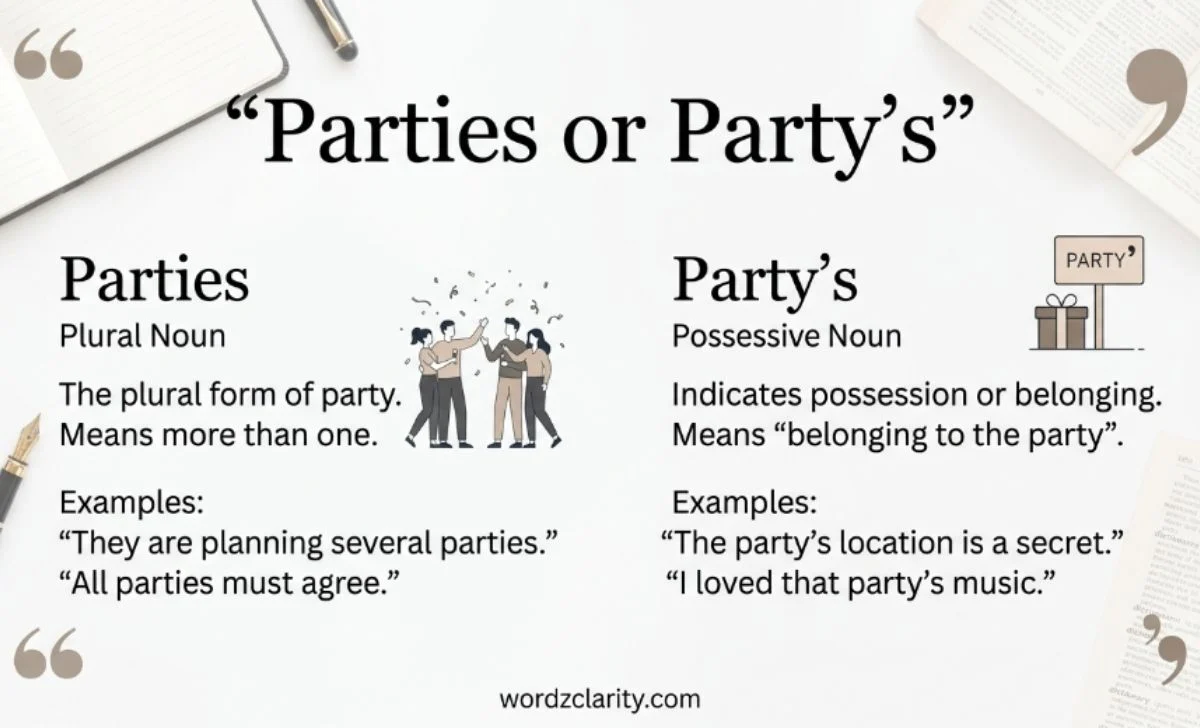
Have you ever stopped while writing and wondered whether the correct form is parties or party’s? The difference looks small, but these two forms do different jobs in English. The confusion becomes even greater when parties’ enters the picture. Each form can be correct, but only in the right context.
Parties is the plural form of party. You use it when you are talking about two or more parties, such as political parties, birthday parties, or two parties in an agreement. Party’s, on the other hand, is the singular possessive form.
It shows that something belongs to or is connected with one party. There is also parties’, the plural possessive form, which shows that something belongs to two or more parties.
In this guide, you will learn when to use parties, party’s, and parties’, how to form each one correctly, and how they work in everyday, legal, business, and academic writing.
Quick Answer
The correct form depends on whether you mean one party, several parties, or possession.
- Party = one party The party agreed to the terms.
- Parties = two or more parties Both parties signed the contract.
- Party’s = something belonging to one party The party’s decision was final.
- Parties’ = something belonging to two or more parties The parties’ agreement was finalized yesterday.
| Form | Use | Example |
|---|---|---|
| party | One party | The party agreed. |
| parties | Two or more parties | Both parties agreed. |
| party’s | Belonging to one party | The party’s decision was final. |
| parties’ | Belonging to two or more parties | The parties’ agreement was final. |
Simple rule: party is singular, parties is plural, party’s shows possession by one party, and parties’ shows possession by multiple parties.
The basic rule is:
| Form | Meaning | Example |
|---|---|---|
| party | One party | The party agreed. |
| parties | More than one party | Both parties agreed. |
| party’s | Belonging to one party | The party’s decision was final. |
| parties’ | Belonging to multiple parties | The parties’ agreement was final. |
So, if you are asking “parties or party’s?”, the answer depends on what you mean. They are not interchangeable spellings.
What Does “Party” Mean?
The noun party has several meanings, but the same plural and possessive rules apply to each meaning.
A party can mean a group of people who share a particular purpose or interest.
For example:
The political party announced its new policy.
It can also mean a social event:
We are having a birthday party on Saturday.
In legal and business contexts, party often refers to a person, group, company, or organization involved in an agreement, contract, case, or transaction.
For example:
Each party must follow the terms of the contract.
Because party is a countable noun, you can talk about one party, two parties, or several parties.
What Is the Plural of “Party”?
The plural of party is parties.
This follows a common spelling rule for nouns ending in a consonant + y. The y changes to ies.
Examples include:
- party → parties
- city → cities
- country → countries
- company → companies
- family → families
- story → stories
Therefore, partys is not the standard plural spelling.
For example:
❌ Several political partys attended the meeting.
✅ Several political parties attended the meeting.
The same rule applies whether you are talking about social events, organizations, groups, or legal participants.
Political Parties
Several political parties contested the election.
Here, parties simply means more than one political party.
Birthday Parties
The children attended three birthday parties this month.
Again, parties is the plural because there is more than one event.
Legal Parties
Both parties agreed to the terms of the contract.
In legal writing, parties commonly refers to two or more people or organizations involved in a legal matter.
When Should You Use “Party’s”?
Party’s is the singular possessive form of party.
Use it when you are talking about something belonging to, controlled by, connected with, or associated with one party.
For example:
The party’s leader gave a speech.
This means the leader of one party.
Another example:
The party’s decision surprised its supporters.
The decision is associated with one party.
Other examples include:
- the party’s position
- the party’s policy
- the party’s representative
- the party’s responsibility
- the party’s agreement
- the party’s legal rights
The apostrophe comes before the s because party is singular.
Why Is It “Party’s”?
The normal possessive rule for a singular noun is to add ’s.
Compare:
- company → company’s
- country → country’s
- family → family’s
- party → party’s
So:
The party’s leader
means:
The leader of the party
The apostrophe does not make the word plural. Instead, it shows possession or association.
When Should You Use “Parties’”?
This is where many writers become confused.
Parties’ is the plural possessive form of party. Use it when you are talking about something belonging to or associated with two or more parties.
For example:
The parties’ agreement was finalized yesterday.
The agreement involves multiple parties.
Another example:
The parties’ representatives attended the meeting.
The representatives are associated with more than one party.
Notice the difference:
The party’s representative
One party.
The parties’ representatives
More than one party.
Because parties already ends in s, the possessive apostrophe is placed after the s.
Parties vs. Party’s vs. Parties’
| Form | Number | Function | Example |
|---|---|---|---|
| party | Singular | Basic noun | The party agreed. |
| parties | Plural | More than one | The parties agreed. |
| party’s | Singular possessive | Belonging to one | The party’s leader spoke. |
| parties’ | Plural possessive | Belonging to several | The parties’ leaders spoke. |
This four-form pattern is the easiest way to understand the entire issue.
Is “The Party” Singular or Plural?
The party is normally singular when party refers to one group, organization, or social event.
For example:
The party is preparing for the election.
Here, party refers to one political organization, so the singular verb is is used.
Similarly:
The party was canceled because of the weather.
Here, party means one social event.
When you mean more than one, use the parties:
The parties are discussing the agreement.
The parties were invited to the meeting.
This distinction also matters for subject-verb agreement:
| Singular | Plural |
|---|---|
| The party is ready. | The parties are ready. |
| The party was informed. | The parties were informed. |
| The party has agreed. | The parties have agreed. |
So, the party is singular, while the parties is plural.
Is “Both Party’s” or “Both Parties” Correct?
The correct expression is:
both parties
The word both refers to two people, groups, or things, so it must be followed by a plural noun.
For example:
Both parties signed the contract.
Both parties agreed to the terms.
Both parties were responsible for the decision.
The following form is incorrect when you mean two parties:
❌ Both party’s agreed to the contract.
Why? Because party’s is singular possessive. It means something belongs to one party.
For example:
The party’s representative signed the document.
If you need a possessive form referring to both parties, use parties’:
Both parties’ representatives attended the meeting.
This gives you a useful pattern:
both parties = two parties
both parties’ representatives = representatives belonging to both parties
Is “Each Party’s” or “Each Parties” Correct?
The correct expression is:
each party’s
The word each is normally followed by a singular noun.
For example:
Each party’s position was carefully considered.
Each party’s representative received a copy.
Each party’s responsibility is clearly stated in the contract.
The form each parties is incorrect.
❌ Each parties must submit a response.
✅ Each party must submit a response.
If you want to show possession, use:
✅ Each party’s response was reviewed.
This is an important distinction because each focuses on the members individually, so the noun after it remains singular.
Political Parties or Party’s?
When talking about more than one political organization, use political parties.
Several political parties participated in the election.
The country has many political parties.
The political parties presented different policies.
Use party’s only when something belongs to one political party:
The political party’s leader addressed the crowd.
Use parties’ when something belongs to multiple political parties:
The political parties’ leaders met to discuss the issue.
Compare:
| Correct phrase | Meaning |
|---|---|
| political parties | More than one political party |
| the political party’s policy | Policy of one political party |
| the political parties’ policies | Policies of multiple political parties |
This distinction is especially useful in news writing and political reporting.
Birthday Parties or Party’s?
When referring to more than one celebration, the correct form is birthday parties.
The children attended several birthday parties.
We organized two birthday parties last month.
You would use party’s only to show possession by one party:
The birthday party’s decorations were beautiful.
Here, the decorations belong to or are associated with one birthday party.
If several parties have decorations, use the plural possessive:
The birthday parties’ decorations were different.
So the same grammar applies even though the meaning of party has changed from a group or organization to a social event.
Parties or Party’s in Legal Writing
The distinction becomes especially important in contracts, court documents, agreements, and other legal writing.
In legal English, party often refers to a person, company, organization, or group involved in an agreement or legal proceeding.
Use more than one:
The parties agree to the following terms.
Each party’s obligations are described below.
The parties’ obligations are set out in the agreement.
Another example:
The parties’ rights and responsibilities are clearly defined.
A common mistake is to write party’s simply because the sentence is legal or formal. The apostrophe is still controlled by number and possession.
Common Mistakes With Parties and Party’s
1. Using “Party’s” as the Plural
Incorrect:
❌ Several party’s attended the meeting.
Correct:
✅ Several parties attended the meeting.
The apostrophe is not used to make party plural.
2. Writing “Partys”
Incorrect:
❌ The political partys announced their policies.
Correct:
✅ The political parties announced their policies.
The plural changes y to ies.
3. Using “Party’s” After “Both”
Incorrect:
❌ Both party’s signed the agreement.
Correct:
✅ Both parties signed the agreement.
Both requires the plural form.
4. Using “Parties” for Singular Possession
Incorrect:
❌ The parties leader gave a speech.
If you mean the leader of one party, write:
✅ The party’s leader gave a speech.
5. Confusing “Parties” With “Parties’”
Compare:
The parties signed the contract.
Here, parties is simply plural.
The parties’ contract was reviewed.
Here, parties’ is plural possessive.
The apostrophe changes the grammatical function.
A Simple Way to Remember the Rule
You can solve most parties or party’s questions by asking two things:
Step 1: How many parties are there?
If there is one, use party.
If there are two or more, use parties.
Step 2: Are you showing possession?
If one party owns or is associated with something:
party’s
If multiple parties own or are associated with something:
parties’
For example:
The party’s leader
One party + possession.
The parties’ leaders
Multiple parties + possession.
The parties signed the agreement.
Multiple parties, but no possessive relationship.
This simple number-and-possession test is usually enough.
Parties or Party’s in Everyday Writing
These forms appear in many types of writing.
In Conversation
We went to two parties last weekend.
Here, parties is plural.
In an Email
Both parties have agreed to the proposed schedule.
Here, parties refers to two groups or people.
In Business Writing
The party’s representative will contact you shortly.
Here, the representative belongs to one party.
In Academic Writing
The parties’ responses were compared in the study.
Here, multiple parties are involved.
On a Website
The company works closely with its business partners and other parties.
Here, parties is simply plural.
In News Writing
The two parties reached a deal after several weeks of negotiations.
Again, parties means two groups.
The context changes, but the grammar rule remains the same.
Is “Party” a Countable Noun?
Yes. Party is a countable noun.
You can say:
- one party
- two parties
- several parties
- many parties
For example:
One party submitted a proposal.
Two parties signed the agreement.
Several parties attended the discussion.
Because it is countable, the plural form parties is used when referring to more than one.
The noun can also refer to different kinds of things. You can have:
- a birthday party
- several birthday parties
- a political party
- several political parties
- one legal party
- multiple legal parties
The spelling changes only according to number and possession.
What Is the Correct Possessive Form?
There are two possessive forms to remember.
For one party, use:
party’s
Example:
The party’s decision was announced today.
For more than one party, use:
parties’
Example:
The parties’ decisions were announced today.
This follows the standard English possessive rule.
A singular noun usually takes ’s:
party → party’s
A plural noun ending in s usually takes only an apostrophe:
parties → parties’
Notice that the plural spelling itself changes from party to parties, and then the possessive apostrophe is added at the end.
Final Comparison
| If you mean… | Use | Example |
|---|---|---|
| One party | party | The party agreed. |
| More than one | parties | The parties agreed. |
| Something belonging to one party | party’s | The party’s leader spoke. |
| Something belonging to multiple parties | parties’ | The parties’ leaders spoke. |
| Two parties | both parties | Both parties agreed. |
| Individual members of a group | each party | Each party must respond. |
| Possession by each individual party | each party’s | Each party’s response was recorded. |
The key is to identify number first and possession second.
FAQs
1. What do parties mean?
Parties is the plural of party. It can refer to two or more social events, political organizations, groups, or people or organizations involved in an agreement or legal matter.
2. When should you use “parties” or “party’s”?
Use parties when you mean more than one party. Use party’s when something belongs to or is associated with one party.
Both parties agreed.
The party’s leader spoke.
3. What is the difference between “party’s” and “parties’”?
Party’s is singular possessive and refers to one party. Parties’ is plural possessive and refers to two or more parties.
The party’s representative
The parties’ representatives
4. Is “the party” singular or plural?
The party is singular when it refers to one group or event.
The party is ready.
The plural form is the parties:
The parties are ready.
5. Is “both parties” or “both party’s” correct?
Both parties is correct when referring to two parties.
Both parties signed the agreement.
Party’s is possessive and does not mean “two parties.”
6. Is “each party’s” or “each parties” correct?
Each party’s is correct when you mean something belonging to each individual party.
Each party’s responsibilities are listed in the contract.
The expression each parties is incorrect because each takes a singular noun.
7. What is the plural of “party”?
The plural is parties.
One party → two parties
The spelling changes from y to ies. Partys is not the standard plural form.
Conclusion
Choosing between parties, party’s, and parties’ becomes much easier when you separate number from possession. Parties is the plural form of party, so use it when you mean two or more parties. This applies to political parties, birthday parties, legal parties, and other groups or events.
Party’s is the singular possessive form. It shows that something belongs to or is connected with one party, as in the party’s leader or the party’s decision. When several parties possess or share something, use parties’, as in the parties’ agreement.
Also remember that both parties is correct, while both party’s is not. Likewise, each party’s is correct because each takes a singular noun.
The easiest rule is simple: party = one, parties = more than one, party’s = one party’s possession, and parties’ = multiple parties’ possession. Once you understand this pattern, you can use these forms confidently in everyday, business, academic, news, and legal writing.
Read More Blogs:
- Skill Set or Skillset: Which Spelling Is Correct?
- Never Mind or Nevermind: British and American English Explained
- Analysed or Analyzed: The Difference Between These Spellings