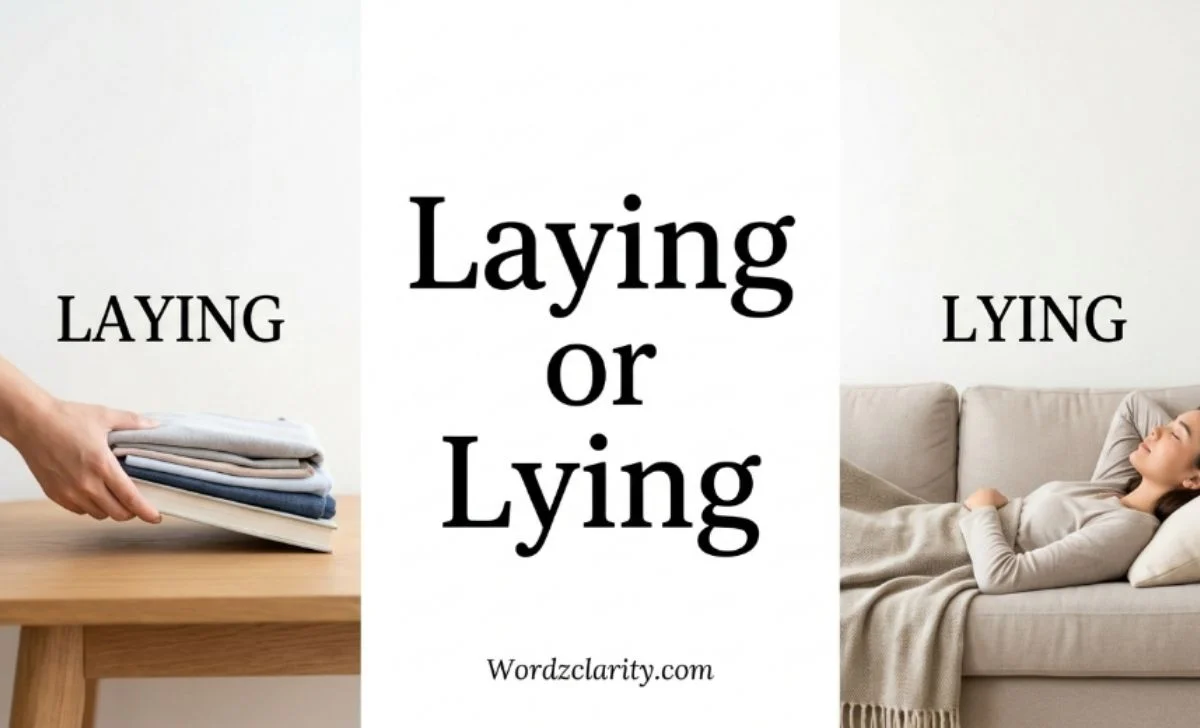
Laying or lying is a common English grammar question because both words describe actions or states connected with the verbs lay and lie. The problem is that these verbs have similar forms, and one of them lay also happens to be the past tense of lie. That makes sentences such as “I am laying in bed” and “I am lying in bed” easy to mix up.
The good news is that you do not need to memorize dozens of isolated rules. The main difference is based on what the verb means. Lying usually means resting or being in a particular position.
Laying usually means putting someone or something somewhere. For example, She is lying on the couch describes her position, while She is laying a blanket on the couch describes what she is doing.
Once you understand that distinction and learn the main verb forms, phrases such as lying in bed, lying on the floor, lying on the beach, lying low, and laying eggs become much easier to use correctly.
Quick Answer: Laying or Lying?
Use lying when you mean resting, reclining, or being in a particular position.
I am lying in bed.
The dog is lying on the floor.
She is lying on the couch.
Use laying when you mean putting or placing something or someone somewhere.
She is laying the baby in bed.
He is laying the book on the table.
She is laying a blanket on the floor.
Laying is also correct when an animal produces eggs:
The hen is laying eggs.
The simplest rule to remember is:
You lie down, but you lay something down.
This rule will solve most everyday cases.
Why Are Laying and Lying So Easy to Confuse?
The problem starts with the two base verbs: lie and lay.
When lie means to rest or recline, it does not normally take a direct object.
I lie on the sofa when I am tired.
When lay means to put or place something, it normally takes a direct object.
I lay the book on the sofa.
The confusion becomes greater because the past tense of lie is lay:
Today I lie on the couch.
Yesterday I lay on the couch.
At the same time, lay is the present form of another verb:
I lay the book on the couch.
So the same word can have different grammatical jobs depending on the sentence.
The Verb Forms You Need to Know
Learning the two verb patterns together is the best way to avoid mistakes.
| Meaning | Present | -ing Form | Past | Past Participle |
|---|---|---|---|---|
| Rest or recline | lie | lying | lay | lain |
| Put or place | lay | laying | laid | laid |
Lie
When lie means to rest or recline:
- Present: lie
- -ing form: lying
- Past: lay
- Past participle: lain
Examples:
I lie down when I need a break.
I am lying on the bed.
Yesterday, I lay on the couch.
I have lain here for an hour.
Lay
When lay means to put or place:
- Present: lay
- -ing form: laying
- Past: laid
- Past participle: laid
Examples:
I lay the keys on the table.
I am laying the keys on the table.
I laid the keys there yesterday.
I have laid the keys on the table.
This chart is worth remembering because it explains why the words seem to behave strangely.
When Should You Use “Lying”?
Use lying when the subject is resting or occupying a position.
This is why we normally say:
She is lying in bed.
He is lying on the floor.
They are lying on the beach.
I am lying on the couch.
The subject is not placing an object somewhere. The subject is simply in a position.
The same idea can apply to objects:
The papers are lying on the desk.
My keys were lying beside the door.
A jacket was lying on the chair.
In each case, lying describes where something is or how it is positioned.
Lying in Bed
If you mean resting in bed, lying in bed is correct.
I am lying in bed.
She stayed home, lying in bed most of the morning.
However, laying in bed can be grammatical when laying has an object:
She was laying the baby in bed.
The first sentence describes a position. The second describes an action involving another person.
Lying on the Floor
Use lying on the floor when someone is resting there:
The child was lying on the floor.
He was lying on the floor after exercising.
If something is being placed there, use laying:
She was laying the blanket on the floor.
Lying on the Couch
For someone resting on a couch:
I am lying on the couch.
He was lying on the couch watching a movie.
If an object is being placed there:
She was laying the blanket on the couch.
Lying on the Beach
When someone is relaxing or resting on a beach:
We spent the afternoon lying on the beach.
She was lying on the beach reading.
When something is being placed there:
They were laying their towels on the beach.
The important point is that the location does not determine the verb. The action does.
When Should You Use “Laying”?
Use laying when it is the present participle of lay, usually meaning putting or placing something somewhere.
For example:
She is laying the book on the desk.
He is laying the clothes on the bed.
They are laying the tiles on the floor.
She is laying the baby in the crib.
A useful question is:
Laying what?
If you can identify the object receiving the action, laying is often the right choice.
For example:
He is laying what?
The papers.
She is laying what?
The blanket.
This object test is particularly useful when you are unsure about a sentence.
Laying Eggs
One important use of laying is different from ordinary placing.
Birds, reptiles, insects, and some other animals can lay eggs.
The hen is laying eggs.
The turtle was laying eggs on the beach.
The bird is laying an egg.
Here, eggs are the object of the verb lay. The word is therefore completely correct.
The past tense is laid:
The hen laid an egg yesterday.
Lying Down or Laying Down?
This is one of the most common points of confusion.
When you mean that you are going to rest, the correct expression is lie down:
I need to lie down.
She went to her room to lie down.
He is lying down.
When you are putting something or someone down, use lay:
She is laying the baby down.
He is laying the phone down.
I am laying the book down.
Lying Low or Laying Low?
The standard expression is lying low.
He is lying low until the attention dies down.
She decided to lie low for a few days.
The idiom lie low means to avoid attention, remain unnoticed, or keep a low profile.
Its forms are:
- lie low
- lying low
- lay low when referring to the past
For example:
He usually lies low during the winter.
He is lying low now.
He lay low for several weeks.
The phrase should not be changed to laying low when you mean the idiom.
The Past Tense of Lie Is “Lay”
This is probably the single most confusing fact in the whole topic.
The verb lie has this pattern:
lie → lay → lain
So:
Today, I lie on the bed.
Yesterday, I lay on the bed.
I have lain on the bed for an hour.
But the verb lay has a different pattern:
lay → laid → laid
So:
Today, I lay the book on the bed.
Yesterday, I laid the book on the bed.
I have laid the book on the bed.
Notice the difference:
Yesterday, I lay on the bed.
I was resting.
Yesterday, I laid the book on the bed.
I put the book there.
If you remember only one advanced rule, remember this one:
Lie becomes lay in the past, but lay becomes laid in the past.
Why “Lying” Is Spelled That Way
The correct spelling is lying, not lieing.
When lie becomes an -ing form, the spelling changes:
lie → lying
The same pattern occurs with other words ending in -ie:
die → dying
tie → tying
lie → lying
Therefore, lieing is not the standard spelling.
This is separate from the meaning difference between laying and lying, but it is a common mistake worth knowing.
Common Mistakes and Their Corrections
Mistake 1: “I am laying in bed.”
If you mean that you are resting:
I am lying in bed.
Mistake 2: “She is laying on the couch.”
If she is simply resting:
She is lying on the couch.
Mistake 3: “He is laying on the floor.”
If he is already resting there:
He is lying on the floor.
Mistake 4: “I am going to lay down.”
If you mean that you are going to rest:
I am going to lie down.
Mistake 5: “He is laying low.”
For the idiom meaning “avoiding attention”:
He is lying low.
Mistake 6: “She is lieing down.”
The correct spelling is:
She is lying down.
Mistake 7: “Yesterday, I laid on the bed.”
When lie means recline, the past tense is lay:
Yesterday, I lay on the bed.
A Useful Object Test
When you are uncertain, try asking whether the verb has a direct object.
With lay, ask:
What is being laid?
She is laying the book on the desk.
The answer is the book.
With lie, ask where the subject is:
She is lying on the desk.
There is no object being placed. She is simply in that position.
Compare these:
| Sentence | What is happening? |
|---|---|
| She is lying on the bed. | She is resting there. |
| She is laying the baby on the bed. | She is placing the baby there. |
| The book is lying on the desk. | The book is already there. |
| She is laying the book on the desk. | She is putting it there. |
The object test is not a substitute for learning the verb forms, but it is a useful practical check.
Examples in Everyday English
The difference appears in many kinds of writing.
Conversation
“Where is Mike?”
“He is lying on the couch.”
I was lying in bed when I saw your message.
Workplace Writing
Several documents were lying on the manager’s desk.
If an employee is putting them there:
The assistant was laying the documents on the desk.
Academic Writing
The samples were lying on a flat surface before the procedure began.
News Writing
The injured man was found lying on the ground.
Website Content
The device is comfortable to use while lying in bed.
Social Media
Just lying on the couch and enjoying a quiet evening.
These examples show the practical difference without changing the underlying rule.
A Few Sentences to Test Yourself
Choose laying or lying:
- I am ___ in bed.
- She is ___ the baby in the crib.
- The dog is ___ on the floor.
- He is ___ the papers on the desk.
- We are ___ on the beach.
- The hen is ___ eggs.
- She is ___ low.
- I am ___ on the couch.
Answers
- lying
- laying
- lying
- laying
- lying
- laying
- lying
- lying
The choices become much easier when you identify whether the sentence describes resting or placing.
Laying or Lying: Complete Comparison
| Situation | Correct form | Example |
|---|---|---|
| Resting in bed | lying | I am lying in bed. |
| Putting a baby in bed | laying | She is laying the baby in bed. |
| Resting on the floor | lying | He is lying on the floor. |
| Putting a blanket on the floor | laying | She is laying the blanket on the floor. |
| Resting on a couch | lying | She is lying on the couch. |
| Placing a blanket on a couch | laying | She is laying a blanket on the couch. |
| Relaxing on a beach | lying | They are lying on the beach. |
| Placing towels on a beach | laying | They are laying towels on the beach. |
| Avoiding attention | lying | He is lying low. |
| Producing eggs | laying | The hen is laying eggs. |
| Reclining | lying | He is lying down. |
| Putting something down | laying | She is laying the book down. |
FAQs
1. Is “laying in bed” wrong?
Not always. It is correct when laying has an object:
She is laying the baby in bed.
But when you mean resting in bed, use:
She is lying in bed.
2. Which is correct: “laying or lying on the floor”?
Use lying on the floor when someone or something is resting there.
The dog is lying on the floor.
Use laying when an object is being placed there:
She is laying the blanket on the floor.
3. Is “lying on the couch” correct?
Yes. Lying on the couch is correct when someone is resting or reclining on the couch.
4. Should I say “lying on the beach”?
Yes. If someone is resting on the beach, lying on the beach is the standard form.
5. What is the past tense of “lie”?
When lie means to rest or recline, its past tense is lay.
Yesterday, I lay on the couch.
The past participle is lain:
I have lain here for an hour.
6. Is “lying low” correct?
Yes. Lying low is the standard form of the idiom lie low, which means to avoid attention or remain unnoticed.
7. Is “laying eggs” correct?
Yes. Laying eggs is correct because eggs are the object of the verb lay.
8. Is “lieing” a word?
No, not as the standard -ing form of lie. The correct spelling is lying.
9. Is “I am laying down” correct?
Usually not if you mean that you are going to rest. In that case, say:
I am lying down.
But laying down is correct when an object or person is being put down:
She is laying the baby down.
10. What is the easiest way to remember laying and lying?
Remember:
You lie down, but you lay something down.
Then keep the two verb patterns in mind:
lie – lay – lain
lay – laid – laid
Conclusion
The difference between laying or lying becomes much clearer when you separate the two verbs behind them. Lying comes from lie when it means to rest, recline, or remain in a particular position. That is why we say lying in bed, lying on the floor, lying on the couch, and lying on the beach. The familiar expression lying low also comes from lie.
Laying comes from lay and normally describes putting or placing someone or something somewhere. You can be laying a book on a desk, laying a baby in bed, or laying a blanket on the floor. The same form is used in laying eggs.
The most useful everyday rule is simple: you lie down, but you lay something down. For situations involving the past, remember that lie becomes lay, while lay becomes laid. Once you learn these patterns rather than memorizing individual phrases, choosing the right word becomes much more natural and reliable.
Read More Blogs:
- Analysed or Analyzed: The Difference Between These Spellings
- Enquiry vs Inquiry: The Complete Guide to Meaning and Usage
- Bachelor’s Degree or Bachelors Degree: Which Is Correct?
- Elses or Else’s: Which Is Correct?