Passed away or past away is a common English usage question, especially when writing about someone’s death. The two expressions sound almost identical when spoken, but they are not interchangeable in writing.
One is a standard English expression, while the other is generally a spelling mistake when used to mean that someone died.
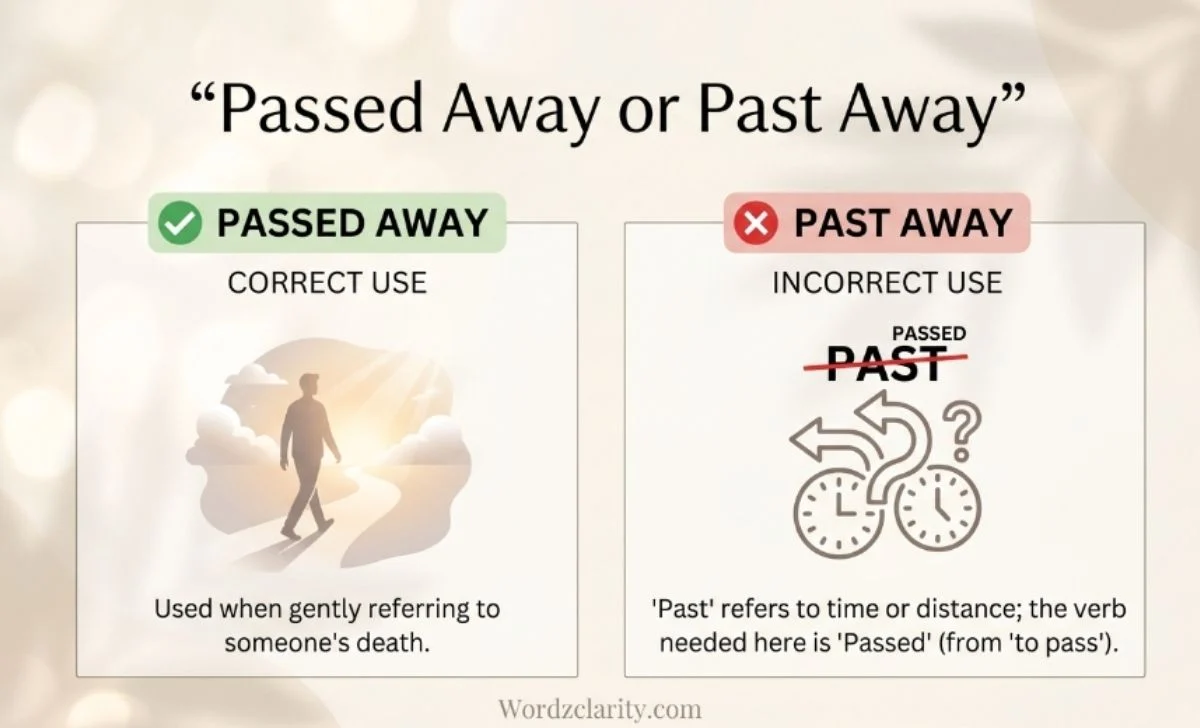
The correct expression is passed away. It is the past-tense form of pass away, a polite and widely used expression meaning to die. For example, you can write, “Her grandfather passed away last year.” You should not write, “Her grandfather past away last year.”
The confusion comes from the fact that passed and past are both real English words. However, they have different meanings and grammatical roles.
Passed is a form of the verb pass, while past can function as a noun, adjective, adverb, or preposition referring to an earlier time or something beyond a particular point.
This guide explains the difference between passed away and past away, shows how to use the correct expression in real sentences, and explains related forms such as pass away, has passed away, and had passed away.
Quick Answer
Passed away is correct when you mean that someone died.
My grandfather passed away last year.
Her mother passed away peacefully.
His uncle passed away yesterday.
Past away is not the standard expression for death.
The reason is simple:
- Pass away = a polite expression meaning die
- Passed away = the past-tense form
- Past = a different word with a different meaning
So if you are talking about someone’s death, use:
passed away
not:
past away
Why “Passed Away” Is Correct
Pass away is a phrasal verb that can be used as a polite way of saying that someone has died.
The verb is pass, so its past tense is passed.
pass → passed
Therefore:
pass away → passed away
For example:
She passed away in 2024.
The word past cannot replace passed in this expression because past is not the past-tense form of pass.
Compare:
He passed away peacefully.
with:
He walked past the hospital.
In the first sentence, passed is a verb. In the second, past describes movement beyond a place.
Passed vs. Past: What Is the Difference?
The easiest way to understand the spelling is to look at the two words separately.
Passed
Passed is a form of the verb pass.
It can mean moved beyond something, succeeded, handed something over, or experienced the passage of time. It is also used in passed away.
Examples:
She passed the exam.
The car passed us on the highway.
He passed the message to his colleague.
Ten years have passed since we met.
Her grandmother passed away peacefully.
Past
Past generally relates to a time before now, a previous period, or movement beyond a particular point.
Examples:
We should learn from the past.
He walked past the store.
It is half past five.
She has a difficult past.
The two words may sound similar, but their meanings are different.
| Word | Main role | Example |
|---|---|---|
| passed | Verb form of pass | She passed the exam. |
| past | Refers to earlier time or beyond a point | We walked past the house. |
| passed away | Polite expression meaning died | His father passed away. |
| past away | Not standard for this meaning | ❌ His father past away. |
Pass Away, Passed Away, and Passing Away
The form you choose depends on the tense and grammatical structure of the sentence.
Pass away
Use pass away as the base form.
People eventually pass away.
We knew that he would pass away peacefully.
It can also follow modal verbs:
She may pass away soon.
He could pass away without warning.
Passed away
Use passed away for a completed event in the past.
Her father passed away last year.
The actor passed away at the age of 82.
My uncle passed away yesterday.
Passing away
Use passing away when the verb requires an -ing form.
We were saddened by his passing away.
The family was with her as she was passing away.
However, in sensitive writing, passing or death may sometimes sound more natural than the full phrase passing away.
Has passed away
Use has passed away when the event is connected to the present.
Her mother has passed away.
Sadly, one of our former teachers has passed away.
Had passed away
Use had passed away when the death happened before another event in the past.
By the time we arrived, he had passed away.
The basic pattern is:
| Form | Example |
|---|---|
| pass away | Some people pass away peacefully. |
| passes away | He passes away in the story. |
| passed away | She passed away last year. |
| passing away | We heard about his passing away. |
| has passed away | Her father has passed away. |
| had passed away | He had passed away before we arrived. |
What Does “Passed Away” Mean?
Passed away is a euphemistic or polite expression for died.
A euphemism is a softer expression used instead of a word that may feel direct, painful, or uncomfortable.
For example:
Her mother died yesterday.
and:
Her mother passed away yesterday.
Both sentences communicate the same basic fact. However, passed away often sounds gentler and more respectful, especially when talking about someone’s family member or loved one.
It is commonly used in:
- condolences
- obituaries
- death announcements
- personal conversations
- workplace messages
- community notices
- formal correspondence
- news reports
The choice depends on context and tone.
Is “Past Away” Ever Correct?
Past away is not the standard expression meaning “died.”
If you see:
My father past away last week.
the writer almost certainly means:
My father passed away last week.
The word past is a legitimate English word, but it does not work in this expression.
For example, past is correct here:
We drove past the hospital.
The worst is in the past.
It is half past six.
But when you mean that someone died, the correct phrase is:
passed away
Why Do People Write “Past Away”?
The mistake is easy to make because passed and past can sound very similar in ordinary speech.
When people hear:
passed away
they may remember only the sound and later write past away.
Another reason is that past is a very common English word, so writers may automatically choose it when they are unsure about the spelling.
There is also a grammatical reason for the confusion. Passed is the past form of pass, while past can describe something that happened earlier. Since death normally happened in the past, some writers mistakenly connect past with the expression.
The important distinction is:
Passed comes from the verb pass.
Past refers to an earlier time or something beyond a point.
Once you understand that difference, passed away becomes much easier to remember.
Passed Away in Different Contexts
The expression appears in many types of writing. Its meaning remains the same, but the surrounding language changes with the situation.
I was sorry to hear that your grandfather passed away.
Her aunt passed away last month.
In a Condolence Message
I am deeply sorry to hear that your father passed away. My thoughts are with you and your family.
Here, the expression fits a sympathetic and respectful tone.
In an Email
I wanted to let you know that Mr. Ahmed’s father passed away over the weekend.
This wording can be appropriate for a workplace or community email.
In a Death Announcement
We are saddened to announce that Mrs. Khan passed away peacefully on Monday.
The phrase is common in announcements because it communicates the news in a respectful way.
In an Obituary
She passed away surrounded by her family after a long and meaningful life.
An obituary often uses gentle language when describing death.
In News Writing
The former mayor passed away on Tuesday at the age of 79.
News organizations may use either died or passed away, depending on their style and the context.
On a Website
We are saddened to share that our founder passed away earlier this week.
The expression can be suitable for a memorial or organizational announcement.
On Social Media
We are heartbroken to share that our beloved teacher passed away peacefully.
On social media, the phrase is often used in personal announcements and memorial posts.
Passed Away vs. Died
Both expressions are grammatically correct, but they have different tones.
Died is direct and factual.
The author died in 2019.
Passed away is generally softer and more euphemistic.
The author passed away in 2019.
Neither form is universally “more correct.” The best choice depends on your audience and purpose.
| Expression | Meaning | Tone |
|---|---|---|
| died | Became deceased | Direct and factual |
| passed away | Died | Softer and more respectful |
| passed on | Died | Euphemistic |
| lost his/her life | Died, often in a particular circumstance | Formal or contextual |
For a personal condolence message, passed away may feel more considerate. In a scientific or strictly factual context, died may be more precise.
Common Mistakes With Passed Away
“He past away yesterday.”
Incorrect:
He past away yesterday.
Correct:
He passed away yesterday.
“She has past away.”
Incorrect:
She has past away.
Correct:
She has passed away.
“My uncle past away peacefully.”
Incorrect:
My uncle past away peacefully.
Correct:
My uncle passed away peacefully.
“He pass away last year.”
Incorrect because the sentence refers to a completed event in the past:
He pass away last year.
Correct:
He passed away last year.
“He passed away yesterday” vs. “He has passed away”
Both can be correct, but they serve different purposes.
He passed away yesterday.
This gives a specific past time.
He has passed away.
This emphasizes the present result or current situation.
How to Remember Passed Away
A simple memory trick is:
Pass → passed → passed away
The expression comes from the verb pass, so its past form is passed.
Do not connect the spelling to the idea of “past time.” Instead, connect it directly to the verb:
pass away → passed away
You can also remember this comparison:
She passed away.
She walked past the house.
If the word means “died,” choose passed.
If it means “beyond” or relates to an earlier time, past may be the right word.
A Quick Practice Test
Choose passed or past in each sentence.
- Her grandfather ___ away peacefully.
- We walked ___ the old church.
- Several years have ___ since they moved.
- He has ___ away.
- The difficult period is in the ___.
- She ___ the message to her brother.
Answers
- passed
- past
- passed
- passed
- past
- passed
The first and fourth answers are especially important because they contain the expression passed away.
Regional and Style Considerations
There is no British-versus-American spelling difference between passed away and past away.
The standard expression passed away is used in both British and American English, as well as in other varieties of standard English.
You therefore do not need to change the spelling based on whether your audience is in the United States, United Kingdom, Canada, Australia, or another English-speaking region.
What can vary is the preferred level of directness.
Some writers choose died because it is clear and factual. Others choose passed away because they want a softer or more sympathetic tone.
The important point is that past away is not an alternative regional spelling.
Practical Tips for Using Passed Away
When writing about someone’s death, these simple tips can help:
- Use “passed away” when you want a softer expression for “died.”
- Use “passed,” not “past,” in this phrase.
- Match the tense to the situation: pass away, passed away, has passed away, or had passed away.
- Consider your audience. A condolence message usually benefits from a respectful tone.
- Avoid unnecessary euphemisms in technical writing when a direct statement is clearer.
- Proofread death announcements carefully. A spelling error can be especially noticeable in sensitive communication.
- Do not assume “past” is correct simply because the event happened in the past. Grammar determines the form.
Passed Away or Past Away: Final Comparison
| Question | Answer |
|---|---|
| Which is correct when someone died? | Passed away |
| Is past away standard English? | No |
| What is the base expression? | Pass away |
| What is its past tense? | Passed away |
| What does passed away mean? | Died |
| Is it British or American? | Used in both |
| Is passed away more polite than died? | It is generally softer or more euphemistic |
| Can past be used elsewhere? | Yes, but not in past away to mean death |
FAQs
1. Is it “passed away” or “past away”?
Passed away is correct when you mean that someone died. Past away is not the standard English expression.
2. What is the past tense of “pass away”?
The past tense is passed away.
Her grandmother passed away last year.
3. Does “passed away” mean “died”?
Yes. Passed away is a common euphemistic expression meaning died.
4. Is “past away” grammatically correct?
Not when it is intended to mean “died.” In that context, use passed away.
5. Is “passed away” appropriate in a condolence message?
Yes. It is widely used in condolence messages because it generally sounds gentle and respectful.
6. What is the difference between “passed away” and “died”?
They have the same basic meaning, but died is more direct, while passed away is usually softer and more euphemistic.
7. Should I write “has passed away” or “passed away”?
Use passed away for a completed past event, especially with a specific past time. Use has passed away when the event is connected to the present.
He passed away yesterday.
Sadly, he has passed away.
Conclusion
When deciding between passed away or past away, the correct choice is passed away. It is the standard expression used to mean that someone has died. The phrase comes from the verb pass, whose past-tense form is passed. Therefore, the natural forms are pass away, passes away, passed away, and has passed away.
The word past is different. It can refer to an earlier time, a previous period, or movement beyond a particular point, as in the past, past midnight, or walked past the building. It does not replace passed in the expression passed away.
For everyday conversations, condolences, emails, announcements, obituaries, and many other forms of respectful writing, passed away is a natural and widely understood choice. If you need a more direct and factual style, died is also perfectly correct.
The easiest rule is to remember the verb behind the phrase: pass away → passed away. Whenever you mean “died,” write passed away, not past away.
Read More Blogs:
- Favor vs Favour: Correct Usage, Common Phrases, and Tips
- Tyre or Tire: What’s the Difference?
- Practises vs Practices: The Easy Way to Remember the Difference