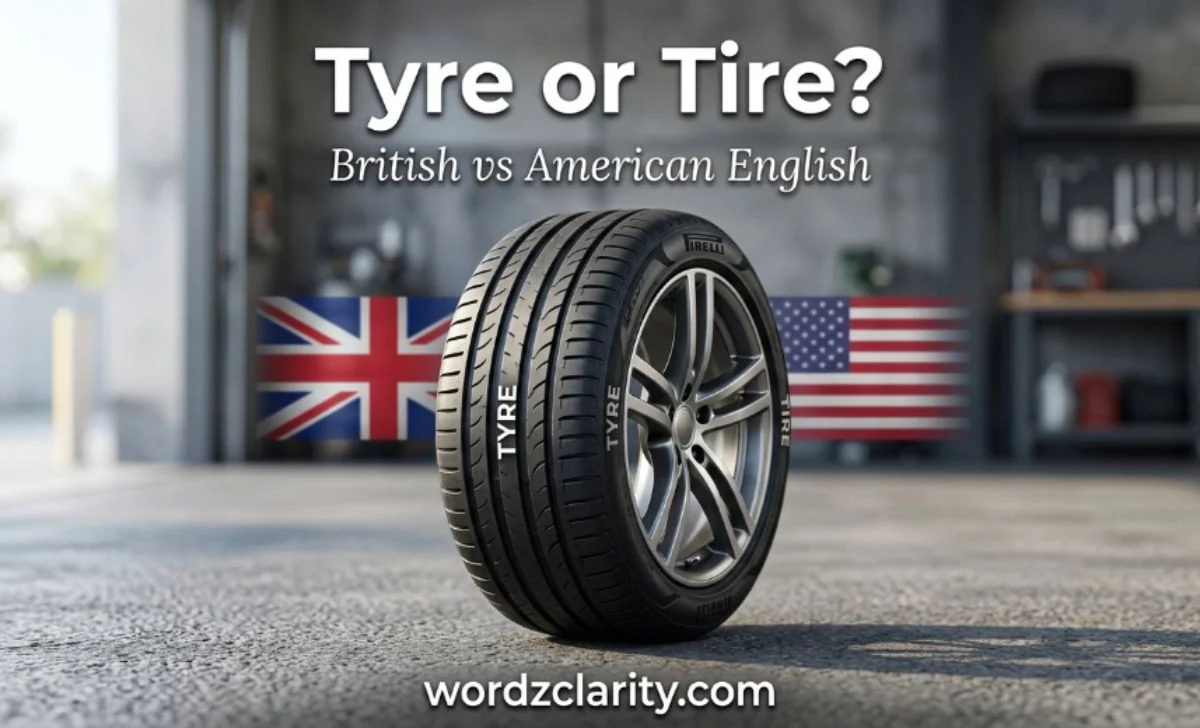
If you have ever wondered whether you should write tyre or tire, you are not alone. Both spellings are correct, but they belong to different varieties of English.
The main difference is regional: tyre is the standard spelling in British English, while tire is the standard spelling in American English when referring to the rubber covering around a vehicle wheel.
This difference can be confusing because the two words have the same meaning and pronunciation in this context. A British driver might talk about changing a tyre, while an American driver would normally say they need to replace a tire.
The same distinction appears in related expressions such as tyre pressure/tire pressure, tyre tread/tire tread, and spare tyre/spare tire.
In this guide, you will learn the difference between tyre and tire, where each spelling is used, how the words relate to wheels, which spelling came first, how their plural forms work, and how to choose the right version for your audience.
Quick Answer
Tyre and tire are both correct spellings when referring to the rubber part of a vehicle’s wheel.
- Tyre = British English and commonly used in other varieties influenced by British English.
- Tire = American English.
- They have the same meaning and pronunciation in this context.
- Neither spelling is a misspelling when used in the appropriate regional variety of English.
Examples
British English:
I need to replace my front tyre.
American English:
I need to replace my front tire.
Both sentences mean the same thing.
The same regional difference applies to related expressions:
| British English | American English |
|---|---|
| car tyre | car tire |
| spare tyre | spare tire |
| flat tyre | flat tire |
| tyre pressure | tire pressure |
| tyre tread | tire tread |
| winter tyres | winter tires |
| tyre repair | tire repair |
| tyre replacement | tire replacement |
So, if you are writing for a British audience, choose tyre. If you are writing for an American audience, choose tire.
Tyre vs Tire:
The most important difference between tyre and tire is spelling rather than meaning.
In modern English, both words can refer to the rubber covering fitted around a wheel, especially on cars, trucks, motorcycles, bicycles, and other vehicles.
The spelling depends largely on the variety of English being used.
Tyre
Tyre is the traditional spelling used in British English.
Examples include:
- The car has a flat tyre.
- Check your tyre pressure before the journey.
- I bought four new tyres.
- The rear tyre needs replacing.
- His bicycle tyre is damaged.
This spelling is also common in countries and regions where British English has traditionally influenced spelling conventions.
Tire
Tire is the standard American English spelling for the vehicle component.
Examples include:
- The car has a flat tire.
- Check your tire pressure before the trip.
- I bought four new tires.
- The rear tire needs replacing.
- His bicycle tire is damaged.
Therefore, tyre is not a misspelling of tire, and tire is not a misspelling of tyre. They are regional spelling variants.
Is Tyre British or American?
Tyre is primarily British English.
If you are following British spelling conventions, use tyre when talking about the rubber covering of a wheel.
For example:
The mechanic checked all four tyres.
British publications, businesses, websites, and government-related writing generally use tyre.
You may also encounter the spelling in countries where British English has historically influenced language and education, although individual countries can have their own established preferences.
Is Tire British or American?
Tire is the standard American English spelling for the vehicle component.
For example:
The mechanic checked all four tires.
American newspapers, websites, automotive companies, schools, businesses, and everyday speakers normally use tire in this sense.
This creates the familiar British-American spelling difference:
British: The tyre needs replacing.
American: The tire needs replacing.
The meaning remains exactly the same.
Tyre or Tire: British vs American English
The difference is similar to other British and American spelling variations.
| British English | American English |
|---|---|
| tyre | tire |
| colour | color |
| centre | center |
| favourite | favorite |
| honour | honor |
| behaviour | behavior |
| organisation | organization |
These differences do not necessarily mean that one version is more correct than the other. They reflect different spelling traditions.
The key is consistency.
If your article, website, school assignment, business document, or publication follows British English, use tyre. If it follows American English, use tire.
Mixing the two systems is usually unnecessary.
Tyre or Tire and the Difference Between a Wheel and a Tyre
One common search question is “tyre or tire wheel?” This can be confusing because a tyre and a wheel are related but are not exactly the same thing.
A wheel is the circular structure that rotates and is attached to a vehicle. A tyre or tire is the rubber component fitted around the wheel.
For a typical car:
Tyre/tire → rubber covering
Wheel → metal or alloy structure inside
For example, you might say:
The tire is worn, but the wheel is still in good condition.
Calling the entire assembly a “wheel” is sometimes acceptable in everyday conversation, but technically the tyre/tire and wheel are separate components.
Example
Imagine a car parked outside a house. Its four wheels each have a rubber tyre or tire fitted around them. If one rubber covering becomes punctured, you have a flat tyre in British English or a flat tire in American English.
This distinction is particularly useful in automotive writing because terms such as wheel, rim, tyre/tire, tread, and pressure can refer to different parts or characteristics.
Which Came First: Tyre or Tire?
The history of tyre and tire is more complicated than simply saying that one spelling replaced the other.
The word has a long history connected with the idea of a circular band or covering around a wheel. Different spellings developed over time, and English spelling was not always standardized in the way it is today.
The spelling tyre became strongly associated with British English, while tire became the dominant American form for the vehicle component.
This is one reason modern British and American English can contain different spellings for the same word.
It is therefore better to think of tyre and tire as established regional forms rather than treating one as the original “correct” spelling and the other as an error.
For modern writing, the practical question is not which spelling is older. The useful question is:
Which English variety are you using?
Tyres or Tires: What’s the Plural?
The plural forms follow the same regional spelling distinction.
- One tyre → two tyres
- One tire → two tires
British English
The car needs four new tyres.
American English
The car needs four new tires.
Both plural forms are grammatically correct.
A common mistake is to use tyres in an otherwise American-English article or tires in an otherwise British-English article. The individual spelling is not wrong, but inconsistent regional usage can make the writing look less polished.
Tyre vs Tire Pronunciation
In the vehicle sense, tyre and tire are normally pronounced the same way.
They are generally pronounced like the word “tie” followed by an r sound in accents that pronounce the final r.
So there is usually no pronunciation difference between tyre and tire simply because the spelling is different.
For example:
The front tyre is worn.
and
The front tire is worn.
The pronunciation is essentially the same in the relevant varieties of English.
This makes the pair a spelling distinction rather than a pronunciation distinction.
Tyre or Tire in F1
Formula 1 is another area where people frequently search for “tyre or tire in F1.”
Formula 1 uses terminology that reflects its international and British roots, so tyre is commonly seen in official and specialist Formula 1 contexts.
You will often encounter expressions such as:
- F1 tyres
- Formula 1 tyres
- soft tyres
- medium tyres
- hard tyres
- wet-weather tyres
- tyre temperature
- tyre degradation
- tyre pressure
For example:
The team struggled with tyre degradation during the race.
However, this does not mean tire is grammatically wrong in every discussion of Formula 1. An American publication may follow its own house style and use tire.
The important point is that specialized organizations and publications may have established terminology, while general writers should normally follow the spelling conventions of their chosen English variety.
Tyre or Tire in Different Countries
Regional spelling is one of the easiest ways to decide which form to use.
United Kingdom
Use tyre.
The tyre needs more air.
United States
Use tire.
The tire needs more air.
Other English-speaking regions
Usage can vary by country, publication, organization, and local language tradition. Many places influenced by British English use tyre, while American-influenced writing may use tire.
If you are writing for an international website, choose one spelling system and use it consistently.
For example, if your entire article uses colour, centre, favourite, and organisation, then tyre will usually fit that British-style spelling system better.
If your article uses color, center, favorite, and organization, then tire will normally be the natural choice.
Common Tyre and Tire Mistakes
Because the two forms are so similar, writers often make mistakes when switching between English varieties.
1. Treating tyre as a misspelling
This is incorrect.
Tyre is a standard British English spelling.
British: I need a new tyre.
There is no spelling error in this sentence.
2. Treating tire as a misspelling
This is also incorrect.
Tire is the standard American English form.
American: I need a new tire.
Again, the sentence is correct.
3. Mixing regional spellings
A writer might use:
The colour of the tire is unusual.
This is not necessarily grammatically wrong, but it combines a British spelling (colour) with an American spelling (tire).
A consistent British version would be:
The colour of the tyre is unusual.
A consistent American version would be:
The color of the tire is unusual.
4. Confusing tire with tired
The word tire has another meaning that has nothing to do with wheels.
As a verb, tire can mean to become tired or to make someone tired.
For example:
The long walk began to tire him.
Tired, meanwhile, describes someone who needs rest:
I am tired after the long walk.
So tire can have two very different uses:
- Tire = the rubber covering around a wheel.
- Tire = to make or become weary.
The spelling tyre is generally used for the vehicle component in British English, while tire can represent both meanings in American English.
Tire vs Tired: Don’t Confuse Them
The search query “tire or tired” usually points to a completely different grammatical issue.
Compare these examples:
My car has a flat tire.
Here, tire is a noun referring to a vehicle component.
The long journey made me tired.
Here, tired is an adjective describing someone’s condition.
You can also use tire as a verb:
The long journey may tire the driver.
These words are related in spelling but have different grammatical roles and meanings.
In British English, the vehicle component is usually spelled tyre, which makes the distinction visually clearer:
My car has a flat tyre.
The long journey made me tired.
Real-World Examples of Tyre
Here are examples of how tyre naturally appears in British English.
Everyday conversation
I think one of the tyres is flat.
Please arrange for the front tyre to be replaced.
Business writing
Customers should check their tyre pressure regularly.
Academic writing
Tyre wear can affect vehicle performance and road safety.
News writing
The driver stopped after noticing a damaged tyre.
Website content
Learn how to check your tyre pressure at home.
Social media
Just got four new tyres for the car.
Real-World Examples of Tire
The same ideas are expressed with tire in American English.
Everyday conversation
I think one of the tires is flat.
Please arrange for the front tire to be replaced.
Business writing
Customers should check their tire pressure regularly.
Academic writing
Tire wear can affect vehicle performance and road safety.
News writing
The driver stopped after noticing a damaged tire.
Website content
Learn how to check your tire pressure at home.
Social media
Just got four new tires for the car.
Tyre or Tire: Which One Should You Use?
The best spelling depends on your audience.
Use tyre when:
- You are writing in British English.
- Your audience is primarily British.
- Your organization follows British spelling.
- Your publication uses British spelling conventions.
- You are following a style guide that specifies British English.
Use tire when:
- You are writing in American English.
- Your audience is primarily American.
- Your organization follows American spelling.
- Your publication uses American English.
- Your style guide specifies American spelling.
For international websites
International websites need a little more care.
If your website targets readers from several countries, you can choose one spelling system and apply it consistently. Alternatively, you can mention both forms once when the distinction is relevant:
In British English, the word is spelled tyre, while American English uses tire.
After that, stick to the spelling appropriate for your main audience.
Tyre or Tire: A Simple Comparison
| Feature | Tyre | Tire |
|---|---|---|
| Main variety | British English | American English |
| Meaning | Rubber covering around a wheel | Rubber covering around a wheel |
| Pronunciation | Generally the same | Generally the same |
| Singular | tyre | tire |
| Plural | tyres | tires |
| Common phrase | tyre pressure | tire pressure |
| Common phrase | flat tyre | flat tire |
| Common phrase | spare tyre | spare tire |
| Vehicle use | Yes | Yes |
| Verb meaning “become weary” | Usually spelled tire | tire |
The table shows why the choice is mainly a matter of regional spelling and context.
Practical Writing Tips
If you regularly write for different audiences, these simple rules can help.
Know your target audience
Before choosing between tyre and tire, decide whether your content is primarily British or American English.
Follow your existing spelling system
Do not choose tyre or tire in isolation. Look at other spelling choices in your article.
If you write:
colour, centre, favourite
then tyre will usually be consistent.
If you write:
color, center, favorite
then tire will usually fit better.
Be consistent
Once you choose a spelling, use it throughout the article unless you are specifically discussing the difference between the two forms.
Follow a house style
Businesses, newspapers, universities, and websites may have their own style guides. If a style guide says to use American English, follow tire. If it requires British English, use tyre.
Don’t call either form wrong
The question is not simply “Which spelling is correct?”
The better question is:
Which spelling is correct for my variety of English?
That approach avoids unnecessary confusion.
FAQs
1. Is tyre or tire correct?
Both are correct. Tyre is the standard British English spelling, while tire is the standard American English spelling for the rubber covering around a wheel.
2. Is tyre British or American?
Tyre is primarily the British English spelling. It is also used in various regions influenced by British English.
3. Is tire British or American?
Tire is the standard American English spelling for the vehicle component.
4. Do tyre and tire mean the same thing?
Yes. When referring to the rubber covering around a wheel, tyre and tire have the same meaning.
5. Are tyre and tire pronounced the same?
Generally, yes. In the vehicle sense, the two spellings normally have the same pronunciation.
6. What is the plural of tyre and tire?
The British plural is tyres, while the American plural is tires.
7. Is a tyre the same as a wheel?
Not exactly. A tyre is the rubber covering fitted around a wheel. The wheel is the circular structure to which the tyre is fitted.
Conclusion
So, tyre or tire? The answer depends on the variety of English you are using. Tyre is the standard British English spelling, while tire is the standard American English spelling.
Both refer to the rubber covering around a vehicle wheel, and neither is a misspelling when used according to the appropriate regional convention.
The difference also appears in related words and phrases. British writers use tyres, tyre pressure, flat tyre, spare tyre, and tyre tread, while American writers use tires, tire pressure, flat tire, spare tire, and tire tread. The pronunciation is generally the same, even though the spelling differs.
For professional writing, the most important rule is consistency. Choose the spelling that matches your audience, publication, or style guide.
If you are writing for a British audience, use tyre. If your readers are primarily American, use tire. For international content, clearly explain the difference when useful and then follow one consistent spelling system.
Read More Blogs:
- Sheath or Sheathe: Which Word Is Correct?
- Website or Web Site: Which Form Is Correct in Modern English?
- Skill Set or Skillset: Which Spelling Is Correct?