If you have ever wondered whether web site or website is the correct spelling, you are not alone. Both forms have appeared in English writing, especially because the internet has changed how people use the word over time.
You may still see web site in older articles, technical documents, or style guides, while website is now the form most readers expect.
The good news is simple: website is the standard modern spelling. It is written as one word and is widely used in American, British, Australian, Canadian, and international English.
In this guide, you will learn why website is preferred, how the spelling developed, whether web site is wrong, when you might encounter the two-word version, and how to use the word naturally in professional, academic, business, and everyday writing.
Quick Answer
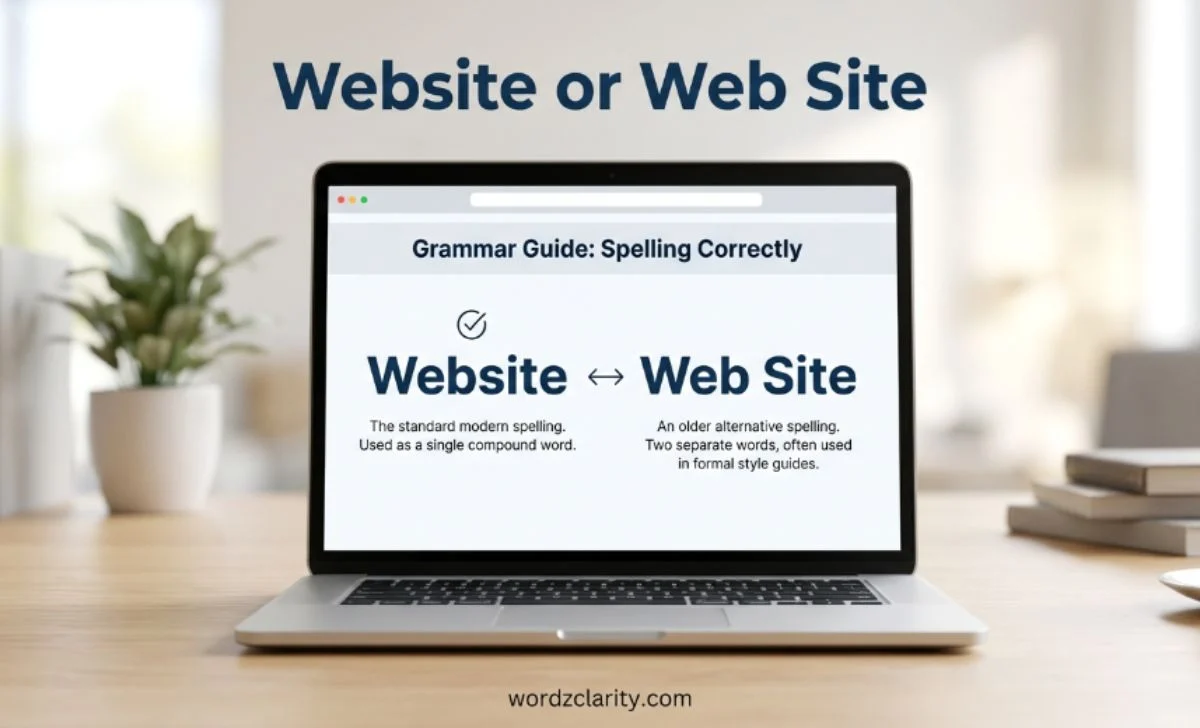
Website is the standard modern spelling.
- Website → preferred and widely accepted today
- Web site → older or less common variant
- web-site → generally unnecessary in modern English
Examples
- Please visit our website for more information.
- I found the application form on their website.
- The company redesigned its website last year.
- You can register through the official website.
If you are writing an email, article, report, academic paper, business page, or social media post, website is normally the best choice.
Website or Web Site: The Basic Difference
The difference between website and web site is mainly a matter of modern usage and spelling convention rather than meaning.
Both forms refer to a collection of connected web pages and related content available under a particular domain or online address.
However, English has gradually moved toward treating the expression as a single compound word.
| Form | Meaning | Modern usage | Recommended? |
|---|---|---|---|
| website | A collection of web pages | Very common | Yes |
| web site | A collection of web pages | Less common/older | Usually no |
| web-site | A collection of web pages | Rare | No |
The one-word form has become the normal choice because compounds often become closed words as they become familiar.
Similar changes have happened with many other English expressions. Words that were once written separately can eventually become hyphenated and then closed into a single word.
For everyday modern English, website is the clearest choice.
Why Is Website Usually Written as One Word?
The word website is a compound formed from web and site.
Originally, writers often treated the expression as two separate words:
web site
As internet-related vocabulary became more familiar, the expression increasingly became treated as a single lexical item:
website
This process is common in English. When two words are frequently used together and develop a specific combined meaning, speakers and writers may gradually begin treating them as one word.
The same general pattern can be seen in words such as:
- online
- homepage
- username
- download
- webpage
Not every language change follows exactly the same path, and some compounds remain open phrases. However, website has become firmly established as a closed compound in modern standard English.
Is Web Site Wrong?
Not necessarily.
Web site can be understood and has been used historically in English. It is not an unintelligible expression, and readers will generally understand what it means.
The important point is that website is now the much more conventional form.
If you are writing modern content, choosing web site may make your writing look dated or inconsistent with current usage.
For example:
Less modern:
Visit our web site to learn more.
Modern:
Visit our website to learn more.
The second version is normally preferable.
This is especially true when writing for:
- Business websites
- Blogs
- Online publications
- Marketing materials
- Academic work
- Professional emails
- Technical documentation
- Social media
- News content
There is usually no advantage to choosing web site over website in these contexts.
When Did Website Become the Standard Form?
The history of the word helps explain the spelling confusion.
In the early years of the World Wide Web, writers used different forms, including web site, website, and sometimes Web site.
At that time, internet vocabulary was still developing. Writers, publishers, and style guides had not completely settled on consistent conventions.
As the web became part of everyday life, website became increasingly common. Eventually, the one-word spelling became the dominant modern form.
This is a normal part of language development. New technology often produces vocabulary that changes quickly.
Early computer and internet terminology frequently went through periods of variation before one spelling became standard.
Today, website is the form most readers will expect.
Website in British and American English
One useful point about website is that the spelling is essentially the same in major varieties of English.
Unlike words such as colour/color, organise/organize, or centre/center, there is no major British-American spelling difference here.
Comparison
| Variety | Preferred form |
|---|---|
| American English | website |
| British English | website |
| Canadian English | website |
| Australian English | website |
| International English | website |
Therefore, you generally do not need to change the spelling depending on whether your audience is American or British.
For example:
American English:
Check the company’s website.
British English:
Check the company’s website.
The spelling remains the same.
Website vs. Web Site in Professional Writing
Professional writing benefits from using familiar and current terminology.
If you are preparing a business report, company email, resume, proposal, presentation, or official document, website is normally the safest choice.
Business example
Our website provides detailed information about our services.
Professional email
You can find the required documents on our website.
Company report
Website traffic increased significantly during the final quarter.
Marketing copy
Visit our website to explore our latest products.
These examples sound natural because website is now deeply established in professional English.
Using web site is not likely to prevent understanding, but it can appear less current.
Website in Academic Writing
Students and researchers may also need to use the word website when discussing online sources.
For example:
The organization provides detailed information on its website.
Or:
The study collected publicly available data from several websites.
When describing online sources in academic writing, consistency matters. If your chosen style guide has specific rules for terminology or citations, follow those rules. But for the ordinary noun referring to an online location, website is the standard modern spelling.
Example
Natural:
The researchers examined information published on the organization’s website.
Less common:
The researchers examined information published on the organization’s web site.
The first version is more consistent with contemporary usage.
Website vs. Webpage
Another common source of confusion is the difference between website and webpage.
They are related, but they do not mean exactly the same thing.
A website is generally a larger online location containing multiple pages or resources.
A webpage is an individual page within a website.
For example, imagine a university website containing:
- Home page
- About page
- Admissions page
- Contact page
- Course pages
The entire collection is the website.
Each individual page is a webpage.
Example
I visited the university’s website and opened its admissions webpage.
This distinction is useful because people sometimes use the two words interchangeably when they actually refer to different things.
Website vs. Web
The word web is broader than website.
The Web, short for the World Wide Web, refers to the interconnected system of websites and web resources accessed through the internet.
A website, on the other hand, is a particular online location.
For example:
The Web has changed the way people communicate.
But:
I visited the company’s website.
The first sentence refers to the broader web environment. The second refers to one particular website.
Common Mistakes With Website
Although the spelling is straightforward, several related mistakes appear in everyday writing.
1. Writing “web site” unnecessarily
Visit our web site.
Modern version:
Visit our website.
The two-word form may be understood, but the one-word form is more conventional.
2. Using “web-site”
Some writers add a hyphen:
Visit our web-site.
This spelling is generally unnecessary in modern English.
Use:
Visit our website.
3. Confusing website with webpage
A website can contain many webpages.
For example:
I found the article on the company’s website.
You could say:
I found the webpage on the company’s website.
But calling the entire website a webpage would change the meaning.
4. Random capitalization
The common noun is normally written in lowercase:
website
You usually do not need:
Website
unless it appears at the beginning of a sentence or is part of a proper name or title.
Should Website Be Capitalized?
Normally, website is lowercase.
Correct
Visit our website for updates.
Also correct at the beginning of a sentence
Website visitors can create an account.
The capital W in the second example appears only because the word begins the sentence.
You should not normally write:
Visit our Website for updates.
unless Website is part of a specific brand name or follows a particular branding convention.
Website in a title
Capitalization in titles depends on the title style being used.
For example:
How to Create a Website
or:
How to Create a website
Different style systems use different title-capitalization rules. The important point is that ordinary running text normally uses lowercase website.
Plural Form: Websites
The plural of website is websites.
Examples
- The company operates several websites.
- I compared three websites before making a decision.
- Government websites often provide official information.
- These websites offer free educational resources.
Do not normally write:
web sites
when you mean the modern plural form.
Use:
websites
The compound remains closed in the plural.
Possessive Form: Website’s
When something belongs to or is associated with a website, use the possessive form website’s.
Examples
The website’s design is easy to navigate.
I could not find the website’s contact information.
The website’s homepage loads quickly.
For a plural possessive, use websites’:
Several websites’ policies were compared.
However, in many sentences, rewriting the sentence can make it sound more natural.
Website in Everyday Conversation
People use website constantly in ordinary speech.
You might hear:
- “What’s their website?”
- “I found it on their website.”
- “Check the website.”
- “The website isn’t working.”
- “Go to the official website.”
- “I saw it on a website.”
Because the word is so common, the one-word form is now firmly established in everyday English.
Conversation example
Where can I apply?
Go to the company’s website.
I’ll check it now.
This sounds natural and current.
Website in Business and Marketing
The word is especially common in business communication.
Businesses use websites to:
- Present products and services
- Publish company information
- Accept orders
- Provide customer support
- Share contact details
- Publish announcements
- Collect applications
- Build brand awareness
Because website is standard business vocabulary, using the modern spelling helps your writing feel polished.
Examples
Our website has been updated with new product information.
Customers can contact us through the website.
The company launched a new website last month.
Website visitors can subscribe to our newsletter.
Website in News and Online Publishing
News organizations and online publishers also commonly use website.
Examples include:
The newspaper published the full report on its website.
More details are available on the official website.
The organization’s website contains the complete statement.
This usage is important because modern readers encounter website across many types of digital content.
Website in Social Media Writing
Social media posts often use informal language, but website remains the normal spelling.
For example:
Visit our website to learn more.
Full details are available on our website.
Link in bio for our website.
Check our website for the latest updates.
Even in casual digital communication, there is usually no reason to replace website with web site.
Useful Words Related to Website
Learning related vocabulary can make your English more precise.
| Word | Meaning |
|---|---|
| website | A collection of related web pages |
| webpage | A single page on the web |
| homepage | The main or starting page of a website |
| web address | The address used to locate a web resource |
| domain | A unique name associated with a website |
| web browser | Software used to access websites |
| web server | A server that delivers web content |
| online | Connected to or available through the internet |
These words often appear together in technical, business, and everyday writing.
Which Form Should You Use?
For almost all modern writing, choose website.
It is the best option when you are writing for:
- A general audience
- American readers
- British readers
- International readers
- Customers
- Students
- Teachers
- Business professionals
- Online readers
There is rarely a practical reason to choose web site today.
Simple rule
Use “website” unless a specific publication, quotation, historical source, or style requirement tells you otherwise.
This rule will work well for most modern English writing.
How to Remember the Correct Spelling
If you regularly hesitate between web site or website, use a simple memory trick:
Website = web + site, written together.
Think of it as one established digital location rather than two separate words.
You can also remember these related forms:
- website
- websites
- webpage
- webpages
- homepage
- homepage’s
Seeing these words as established compounds makes the spelling easier to remember.
Website or Web Site: Final Comparison
| Feature | Website | Web site |
|---|---|---|
| Spelling | One word | Two words |
| Meaning | Online location | Online location |
| Modern usage | Very common | Less common |
| British English | Standard | Older/less common |
| American English | Standard | Older/less common |
| Professional writing | Recommended | Usually avoid |
| Academic writing | Preferred | Less common |
| Business writing | Preferred | Less common |
| Social media | Preferred | Unusual |
| Plural | websites | web sites |
| Best modern choice | Yes | Usually no |
The key difference is not meaning. Both forms can refer to the same thing. The main issue is which spelling reflects current standard usage.
Practical Writing Tips
When writing about websites, keep these points in mind:
- Use “website” as the default spelling.
- Do not add a hyphen unless a specific style requires one.
- Use lowercase “website” in ordinary sentences.
- Use “websites” for the plural.
- Do not confuse a website with an individual webpage.
- Keep your spelling consistent throughout an article or document.
- If you are following a specific publication’s style guide, follow its stated preference.
- When writing for an international audience, website is a clear and familiar choice.
These simple rules will prevent most spelling and usage problems.
FAQs
1. Is “website” one word or two?
Website is normally written as one word in modern English. The older form web site is still understandable but is much less common.
2. Is “web site” grammatically correct?
Yes, web site has been used in English and may appear in older material. However, website is the standard modern spelling and is generally the better choice today.
3. Is website British or American English?
Website is used in both British and American English. Unlike some spelling differences between the two varieties, this word normally does not change.
4. Should I write web-site with a hyphen?
Generally, no. Web-site is not the normal modern spelling. Use website instead.
5. What is the plural of website?
The plural is websites.
Example:
The company owns several websites.
6. Is webpage one word like website?
Yes. Webpage is commonly written as one word in modern English. It refers to an individual page, while a website can contain many webpages.
7. Should website have a capital W?
Usually, no. Write website in lowercase in normal sentences. Capitalize it only when it starts a sentence or when a specific proper name or title requires capitalization.
Conclusion
When choosing between web site or website, the best modern choice is website. Although web site has a legitimate history in English and may still appear in older publications or archived material, the one-word spelling has become the normal form in contemporary English.
The spelling website works across American, British, Canadian, Australian, and international English, so you do not normally need to change it for different audiences.
It is also the preferred choice for business writing, academic content, emails, blogs, news articles, marketing copy, and social media.
Remember the simple rule: write website as one word. Use websites for the plural, and avoid the unnecessary hyphenated form web-site. If you consistently use the modern form, your writing will look natural, current, and professional.
Read More Blogs:
- Milwaukee or Makita: Which Brand Is Better for Your Tools?
- Kilm or Kiln: Understanding the Correct Spelling and Meaning
- Fios or Comcast: Which Internet Provider Should You Choose?