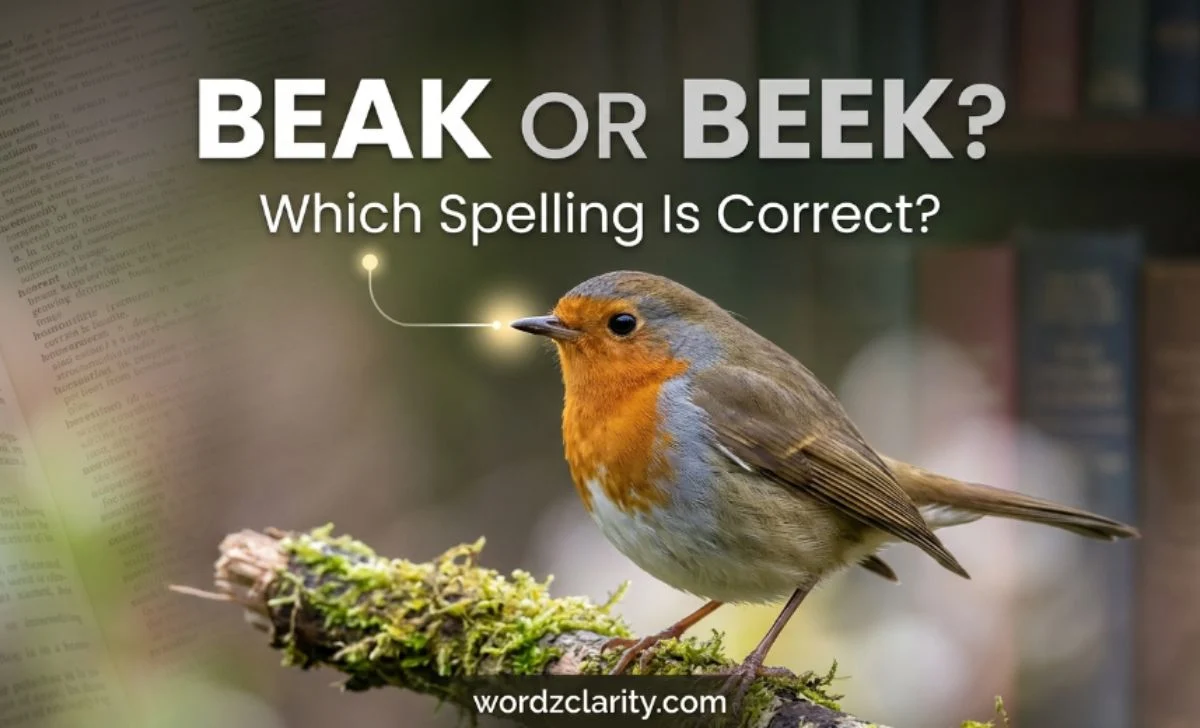
Choosing between beak or beek can be confusing when you hear the word but do not see it written. Both forms may sound similar, but they are not equal in standard English. If you mean the hard mouth of a bird, beak is the correct spelling.
Beek is generally a misspelling in this context. This small spelling difference can matter in schoolwork, articles, emails, and other formal writing.
The good news is that the rule is easy to remember. This guide explains what beak means, why beek is usually incorrect, and how to use the correct word in everyday sentences.
You will also learn how pronunciation causes confusion, whether British and American English use different forms, and how to avoid this spelling mistake.
Quick Answer
Beak is the correct spelling when you mean a bird’s mouth.
Beek is not the standard spelling for this meaning.
Examples
The eagle has a sharp beak.
The parrot cleaned its beak.
The bird used its beak to pick up a seed.
So, the simple rule is:
Beak = correct
Beek = incorrect for a bird’s mouth
This is not a British or American spelling difference. Beak is the standard form in both.
What Does “Beak” Mean?
Beak is a noun.
It means the hard mouth of a bird.
Birds use their beaks in many ways. They use them to eat, pick up food, and clean their feathers. Some birds also use their beaks to build nests or protect themselves.
Different birds have different beaks.
For example:
- Eagles have strong, hooked beaks.
- Parrots have curved beaks.
- Hummingbirds have long, thin beaks.
- Ducks have wide bills.
Simple examples
The bird has a yellow beak.
The eagle opened its beak.
The parrot broke the seed with its beak.
The small bird has a short beak.
In every example, beak is the correct spelling.
What Does “Beek” Mean?
When you mean a bird’s mouth, beek is not the standard English spelling.
It is usually a spelling mistake.
The mistake often happens because people spell words by sound. When someone hears beak, the spelling beek may seem possible.
However, English spelling does not always follow pronunciation perfectly.
So you should write:
The bird has a long beak.
Not:
The bird has a long beek.
The correct form is especially important in formal writing.
Beak vs Beek: What Is the Difference?
The difference is simple.
Beak is the standard English word.
Beek is generally a misspelling when it refers to a bird’s mouth.
| Word | Standard spelling? | Meaning |
|---|---|---|
| Beak | Yes | A bird’s hard mouth |
| Beek | No | Usually a spelling mistake |
This is different from spelling pairs such as color/colour.
Those forms are accepted in different English varieties.
Beak and beek are not like that.
You should use beak in standard English.
Why Is “Beek” a Common Mistake?
The main reason is pronunciation.
Beak has a long vowel sound. This can make beek look like a reasonable spelling.
However, the correct spelling uses ea:
B + EA + K = BEAK
The letters ea appear in many common English words.
For example:
- speak
- weak
- leak
- peak
The spelling pattern can help you remember beak.
A simple memory rule
Think:
Bird + EA + K = BEAK
You do not need to memorize a complicated grammar rule.
Just remember the middle letters:
EA
Is “Beak” British or American English?
Beak is used in both British and American English.
There is no different standard spelling for either variety.
| English variety | Standard spelling |
|---|---|
| British English | beak |
| American English | beak |
| Canadian English | beak |
| Australian English | beak |
For example:
British English:
The bird has a large beak.
American English:
The bird has a large beak.
The spelling stays the same.
Therefore, you do not need to choose between beak and beek based on your audience.
How to Use “Beak” in a Sentence
Beak is a noun.
It can appear in many simple sentence patterns.
The bird has a beak.
The bird opened the beak.
The parrot cleaned its beak.
The eagle has a sharp beak.
With a possessive noun
The eagle’s beak is curved.
These patterns work well in both everyday and formal writing.
Beak in Everyday Conversation
People commonly use beak when talking about birds.
For example:
Look at that bird’s beak!
Its beak is really long.
What color is the bird’s beak?
The bird has a strange-looking beak.
These sentences sound natural.
Using beek instead would be a spelling error.
Beak in School and Academic Writing
The word beak is also common in educational writing.
For example:
Birds use their beaks to find and eat food.
The shape of a bird’s beak can suit its diet.
Different bird species have different beak shapes.
A science student might write:
The eagle’s curved beak helps it tear food.
In academic writing, correct spelling matters. Therefore, beak should always be used instead of beek.
Beak in Emails, Websites, and Social Media
The word can also appear in many types of everyday writing.
I attached a photo of the bird with the unusual beak.
Website
This bird is known for its long, narrow beak.
Social media
Look at this little bird’s colorful beak!
News writing
The bird was identified by its distinctive beak.
Conversation
That bird has a very sharp beak.
The context may change, but the spelling does not.
Beak or Bill: Are They the Same?
Beak and bill can both describe a bird’s mouth.
However, bill is often used for certain birds.
Ducks are a good example.
The duck has a wide bill.
You can also use beak as a general term for a bird’s mouth.
The eagle has a curved beak.
So, both words can be correct.
But beek is not the standard alternative.
| Word | Common meaning |
|---|---|
| Beak | General term for a bird’s mouth |
| Bill | Often used for ducks and similar birds |
| Beek | Not the standard spelling for this meaning |
Different Beak Shapes
Birds have different beak shapes.
Their shapes often suit the food they eat.
Hooked beaks
Eagles and hawks have hooked beaks.
These beaks help them tear food.
Long beaks
Some birds have long beaks.
These can help them reach food in narrow places.
Short beaks
Some birds have short, strong beaks.
These can help them handle seeds and other hard food.
Wide bills
Ducks have broad bills.
These are useful for their feeding habits.
For example:
The hummingbird has a long beak.
The eagle has a hooked beak.
The duck has a wide bill.
Common Mistakes With “Beak”
1. Writing “Beek”
❌ The bird has a sharp beek.
✅ The bird has a sharp beak.
This is the main spelling mistake.
2. Thinking “Beek” Is British English
❌ British English uses beek.
✅ British English uses beak.
American English also uses beak.
3. Spelling the Word by Sound
The sound may make beek seem logical.
But the standard spelling is:
BEAK
Remember the EA.
4. Using the Wrong Spelling in Formal Writing
Avoid beek in:
- Essays
- Reports
- Schoolwork
- Articles
- Business writing
- Professional documents
Use beak instead.
An Easy Way to Remember “Beak”
You can use a simple spelling trick.
Remember:
BEAK has EA in the middle.
Then connect it with familiar words such as:
- weak
- speak
- leak
You can also use this sentence:
A bird has a beak.
The more often you see the correct spelling, the easier it becomes to remember.
When Should You Use “Beak”?
Use beak when you are talking about the mouth of a bird.
For example:
The bird opened its beak.
The eagle has a powerful beak.
The parrot has a curved beak.
The bird used its beak to eat the seed.
If that is your meaning, beak is the word you need.
You do not need to use beek.
Summary
The difference between beak or beek is easy to understand.
Beak is the correct standard spelling for a bird’s mouth. Beek is generally a spelling mistake when used with this meaning.
The confusion usually comes from pronunciation. The word sounds as though it could be written with ee. However, the correct spelling uses ea:
B + EA + K = BEAK
The spelling is the same in British and American English. It does not change by region.
Remember these examples:
The eagle has a sharp beak.
The parrot cleaned its beak.
The bird picked up the seed with its beak.
If you mean a bird’s mouth, choose beak every time.
How Is “Beak” Pronounced?
Beak is pronounced like “beek.”
Its pronunciation can explain why people sometimes spell it incorrectly.
The word has one syllable.
A simple pronunciation guide is:
beak → /biːk/
The vowel sound is the same sound you hear in words such as:
- see
- tree
- green
- speak
However, pronunciation does not tell you the spelling.
The correct written form is still:
beak
This is why writing the word as beek is considered a spelling mistake when you mean a bird’s mouth.
Where Did the Word “Beak” Come From?
The word beak has a long history in English.
It entered English through French and is related to older words referring to a bird’s bill or pointed structure.
Over time, beak became the familiar English word used for a bird’s hard mouth.
The word is now common in everyday English.
You will find it in:
- Children’s books
- Nature articles
- School textbooks
- Wildlife websites
- Newspapers
- Conversations
- Scientific discussions
Although the history is interesting, you do not need to know its origin to use the word correctly.
The most important point is simple:
Beak is the standard spelling.
What Are the Plural and Possessive Forms?
The plural form of beak is easy.
Singular
The bird has a long beak.
Plural
The birds have long beaks.
Simply add -s:
beak → beaks
You can also use the possessive form.
Singular possessive
The eagle’s beak is curved.
Plural possessive
The birds’ beaks are different shapes.
These forms are useful in both casual and formal writing.
Beak in Descriptive Writing
Beak is especially useful when describing birds.
Writers often add an adjective before the word.
For example:
- sharp beak
- curved beak
- long beak
- short beak
- wide beak
- narrow beak
- colorful beak
- powerful beak
- pointed beak
Examples
The eagle has a powerful, curved beak.
The hummingbird has a long, narrow beak.
The parrot has a bright red beak.
The small bird has a short, pointed beak.
These descriptions make writing more specific.
Beak in Science and Nature Writing
The word beak is common in scientific and educational texts.
For example:
The shape of a bird’s beak can affect how it feeds.
Another example:
Birds have different beak shapes because they have different diets and feeding habits.
A science article might explain how certain birds use their beaks to find food.
For instance:
A long beak can help a bird reach food in narrow spaces.
The exact function depends on the species.
This makes beak an important word in biology and nature-related writing.
Can “Beak” Be Used Figuratively?
Yes.
English sometimes uses beak in informal or figurative expressions.
One example is the phrase:
Keep your beak out.
This means do not interfere in something that does not concern you.
For example:
It’s a private matter, so keep your beak out of it.
This expression is informal and may sound humorous or rude depending on the situation.
There is also an older informal use of beak for a judge or magistrate in British English.
This use is much less common today and usually depends on context.
The important point is that these meanings still use the spelling:
beak
not beek.
Beak vs Beak-Like
The word beak can also appear in compound or descriptive forms.
For example:
The creature had a beak-like mouth.
Here, beak-like means something that looks like a beak.
The spelling uses the original word beak.
Depending on the style guide and sentence structure, compounds may be written with or without a hyphen.
For ordinary writing, however, the most important form to remember is simply:
beak
Beak vs Bill: Which Word Should You Choose?
Both beak and bill can describe a bird’s mouth.
However, the choice often depends on the type of bird.
Beak is a broad, familiar term.
Bill is especially common for ducks, geese, and some other birds.
Compare these examples:
The eagle has a hooked beak.
The duck has a broad bill.
Both sentences sound natural.
You do not need to replace beak with bill unless the context makes bill more appropriate.
And remember:
beek is not a standard replacement for either word.
How to Avoid the Beak or Beek Mistake
If this spelling causes problems, use a short checking process.
Step 1: Ask what you mean
Are you talking about a bird’s mouth?
If yes, use beak.
Step 2: Check the middle letters
The correct word contains:
EA
Not:
EE
Step 3: Read the sentence again
For example:
The bird has a long beak.
The sentence looks correct.
Step 4: Remember that it is not regional
Do not change the spelling for British or American readers.
Both use:
beak
This four-step check takes only a few seconds.
Examples: Correct and Incorrect
The easiest way to understand the difference is to compare sentences.
| Incorrect | Correct |
|---|---|
| The bird has a sharp beek. | The bird has a sharp beak. |
| The parrot opened its beek. | The parrot opened its beak. |
| The eagle has a curved beek. | The eagle has a curved beak. |
| The bird used its beek to eat. | The bird used its beak to eat. |
| The chick opened its beek for food. | The chick opened its beak for food. |
The pattern is consistent.
When the meaning is a bird’s mouth, choose beak.
What Should You Write in Formal English?
In formal writing, always use the standard spelling beak.
This includes:
- Academic papers
- School assignments
- Research reports
- Business documents
- News articles
- Website content
- Educational materials
For example:
The bird’s beak is adapted to its diet.
This is clear and professional.
Avoid:
The bird’s beek is adapted to its diet.
The second sentence contains a spelling error.
Is “Beek” Ever a Word?
You may encounter Beek in names or other proper contexts.
For example, a word can appear as a surname or part of a place name. In such cases, capitalization and context matter.
That does not mean beek is an alternative spelling of the common noun beak.
So if you are writing:
The bird has a large ___.
The answer is:
beak
Not:
beek
Beak or Beek: A Quick Decision Guide
When you are unsure, use this guide.
Are you talking about a bird’s mouth?
Yes → Beak
Are you writing for British readers?
Use → Beak
Are you writing for American readers?
Use → Beak
Are you writing an academic paper?
Use → Beak
Are you describing an eagle, parrot, or hummingbird?
Use → Beak
The answer remains the same in each case.
FAQs
1. Is “beak” the correct spelling?
Yes. Beak is the standard spelling for the hard mouth of a bird.
2. Is “beek” a correct spelling of beak?
No. Beek is generally a spelling mistake when it is used to mean a bird’s mouth.
3. Is “beek” British English?
No. Beek is not the standard British spelling. British English uses beak.
4. Is “beak” American English?
Yes. Beak is the standard American English spelling as well.
5. Why do people spell beak as beek?
The main reason is pronunciation. Beak sounds like “beek,” so people may spell it according to the sound.
6. What is the plural of beak?
The plural is beaks.
For example:
The birds have different beaks.
7. Can I use “bill” instead of “beak”?
Sometimes. Bill is commonly used for ducks and some other birds. Beak is a general term for a bird’s mouth.
Conclusion
The correct spelling is beak, not beek, when you mean the hard mouth of a bird. The confusion mainly comes from pronunciation because beak sounds like “beek.” Even so, standard English uses ea, giving us b-e-a-k.
The same spelling is used in British and American English, so there is no regional difference to remember. Beak can be used in everyday conversation, schoolwork, science writing, articles, emails, and professional content.
Its plural form is beaks, and related words such as bill may be appropriate for certain birds. If you are unsure, remember one simple rule: a bird has a beak. Once you remember the ea spelling, you can easily avoid the common beek mistake in both casual and formal writing.
Read More Blogs:
- Quite vs Quiet: Definitions, Examples, and Grammar Rules
- Optimize or Optimise: American and British Spelling Compared