If you have ever wondered whether “themselves or theirselves” is the correct form, you are not alone. The two words may sound similar, especially in fast or informal speech. However, they do not have the same status in standard English.
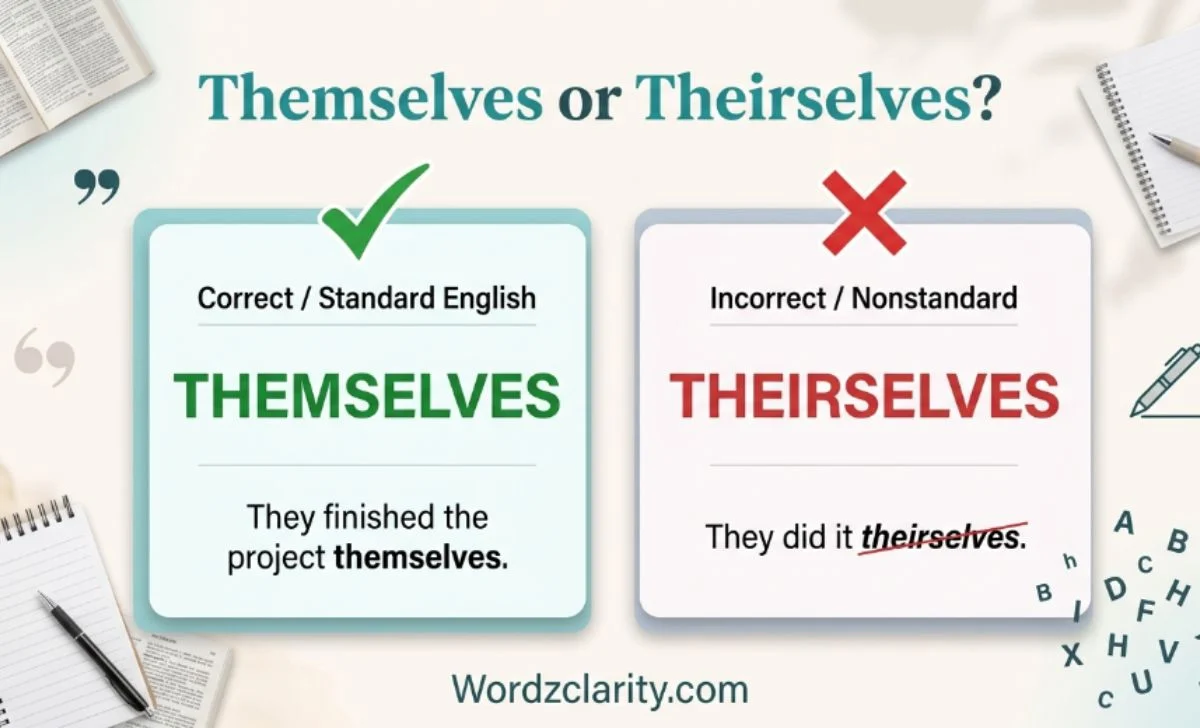
The correct form for normal English writing is themselves. It is the standard reflexive pronoun used with they and them.
Theirselves can be found in some regional or nonstandard varieties of English, but it is not the usual choice in formal or standard writing.
In this guide, you will learn the difference between themselves and theirselves, how to use themselves correctly, why people sometimes say theirselves, and how singular “they” affects the rule. You will also see clear examples and common mistakes.
Quick Answer:
Themselves is the standard and correct form in modern standard English.
Theirselves is generally considered nonstandard, although it occurs in some dialects and informal speech.
| Word | Standard English? | Main use |
|---|---|---|
| themselves | Yes | Reflexive pronoun for they |
| theirselves | Generally no | Nonstandard or dialectal usage |
Examples
- The students introduced themselves.
- The players prepared themselves for the match.
- They should be proud of themselves.
- The children cleaned the room themselves.
In standard English, these sentences should not use theirselves instead.
What Does “Themselves” Mean?
Themselves is a reflexive pronoun. It refers back to a subject represented by they.
For example:
The students taught themselves how to use the software.
The subject is the students, while themselves refers back to those students.
The word can also be used for emphasis:
They themselves approved the proposal.
Here, themselves emphasizes that the people in question personally approved it.
The basic pronoun pattern
A useful way to understand the form is:
They → them → their → theirs → themselves
Each word has a different grammatical role.
| Pronoun | Function | Example |
|---|---|---|
| they | Subject | They arrived early. |
| them | Object | I called them. |
| their | Possessive determiner | Their car is outside. |
| theirs | Possessive pronoun | The car is theirs. |
| themselves | Reflexive pronoun | They prepared themselves. |
This pattern makes it easier to see why themselves is the standard reflexive form.
Why Is “Themselves” Correct?
English reflexive pronouns usually have a recognizable relationship with their personal pronouns.
For plural they, the standard reflexive form is themselves.
Compare:
- I → myself
- you → yourself / yourselves
- he → himself
- she → herself
- it → itself
- we → ourselves
- they → themselves
The ending -selves is used with plural reflexive forms.
So when the subject is plural they, the natural standard form is themselves.
Examples
- They blamed themselves for the mistake.
- The employees organized themselves into groups.
- The guests helped themselves to food.
- The children amused themselves during the trip.
- The teams congratulated themselves after the victory.
These examples show the normal grammatical relationship between they and themselves.
What Is the Difference Between “Themselves” and “Theirselves”?
The main difference is standard usage.
Themselves is the accepted reflexive pronoun in standard English. Theirselves is a nonstandard form that appears in some varieties of spoken or regional English.
The two forms can appear to make sense because English has the possessive word their. A speaker may naturally form theirselves by combining “their” with “selves.” However, standard English uses themselves instead.
Compare these sentences
Standard:
The workers completed the project themselves.
Nonstandard:
The workers completed the project theirselves.
The first sentence is the appropriate choice for formal writing, education, business communication, academic work, and most published content.
Is “Theirselves” a Word?
Theirselves is a word in the sense that it can be found in real English usage, including some dialects and informal speech. But that does not make it the standard reflexive pronoun.
This distinction matters.
You may encounter theirselves in conversations, regional speech, older texts, or writing that intentionally represents a particular dialect. In those contexts, the writer may be using the form deliberately.
However, if you are writing standard English, themselves is the safer and expected choice.
So if you are asking:
“Is theirselves correct in standard English?”
The answer is generally no.
If you are asking:
“Can theirselves appear in real English?”
Yes. It can occur in nonstandard or dialectal usage.
Themselves or Theirselves in a Sentence
Seeing the difference in complete sentences makes the rule easier to remember.
Correct standard examples
- The students introduced themselves to the class.
- They completed the assignment themselves.
- The children dressed themselves.
- The employees organized themselves into teams.
- The visitors enjoyed themselves at the event.
- The players pushed themselves to improve.
- The families prepared themselves for the journey.
- They asked themselves an important question.
Avoid this in standard writing
- The students introduced theirselves.
- They completed the work theirselves.
- The children dressed theirselves.
Replace theirselves with themselves in standard English.
“Introduce Themselves” or “Introduce Theirselves”?
The correct standard phrase is:
introduce themselves
For example:
The new students introduced themselves to the teacher.
Not:
The new students introduced theirselves to the teacher.
This is one of the most common searches around this grammar question because introduce themselves is a very common phrase.
More examples
- Please introduce yourself to the group.
- The candidates introduced themselves before the interview.
- The students introduced themselves one by one.
- The new employees introduced themselves during the meeting.
- The guests introduced themselves to everyone at the event.
The reflexive pronoun changes according to the subject.
When Should You Use “Themselves”?
Use themselves when it refers back to they or to a plural noun that can be replaced by they.
1. When the subject and object are the same
The children hurt themselves.
The children are both the ones doing the action and the ones receiving it.
Compare:
The children hurt them.
Here, them refers to other people.
2. For emphasis
Themselves can emphasize who performed an action.
The managers themselves reviewed the documents.
This means the managers personally reviewed them.
Another example:
The authors themselves answered the questions.
The word adds emphasis.
3. After certain common expressions
You will often see themselves after verbs such as:
- blame
- introduce
- prepare
- teach
- hurt
- enjoy
- control
- express
- organize
- defend
Examples:
They blamed themselves.
They taught themselves English.
They prepared themselves for the exam.
They enjoyed themselves at the party.
Themselves With Singular “They”
Modern English often uses they for one person when the person’s gender is unknown, irrelevant, or when the person uses they/them pronouns.
In these situations, themselves can also be used.
For example:
Every student should ask themselves whether the answer is clear.
Here, every student is grammatically singular, but they can be used as a gender-neutral pronoun. The reflexive form themselves is common in this construction.
Another example:
If someone calls, ask them to introduce themselves.
Here, someone refers to one person, but themselves is used with singular, gender-neutral they.
This is different from the traditional plural use of themselves, but it is an established feature of modern English.
Themselves vs. Themself vs. Theirselves
These three forms can cause confusion.
| Form | Typical use |
|---|---|
| themselves | Standard plural reflexive pronoun; also common with singular they |
| themself | Singular reflexive form used with singular they in some contexts |
| theirselves | Generally nonstandard or dialectal |
Themselves
The employees introduced themselves.
Plural they → themselves.
Themself
Someone should be able to speak for themself.
Themself can be used when they clearly refers to one person. Usage varies by style and context, so follow the conventions of your audience.
Theirselves
The employees introduced theirselves.
This is generally nonstandard in formal English.
For standard writing, use themselves.
Common Mistakes With “Themselves”
Understanding the most common errors can help you avoid them.
Mistake 1: Using “theirselves”
Incorrect in standard English:
They completed the task theirselves.
Better:
They completed the task themselves.
Mistake 2: Confusing “their” with “themselves”
Their shows possession:
Their house is large.
Themselves is reflexive:
They painted the house themselves.
These words perform completely different grammatical jobs.
Mistake 3: Using “them” when a reflexive pronoun is needed
Compare:
They blamed themselves.
and:
They blamed them.
The first means they blamed the same people who performed the action. The second normally refers to different people.
Mistake 4: Forgetting pronoun agreement
The reflexive pronoun should match the intended subject.
- He → himself
- She → herself
- We → ourselves
- They → themselves
For example:
The girls prepared themselves.
Not:
The girls prepared himself.
They, Them, Their, Theirs, and Themselves
If you often confuse these forms, learning their basic roles can solve many problems at once.
| Word | Question to ask | Example |
|---|---|---|
| they | Who is doing it? | They are working. |
| them | Who receives the action? | I called them. |
| their | Whose? | Their books are here. |
| theirs | Whose is it? | The books are theirs. |
| themselves | Did they do it to or for the same people? | They helped themselves. |
A simple example shows all five forms:
They brought their books with them, and the books are now theirs. They organized themselves into groups.
Learning the function of each form is more useful than simply memorizing spellings.
Real-World Examples of “Themselves”
Themselves is common in everyday and professional English. You may see it in emails, business writing, academic work, websites, news, and conversations.
Here are some simple examples:
- Email: Please ask the team members to introduce themselves before the meeting.
- Business: The employees can complete the registration process themselves.
- Academic writing: Students should evaluate themselves before submitting their assignments.
- Websites: Users can create their accounts themselves.
- News: The residents organized themselves to help others.
- Conversation: They can take care of themselves.
- Social media: They challenged themselves to reach their goal.
In each example, themselves refers back to they or a plural noun. This is the standard form to use in normal English writing.
Why Do Some People Say “Theirselves”?
The existence of theirselves is not completely mysterious. English speakers sometimes build words based on patterns they already know.
For example, English has:
- their
- theirs
- themselves
Because their is connected to they, a speaker may naturally produce theirselves. The form also appears in some regional varieties of English.
Language does not always develop according to the rules taught in formal grammar books. Spoken varieties can preserve or create forms that are not part of standard written English.
That is why you may hear theirselves without assuming that the speaker does not know English.
The important point is context. Dialectal speech and standard written English do not always use exactly the same forms.
A Simple Trick to Remember the Correct Form
Use this chain:
They → them → themselves
For example:
They prepared themselves.
Think of themselves as the reflexive partner of they/them.
You can also remember:
their = possession
themselves = reflexive
Compare:
They brought their bags.
Here, their tells us who owns the bags.
They carried the bags themselves.
Here, themselves tells us who performed the action personally.
Once you separate these functions, the choice becomes much easier.
Practice: Themselves or Theirselves
Choose the correct form for standard English.
- The students introduced ______ to the class.
- They completed the project ______.
- The players congratulated ______ after the victory.
- The children prepared ______ for the trip.
- The workers organized ______ into groups.
- They blamed ______ for the mistake.
- The guests enjoyed ______ at the celebration.
- The team members taught ______ how to use the system.
Answers
- themselves
- themselves
- themselves
- themselves
- themselves
- themselves
- themselves
- themselves
For standard English, themselves is the form to choose in these sentences.
Which One Should You Use?
If you are writing for a general English-speaking audience, choose themselves.
It is the appropriate form for:
- School assignments
- Academic writing
- Business emails
- Professional documents
- Websites
- Reports
- Applications
- Formal communication
- Most edited publications
You may encounter theirselves in regional speech, informal writing, or dialect representation. If you are quoting someone or deliberately representing a particular variety of English, retaining the form may make sense.
Otherwise, themselves is the clear standard choice.
FAQs
1. Is “theirselves” grammatically correct?
Theirselves is generally not considered standard English. It can occur in some dialects and informal speech, but themselves is the standard reflexive form.
2. What is the difference between themselves and theirselves?
Themselves is the standard reflexive pronoun associated with they. Theirselves is a nonstandard or dialectal form that appears in some varieties of English.
3. Is “theirselves” a real word?
Yes, theirselves can be found in real English usage. However, being attested in speech or writing does not mean it is the preferred form in standard English.
4. Should I say “introduce themselves”?
Yes. Introduce themselves is the standard phrase.
For example:
The students introduced themselves to the teacher.
5. What does “themselves” mean?
Themselves is a reflexive pronoun. It refers back to they or to a plural noun and can also add emphasis.
6. Is “they themselves” correct?
Yes. They themselves is correct when themselves is being used for emphasis.
Example:
They themselves made the decision.
7. Is “themself” the same as “themselves”?
Not always. Themselves is the standard plural reflexive form and is also widely used with singular they. Themself can be used as a singular reflexive with singular they in some contexts.
Conclusion
When choosing between themselves or theirselves, use themselves in standard English. It is the established reflexive pronoun for they and is appropriate for formal and everyday writing.
Theirselves does appear in some regional, dialectal, and informal forms of English, so hearing or seeing it does not mean the word never exists. However, it is generally not the form you should choose in school assignments, professional emails, academic work, or other standard writing.
Remember the simple pattern: they → them → themselves. Use their for possession and themselves when the pronoun refers back to the subject or adds emphasis.
If you remember that one distinction, you can avoid one of the most common reflexive-pronoun mistakes in English.
Read More Blogs:
- Enquiry vs Inquiry: The Complete Guide to Meaning and Usage
- Elses or Else’s: Which Is Correct?
- Jesus’ or Jesus’s: Which Possessive Form Is Correct?