You may have typed “diddo” in a text message, seen it in a social media comment, or noticed it in an online discussion and wondered whether it was actually a real word.
It’s an easy mistake to make because ditto is far more common in speech than in writing. When people hear the word for the first time, they often guess its spelling based on pronunciation rather than memory.
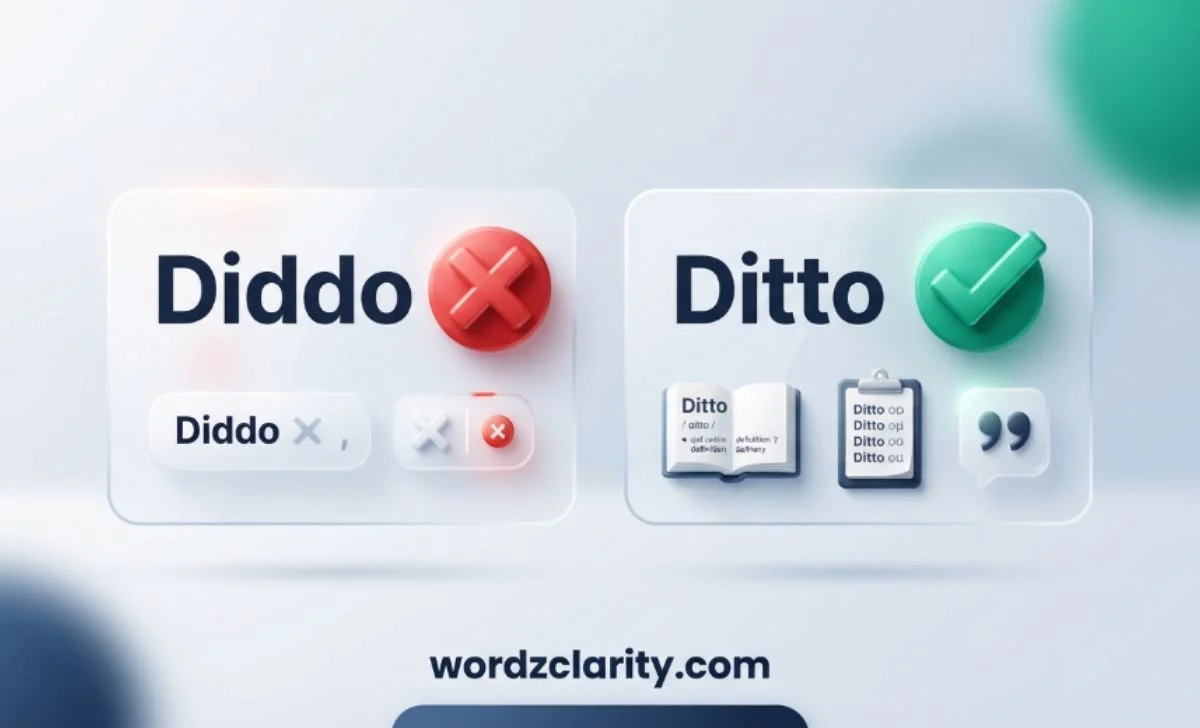
In standard English, however, the answer is clear: ditto is the correct spelling, while diddo is simply a misspelling. Although the two look similar, only one appears in trusted dictionaries and is accepted in professional, academic, and everyday writing.
This guide explains the correct spelling, why the confusion happens, what ditto means, where the word came from, and how to use it naturally in real-life situations.
Quick Answer: Is It “Diddo” or “Ditto”?
The correct spelling is ditto.
Diddo is not a standard English word. In almost every case, it is a spelling mistake caused by pronunciation, fast typing, or unfamiliarity with the word.
Here’s a quick comparison:
| Feature | Ditto | Diddo |
|---|---|---|
| Correct English spelling | ✅ Yes | ❌ No |
| Found in dictionaries | ✅ Yes | ❌ No |
| Means “the same as previously mentioned” | ✅ Yes | ❌ No |
| Suitable for professional writing | ✅ Yes | ❌ No |
If you’re writing an email, assignment, report, message, or social media post, ditto is always the correct choice.
Why Do People Spell “Ditto” as “Diddo”?
At first glance, diddo doesn’t seem like an unusual mistake. In fact, it’s one of those errors that makes sense once you understand how people learn language.
Unlike many spelling mistakes that happen because of grammar rules, this one is mainly influenced by pronunciation and modern typing habits.
Most People Hear the Word Before They Read It
Words such as ditto are often learned through conversation.
Imagine you’re having lunch with friends.
“I’ll order the pasta.”
“Ditto.”
If you’ve never seen the word written, it’s natural to assume it’s spelled the way it sounds. That’s why many people type diddo the first time they use it.
This pattern is especially common among English learners, children, and anyone who has picked up the word through movies, television, or casual conversations instead of books.
Pronunciation Can Be Misleading
Another reason for the confusion is pronunciation.
In conversational American English, the t in the middle of some words is pronounced very softly. To many listeners, it sounds similar to a light d. Because of this, ditto may be heard as diddo, even though the spelling never changes.
This is a pronunciation feature , not a spelling rule.
Fast Typing Makes Small Errors Easy
Today’s conversations happen on phones more than paper.
When people type quickly on WhatsApp, Messenger, Instagram, or X, accuracy often takes a back seat to speed. A simple tap in the wrong place can turn ditto into diddo, and once the mistake is posted, others may copy it without realizing it’s incorrect.
Unlike grammar mistakes, these spelling errors spread because people see them repeatedly online.
Autocorrect Isn’t Always Reliable
Many people assume spell check catches every typo, but that’s not always true.
Some mobile keyboards learn from a user’s typing history. If an incorrect spelling has been entered several times, predictive text may stop treating it as an error. As a result, diddo can continue appearing in messages even though it isn’t a recognized English word.
What Does “Ditto” Mean?
The word ditto means “the same as what was just said, written, or listed.”
Instead of repeating identical information, people use ditto as a quick and natural substitute.
For example:
Emma: I’m planning to take Friday off.
Noah: Ditto.
In this conversation, Noah means:
I’m planning to take Friday off as well.
The word saves time because everyone already understands the original statement.
Everyday Meaning
In daily conversations, ditto usually expresses agreement or shared feelings.
For example:
“That was the best pizza I’ve had in months.”
“Ditto.”
Here, ditto means “I completely agree.”
Likewise:
“I’m exhausted after today’s meeting.”
“Ditto.”
Instead of repeating the entire sentence, the speaker communicates the same idea with a single word.
What Does “Ditto” Mean in Text Messages?
In texting and online conversations, ditto often replaces phrases such as:
- Same here
- Me too
- I agree
- Likewise
For example:
Friend: “I can’t wait for the holidays.”
Reply: “Ditto!”
The meaning stays exactly the same, but the response is shorter and more conversational.
Where Did the Word “Ditto” Come From?
Many everyday English words have interesting histories, and ditto is no exception.
The word entered English from the Italian word detto, meaning “said” or “already mentioned.” Merchants and clerks used it when recording information that appeared more than once in business records. Instead of writing the same entry repeatedly, they simply marked it as detto, indicating that the previous word should be repeated.
Over time, English speakers adapted the word into ditto, and its meaning remained almost unchanged.
The Italian term itself comes from the Latin verb dicere, meaning “to say.” Although most people never think about this history while using the word today, it explains why ditto has always been associated with repeating information rather than introducing something new.
The Story Behind the Ditto Mark (〃)
Before computers, spreadsheets, and digital documents, copying the same information over and over was slow and unnecessary.
To save time, writers often used the ditto mark (〃) instead of repeating a word.
For example:
| Item | Quantity |
|---|---|
| Pens | 12 |
| 〃 | 8 |
The symbol meant that the second row referred to the same item listed above.
Although the ditto mark is rarely used in modern documents, it played an important role in bookkeeping, inventories, handwritten forms, and accounting records for many years. The word ditto, however, remains part of everyday English.
Is “Diddo” Ever Correct?
If you’re asking about standard English, the answer is no.
Major dictionaries recognize ditto, but they do not list diddo as an accepted spelling of the word.
That said, context matters.
You might occasionally come across Diddo as a:
- personal name
- username
- company name
- brand name
- gaming profile
In those situations, Diddo functions as a proper noun rather than an English vocabulary word.
For example:
- Diddo Studios
- Diddo99
- Diddo Gaming
These are names chosen by individuals or businesses. They don’t change the correct spelling of the English word, which remains ditto.
The easiest way to remember the difference is this:
- Ditto = a real English word meaning the same as previously mentioned.
- Diddo = usually a typo, or occasionally someone’s chosen name.
Real-Life Examples of “Ditto” in Context
Seeing the word in natural situations makes it easier to remember than memorizing a dictionary definition.
At a café
Customer 1: “I’ll have a cappuccino.”
Customer 2: “Ditto.”
During a meeting
Manager: “Let’s use the same strategy for next month’s campaign.”
Team member: “Ditto.”
In a family group chat
Alex: “I’m bringing dessert.”
Sarah: “Ditto.”
Talking with a friend
Friend: “That was a fantastic book.”
You: “Ditto.”
Notice how ditto replaces unnecessary repetition while keeping the conversation natural and concise. That’s exactly why the word has remained part of English for generations.
How to Use “Ditto” Correctly in English
Knowing that ditto is the correct spelling is only the first step. The next question is knowing when it sounds natural , and when another word is a better choice.
Although ditto is a common English expression, it works best when the previous statement is already clear. If the reader or listener has to guess what you’re referring to, it’s usually better to repeat the information instead.
Using “Ditto” in Everyday Conversations
In casual speech, ditto is often used to show agreement or indicate that you feel the same way as someone else.
Examples
Friend: “I’m looking forward to the weekend.”
You: “Ditto.”
Colleague: “Today’s meeting was longer than expected.”
You: “Ditto.”
Sibling: “I’m starving.”
You: “Ditto.”
In each example, ditto replaces a longer reply such as “Me too,” “Same here,” or “I feel the same.”
Using “Ditto” in Text Messages and Social Media
On platforms like WhatsApp, Instagram, Facebook, or X, people prefer short replies. That’s one reason ditto remains popular.
Examples:
- “That sunset was incredible.” → Ditto!
- “I need another coffee.” → Ditto.
- “Can’t wait for the holidays.” → Ditto!
Because the conversation is informal, ditto feels natural and friendly.
Can You Use “Ditto” in Emails?
Yes , but it depends on the email.
For a casual message to a coworker or someone you know well, ditto is perfectly acceptable.
Example:
Emma: “I think Tuesday works best.”
James: “Ditto.”
However, if you’re writing to a client, professor, or employer, repeating the complete thought usually sounds more professional.
Instead of writing:
Ditto.
Write:
I agree with your recommendation.
or
I share the same opinion.
Those alternatives are clearer and better suited to formal communication.
Using “Ditto” in Business Documents
Historically, ditto appeared frequently in ledgers, invoices, inventory books, and handwritten records. It helped clerks avoid writing the same item repeatedly.
Today, most businesses avoid using ditto in official documents because digital spreadsheets automatically duplicate information more accurately.
For example, instead of using ditto, modern reports often repeat the data or use spreadsheet features that reduce ambiguity.
Is “Ditto” Formal or Informal?
One reason people search for diddo or ditto is that they’re unsure whether ditto is appropriate in every situation.
The answer depends on context.
Informal Situations
Ditto works well in:
- everyday conversations
- text messages
- social media comments
- chats with friends
- casual workplace discussions
In these situations, the word sounds natural because everyone already understands what is being repeated.
Formal Situations
In professional or academic writing, it’s usually better to be explicit.
For example, instead of saying:
Ditto.
Write:
- I agree with the previous statement.
- The same recommendation applies.
- The above information also applies here.
These alternatives leave no room for confusion, especially in reports, contracts, or research papers.
Common Mistakes People Make
The confusion doesn’t stop at diddo. Several similar mistakes appear online because people rely on pronunciation instead of spelling.
Here are the most common ones:
| Incorrect | Correct |
|---|---|
| Diddo | ✅ Ditto |
| Dito | ✅ Ditto |
| Dittoo | ✅ Ditto |
| Ditow | ✅ Ditto |
| Dittoe | ✅ Ditto |
Another mistake is using ditto without a clear reference.
For example:
❌ “Ditto.”
If no previous statement exists, the reader won’t know what ditto refers to.
Always make sure the original idea has already been mentioned.
Better Alternatives to “Ditto”
Although ditto is useful, it isn’t the only way to express agreement.
Depending on the situation, these alternatives may sound more natural.
| Alternative | Best Used When |
|---|---|
| Same here | Casual conversations |
| Me too | Everyday speech |
| Likewise | Professional and casual writing |
| I agree | Meetings and discussions |
| The same | Lists and forms |
| Identical | Technical or academic writing |
| Agreed | Workplace communication |
Choosing the right alternative depends on your audience rather than strict grammar rules.
How to Pronounce “Ditto”
Many spelling mistakes happen because people aren’t sure how the word is pronounced.
American English
/ˈdɪtoʊ/
British English
/ˈdɪtəʊ/
Despite slight differences in accent, the spelling stays exactly the same in both American English and British English.
A simple way to remember it is:
Dit + Toe
Even if the middle sound seems soft in fast speech, the spelling still uses tt, not dd.
Quick Quiz: Did You Learn the Difference?
1. Which spelling is correct?
A. Diddo
B. Ditto
✅ Answer: B. Ditto
2. Which sentence is correct?
A. “Diddo, I’ll have the same.”
B. “Ditto, I’ll have the same.”
✅ Answer: B
3. What does ditto usually mean?
A. Different
B. The same as previously mentioned
C. Tomorrow
✅ Answer: B
4. Is diddo listed as the standard English spelling?
A. Yes
B. No
✅ Answer: No
5. Can ditto be used in casual conversations?
A. Yes
B. No
✅ Answer: A
FAQs
1. Is diddo a real English word?
No. In standard English, diddo is not the correct spelling. It is almost always a typo or a phonetic misspelling of ditto.
2. Why do people write diddo instead of ditto?
Most people hear the word before they see it written. Fast typing, soft pronunciation, and mobile keyboards also contribute to the mistake.
3. What does ditto mean?
Ditto means “the same as what was previously said or written.” It’s commonly used to avoid repeating identical information.
4. Is ditto a slang word?
No. It’s a standard English word that has been used for centuries. While it’s common in informal conversations, it isn’t slang.
5. Can I use ditto in professional writing?
Yes, but only when the meaning is completely clear. In formal reports or academic writing, repeating the full idea is usually a better choice.
6. Is ditto used in both British and American English?
Yes. The spelling is the same in both varieties of English, although the pronunciation differs slightly.
7. What is the ditto mark (〃)?
The ditto mark (〃) is a traditional symbol used to indicate that the same word or entry should be repeated from the line above. It was commonly found in handwritten records and accounting books.
8. What are the best alternatives to ditto?
Common alternatives include same here, me too, likewise, I agree, and the same, depending on the context.
Conclusion
When comparing diddo or ditto, the correct spelling is ditto. Although diddo appears in text messages, online comments, and search queries, it isn’t a recognized English word.
The confusion usually comes from pronunciation, fast typing, or seeing the mistake repeated on the internet.
Understanding the history, meaning, and proper usage of ditto makes it much easier to remember. Whether you’re replying to a friend, writing an email, or improving your English, choosing the correct spelling helps your writing look more accurate and professional.
When in doubt, remember this simple rule: if you mean “the same as previously mentioned,” the word you’re looking for is always ditto.
Read More Blogs: