Theirself or themself can be confusing because both forms appear in English, but they do not have the same status or usage. If you have seen phrases such as “they did it themself” or “they did it theirself,” you may wonder which one is correct.
The answer depends on the meaning, context, and level of formality.
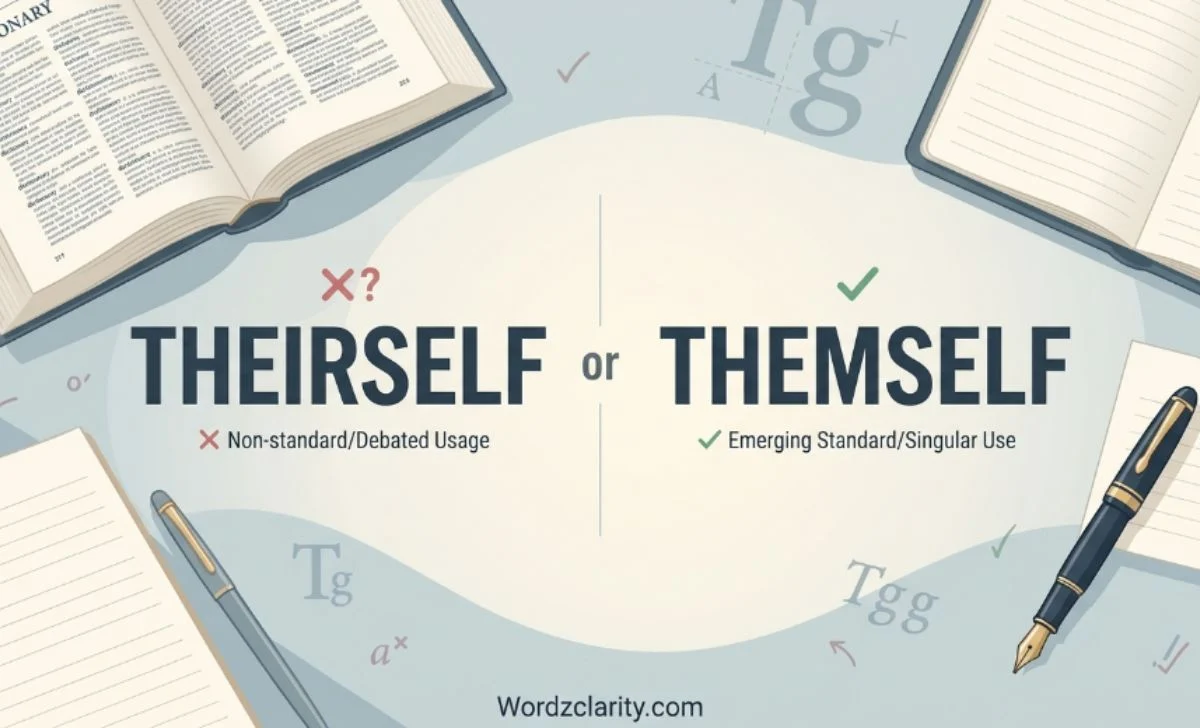
Themself is used as a reflexive form with singular they in some modern English. Themselves is also widely used with singular they and remains the more familiar choice in formal writing. Theirself, meanwhile, is mainly a dialectal form and is not normally recommended in standard English.
This guide explains theirself or themself, including their meanings, grammatical roles, differences, examples, common mistakes, and the best choice for formal writing.
Quick Answer: Theirself or Themself?
If you are choosing between theirself and themself, themself is generally the better choice in modern English when a singular person is referred to with they.
However, themselves is often the safest option in formal writing because it is much more established and familiar.
Theirself does exist, but dictionaries generally describe it as dialectal rather than standard formal English.
Compare these examples:
The student introduced themself.
The student introduced themselves.
Both sentences can refer to one person when they is singular. The second version is more familiar in many formal contexts.
Now compare:
The student introduced theirself.
This form occurs in dialectal English but is not the usual choice for standard professional writing.
Simple rule
- Themself = recognized singular reflexive form of they
- Themselves = standard and widely used reflexive form
- Theirself = mainly dialectal
- Theirselves = dialectal form of themselves
What Does “Themself” Mean?
Themself is a reflexive pronoun used with singular they.
A reflexive pronoun refers back to the subject of a sentence.
For example:
The child hurt themself.
Here, themself refers back to the child.
Another example is:
The applicant prepared themself for the interview.
The word themself refers to the applicant.
Merriam-Webster recognizes themself as a pronoun and describes it as a gender-neutral reflexive form of they when they refers to one person.
The word also has a long history in English. Its modern use has become more noticeable as singular they has become increasingly common.
Is “Themself” a Word?
Yes, themself is a word.
It is not simply a spelling mistake or an accidental combination of them and self. Major dictionaries recognize it, although they differ in how they describe its standardness and frequency.
Merriam-Webster lists themself as a pronoun and notes that its use has increased as an alternative singular reflexive form.
Oxford Advanced Learner’s Dictionary also lists themself as the reflexive form of they.
Cambridge, however, currently labels themself as “not standard” while explaining its use with singular they.
This difference between dictionaries is useful to understand.
A word can be recognized and used in real English without being the preferred option in every formal setting.
Therefore, “Is themself a word?” has a clear answer: yes. The more difficult question is when should you use it?
What Does “Theirself” Mean?
Theirself is a reflexive pronoun found mainly in dialectal English.
It can function in a sentence where themselves or themself might be expected in standard modern English.
For example:
They completed the work theirself.
This sentence may be heard or found in some varieties of English. However, theirself is not the normal choice for standard formal writing.
Merriam-Webster lists theirself as “chiefly dialectal” and records its first known use in the 14th century.
So, theirself is not simply a modern misspelling. It has a historical background, but its modern use is limited mainly to dialectal contexts.
Themself vs. Themselves
The difference between themself and themselves is more important for most writers than the difference between theirself and themself.
“Themselves”
Themselves is the established reflexive form of plural they.
The players congratulated themselves.
The subject players is plural, so themselves is the natural choice.
But themselves can also be used when they refers to one person.
Someone should ask themselves whether the answer is correct.
This is known as singular they. Merriam-Webster recognizes themselves as a reflexive form used with singular they as well as plural they.
“Themself”
Themself can make the singular meaning more obvious:
Someone should ask themself whether the answer is correct.
Here, someone refers to one unspecified person, and themself functions as the reflexive form.
Side-by-side comparison
| Form | Typical use | Formal writing |
|---|---|---|
| themselves | Plural they; also singular they | Widely accepted |
| themself | Singular they | Accepted in some usage; less common |
| theirself | Dialectal reflexive form | Usually avoided |
| theirselves | Dialectal plural reflexive form | Usually avoided |
Themself or Themselves for Singular They?
This is one of the most common questions surrounding themself.
When they refers to one person, both themself and themselves can occur.
Consider:
Each employee can introduce themselves.
and:
Each employee can introduce themself.
The subject each employee is grammatically singular, but they can be used instead of a gendered pronoun. The reflexive form may therefore be themselves or themself, depending on the style and context.
The MLA Style Center gives both themselves and themself as possible choices in a singular-they construction.
Which is more common?
Themselves is more familiar and widely established.
Themself is useful when the writer wants a clearly singular reflexive form.
For example:
Every applicant should check the form themselves.
This is natural and widely understood.
Every applicant should check the form themself.
This also makes the singular reference more explicit.
For formal writing where you want the most familiar construction, themselves is generally the safer choice.
Is “Theirself” Correct English?
Theirself exists in English, but it is not normally recommended in standard formal writing.
The key issue is not whether the word exists. It does.
The issue is register.
Merriam-Webster identifies theirself as chiefly dialectal.
Therefore, these sentences have different levels of acceptability:
They completed the project themselves.
Standard and widely accepted.
They completed the project themself.
Possible with singular they.
They completed the project theirself.
Dialectal; generally avoid in formal writing.
This distinction is important because calling theirself simply “wrong” would ignore its documented use in English. At the same time, presenting it as the normal standard form would be misleading.
What About “Theirselves”?
Another form you may encounter is theirselves.
Merriam-Webster lists theirselves as a plural pronoun meaning themselves and labels it chiefly dialectal.
For example:
They did the work theirselves.
This construction can occur in regional or dialectal English.
In standard professional writing, use:
They did the work themselves.
Theirselves vs. Themselves
| Form | Status |
|---|---|
| themselves | Standard and widely accepted |
| theirselves | Dialectal |
If your goal is conventional formal English, themselves is the better choice.
Theirself or Themself in a Sentence
The easiest way to understand these forms is to see them in context.
Examples with “themself”
The participant introduced themself before the presentation.
The applicant can complete the form themself.
The writer described themself in the opening paragraph.
The customer can reset the password themself.
The winner allowed themself a few minutes to celebrate.
In each example, themself refers back to a singular subject.
Examples with “themselves”
The students prepared themselves for the test.
The employees introduced themselves at the meeting.
The visitors found themselves near the wrong entrance.
Someone should ask themselves whether the information is reliable.
Each participant can register themselves online.
The final two examples demonstrate how themselves can work with a singular or indefinite subject.
Real-World Usage Examples
In an email
Please ask the new employee to introduce themself before the meeting.
A more conventional formal alternative is:
Please ask the new employee to introduce themselves before the meeting.
In business writing
Customers can update their information themselves through the online portal.
This version is natural because customers is plural.
In academic writing
Each student should review their work themselves before submitting it.
Here, themselves works with the singular expression each student.
On a website
If a user forgets their password, they can reset it themselves.
This is a natural example of singular they with themselves.
In conversation
They said they would handle it themself.
This construction may sound natural in some varieties of modern English, particularly when the speaker wants a singular reflexive form.
Common Mistakes With Theirself and Themself
Mistake 1: Assuming “theirself” is the standard form
The presence of their does not mean that theirself is the standard reflexive form.
The established reflexive form is themselves, while themself is used in some singular-they contexts.
Mistake 2: Assuming “themself” is always wrong
That is also inaccurate.
Themself is a recognized English word and is used as a singular reflexive form with they.
Mistake 3: Thinking “themselves” can only refer to multiple people
In modern English, themselves can also appear with singular they.
For example:
Someone left their phone, so they should collect it themselves.
Mistake 4: Treating “theirself” and “themself” as spelling variants
They are not simply two spellings of the same word.
Themself has a recognized grammatical role in singular-they constructions.
Theirself is chiefly dialectal.
Mistake 5: Choosing a form without considering the audience
A word may be understandable but still unsuitable for a particular type of writing.
For professional documents, academic work, and edited publications, the more established form is usually preferable.
Is Theirself or Themself British or American?
Theirself or themself is not mainly a British-versus-American spelling issue.
Unlike words such as colour/color or organise/organize, these forms do not represent a simple spelling difference between two major varieties of English.
The distinction is more closely related to:
- grammar
- reflexive pronouns
- singular they
- dialect
- historical usage
- formal versus informal language
You may encounter theirself in dialectal English, while themself appears in some modern singular-they constructions.
Therefore, there is no simple rule such as “Americans use one form and British speakers use another.”
How to Choose the Right Form
When writing, consider the sentence first.
Use “themselves” when:
- the subject is plural
- you want the most familiar formal construction
- singular they is already clear from context
- you are writing for a broad audience
Example:
The researchers checked the results themselves.
Use “themself” when:
- they refers to one person
- an explicitly singular reflexive form fits the context
- your publication or style allows it
- the construction sounds natural in your intended variety of English
Example:
The researcher checked the results themself.
Avoid “theirself” in standard formal writing when:
- you are writing an academic paper
- you are preparing a business document
- you are writing website copy
- you are producing edited professional content
Instead, use themselves or, where appropriate, themself.
A Quick Grammar Test
When you are unsure about theirself or themself, replace the word with a familiar reflexive pronoun.
For example:
The writer blamed ___ for the mistake.
If the subject is one person and singular they is being used, you may see:
The writer blamed themselves for the mistake.
or:
The writer blamed themself for the mistake.
But:
The writer blamed theirself for the mistake.
is not the standard formal choice.
This simple comparison makes the difference easier to see.
Theirself or Themself: Final Comparison
| Question | Themself | Theirself |
|---|---|---|
| Is it a real English word? | Yes | Yes |
| Can it refer to one person? | Yes | Can occur in dialectal usage |
| Used with singular they? | Yes | Not the standard choice |
| Common in formal English? | Less common than themselves | No |
| Main modern role | Singular reflexive form of they | Dialectal reflexive form |
| Best choice for formal writing? | Sometimes | Generally no |
The safest standard alternative in many situations is themselves.
FAQs
1. Is “themself” grammatically correct?
Themself is a recognized reflexive pronoun used with singular they. However, themselves remains more widely established, especially in formal writing.
2. Is “theirself” grammatically correct?
Theirself occurs in English, but it is chiefly dialectal. It is generally not the preferred form in standard formal writing.
3. Is “themself” singular?
Yes. Themself can be used as a singular reflexive form when they refers to one person.
4. Can “themselves” refer to one person?
Yes. Themselves is widely used with singular they, particularly with an indefinite or unspecified person.
5. What is the difference between theirself and themself?
Themself is used in some modern singular-they constructions. Theirself is mainly dialectal and is not normally used in standard formal English.
6. Should I use themself or themselves?
For formal writing, themselves is usually the safer and more familiar choice. Themself can be suitable when an explicitly singular reflexive form is appropriate.
7. Is “theirselves” a word?
Yes. Theirselves is a documented dialectal form meaning themselves.
8. Can I use “themself” in an academic paper?
You can if it fits the style and context, but themselves is often the more conventional choice in formal academic writing.
9. Is “theirself or themself” a spelling difference?
No. The difference is mainly grammatical and related to usage, dialect, and the treatment of singular they.
10. What is the safest form for professional writing?
Themselves is generally the safest and most familiar form. Use themself when the context specifically calls for a singular reflexive form and the style permits it.
Conclusion
The choice between theirself or themself depends on grammar and context rather than spelling alone. Themself is a recognized reflexive form that can be used with singular they, while themselves remains the more familiar and widely accepted choice in many formal contexts.
Theirself is a different case. Although it has a long history in English, dictionaries describe it mainly as dialectal. Theirselves is also dialectal.
For everyday and professional writing, the easiest approach is to prefer themselves when it fits naturally. Use themself when an explicitly singular reflexive form is useful and appropriate for the style of writing. Reserve theirself and theirselves for contexts where dialectal or historical language is intentional.
Understanding these differences will help you write clearly without treating every variation as simply right or wrong.
Read More Blogs:
- Prey vs. Pray: Complete Guide to Meaning, Spelling & Usage
- Themselves or Theirselves: Which Is Correct?
- Onto or Into: Understanding the Difference With Examples
- Coarse or Course: How to Choose the Right Word Every Time