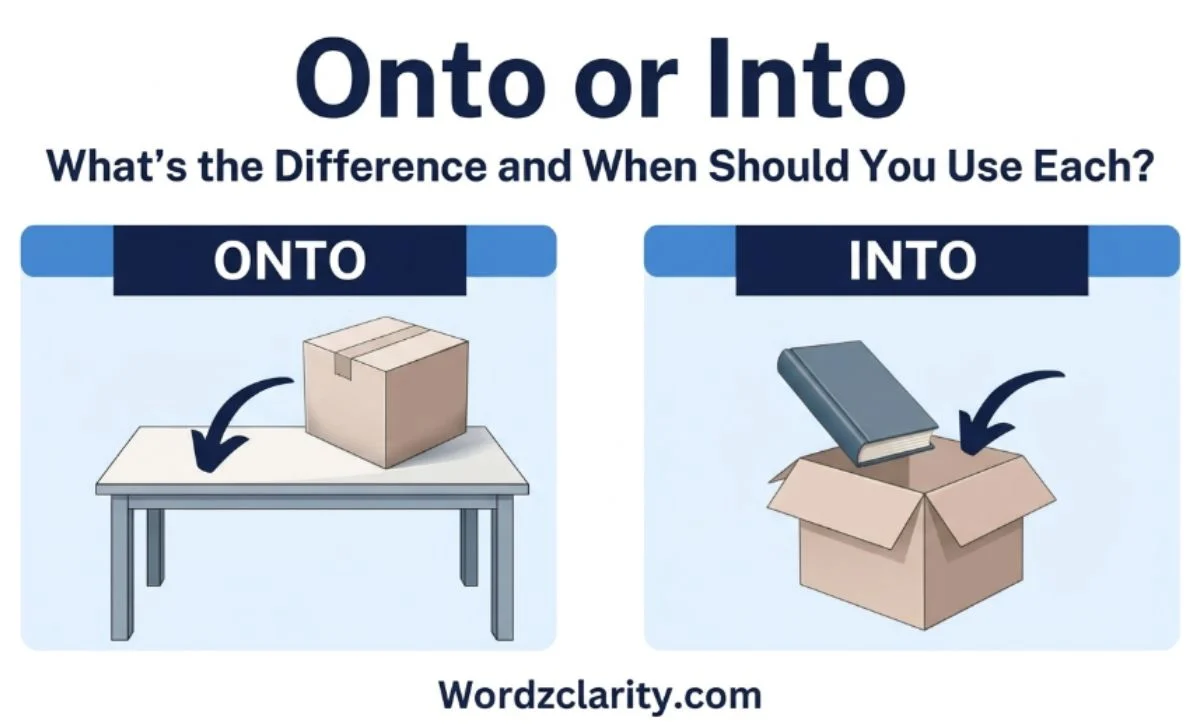
Choosing between onto and into can be confusing because both words describe movement or a change of position. However, they point to different destinations. Onto usually describes movement toward a position on a surface, while into describes movement from outside to inside a space, container, situation, or condition.
For example, “The cat jumped onto the table” means the cat moved to the top of the table. In contrast, “The cat jumped into the box” means the cat moved inside the box.
The confusion becomes greater when onto, into, on to, and in to appear in similar sentences. This guide explains the difference between these forms, shows how they work in everyday English, and provides practical examples so you can choose the right one with confidence.
Quick Answer: Onto or Into?
Use onto when something moves to a position on a surface or object.
- The child climbed onto the bed.
- She put the book onto the desk.
- The bird flew onto the roof.
Use into when something moves from outside to inside a place, container, or enclosed space.
- The child climbed into the car.
- She put the book into her bag.
- The bird flew into the house.
A simple memory trick is:
Onto = movement to a surface
Into = movement to the inside
The distinction is not always completely physical. Into can also describe entering a situation, activity, group, or state, while onto can describe movement toward a position or subject.
What Does “Onto” Mean?
Onto is a preposition that commonly shows movement toward and then a position on something.
The object or person moves from one place to another and ends up on a surface, platform, area, or object.
Examples:
- The dog jumped onto the sofa.
- He stepped onto the stage.
- The workers climbed onto the roof.
- She placed the documents onto the table.
- The child climbed onto the chair.
In each example, the destination is understood as a surface or position that can support the person or object.
Onto Can Also Describe a Change in Position
Not every use of onto involves dramatic physical movement.
For example:
- The company moved onto a new software platform.
- The team advanced onto the next stage of the competition.
- The discussion moved onto another topic.
Here, onto suggests movement toward a new position, stage, platform, or topic.
What Does “Into” Mean?
Into normally indicates movement from outside to inside something.
Examples:
- She walked into the room.
- He got into the car.
- The dog ran into the house.
- Pour the water into the glass.
- Put the clothes into the suitcase.
The important idea is that the destination has an inside.
Into Can Describe Change
Into is also used when something changes from one state, form, or condition to another.
For example:
- The caterpillar changed into a butterfly.
- The discussion turned into an argument.
- The small project grew into a successful business.
- The water froze into ice.
It can also describe becoming involved in an activity or interest:
- She got into photography.
- He is really into jazz.
- They became into the idea after hearing the details.
The exact meaning depends on the sentence, but the central idea is often entering or changing into something.
Onto vs Into: The Main Difference
The easiest way to distinguish these words is to ask where the movement ends.
| Word | Basic idea | Typical destination | Example |
|---|---|---|---|
| onto | Movement to a position on something | Surface or platform | He climbed onto the roof. |
| into | Movement from outside to inside | Enclosed space or container | He climbed into the car. |
| on | Position or contact | Surface | The book is on the desk. |
| in | Position inside | Interior space | The book is in the bag. |
Compare these sentences:
- The boy jumped onto the bed.
- The boy jumped into the pool.
In the first sentence, the boy lands on the bed. In the second, he enters the water.
Another pair makes the distinction even clearer:
- She walked onto the stage.
- She walked into the theater.
The stage is a surface or platform. The theater is an enclosed place.
Onto or Into in Everyday Examples
Understanding examples is often easier than memorizing grammar rules.
Movement
- The cat jumped onto the table.
- The cat jumped into the basket.
- The player ran onto the field.
- The player ran into the locker room.
- The child climbed onto the chair.
- The child climbed into the cupboard.
Putting Things Somewhere
Use onto when an object is placed on a surface:
- Put the plate onto the counter.
- Place the package onto the shelf.
- Set the phone onto the desk.
Use into when something is placed inside:
- Put the plate into the dishwasher.
- Place the package into the box.
- Put the phone into your pocket.
Transportation
This distinction is especially useful with vehicles.
- She got onto the bus.
- She got into the car.
- He stepped onto the train.
- He climbed into the taxi.
The choice depends partly on how English conceptualizes the vehicle. We generally get onto buses, trains, planes, and similar larger forms of transport, while we get into cars, taxis, and other smaller enclosed vehicles.
Onto or Into in Business Writing
Both words appear frequently in professional communication.
Consider:
The company moved onto a new platform.
This suggests adopting or moving to a platform.
Compare:
The company moved into a new market.
Here, the company is entering a market.
Other examples include:
- The team moved onto the next phase of the project.
- The company expanded into international markets.
- The discussion then moved onto pricing.
- The business moved into a new industry.
- The organization transitioned into a different operating model.
The difference becomes clearer when you identify whether the destination is being treated as a surface/stage/platform or as a space, field, state, or area being entered.
Onto or Into in Academic Writing
Academic writing often uses these prepositions in both literal and figurative ways.
Examples with onto:
- The researchers moved onto the next stage of the study.
- The results were transferred onto a separate spreadsheet.
- The analysis moved onto a more detailed question.
Examples with into:
- The researchers divided the participants into three groups.
- The study provides insight into human behavior.
- The data were entered into the system.
- The experiment developed into a larger investigation.
Notice that into is especially common when describing entry, transformation, division, or investigation.
Onto or Into in Emails and Conversations
These words appear naturally in everyday communication.
Email examples
- “Please upload the document onto the shared platform.”
- “I’ve entered the information into the database.”
- “Let’s move onto the next item on the agenda.”
- “We need to look into this issue.”
Conversation examples
A: Where did the dog go?
B: It jumped onto the sofa.
A: Where did Sarah go?
B: She went into the kitchen.
The distinction is usually intuitive once you focus on the destination.
“On To” or “Onto”?
This is one of the most important related questions.
Onto is normally one word when it functions as a preposition meaning movement to a position on something.
- The cat jumped onto the chair.
- He climbed onto the roof.
But on to can be two separate words when on belongs to the verb or phrase and to introduces what comes next.
For example:
We moved on to the next question.
Here, move on is the expression, and to introduces the next destination or subject.
Compare:
The cat jumped onto the table.
A useful test is to see whether on naturally belongs with the verb.
More Examples
Onto:
- The child climbed onto the bed.
- The bird landed onto the branch.
On to:
- Let’s move on to the next topic.
- She passed the message on to her manager.
In some sentences, the distinction can be subtle, and modern usage sometimes permits variation. However, understanding the underlying structure helps you make the better choice.
“In To” or “Into”?
The same issue occurs with into and in to.
Use into when the meaning is movement or change toward the inside or another state.
- She walked into the room.
- He put the keys into the drawer.
- The company expanded into Europe.
Use in to when in and to perform separate grammatical jobs.
For example:
I went in to speak with the manager.
Here, in relates to the action of going in, while to speak introduces the purpose.
Compare:
She walked into the office.
This means she entered the office.
Another example:
- He went into the store.
- He went in to ask a question.
The first describes entering the store. The second can describe going in for a particular purpose.
Common Mistakes With Onto and Into
Mistake 1: Using “into” for a surface
Incorrect in standard usage:
The cat jumped into the table.
If the cat lands on the table, use:
The cat jumped onto the table.
Mistake 2: Using “onto” for an enclosed space
Incorrect:
She walked onto the room.
Correct:
She walked into the room.
A room has an interior, so into is appropriate.
Mistake 3: Confusing “onto” with “on to”
Not every occurrence of the sounds / words “on to” should be written as onto.
- We moved on to another subject.
- The dog jumped onto the bed.
Mistake 4: Confusing “into” with “in to”
Likewise, into is not always the correct form.
- He walked into the building.
- She went in to check on him.
Look at the grammatical role of in and to before choosing the spelling.
A Simple Trick to Remember the Difference
Try replacing the destination with “on it” or “in it.”
If on it makes sense, onto may be appropriate.
The child climbed onto the table.
The child climbed on it.
If in it makes sense, into may be appropriate.
The child climbed into the box.
The child climbed in it.
This isn’t a perfect test for every figurative expression, but it works well for many physical examples.
Another quick rule:
Surface → onto
Interior → into
For example:
- roof → onto
- stage → onto
- platform → onto
- table → onto
- room → into
- box → into
- car → into
- building → into
When “Onto” Has a Figurative Meaning
Onto is not limited to physical surfaces.
It can describe movement toward a new stage, subject, platform, or position.
Examples:
- Let’s move onto the next question.
- The team progressed onto the final stage.
- The company moved onto a new platform.
- The conversation shifted onto a more serious subject.
There is also an informal expression:
“I’m onto you.”
This means that someone believes they have discovered what another person is doing or hiding.
For example:
“You said you didn’t eat the cookies, but I’m onto you.”
Here, onto does not describe physical movement at all.
When “Into” Has a Figurative Meaning
Into is not only used for physical movement. It can also describe interest, investigation, change, or division.
Showing Interest
We use into when someone is very interested in a subject, activity, or hobby.
- She is into photography.
- He is into science fiction.
- My brother is into video games.
Showing Investigation
Into can also mean examining or investigating something carefully.
- The police looked into the complaint.
- We need to look into the problem.
- The company is looking into the issue.
Showing Change
We use into when one thing changes or develops into something else.
- The discussion turned into an argument.
- The hobby developed into a career.
- The small project grew into a successful business.
Showing Division
Into is also used when something is separated or divided into groups or parts.
- Divide the class into four groups.
- The teacher divided the students into pairs.
- The cake was cut into eight pieces.
So, into does not always mean moving inside a physical place. Depending on the context, it can also show interest, investigation, change, or division.
Ye version readability ke liye better hai because sentences short hain, har use ka clear purpose diya gaya hai, aur same wording ko repeatedly use karne ke bajaye natural transitions hain.
Onto or Into: A Practical Comparison
| Situation | Correct choice | Example |
|---|---|---|
| Moving to a surface | onto | She stepped onto the platform. |
| Entering a room | into | She stepped into the room. |
| Climbing a roof | onto | He climbed onto the roof. |
| Entering a car | into | He climbed into the car. |
| Moving to the next stage | onto | They advanced onto the next stage. |
| Entering a new market | into | The company expanded into a new market. |
| Becoming interested | into | She is into photography. |
| Moving a discussion forward | onto | Let’s move onto the next topic. |
| Investigating something | into | They looked into the complaint. |
| Changing into something | into | The plan developed into a major project. |
Which One Should You Use?
Choose onto when the sentence presents the destination as a surface, platform, stage, or position.
Choose into when the sentence presents the destination as an interior, container, area, condition, activity, or new state.
When you’re unsure, ask:
“Is something going on something, or going inside something?”
If it is going on, choose onto.
If it is going inside, choose into.
Then check whether the sentence is actually using on to or in to as two separate words.
FAQs
1. What is the difference between onto and into?
Onto usually describes movement to a position on a surface, while into usually describes movement from outside to inside something. For example, “She climbed onto the roof” and “She climbed into the car.”
2. Is it “jump onto” or “jump into”?
Both are correct, but they have different meanings. Jump onto means land on a surface, while jump into means enter an enclosed space or area.
- The boy jumped onto the bed.
- The boy jumped into the pool.
3. Is it “get onto” or “get into”?
Both can be correct depending on the object. We commonly say get onto a bus, train, or plane, but get into a car or taxi.
4. Is “onto” always one word?
No. Onto is one word when it functions as the preposition meaning movement to a position on something. However, on to can be two words when on and to have separate grammatical functions.
5. Is “into” always one word?
No. Into is one word when it functions as a preposition meaning movement toward the inside or a change into something. In to can be two words when in and to perform separate grammatical roles.
6. Can onto and into be used interchangeably?
Usually not. They normally describe different destinations. Onto focuses on a position on something, whereas into focuses on entering or becoming part of something.
7. How can I remember onto vs into?
Remember surface = onto and inside = into. For example, “The cat jumped onto the table” but “The cat jumped into the box.”
Conclusion
The difference between onto and into becomes much easier when you focus on the destination. Onto generally describes movement toward a position on a surface, platform, stage, or object.
Into normally describes movement from outside to inside a place, container, or enclosed area. Both words can also have broader figurative meanings, so context matters.
For everyday writing, remember the simple distinction: onto = on a surface, while into = inside. Then pay special attention to the related forms on to and in to, because these can contain two separate words rather than the single prepositions onto and into.
Whether you’re writing an email, school assignment, business document, website, or social media post, choosing the correct form makes your meaning clearer.
When in doubt, ask yourself whether the action ends on something or inside something. That quick test will solve many common cases.
Read More Blogs:
- Effect or Affect: What’s the Difference and How Do You Use Them?
- Steel or Steal: What Is the Difference?
- To or Too: The Simple Difference You Need to Know